













A revenue team may bring in new customers every month, but growth still feels flat when older customers quietly stop buying or renewing. This gap is customer churn, a revenue leak that often goes unnoticed until targets become harder to reach. When churn stays high, new leads only replace lost revenue instead of driving real growth.
This is especially relevant for businesses in Malaysia, where rising competition in retail, SaaS, and services makes customer loyalty harder to keep. Local companies now see retention as equally important as acquisition, given how many options consumers have today. Understanding why customers leave and how to re-engage them has become a key priority.
The math behind churn is harsh because every lost client takes future revenue with them, and replacing them costs far more than keeping them. Businesses need a stronger process for managing potential sales leads and maintaining customer relationships before revenue starts slipping.
Key Takeaways
|
Many businesses have already started using smart CRM tools to track, predict, and prevent customer churn before it hurts their revenue.

What is Customer Churn?
Customer churn is the percentage of customers who stop buying your products or using your services within a certain period. Also known as customer attrition or churn rate, this metric helps businesses measure customer retention, satisfaction, and overall business performance.
Customer churn can happen in many industries, including SaaS, retail, e-commerce, and B2B. In some cases, customers leave by choice because they are unhappy with the product, service, or pricing. In other cases, churn happens because of failed payments, expired cards, or billing issues.
Customer Churn vs Return Churn
Customer Churn
Customer churn happens when customers stop buying, subscribing, or using a service within a specific period. This shows that the business has lost customers and needs to understand why they left. Common causes include poor onboarding, weak support, pricing issues, low product value, or better offers from competitors.
Return Churn
Return churn happens when customers leave, come back, but still show signs that they may leave again. These customers are not fully retained yet because their return may only be temporary. For example, they may reactivate because of a discount, promotion, or short-term need, but still have low engagement or unresolved concerns.
Key Difference
Customer churn focuses on customers who are already lost. Return churn focuses on customers who have returned but are still unstable. That is why customer churn needs recovery analysis, while return churn needs stronger follow-up, better engagement, and clearer value so returning customers do not leave again.
The Hidden Costs of Customer Churn
The most immediate impact of a declining client base is the loss of recurring revenue, but the real cost goes much deeper. When customers leave, the effects spread across the entire organization, influencing sales, marketing, product development, and customer success teams.
- The acquisition vs. retention imbalance
According to DOSM, Malaysia’s e-commerce income reached RM918.2 billion in the first nine months of 2024, showing how active digital customer transactions have become. When churn is high, teams spend more effort replacing lost customers instead of strengthening long-term revenue. - Declining brand reputation
In today’s digital landscape, dissatisfied customers often share their experiences online. As negative feedback increases, brand trust weakens, making it more difficult to attract new customers and retain existing ones. - Lower employee morale
Handling frequent complaints, cancellations, and unstable targets can strain employees. Over time, this pressure can reduce morale, increase turnover, and impact overall service quality, creating a cycle that is hard to reverse.
How to Calculate Customer Churn Rate
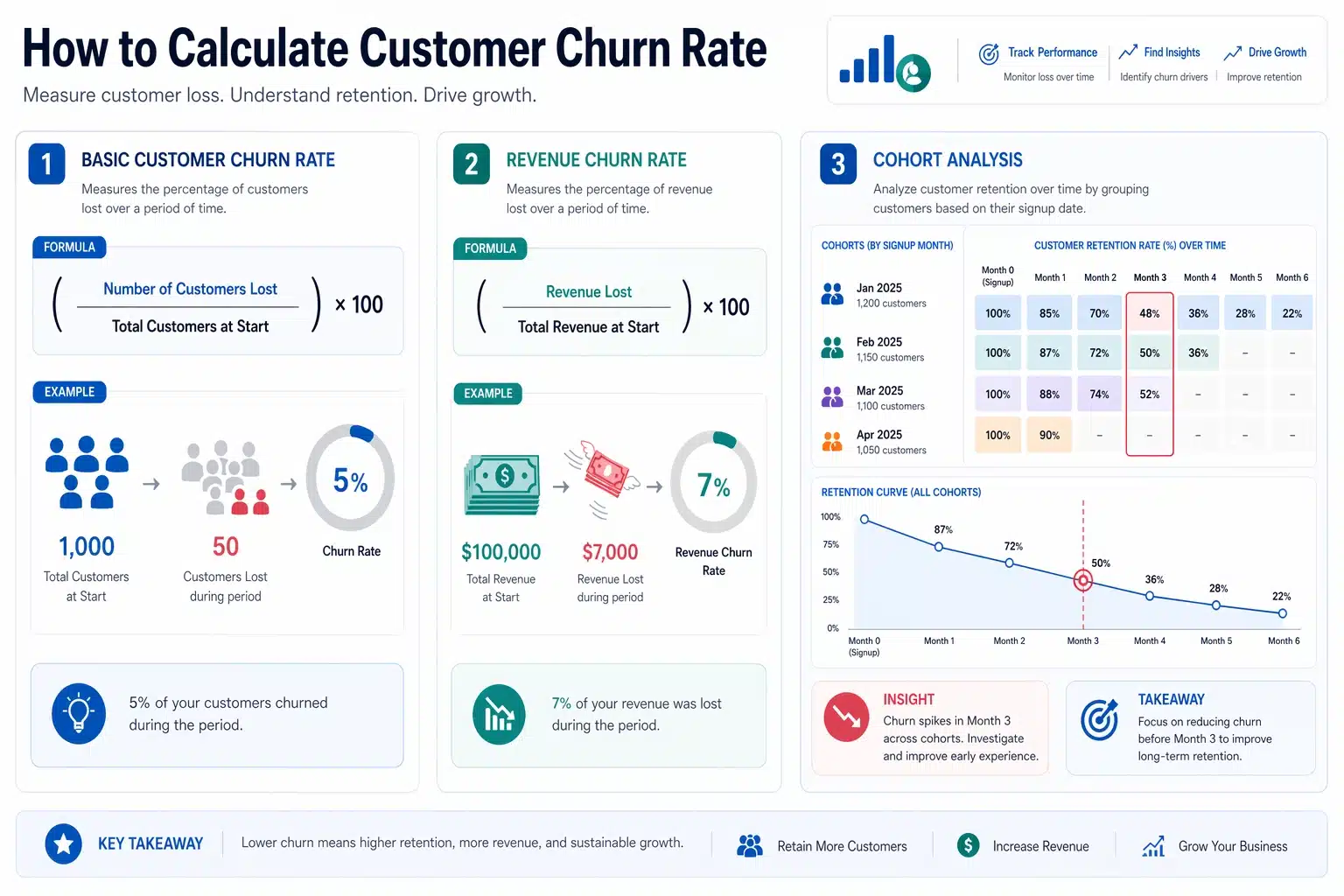
Accurate measurement is the first step toward effective management. You cannot fix what you do not measure. Calculating your attrition rate requires a clear understanding of your starting baseline and the specific timeframe you are analyzing, typically measured on a monthly, quarterly, or annual basis.
1. The Basic Customer Churn Formula
The standard formula for calculating this metric is straightforward. You take the number of clients lost during a specific period and divide it by the total number of clients you had at the beginning of that period. Finally, multiply the result by 100 to express it as a percentage.
Formula: (Number of Customers Lost in Period / Total Customers at Start of Period) x 100
For example, if you started the first quarter with 1,000 active accounts and lost 50 of them by the end of March, your calculation would be: (50 / 1000) x 100 = 5%. This means your quarterly attrition rate is 5%.
2. The Revenue Churn Formula
As mentioned earlier, understanding the financial impact is just as crucial. Gross Revenue Churn calculates the percentage of revenue lost from existing clients in a given period.
Formula: (Revenue Lost from Cancellations and Downgrades in Period / Total Recurring Revenue at Start of Period) x 100
If your Monthly Recurring Revenue (MRR) at the start of the month was RM100,000, and you lost RM5,000 due to cancellations and another RM2,000 due to downgrades, your gross revenue attrition would be: (RM7,000 / RM100,000) x 100 = 7%.
3. Cohort Analysis
To gain deeper insights, advanced organizations utilize cohort analysis. Instead of looking at the entire user base as a single entity, cohort analysis groups users based on a shared characteristic, most commonly, the month they signed up. By tracking these specific cohorts over time, you can identify exactly when users are most likely to drop off.
If you notice a massive spike in cancellations during the third month of a subscription, you can deduce that there is a specific friction point in the user journey at that precise moment. Understanding these timelines is essential for maximizing understanding customer lifetime value, as it allows you to intervene right before the critical drop-off points occur.
Common Reasons Why Customers Churn
To reduce attrition effectively, businesses need to understand its root causes. While each company faces different challenges, customer churn usually stems from several common issues. Identifying these factors requires honest evaluation and careful analysis of customer data.
- Ineffective onboarding experience
Churn often begins during a user’s first interaction with a product. If onboarding is confusing or lacks clear direction, users struggle to see immediate value. When the time to achieve initial benefits is too long, frustration builds and increases the likelihood of early abandonment. - Poor customer support
Today’s customers expect fast and helpful support. Delayed responses, complicated service channels, or unhelpful interactions can quickly damage trust. Even a single negative experience may push customers to switch to competitors. - Low perceived value
Customers rarely leave because of price alone. More often, they leave because they feel the product is no longer worth the cost. This can happen when features are lacking, performance is average, or the product no longer meets evolving needs. Demonstrating clear value and ROI is essential to retain users. - Intense market competition
Competitors continuously improve their offerings and target your customers. If alternatives provide better features, usability, or pricing, customers are more likely to switch. Staying competitive requires ongoing innovation and market awareness. - Product issues and instability
Reliability plays a critical role in customer retention. Frequent bugs, downtime, or performance issues can quickly erode trust. For many users, especially in B2B environments, unstable systems directly impact their operations, making them less tolerant of technical problems.
Key Metrics to Monitor Alongside Churn

Relying only on attrition rates is like driving while looking in the rearview mirror—it shows past outcomes but doesn’t help you anticipate what’s ahead. To act proactively, businesses need to track leading indicators that signal early signs of customer dissatisfaction.
- Net Promoter Score (NPS)
NPS measures overall customer loyalty by asking how likely users are to recommend your product or service. Responses are grouped into Promoters, Passives, and Detractors, with a growing number of Detractors indicating potential churn risk. Monitoring NPS trends helps businesses understand overall customer sentiment. - Customer Satisfaction Score (CSAT)
CSAT focuses on satisfaction with specific interactions, such as support experiences or onboarding. Low scores in certain areas can reveal operational issues that negatively affect the customer experience. This makes it easier to identify and fix pain points quickly. - Customer Effort Score (CES)
CES evaluates how easy it is for users to complete tasks or resolve issues. When customers feel they must exert too much effort, frustration increases and retention declines. Reducing friction in the user experience is key to improving long-term customer loyalty.
Identifying At-Risk Customers Before They Leave
The main objective of churn management is prevention. Once a customer decides to cancel, it is often too late to recover the relationship. Businesses need systems that detect early behavioral signals, allowing teams to intervene before users reach that point.
- Tracking declines in usage
A drop in engagement is one of the strongest indicators of potential churn. When active users begin logging in less frequently or stop using key features, it signals disengagement. Monitoring metrics like login frequency, session time, and feature usage helps teams take early action. - Evaluating support activity
Changes in support interactions can also reveal risk. A spike in tickets may indicate ongoing issues, while a sudden silence from previously active users can suggest disengagement. Analyzing both the volume and tone of these interactions provides valuable insight into customer sentiment. - Using data for targeted action
Not all at-risk customers require the same approach. Effective customer segmentation based on behavior, industry, or company size allows businesses to respond more effectively. With the right data, teams can focus on high-risk groups and tailor strategies to address their specific needs.
Proven Strategies to Reduce Customer Churn
After identifying the causes of churn and detecting at-risk users, the next step is taking proactive action. Reducing attrition requires a combination of efforts across product, customer support, and marketing to improve overall customer experience.
- Improve the onboarding experience
Since many users leave early, onboarding plays a critical role in retention. Replace generic introductions with personalized, interactive guidance such as product tours, tooltips, and tutorials. The goal is to help users realize value quickly and integrate the product into their routine. - Adopt proactive customer support
Instead of waiting for issues to arise, businesses should anticipate and address them early. Inform users about known issues, provide solutions, and communicate updates clearly. This approach builds trust and shows commitment to customer success. - Encourage community engagement
Customers are more likely to stay when they feel connected. Creating forums, hosting webinars, and enabling peer interaction can strengthen engagement and build a sense of belonging. - Introduce loyalty and reward programs
Offering incentives for long-term users can increase customer retention. Benefits such as early feature access, priority support, or exclusive services make customers feel valued and less likely to switch. - Act on customer feedback
Collecting feedback is important, but acting on it is critical. When users see their input lead to real improvements, it strengthens trust and encourages long-term commitment. - Provide flexible pricing options
Some customers leave due to temporary constraints. Offering options like subscription pauses or lower-tier plans helps maintain relationships and makes it easier for users to return later.
The Role of CRM in Managing Customer Churn
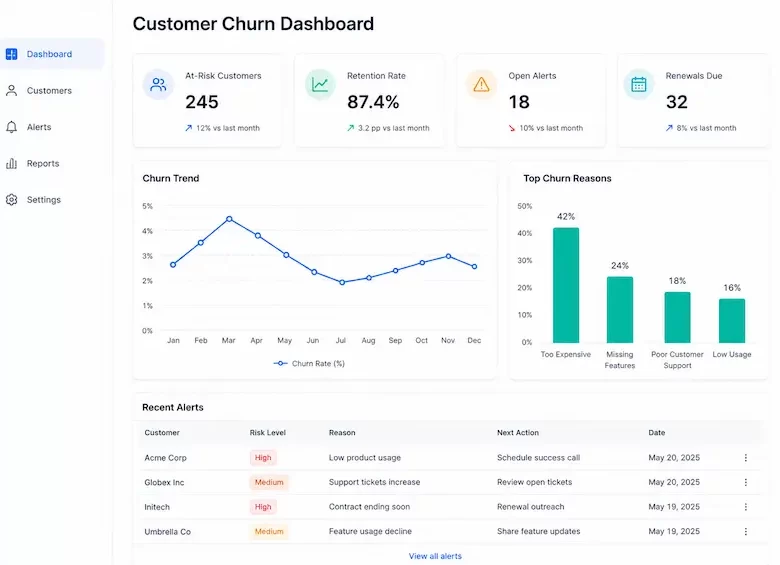
Implementing retention strategies at scale is difficult without the right technology. Disconnected tools like spreadsheets, emails, and separate billing systems often cause businesses to miss early warning signs. This is why a Customer Relationship Management (CRM) system becomes essential for managing customer relationships effectively.
1. Centralized customer data
A CRM serves as a single source of truth by bringing together data from marketing, sales, support, billing, and product usage. This unified view allows teams to understand the full customer journey and identify potential issues more accurately. With complete visibility, businesses can respond faster and tailor their retention efforts.
2. Automated workflows and alerts
CRM systems reduce manual errors by automating key processes. For example, alerts can be triggered when usage drops or when customers report repeated issues. Automated campaigns can also re-engage inactive users with targeted communication, helping prevent churn before it happens.
3. Personalization at Scale
As businesses grow, maintaining personalized interactions becomes more challenging. A automated CRM system enables segmentation and targeted messaging based on user behavior and preferences. This level of personalization helps strengthen customer relationships and improve long-term retention.
Conclusion
Customer churn is a common part of running a business, but it is not something beyond control. It can be measured, analyzed, and managed with the right approach. By understanding its financial impact, tracking key metrics, and addressing root causes, businesses can turn revenue loss into sustainable growth.
Improving retention requires a shift in mindset across the organization. Every team, not just customer success, must take responsibility for delivering a consistent and valuable user experience. From initial engagement to daily usage and support interactions, each touchpoint should be designed to reduce friction and increase value.
Using advanced tools like a CRM system with predictive insights helps businesses act proactively and improve retention. With better data, companies can address issues early and strengthen customer loyalty. Try a free demo to see how it works.

FAQ about Customer Churn
-
What is the difference between voluntary and involuntary churn?
Voluntary churn happens when customers actively choose to leave, usually due to dissatisfaction or better alternatives. Involuntary churn happens due to failed payments, expired credit cards, or technical billing errors, which can often be recovered with proper dunning management.
-
Can customer churn ever be reduced to zero?
No, some level of churn is unavoidable because customers may close their businesses, change needs, or move to different markets. The goal is not zero churn but keeping it low enough that new growth consistently outpaces customer loss.
-
How long does it take to see results from churn reduction strategies?
Most businesses start seeing measurable improvements within 3 to 6 months after implementing retention strategies. However, long-term impact on loyalty and revenue usually becomes clearer after a full year of consistent effort.
-
Can AI and predictive analytics help reduce customer churn?
Yes, AI tools can analyze large volumes of customer data to detect early warning signs that are difficult for humans to spot. Many Malaysian businesses are now adopting AI-powered CRM systems to predict churn risk and trigger automated retention campaigns.