














Many Malaysian leaders lose market share by overlooking fragmented buyer interactions. Failing to align internal operations with evolving expectations creates friction that drives customers to competitors. This operational gap prevents sustainable revenue growth and weakens your brand position 2026.
Optimizing the journey is a vital financial driver for companies in the region. PWC Research indicates that organizations prioritizing these interactions achieve 80 percent higher retention rates. Data shows Malaysian buyers are willing to pay a price premium of 16 percent for better experiences.
Mastering this CRM sales system is essential for maintaining business scalability in the digital economy. This article will help you to ensure your strategy delivers maximum economic value. This knowledge secures long term success and prepares your organization for future market shifts.
Key Takeaways
|
Use the best CRM software system to maintain long term consistency across all touchpoints. Unified data remains the essential foundation for stable and predictable growth.

What is Customer Experience Management (CXM)?
Customer Experience Management is the strategic process of overseeing every interaction throughout the entire buyer journey. This oversight spans from initial brand discovery to the final purchasing phase and long term retention. By managing these touchpoints leaders ensure consistent brand delivery at every organizational level.
Traditional customer service is often reactive because it only addresses issues after they occur. Customer Experience Management provides a proactive framework to identify and eliminate friction before it impacts the user experience. This method creates a unified journey across digital channels, sales, and support teams.
Companies use feedback and behavioral data to understand specific needs and fix operational pain points. This data driven approach strengthens brand trust and secures loyalty for high value accounts. A disciplined strategy remains the foundation for stable expansion within the Malaysian market.
Core Components of a Successful CXM Strategy

Building a high quality strategy requires a multifaceted approach beyond just software or training. Success relies on several interdependent parts working together to drive revenue and growth. This alignment ensures the organization meets the high expectations of the Malaysian market.
1. End to End Journey Mapping
The foundation of any strategy is a visual map of the entire buyer experience. This tool identifies every touchpoint and pinpoints areas of operational friction that damage brand perception. By mapping these paths leaders move from process centric thinking toward empathy driven results.
2. Personalization at Scale
Modern buyers expect brands to anticipate their specific needs through relevant and timely interactions. This level of relevance requires deep data analysis and strategic audience categorization to deliver the right message. Tailoring experiences to specific cohorts significantly boosts emotional engagement and conversion rates.
3. Omnichannel Consistency
Buyers view a brand as a single entity rather than a collection of separate departments or digital channels. An effective strategy ensures that context is preserved as users move between mobile apps and physical stores. Maintaining this consistency remains a challenging but rewarding part of managing the overall experience.
4. Employee Experience Alignment
There is a direct relationship between internal culture and the quality of every customer interaction. Engaged and well trained staff are far more likely to deliver the outstanding service required for brand loyalty. Prioritizing the internal team ensures frontline workers can make decisions that benefit the buyer.
The Business Impact of Effective Management CXM
Investing in this discipline is more than just making people happy; it is a proven driver of hard business outcomes. The financial and operational impacts of a well executed strategy are profound for any organization. This approach directly affects both top line revenue and bottom line profit margins.
| Business Impact | Explanation | Business Benefit |
| Revenue Growth and Premium Pricing | Superior customer experiences increase the perceived value of products and services through personalization and frictionless interactions. |
|
| Enhanced Customer Retention and Loyalty | Proactive customer management helps businesses resolve issues early and maintain stronger relationships. |
|
| Brand Advocacy and Organic Acquisition | Positive customer experiences encourage buyers to recommend the brand and share positive feedback. |
|
Key Metrics for Measurement Customer Experience Management (CXM)
Effective oversight requires precise measurement to track the success of any strategy. Organizations need a diverse set of indicators to evaluate performance accurately without relying on a single data point. Using multiple signals provides a clearer view of how the business delivers value to its audience.
1. Net Promoter Score (NPS)
This indicator measures long term loyalty by asking how likely a buyer is to recommend the brand. Responses help categorize users into promoters and detractors based on a standard numerical scale. While useful for gauging sentiment it works best when paired with direct feedback to understand the underlying causes.
2. Customer Satisfaction Score (CSAT)
This metric tracks short term satisfaction following a specific interaction or purchase completion. It is highly effective for identifying friction within isolated operational processes. Leaders use these scores to make immediate improvements to service quality and maintain high standards across all departments.
3. Customer Effort Score (CES)
Ease of interaction is often more critical to loyalty than making grand gestures. This score measures how much effort a buyer puts into resolving an issue or completing a task. Minimizing this friction is a primary objective for reducing account loss and ensuring a smooth journey for every user.
4. Churn Rate and Retention Rate
Behavioral data often provides more clarity than survey responses alone. These rates measure the percentage of buyers who remain active versus those who stop doing business with the company. Monitoring these shifts helps identify systemic failures in the ecosystem before they impact total revenue growth.

Step-by-Step Implementation Guide for Customer Experience Management (CXM)
Transitioning to a customer centric operational model requires a structured and phased approach. This strategic transformation impacts every department from product development and marketing to IT and human resources. Leadership must oversee this shift to ensure every team works toward a unified organizational goal.
Step 1: Discovery and Baseline Assessment
Understanding the current situation involves auditing touchpoints and identifying internal data silos. Analyze historical feedback to find where buyers drop off in the sales funnel or experience delays. Establishing a data backed baseline is vital for measuring progress and securing executive support.
Step 2: Defining the CX Vision and Strategy
Leadership must define a clear vision that aligns with the corporate strategy and brand identity. A luxury provider might focus on extreme personalization while a budget utility prioritizes speed and efficiency. This vision serves as the primary guide for all subsequent business initiatives.
Step 3: Cross-Functional Alignment and Culture Shift
Success requires breaking down organizational silos so teams share data and key performance indicators. This phase involves training employees on the new vision and using specific metrics for performance incentives. Empowering staff to take ownership of buyer results is key to a successful culture shift.
Step 4: Technology Integration and Execution
Deploy the necessary infrastructure to execute the vision at a larger scale. This stage involves integrating databases and optimizing digital interfaces for better performance. Journey maps are then translated into automated workflows and personalized communication sequences to reach the target audience effectively.
Step 5: Continuous Feedback and Iteration
This process is an infinite loop because consumer expectations constantly evolve with market trends. Establish feedback systems to ensure data from surveys quickly reaches the product development team. Regular reviews and testing are essential for maintaining a competitive edge and ensuring long term growth.
Customer Experience Management Issues and How to Solve Them?
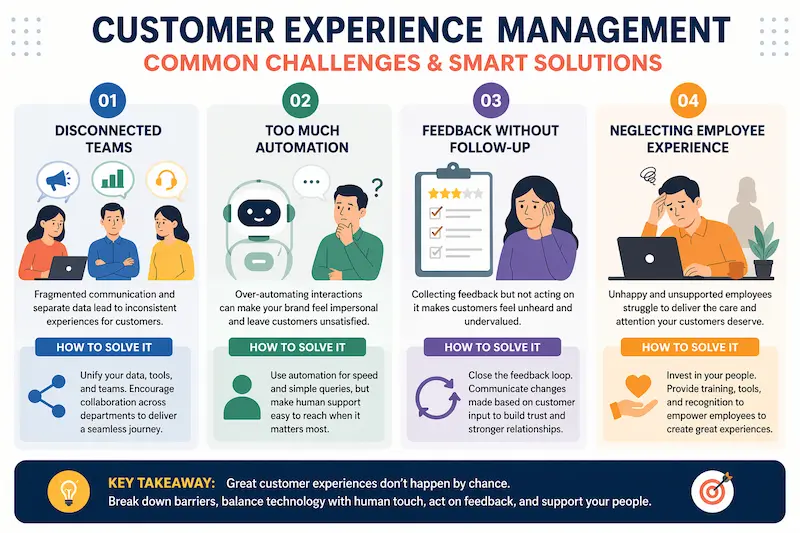
Even with the best intentions and substantial investments, organizations often stumble when executing their customer experience management strategies. Recognizing and mitigating these common pitfalls is essential for maintaining momentum and achieving ROI.
- Operating in Organizational Silos: The most frequent barrier to effective CXM is departmental isolation. When marketing, sales, and support teams do not share data or communicate seamlessly, the customer experiences a disjointed, frustrating journey. Breaking down these silos requires integrated technology and a culture of cross-functional collaboration.
- Over-Reliance on Automation: While Artificial Intelligence and chatbots are powerful tools for operational efficiency, relying on them too heavily can strip the empathy from your brand. Customers still crave human connection, especially when dealing with complex, nuanced, or emotionally charged issues. Striking the right balance between automated self-service and accessible human intervention is critical.
- Survey Fatigue and Inaction: Organizations often fall into the trap of over-surveying their audience without taking tangible action on the feedback received. If customers take the time to share their thoughts but see no subsequent improvements, their frustration will only compound. Always close the loop by informing customers how their feedback has driven actual, noticeable change.
- Ignoring the Employee Experience: Companies that entirely focus outward while neglecting their own workforce will inevitably see their customer experience suffer. Disengaged, overworked, or poorly equipped employees cannot deliver the enthusiasm, patience, and care required to create genuine brand advocates.
The Role of Technology and AI for Customer Experience Management (CXM)
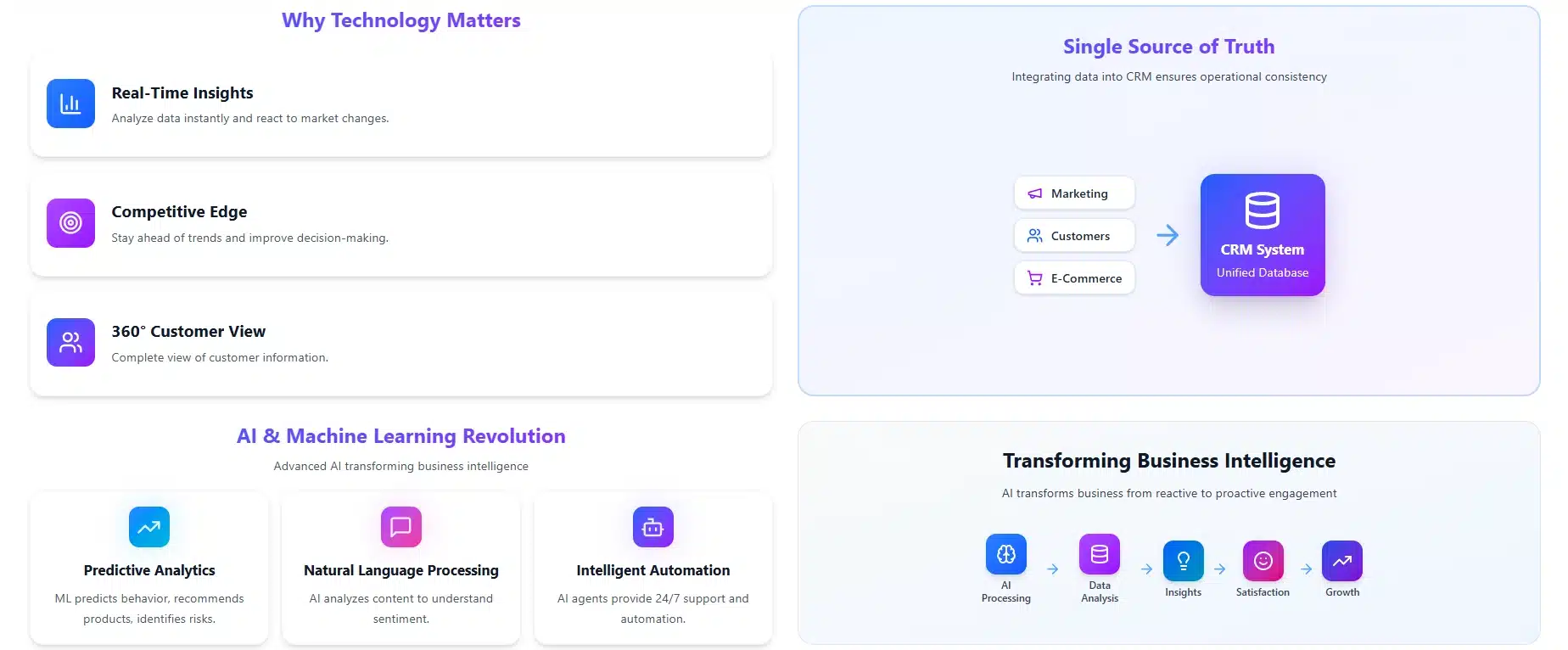
Modern data volumes are too large to manage manually. Technology provides the tools needed to analyze insights in real time, allowing leaders to stay ahead of market shifts with speed. This digital foundation is essential for maintaining a competitive edge.
A centralized database is the foundation for achieving a 360 degree view. Consolidating marketing and e commerce data is essential for operational consistency. Choosing the best CRM software system is the first step toward creating a single source of truth.
Beyond databases, Artificial Intelligence and Machine Learning are revolutionizing the field. AI powered applications transform how businesses anticipate needs and scale personalization. These tools allow leaders to move toward proactive engagement and predictable outcomes.
- Predictive Analytics: ML algorithms analyze behavior to predict future actions. This allows businesses to offer relevant product recommendations and identify accounts at high risk of churn. It also optimizes inventory based on anticipated demand.
- Natural Language Processing: Advanced AI interprets unstructured data from social media and call transcripts. By analyzing sentiment and themes, organizations gauge public perception at scale. This eliminates the need to rely solely on traditional surveys.
- Intelligent Automation: Modern AI driven agents handle complex queries and process transactions. These tools effectively escalate issues to human staff with full context. This ensures 24 7 support availability while focusing on high value tasks.
Now that you have seen some of the benefits and roles of technology in customer experience management, perhaps it is time for you to consider a system that can simplify the process.
Conclusion
Mastering this discipline requires commitment from leadership down to frontline staff. It marks a shift from a transactional mindset toward a relational approach. By understanding the buyer journey businesses create a competitive advantage and maintain long term relevance.
In a market where products are commoditized the interaction itself becomes the primary offering. Organizations that invest in unified and personalized experiences will thrive. This strategic focus builds a lasting legacy of loyalty and sustainable growth for the organization.
Ready to transform your organizational strategy and improve buyer retention through advanced management tools? Our team helps you identify operational friction and implement high impact solutions. Contact us today to schedule your free consultation and secure your market position.
FAQ about Customer Experience Management (CXM)
-
What is customer experience management?
Customer experience management (CEM) is the practice of tracking, managing, and optimizing every interaction a customer has with a business, from initial awareness through post-purchase support. It involves collecting customer data, analyzing touchpoints, and implementing strategies that improve satisfaction, loyalty, and long-term retention across all channels and platforms.
-
What is the difference between CEM and CRM?
CRM (Customer Relationship Management) focuses on managing business relationships and customer data, primarily for sales and marketing. CEM (Customer Experience Management) focuses on the customer’s emotional perception across every interaction. In short, CRM is the tool businesses use to store data, CEM is the strategy that determines how customers actually feel about the brand.
-
What are the key components of customer experience management?
Effective CEM includes five core components: customer journey mapping, omnichannel consistency, data-driven personalization, employee experience alignment, and continuous feedback loops. Each component works together to ensure customers receive consistent, relevant interactions at every touchpoint, whether online, in-store, or through customer support.
-
Why is customer experience management important for businesses in Malaysia?
As Malaysian consumers become more digitally active and comparison-driven, customer experience has become a key competitive differentiator. Businesses that invest in CEM see higher retention, stronger brand loyalty, and increased revenue, particularly significant given that acquiring a new customer typically costs five times more than retaining an existing one.
-
How do you measure customer experience?
Customer experience is typically measured using three core metrics: Net Promoter Score (NPS), Customer Satisfaction Score (CSAT), and Customer Effort Score (CES). Businesses also track churn rate, repeat purchase rate, and customer lifetime value (CLV) to build a broader picture of how experience quality evolves over time.