












Sustainability is now a bigger business priority, not just a side initiative. In Malaysia, more companies are under pressure to align with ESG standards and show clear proof of their commitments to investors, customers, and business partners.
That proof usually goes beyond internal policies. It often requires measurable progress and third-party validation that can strengthen trust and support long-term business growth. For both large companies and SMEs, understanding ESG certification in Malaysia is becoming more important.
That is why this topic matters. ESG certification is not only about meeting expectations, but also about building a more credible and future-ready business. Keep reading to understand how it works and what your business should prepare.
Key Takeaways
|

Understanding ESG Certification in Malaysia
ESG certification in Malaysia refers to a formal process that assesses whether a company’s environmental, social, and governance practices meet recognized standards. Unlike internal CSR efforts or self-reported sustainability claims, this certification involves third-party validation. That matters because businesses now need clearer proof that their sustainability efforts are measurable and credible.
In practice, ESG certification in Malaysia can refer to different things. It may cover company-wide operations, specific management systems such as ISO standards, or even professional qualifications for individuals working in ESG-related roles. Understanding this distinction helps businesses decide whether they need to certify their operations, strengthen internal capabilities, or pursue both.
Malaysia’s shift from voluntary CSR to more structured ESG compliance also shows how business expectations are changing. Investors, regulators, and business partners now expect clearer data on emissions, labor practices, governance, and risk management. That is why ESG certification is becoming more relevant for businesses that want to stay credible, competitive, and prepared for future requirements.
What Drives ESG Certification in Malaysia
ESG certification in Malaysia is growing largely because regulations and market expectations are becoming stricter. Bursa Malaysia, for example, has strengthened sustainability reporting requirements for listed companies, especially on material sustainability matters and climate-related risks. This shows a clear push toward reporting standards that are more aligned with global expectations.
The Securities Commission Malaysia has also shaped this shift through its Sustainable and Responsible Investment (SRI) Roadmap and SRI Taxonomy. These frameworks help define what counts as sustainable economic activity and reduce the risk of greenwashing. For businesses, this also matters financially, because stronger ESG alignment can support access to green financing and sustainability-linked funding.
Bank Negara Malaysia has added further pressure by introducing the Climate Change and Principle-based Taxonomy (CCPT). This framework pushes financial institutions to assess environmental impact more carefully, which means ESG performance can now influence lending and investment decisions. As a result, ESG certification is no longer only about compliance, but also about business credibility and access to capital.
Corporate and Professional ESG Certification

When discussing ESG certification in Malaysia, it is vital to distinguish between corporate certifications and professional certifications. Both play complementary roles in advancing an organization’s sustainability agenda, but they serve different purposes and involve distinct processes.
Corporate ESG Certifications
Corporate certifications are awarded to an organization as a whole or to specific facilities following a comprehensive audit of their operations. These certifications validate that the company’s processes meet specific international standards. Prominent examples relevant to the Malaysian market include:
-
ISO 14001 (Environmental Management Systems): This globally recognized standard provides a framework for organizations to design and implement an effective environmental management system. It helps businesses reduce their environmental footprint, ensure compliance with environmental laws, and continuously improve environmental performance.
-
ISO 45001 (Occupational Health and Safety): Addressing the social aspect of ESG, this standard provides a framework to improve employee safety, reduce workplace risks, and create better, safer working conditions.
-
ISO 37001 (Anti-Bribery Management Systems): Important to the governance pillar, this standard helps organizations prevent, detect, and address bribery, aligning closely with the stringent requirements of Section 17A of the Malaysian Anti-Corruption Commission (MACC) Act.
-
B Corp Certification: While still growing in Malaysia, B Corp certification is highly regarded. It assesses a company’s entire social and environmental performance, requiring high standards of verified performance, accountability, and transparency.
- Green Building Index (GBI): For companies in real estate, construction, or those managing large corporate facilities, Malaysia’s industry-recognized green rating tool for buildings promotes sustainability in the built environment.
Professional ESG Certifications
The rapid integration of ESG into business operations has created a serious talent gap. Organizations need skilled professionals who can navigate complex frameworks, conduct materiality assessments, and ensure compliance. This has led to a surge in professional ESG certifications designed for individuals. These programs equip professionals with the knowledge to drive sustainability initiatives from within.
- Certified ESG Professional Programmes: Offered by various educational institutions and professional bodies in Malaysia, these courses cover the core principles of sustainability, regulatory requirements, and practical implementation strategies.
- IERP® Certification Framework: The Institute of Enterprise Risk Practitioners offers certifications that integrate ESG into broader Enterprise Risk Management (ERM) frameworks, teaching professionals how to identify and manage sustainability-related risks.
- Certified ESG Innovator (CESGI): These specialized credentials focus on vendor-neutral, industry-validated training, enabling professionals to drive sustainable innovation and manage complex sustainability projects within their organizations.
For a business to truly excel, it must invest in both avenues. Achieving corporate certification requires a knowledgeable internal team to lead the charge, making professional development a critical precursor to organizational compliance.
What ESG Certification Assesses

Technology in ESG Certification
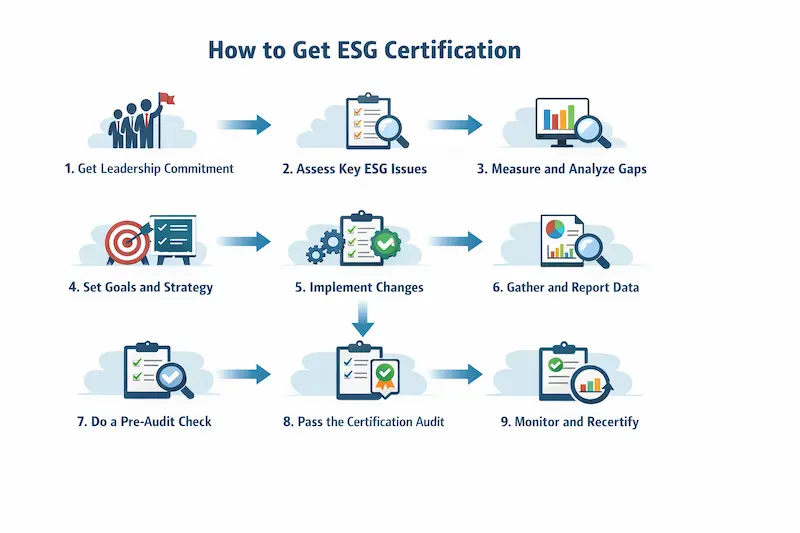
One of the biggest challenges during the certification process is the amount and complexity of data involved. Sustainability data is often spread across spreadsheets, older systems, and different departments. Gathering it manually takes time and increases the risk of human error. During an external audit, inaccurate or incomplete data can slow down or even disrupt the certification process.
This is where digital transformation becomes closely tied to sustainability. Using advanced technology is no longer optional for companies that want to achieve and maintain ESG compliance. By deploying advanced ESG platforms, organizations can automate data collection, analysis, and reporting across the business. These platforms also help map internal data to global reporting frameworks, which reduces the compliance burden.
Sustainability metrics also need to connect with daily business operations through a unified system. A strong ERP system can capture real time data from procurement, HR, manufacturing, and supply chain activities. With a strong ERP system, businesses can track emissions, workforce diversity, and supplier compliance more efficiently.
Implementing a unified digital system helps businesses move beyond manual data entry. By creating a single source of truth, it provides the audit trail that certification bodies need. Real time dashboards also help teams track sustainability targets more clearly and respond faster when adjustments are needed. In the end, technology helps make ESG compliance a more practical and strategic part of business operations.
ESG Certification Challenges in Malaysia
While the benefits of ESG certification are clear, Malaysian businesses often face several challenges during the process. Preparing for these issues early can make the certification journey smoother.
Resource Constraints for SMEs: While large PLCs often have dedicated sustainability teams, SMEs may not have the same financial and human resources. To manage this, SMEs can explore government grants, join capacity building programmes from MITI or SME Corp, and focus on gradual improvements instead of changing everything at once.
Supply Chain Opacity: For manufacturers and exporters, it can be difficult to trace the sustainability practices of suppliers across multiple tiers. Strong supplier codes of conduct, better traceability tools, and regular supplier audits can help reduce this risk.
Evolving Regulatory Standards: The sustainability landscape continues to change, with new taxonomies and disclosure requirements appearing regularly. Organizations need to stay agile by keeping leadership informed and staying involved in relevant industry networks.
The Risk of Greenwashing: As more businesses feel pressure to show sustainability progress, some may overstate their environmental efforts. Certification bodies are highly alert to this. Companies need to make sure their claims are supported by real data and communicated transparently.
The Future of ESG Certification in Malaysia
Looking ahead, ESG certification in Malaysia will continue to evolve as global expectations and local economic priorities change.
First, scrutiny around Scope 3 emissions will continue to grow. In the past, companies focused more on emissions they controlled directly. Now, as global supply chains come under more pressure, Malaysian exporters will also need to provide clearer data on value chain emissions.
Second, Artificial Intelligence and the Internet of Things will play a bigger role in sustainability management. IoT sensors can provide real time environmental data such as energy use or water quality, while AI can help predict future emissions and suggest ways to improve performance. This will make the certification process more continuous and responsive.
Finally, financial performance and ESG performance will become more closely linked. As Bank Negara Malaysia continues implementing its climate risk taxonomy, the cost of capital may increasingly depend on verified sustainability performance. This could also lead to more sector specific certifications in areas such as sustainable finance and sustainable agriculture.
Conclusion
ESG certification in Malaysia is becoming more important as businesses face higher expectations around transparency, accountability, and long term sustainability. It is no longer seen as an optional credibility booster, but as a practical way to show that a company’s environmental, social, and governance efforts are structured, measurable, and aligned with current market demands.
As this article has shown, ESG certification involves more than meeting a checklist. Businesses need to understand the regulatory landscape, identify the right type of certification, strengthen internal processes, and build reliable reporting practices. While the process can take time, it can also help companies improve risk management, strengthen stakeholder trust, and stay more prepared for future business requirements.
If your business is still assessing where to start, a free consultation can help you better understand your current ESG readiness, the gaps that need attention, and the steps that make the most sense for your operations. With the right direction, the certification process can become more manageable and more relevant to your long term business goals.
Frequently Asked Questions About ESG Certification in Malaysia
-
What is ESG certification?
ESG certification is formal proof that a company’s environmental, social, and governance practices meet recognized standards. It helps show that sustainability efforts are credible and measurable.
-
What does ESG certification usually assess?
It usually reviews three areas: environmental impact, social responsibility, and corporate governance. Material issues and reporting quality also matter.
-
Why is ESG data often challenging?
Because ESG data is often spread across teams and systems, which makes it harder to collect, verify, and report accurately.
-
Why does supply chain visibility matter in ESG?
Because supply chain emissions and supplier practices can have a major impact on overall ESG performance and risk.