











Modern warehouses must maximize limited space, reduce labor costs, and control budgets while maintaining high order accuracy and fast fulfillment. ASRS (Automated Storage and Retrieval Systems) warehousing has become a strategic solution for distribution centers focused on long-term efficiency. By using robotics, hardware, and intelligent software, ASRS automates storage and retrieval processes, transforms overall warehouse operations.
Despite its increasing adoption, many operations managers still seek clear explanations about ASRS systems. In Malaysia, Johor warehouses report adoption challenges like high costs but project 20-30% efficiency gains per STEEPV analysis. This guide outlines the fundamentals, system categories, key benefits, and practical considerations for implementing ASRS in modern warehouses.
Key Takeaways
|
What Is ASRS Warehousing?
ASRS (Automated Storage and Retrieval System) in warehousing is a category of technology that uses mechanical equipment combined with computer control software to automatically place items into storage and retrieve them on demand. The fundamental purpose is to remove or significantly reduce the need for human workers to manually travel through aisles to pick, place, or move inventory.
Emerging in the 1950s, the first industrial storage systems relied on simple motorized rail cranes to manage high-bay inventory. Significant breakthroughs in robotics and sensor technology eventually replaced these rudimentary setups with intelligent, data-driven automation. Modern ASRS warehouse solution now leverage powerful computing to deliver the sophisticated and responsive warehouse performance required by global businesses.
At its core, an ASRS system consists of three functional elements working in concert:
- Storage structure: The physical racking, bins, carousels, or grid systems where inventory is housed.
- Retrieval mechanism: The cranes, robots, shuttles, or conveyors that physically move goods in and out of storage positions.
- Control system: The software intelligence, often a Warehouse Control System (WCS) or Warehouse Management System (WMS) integration, that orchestrates every movement based on incoming orders, inventory logic, and operational rules.
When all three components integrate effectively, warehouses achieve minimal human intervention, higher throughput, and near-perfect accuracy. For operators facing common warehouse challenges like labor shortages, picking errors, and space limits, ASRS provides a direct solution.
6 Types of ASRS Systems
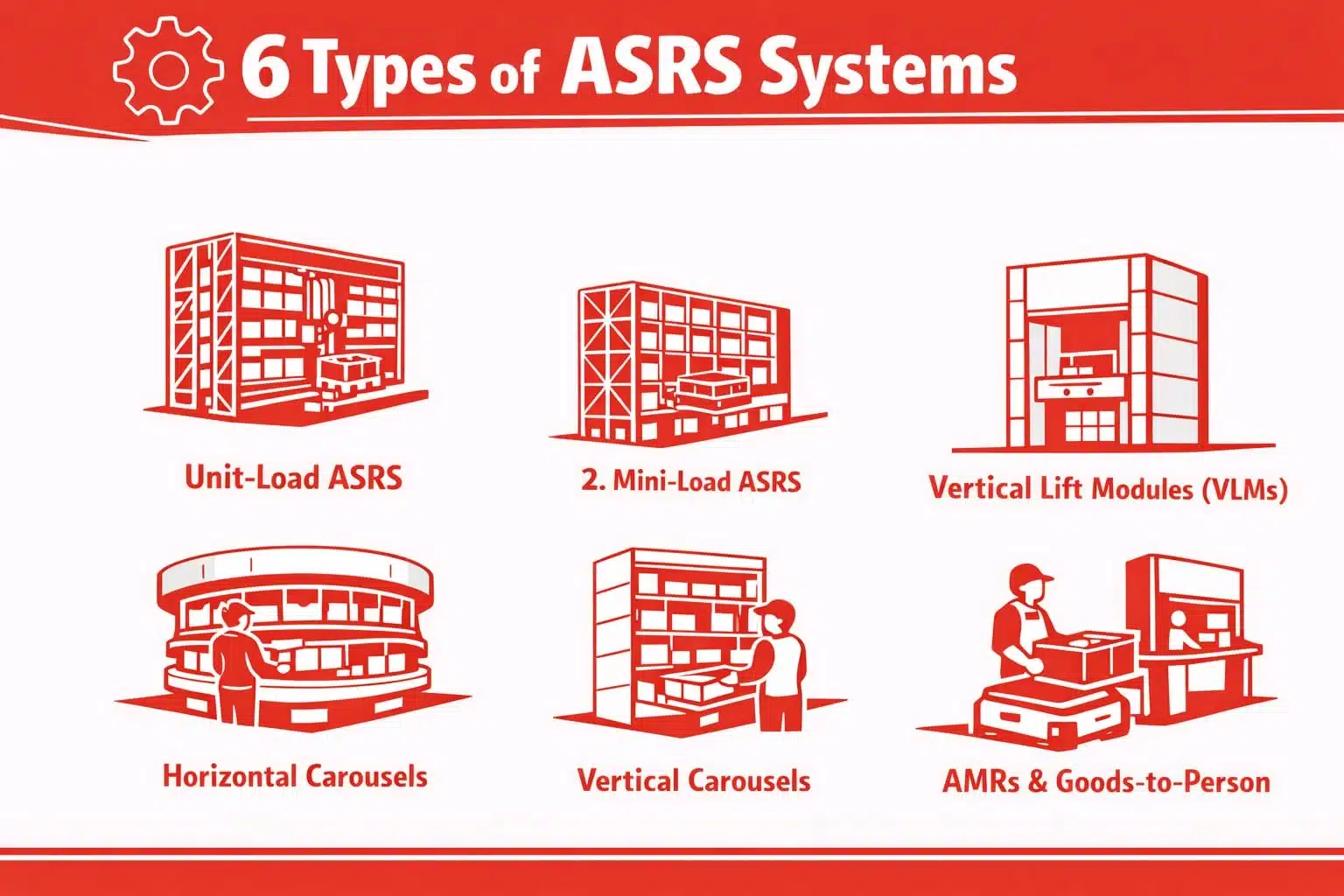
The right ASRS system for operation depends heavily on Unit-load systems handle full pallets or heavy containers using stacker cranes in high-bay racking. Here is a breakdown of the six primary ASRS types used in contemporary warehousing.
1. Unit-Load ASRS
Unit-load systems handle full pallets or heavy containers using stacker cranes in high-bay racking. They access heights over 40 meters, unsafe for forklifts. Ideal for distribution centers storing bulk goods like beverages or building materials.
2. Mini-Load ASRS
Mini-load systems use smaller, faster cranes for totes, trays, or cartons. They suit e-commerce, pharmaceuticals, and spare parts with high item turnover. Throughput exceeds unit-load for small-SKU picking.
3. Vertical Lift Modules (VLMs)
VLMs feature facing tray columns with a central extractor delivering items to an ergonomic front opening. Popular in manufacturing and tight spaces, they require no major building changes. Self-contained design saves floor space.
4. Horizontal Carousels
Horizontal carousels rotate bins on oval tracks to operators. Often clustered (3 carousels per operator), they maximize picking time for small parts. Highly space-efficient for medium-volume storage, maximizing productive time.
5. Vertical Carousels
Similar in principle to horizontal carousels but oriented vertically, vertical carousels use a Ferris-wheel-like mechanism to rotate shelves up and down to present items at an ergonomic height. They occupy a smaller footprint than horizontal carousels and are well suited to environments with limited floor space but adequate ceiling height.
6. Autonomous Mobile Robots (AMRs) and Goods-to-Person Systems
Goods-to-person ASRS uses AMRs or overhead grid robots to deliver bins/shelves to stationary pickers. AutoStore’s grid system represents cutting-edge dense storage tech. Ideal for high-SKU e-commerce and omnichannel retail with massive order volumes.
Understanding how these different technologies fit into a broader warehouse storage strategy is essential before committing to any particular ASRS investment.
Benefits of ASRS in Warehouse Operations
The business case for ASRS is built on a combination of hard operational metrics and strategic positioning advantages. Let us examine the most significant benefits in detail.
1. Space Utilization and Density
ASRS systems eliminate wide forklift aisles that consume 30-50% of traditional warehouse floor space. A single narrow aisle serves dual racking rows while cranes access vertical storage up to 40 meters high. The result is ASRS installation can store the same inventory volume in as little as 40% of the footprint required by a conventional warehouse layout.
2. Throughput and Speed
Unlike human pickers limited by walking speed and fatigue, ASRS cranes and robots travel fixed paths at high velocity without breaks. Mini-load systems achieve cycle times in seconds, while goods-to-person solutions boost picking rates three to five times per operator hour. Ideal for high-volume e-commerce and distribution centers.
3. Inventory Accuracy
ASRS control software records every item movement in real-time to precise locations, eliminating misplaced stock. No scanning errors or phantom inventory plague these automated systems. Inventory accuracy rates in ASRS environments routinely exceed 99.9%, compared to industry averages of 93–97% in manual operations.
4. Labor Cost Reduction
Warehouse labor typically accounts for 50-65% of operating expenses, but ASRS dramatically cuts required pickers and forklift operators. Systems maintain or exceed throughput levels with minimal staff oversight. Most installations achieve full ROI payback within three to seven years.
5. Improved Safety
ASRS removes forklifts from storage aisles, eliminating vehicle-pedestrian collision risks entirely. ASRS systems move that risk out of the equation for the storage and retrieval function. VLMs and carousels also prevent ladder climbing or elevated access injuries. Results include lower insurance premiums and reduced regulatory compliance burdens.
6. Energy Efficiency
Many crane-based systems use regenerative braking to capture the energy released when a load descends and feed it back into the system’s power supply. The dense storage configurations also mean that a smaller building footprint needs to be heated, cooled, or lit, particularly relevant for cold storage operations where refrigeration energy costs are significant.
How ASRS Integrates with Warehouse Management Software

An ASRS system is only as effective as the software ecosystem it operates within. The physical hardware executes movements, but the intelligence behind those movements comes from the software layer. Understanding how these layers interact is critical to planning a successful ASRS deployment.
1. The Three Software Layers
In most sophisticated ASRS installations, three distinct software layers work in a hierarchy:
- Enterprise Resource Planning (ERP): The top layer manages master data, purchase orders, sales orders, and financial transactions. The ERP tells the WMS what inventory exists and what needs to be fulfilled.
- Warehouse Management System (WMS): The middle layer translates business-level instructions into warehouse-level tasks, such as which orders to pick, in what sequence, from which zones. A modern warehouse control system is the operational brain of the entire warehouse, making real-time decisions about inventory slotting, pick sequencing, and workload balancing.
- Warehouse Control System (WCS) / Material Flow Controller (MFC): The bottom layer receives task instructions from the WMS and translates them into real-time machine commands — telling a specific crane to go to rack row 12, level 5, position 3 and retrieve tote number X4592.
2. Real-Time Inventory Visibility
Integrated ASRS software delivers instant inventory updates for every put-away, retrieval, and transfer. Managers access exact SKU quantities and locations anytime without manual counts. This visibility improves customer promise dates and buying forecasts across the supply chain.
3. Slotting Optimization
ASRS systems track movement data with precise timestamps to analyze pick frequency and access speeds. Algorithms automatically re-slot fast-moving SKUs to prime locations and slow-movers to back positions. Continuous optimization cuts retrieval times across seasons and order patterns.
4. Integration Challenges
Older ASRS hardware often needs middleware to connect with modern WMS via proprietary protocols. Data sync between WCS and WMS must be instantaneous to prevent inventory mismatches. Scaling requires careful software reconfiguration to choose experienced automation partners.
Challenges and Considerations Before Adopting ASRS
The benefits of ASRS are well documented, but so are the implementation challenges. Any operation considering ASRS investment should approach the decision with clear eyes about the risks and constraints involved.
| Aspect | Key Points |
|---|---|
| Capital Investment & ROI Timelines | High upfront cost (hundreds of thousands to tens of millions). ROI depends on labour costs, operational inefficiencies, order volume, and deployment speed. Faster payback in high-labour-cost markets. |
| Flexibility & Adaptability | Traditional crane ASRS less flexible if SKU mix changes. Modular and goods-to-person systems offer greater adaptability but at higher per-unit cost. Requires early trade-off analysis. |
| Downtime Risk | Equipment failure may restrict inventory access, especially in single-aisle setups. Needs redundancy planning, preventive maintenance, and strong service agreements. |
| Implementation Timeline & Change Management | Implementation can take months to over a year. Requires phased deployment, workflow adjustments, and workforce retraining. Poor change management may delay performance results. |
The broader context of warehouse automation deployment shows that the most successful implementations combine robust technology selection with equally rigorous operational change management and ongoing performance optimization after go-live.
Industries That Benefit Most from ASRS Warehousing
While ASRS technology can deliver value across a wide range of operational environments, certain industries have profile characteristics that make them particularly well suited to automated storage and retrieval.
1. E-Commerce and Omnichannel Retail
E-commerce faces massive SKU variety, high order volumes, and tight delivery windows driving ASRS adoption. Goods-to-person systems enable same-day fulfillment at scale beyond manual capabilities. Processing thousands of single-item orders hourly with 99.9% accuracy creates competitive edge.
2. Pharmaceuticals and Healthcare
Pharma demands perfect accuracy, batch tracking, and temperature control for patient safety. ASRS eliminates manual picking errors while maintaining controlled environments. Closed storage prevents contamination better than open racking systems.
3. Automotive and Aerospace
Spare parts operations manage thousands of SKUs from fasteners to assemblies with zero-tolerance for wrong parts. VLMs and mini-load ASRS deliver fast, accurate retrieval in compact footprints. High SKU diversity meets critical availability needs perfectly.
4. Food and Beverage
Unit-load ASRS dominates food distribution with pallet handling in temperature-controlled environments. Automated cranes excel in deep-freeze where humans can not work extended periods. Fewer door openings boost cold storage energy efficiency significantly.
5. Electronics and High-Value Goods
ASRS provides secure, logged access for high-theft-risk inventory with complete audit trails. Closed storage eliminates open-aisle shrinkage vulnerabilities. Perfect inventory accuracy compounds security benefits for valuable goods.
6. Manufacturing and Assembly
ASRS acts as automated component supermarkets for just-in-time assembly lines. Precise integration with MES/ERP delivers right parts to right stations eliminating manual handling waste. Supports lean manufacturing with perfect material flow timing.
How to Evaluate and Select the Right ASRS for Your Warehouse
Selecting an ASRS system is a major strategic decision that will shape your warehouse’s operational capabilities for a decade or more. The following framework provides a structured approach to evaluation and selection.
Step 1: Define Your Operational Profile
Start by documenting your current and projected needs including SKU volume, throughput rates, product dimensions/weights, storage rotation (FIFO/LIFO/FEFO), order types (pallet/case/unit), and building constraints like ceiling height and floor capacity. Include special requirements such as temperature control, fragile items, or hazmat handling. This comprehensive profile ensures technology matches your specific operational reality.
Step 2: Map Your Pain Points
Identify the specific operational problems that ASRS is expected to solve. Is the primary driver labor cost reduction? Space constraint? Accuracy improvement? Throughput capacity? Safety? Each of these motivations points toward different system types and performance specifications. A clear articulation of the primary and secondary objectives will prevent scope creep and keep the selection process focused.
Step 3: Assess Technology Options Against Requirements
Using the operational profile and pain point mapping from steps 1 and 2, evaluate each ASRS technology type against your specific requirements. Use a weighted scoring matrix that applies different importance weights to each evaluation criterion based on your operational priorities. Consider not just current requirements but your projected operational profile three to five years out.
Step 4: Evaluate Total Cost of Ownership
The purchase price of an ASRS system is only one component of the total cost of ownership. Factor in installation and commissioning costs, annual maintenance and service contract costs, software licensing and upgrade costs, energy consumption, staff retraining costs, and the cost of potential downtime. Build a multi-year financial model that compares the TCO of the ASRS investment against the status quo operational cost trajectory.
Step 5: Assess Vendor Capabilities
Evaluate vendors on implementation success, local service availability, integration experience with your WMS/ERP, financial stability, and industry references. Superior technology without reliable local support creates bigger risks than slightly less advanced systems with excellent service organizations. Long-term partnership quality determines success.
Step 6: Plan for Integration and Change Management
Map ASRS integration with existing WMS/ERP systems before vendor selection. Create detailed implementation roadmaps with phased rollouts, parallel operations, comprehensive training, and measurable performance milestones. Operational transition planning equals technical specification in deployment success.
The Future of ASRS Technology in Warehousing
ASRS technology is evolving rapidly, driven by advances in robotics, artificial intelligence, machine vision, and connectivity. Understanding where the technology is heading helps warehouse operators make investment decisions that remain relevant beyond the immediate deployment horizon.
AI-Driven Optimization
Next-gen ASRS systems leverage machine learning to evolve beyond fixed rules, learning from real-time operational data. AI predicts demand patterns, forecasts next picks, and proactively re-slots inventory for optimal retrieval speed. This reduces cycle times and boosts throughput without hardware upgrades.
Collaborative Robots and Human-Robot Integration
Modern ASRS enables human-robot collaboration through safety-equipped cobots and AMRs working in shared spaces. Hybrid workflows combine automation efficiency with human flexibility for variable product mixes. Eliminates need for fully segregated zones while maintaining safety standards.
Modular and Scalable Architectures
Unlike traditional fixed ASRS, modular designs deploy incrementally with low upfront commitment. Start small with grid robots or mini-loads, then scale by adding modules as volume grows. Reduces over/under-investment risk and operational disruption during expansion.
Integration with Digital Twins
Digital twins create real-time virtual warehouse models integrated with ASRS controls for scenario testing. Operators simulate changes, predict performance impacts, and diagnose issues before physical implementation. Powerful tool for proactive maintenance planning and optimization.
Sustainability and Green Warehousing
ASRS energy efficiency and space savings support corporate ESG goals in regulated supply chains. Future designs emphasize energy recovery, reduced construction materials, and renewable integration like solar power. Positions automation as green warehousing solution.
For warehouse operators looking to build a future-ready operation, understanding how ASRS fits within the broader landscape of warehouse automation capabilities is an essential part of the planning process.
Building a Roadmap Toward ASRS Adoption
For many operations, full ASRS deployment is not an immediate step but rather the destination of a multi-phase automation journey. Building a pragmatic roadmap helps organizations sequence their investments logically, capture early wins that fund later stages, and avoid costly missteps that come from trying to automate before the foundational operational processes are stable.
Phase 1: Operational Baseline and Data Quality
Reliable data forms the foundation before any ASRS investment. Ensure WMS reflects accurate on-hand stock, clean SKU master data, and consistent inbound/outbound transactions. Poor data quality causes most automation delays and post-launch failures.
Phase 2: Process Standardization
ASRS executes programmed processes with perfect consistency, good or bad. Map and optimize core workflows (receiving, put away, picking, packing, shipping) before deployment. Eliminate waste, standardize exceptions, and document logic for control software encoding.
Phase 3: Targeted Automation Pilots
Test ASRS with small-scale pilots like VLMs for spare parts or goods-to-person robots for fast-movers. Build team skills, integration experience, and change management capability while generating real ROI data. Pilot success strengthens full-scale business justification.
Phase 4: Scale and Integrate
Expand proven pilots with real operational data backing broader deployment. Deepen ASRS integration across warehouse technology stack while redeploying staff to higher-value roles. Manage workforce transformation from manual handling to oversight and quality control.
Throughout this automation journey, software bridging physical systems and business processes becomes increasingly critical. A robust, integrated WMS platform serves as essential connective tissue, ensuring ASRS delivers peak performance while adapting to business evolution.
Conclusion
ASRS technology transforms modern warehousing by maximizing vertical space and ensuring high inventory accuracy. This automated solution effectively reduces long-term labor costs while speeding up order fulfillment processes. By integrating smart robotics, businesses can maintain a highly responsive and efficient distribution network.
Selecting the ideal system depends on your specific operational needs and long-term throughput goals. While initial costs are significant, the resulting scalability and improved safety provide a strong return on investment. Ultimately, ASRS serves as a vital foundation for any competitive, future-ready supply chain.
FAQ about ASRS Warehousing
-
How does an ASRS improve efficiency in warehousing?
An ASRS improves efficiency by automating the processes of storing and retrieving items, which reduces the need for manual labor and minimizes human error. It allows for faster order fulfillment, optimized space usage, and enhanced inventory management, resulting in lower operational costs and increased productivity.
-
What types of businesses can benefit from implementing an ASRS?
Various businesses can benefit from implementing an ASRS, including e-commerce retailers, manufacturing companies, and distribution centers that handle large volumes of inventory. Industries that require high accuracy and speed in order fulfillment, such as pharmaceuticals and food and beverage, also find ASRS particularly advantageous.
-
What types of products are suitable for storage in an ASRS?
ASRS systems are suitable for a variety of products, including small parts, bulk items, and pallets. They are especially beneficial for high-volume items that require quick retrieval and precise inventory management.