









Key Takeaways
|
What Is Load Balancing?
Why Is Load Balancing Important for Business Continuity?
Load balancing plays a critical role in maintaining stable digital operations by preventing downtime and performance slowdowns. In today’s connected business environment, consistent application availability directly supports revenue, reputation, and customer trust.
By distributing traffic efficiently, load balancing strengthens system resilience and allows infrastructure to adapt as demand grows. It enables businesses to scale, maintain performance, and operate without disruption during traffic spikes or system maintenance.
1. Increasing availability and reliability (High Availability & Reliability)
Load balancing eliminates single points of failure by automatically redirecting traffic from unhealthy servers to healthy ones. This ensures continuous service availability and protects operational continuity.
2. Ensuring flexible scalability (Flexible Scalability)
It supports horizontal scaling by allowing businesses to add servers as demand increases. This approach provides a cost-effective and flexible path for sustainable growth.
3. Optimizing performance and user experience (Performance Optimization)
By distributing workloads evenly, load balancing reduces server strain and improves response times. Faster performance enhances user satisfaction, engagement, and conversion rates.
4. Reinforcing cybersecurity (Cybersecurity Reinforcement)
Modern load balancers can help mitigate DDoS attacks and manage SSL/TLS encryption processes. These features strengthen infrastructure security while reducing the burden on application servers.
5. Simplifying system maintenance (Simplified Maintenance)
Load balancing allows servers to be removed for maintenance without affecting overall service availability. This ensures seamless updates and minimizes operational disruption.
How Does Load Balancing Work?
Conceptually, load balancing works like a receptionist coordinating tasks—similar to how the best office management software assigns work efficiently. Instead of sending every request to one destination, it first checks which servers are available and ready to handle the load.
When a user opens a webpage, the request is sent to a public IP address connected to the load balancer, which acts as a central intermediary. It evaluates server health and current workload before distributing traffic.
Using predefined rules and algorithms, the load balancer selects the most suitable server from a server pool based on real-time data. This ensures requests are handled efficiently without overloading any single server.
Common Types of Load Balancing Algorithms
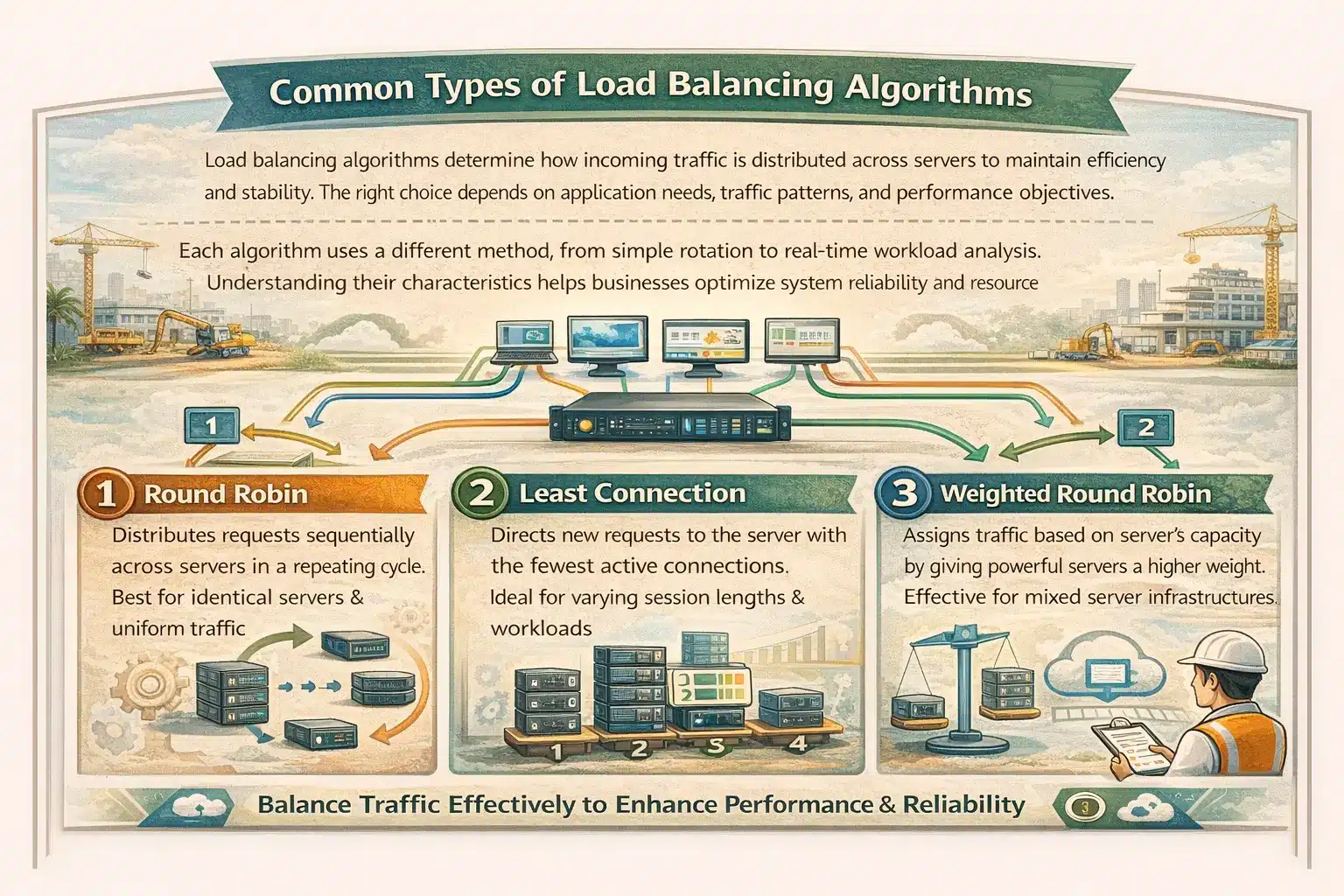
Load balancing algorithms determine how incoming traffic is distributed across servers to maintain efficiency and stability. The right choice depends on application needs, traffic patterns, and performance objectives.
Each algorithm uses a different method, from simple rotation to real-time workload analysis. Understanding their characteristics helps businesses optimize system reliability and resource utilization.
1. Round Robin
Round Robin distributes requests sequentially across servers in a repeating cycle. It works best when servers have identical capacity and traffic loads are relatively uniform.
2. Least Connection
Least Connection directs new requests to the server with the fewest active connections. This approach is ideal for environments where session lengths and workloads vary significantly.
3. Weighted Round Robin
Weighted Round Robin assigns traffic based on server capacity by giving more powerful servers a higher weight. It is effective in infrastructures with mixed server specifications.
4. IP Hash
IP Hash routes requests based on a hash of the client’s IP address, ensuring session persistence. It is commonly used for applications that require users to remain connected to the same server.
Types of Load Balancers: Which One Is Right for You?
Choosing the right type of load balancer depends on your company’s traffic needs, budget, and IT capabilities. Each option hardware, software, or cloud offers different performance, flexibility, and management requirements.
The decision impacts initial costs, scalability, and operational complexity, so understanding the pros and cons of each type is essential for making an informed investment.
Let’s break down the three main types of load balancers to help you determine which is most appropriate for your business.
Implementation of Load Balancing on Critical Business Systems
Load balancing is often associated with public websites serving millions of visitors, but its benefits extend far beyond that. Various critical business systems support daily activities, such as ERP, CRM, and supply chain management applications.
The availability and performance of these systems are vital, as even a few minutes of downtime can halt production lines, delay shipments, and significantly disrupt customer service.
For example, in a manufacturing company, hundreds of employees from various departments, including warehousing, production, and finance, access the ERP system simultaneously to update inventory data, track production orders, and manage invoices.
Just as ensuring system availability is crucial, maintaining the integrity of the data within them is also a top priority. Complex operational processes require accurate visibility and traceability of data from end to end.
For instance, the ability to track products in detail is a critical foundation for quality management and regulatory compliance. Just as load balancing ensures a system is always active, integrated solutions ERP are designed to operate in high-demand environments.
Case Study: Load Balancing Implementation for Scalable Business Operations

Conclusion
Load balancing has become more than just a technical tool it is a strategic component that ensures digital services remain fast, reliable, and secure. By intelligently distributing traffic, businesses can maintain application availability while supporting a seamless user experience.
The right system enhances scalability, optimizes performance, and improves operational efficiency, directly contributing to higher customer satisfaction and business growth. With clear visibility and control over traffic flow, companies can prevent downtime and reduce the risk of service interruptions.
Whether through hardware, software, or cloud solutions, effective load balancing strengthens business continuity and supports long-term growth. To explore how this strategy can fit your operations, consider consulting with a specialist to determine the best setup for your infrastructure needs.
Frequently Asked Questions
-
What are the two main types of load balancing?
The two main types are hardware and software load balancers. Hardware load balancers are dedicated physical devices offering high performance, while software load balancers are applications installed on standard servers, offering greater flexibility and lower cost.
-
Why is load balancing needed?
Load balancing is needed to improve the performance, reliability, and scalability of applications. It prevents server overload by distributing traffic, ensuring high availability and a fast, responsive experience for all users.
-
Is a router a load balancer?
While some advanced routers have basic load-balancing capabilities, a dedicated load balancer is a far more sophisticated device. A router’s primary job is to direct traffic between networks, whereas a load balancer’s job is to distribute traffic among servers within a single network to optimize performance.