





With the aftermath of COVID-19 and the current energy crisis, work-from-home (WFH) has become more common than ever. And work has become more remote as the Philippine job market shifts to the BPO industry and global IT talent. Every business now must be able to provide financial support to remote employees to ensure productivity, engagement, and proper equipment.
Navigating the complexities of a WFH allowance in the Philippines requires a deep understanding of local labor laws, tax regulations, and evolving industry standards. Employers must stay competitive in a tight talent market while managing their budgets carefully. At the same time, they need to follow DOLE and BIR rules on the design, granting, and taxation of allowances. For HR teams, understanding these rules is now essential if they want to avoid legal problems and form an efficient workforce.
Table of Contents
Key Takeaways
|
What Is WFH Allowance?
WFH allowance, also called remote work subsidy, is a specific financial benefit provided by an employer to an employee to cover the direct and indirect costs associated with performing their job duties outside the traditional office environment. Allowance is strictly meant to subsidize operational expenses, not the base salary, including work time, employee skills, and work output.
Are Employers Obligated to Pay WFH Allowance?

The short answer is not automatically. In the Philippines, Republic Act No. 11165, or the Telecommuting Act, does not expressly require every private employer to pay a separate cash allowance for home internet or electricity. Instead, the law says telecommuting is a voluntary work arrangement that employers may offer on terms both sides mutually agree on, provided those terms still meet minimum labor standards.
What the law does require is fair treatment. Under Republic Act No. 11165 sec. 5. Fair Treatment, states that “The employer shall ensure that the telecommuting employees are given the same treatment as that of comparable employees working at the employer’s premises.” Meaning they have to have the same monetary compensation, workload, holidays, rest period, bargaining rights, and equipment training as on-site workers.
DOLE’s revised implementing rules reinforce that point; Department Order No. 237-22 says telecommuting terms must meet minimum labor standards and must not reduce benefits already granted under company policy, contracts, or a CBA. That same rule also covers the facilities, training, equipment, and supplies needed for remote work. In practice, employers usually need to provide WFH allowance only if they have already promised it through an existing agreement or policy.
Comprehensive Breakdown: Types of WFH Allowances
When designing a compensation package for distributed teams, organizations typically break down the subsidies into several distinct categories. Understanding these categories helps HR professionals create a comprehensive and targeted support system.
1. Internet and Connectivity Subsidies
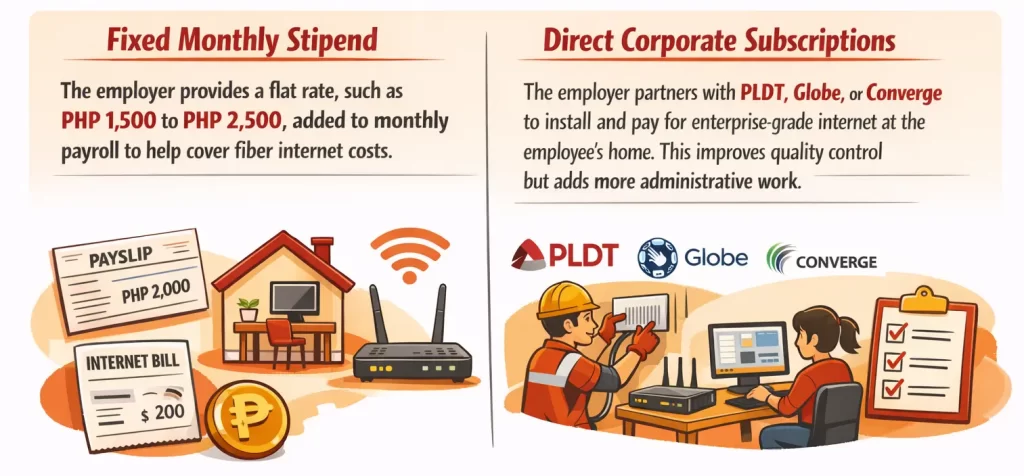
In the digital age, a stable internet connection is the lifeline of remote work. The Philippines has historically faced challenges with internet speed and reliability, making connectivity a primary concern for employers. Companies usually address this in two ways:
2. Electricity and Utility Allowances
Working from home eight to nine hours a day significantly increases an employee’s household electricity consumption, especially in a tropical country where air conditioning or continuous fan usage is necessary. Utility allowances are often calculated based on the average power consumption of a desktop computer, monitors, and basic cooling appliances during working hours. This stipend is usually bundled with the internet allowance into a single “Connectivity and Utility” package.
3. Equipment and Ergonomic Setup Stipends
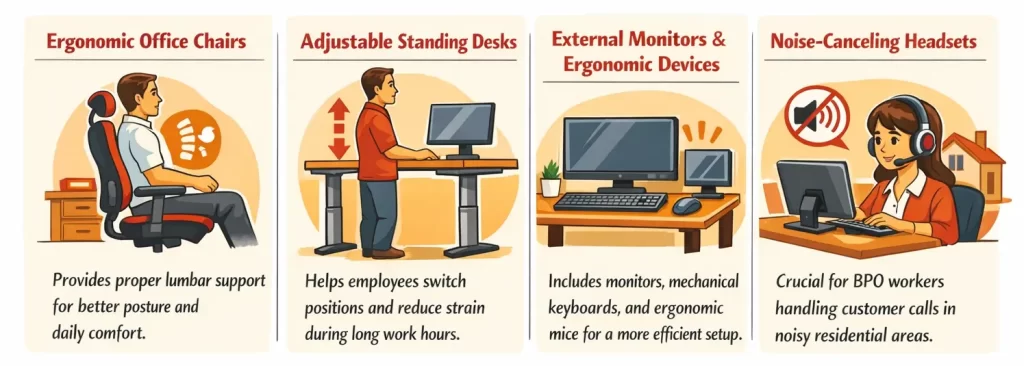
Long-term remote work on inadequate furniture can lead to musculoskeletal issues, reducing productivity and increasing healthcare costs. Noisy environments also lower workers’ productivity, especially those who require constant communication. Forward-thinking companies provide a one-time or annual stipend for employees to purchase:
4. Co-working Space Reimbursements
Not all employees have a home environment conducive to focused work. Disruptions from family members, lack of space, or frequent power outages (a reality in some Philippine provinces) can hinder performance. To mitigate this, some companies offer a monthly budget that employees can use to rent a desk at a local co-working space or coffee shop, providing a flexible alternative to the home office.
Is WFH Allowance Taxable or Non-Taxable?

The tax treatment of WFH support depends less on the label and more on how the company gives the benefit. As a rule, cash-based allowances are usually taxable, while employer-provided tools or services are more defensible from a tax perspective but still depend on the facts. BIR’s current rules treat fixed allowances paid per payroll period as part of regular compensation, and the updated de minimis list does not specifically include internet, electricity, or a generic WFH allowance.
1. Is a Fixed Internet Allowance Taxable?
Yes, a fixed monthly internet allowance is generally taxable. BIR says regular compensation includes fixed allowances and other allowances paid per payroll period. Since internet allowance is not listed under the current de minimis benefits, employers should usually treat it as taxable compensation when it appears as a flat monthly amount in payroll.
2. Is a Fixed Electricity Allowance Taxable?
Yes, a fixed electricity allowance is also generally taxable. Like internet support, it is usually given as a recurring cash amount and therefore falls closer to regular compensation than to a tax-exempt benefit. The current de minimis list does not specifically exempt the electricity allowance.
3. Is a Reimbursement for Internet or Electricity Non-Taxable?
DOLE Department Order No. 237-22, Section 9, affirms that the facilities, equipment, supplies, expenses for acquisition, handling, usage, maintenance, repair, and return needed for telecommunications are considered as ordinary and necessary costs of the business. Therefore, a reimbursement can be taxable depending on the documentation strength, internal policy, and how closely the expense relates to business use.
4. Is a General WFH or Remote Work Stipend Taxable?
Yes, a general remote work stipend is usually taxable if the company gives it as cash through payroll. BIR’s rules focus on whether the payment is part of compensation, and fixed allowances paid regularly are treated as regular compensation. A generic WFH allowance also does not appear in the current de minimis list.
5. Is a Cash Equipment Allowance Taxable?
In most cases, employers should treat a cash equipment allowance as taxable. When a company gives employees money to buy chairs, desks, monitors, keyboards, or headsets, that payment still counts as cash compensation unless a specific exemption clearly applies. BIR’s current de minimis list covers benefits such as rice subsidy, clothing allowance, laundry allowance, medical assistance, overtime meal allowance, and certain CBA or productivity benefits, but it does not include a home-office equipment allowance.
6. Is Company-Provided Equipment Taxable?
Usually lower-risk than a cash equipment stipend, but still fact-dependent. When the company provides work tools directly, such as monitors, headsets, or ergonomic devices, the support is easier to position as a business necessity than a cash allowance. For employees other than rank-and-file, BIR expressly recognizes an exception from fringe benefit tax when the benefit is necessary to the employer’s trade or business and for the employer’s convenience.
7. Is Company-Provided Internet Service Taxable?
Generally, it is safer than giving cash, although it still depends on the case. If the employer directly pays the service provider instead of giving cash to the employee, it does not look like regular pay. According to the BIR, a fringe benefit will not be taxed as a fringe benefit if it is needed for the business and for the employer’s convenience and advantage.
8. Does the ₱90,000 “Other Benefits” Cap Make WFH Allowance Non-Taxable?
Not by default. RR No. 11-2018 applies the ₱90,000 exclusion to 13th-month pay and other benefits such as Christmas bonus, productivity incentives, loyalty awards, gift in cash or in kind, and similar benefits. A recurring monthly WFH allowance is harder to fit into that bucket because BIR separately classifies fixed allowances paid per payroll period as regular compensation.
Handling all these factors can be a hassle for any HR team. Accounting for what’s taxable and non-taxable will take a lot of time and resources, which will only increase as the business grows. It is for that reason that an accounting management system is needed in our current age of allowance management.
How to Record WFH Allowance in Payroll

Recording a WFH allowance in payroll requires more than simply adding extra pay to an employee’s salary. Employers need to separate it clearly, classify it correctly, and apply the proper tax treatment based on how the allowance is given. A structured payroll record also helps the company stay organized, support its telecommuting policy, and reduce issues during tax or compliance review.
Step 1: Create a separate payroll item
Set up a distinct payroll code, such as WFH Allowance or Remote Work Support. Do not combine it with basic pay. A separate line item makes the payment easier to track and helps payroll apply the correct treatment.
Step 2: Identify the type of payment
Decide whether the amount is a fixed monthly allowance, a reimbursement, or another form of employer support. This step matters because payroll must treat each type properly before calculating taxes and deductions.
Step 3: Check whether the allowance is taxable
If the company provides a fixed monthly amount for internet or electricity, payroll should generally treat it as taxable compensation unless there is a clear legal basis to classify it differently. This prevents errors in withholding tax computation.
Step 4: Collect supporting documents for reimbursements
If the company reimburses actual WFH expenses, keep all supporting records such as receipts, reimbursement forms, approval documents, and the company’s internal WFH policy. Good documentation helps justify the tax treatment and supports the payroll record during audits or reviews.
Step 5: Consider employee classification
Review whether the employee is rank-and-file or non-rank-and-file. In some cases, benefits given to non-rank-and-file employees may require separate treatment, especially if they fall under fringe benefit rules.
Step 6: Include the allowance in the payroll run
Once payroll classifies the allowance correctly, include it in the employee’s payroll processing for the period. Make sure the amount appears clearly on the payslip and is not buried under another earning category.
Step 7: Apply the correct withholding and year-end reporting
After adding the WFH allowance to payroll, apply the correct withholding tax when required. Payroll should also include the amount in annualized payroll computation and year-end reporting to keep records complete and accurate.
Clear classification, complete documentation, and accurate payroll reporting help companies stay organized, reduce compliance risks, and manage telecommuting payments more effectively. Using payroll management software can also streamline the processes to keep payroll and financial records aligned.
How to Track WFH Expense Reimbursement With Accounting Software
Tracking an expense reimbursement is no small task. Finance teams need to record internet, electricity, equipment, or other remote work costs, and each claim needs to be properly verified with supporting documents. They have to make sure the reimbursement flows into the books without creating reporting errors, which can be difficult with manual spreadsheets, emails, and scattered receipts. Thus, accounting software is needed to handle the increasing workload.
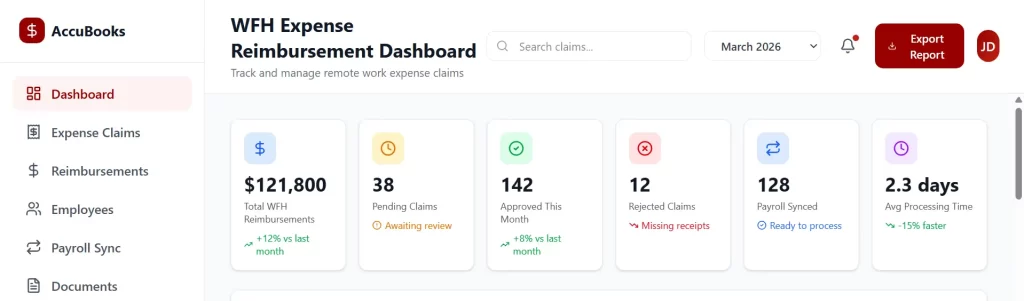
Here’s how to use accounting software to track WFH expense reimbursement:
- Create a dedicated expense category for WFH reimbursements.
- Set up employee reimbursement records in the system.
- Upload and store receipts, forms, and approval documents digitally.
- Record each claim under the correct expense type, such as internet, electricity, or equipment.
- Link reimbursement entries to the right employee, department, or cost center.
- Review and approve claims before posting them to the accounts.
- Sync approved reimbursements with payroll or payable records when needed.
- Generate reports to monitor total remote work spending over time.
In short, accounting software helps businesses track WFH reimbursements more accurately, stay organized as claims increase, and reduce the administrative burden on finance teams. For companies that want tighter control over expense recording and smoother financial reporting, using the right accounting software can make the entire process easier to manage.
Conclusion
WFH allowance in the Philippines involves more than employee support. Employers must first check whether company policy or an existing agreement requires the allowance, then classify it correctly as taxable or non-taxable, and finally record it properly in both payroll and accounting. Clear rules, complete documentation, and proper classification help businesses reduce compliance risk and manage remote work support more efficiently.
The bigger the business, the bigger the bureaucracy. Managing remote work subsidies via spreadsheets and manual email is impossible if you have more than a thousand employees. Using the best HRIS software helps businesses handle allowance management and payroll more efficiently as operations grow more complex.
FAQ for WFH Allowance
-
What is a WFH stipend?
A WFH stipend gives employees financial support for remote work costs such as internet, electricity, or home-office tools. Philippine law does not define the term directly, but DOLE’s telecommuting rules recognize that remote work involves business-related facilities, equipment, supplies, and related expenses.
-
Can employer refuse to allow employees to work from home?
Yes. Employers may allow telecommuting, but the Telecommuting Act makes it a voluntary arrangement, not an automatic employee right. Once a company adopts it through policy, contract, or CBA, it must still follow minimum labor standards.
-
What conditions qualify for remote work?
Remote work usually qualifies when the job can be done through telecommunications or computer technology, the employer offers the arrangement, the employee agrees to it, and the setup complies with DOLE rules on fair treatment and minimum labor standards.
-
Does WFH allowance count as a de minimis benefit?
Usually, no. BIR’s de minimis list does not specifically include internet, electricity, or a general WFH allowance. Because of that, employers generally treat a fixed WFH allowance as taxable compensation unless another specific exemption applies.