


Time is a resource, and it is a resource that has to be used fully in the restaurant industry. Just wasting a few minutes can cause a delay in serving the customers, leading them to leave a one-star review. The industry is notoriously fast-paced, highly competitive, and consistently evolving. A shift towards digitization is accelerating, and those who can’t catch up will be left behind.
One of the most critical operational decisions a restaurant owner will make is to choose the best POS system. The chosen platform dictates not only how transactions are processed but also how the kitchen communicates with the front of house, how inventory is managed, and how customer loyalty is cultivated. Among the most prominent players in this space is Toast POS, a platform specifically engineered to address the unique, multifaceted challenges of the restaurant sector.
Table of Contents
Key Takeaways
|
What is Toast POS and Who it fit best?
Toast POS is a comprehensive, cloud-based point-of-sale, retail, and restaurant management system that focuses on the food industry. The company discovered that retail-focused POS systems often lacked the specialized functionalities required to handle the complex workflows of a bustling restaurant. Toast was developed to bridge this gap, offering a unified platform that integrates front-of-house (FOH) operations, back-of-house (BOH) management, and overarching business analytics.
Toast builds its architecture around the operational demands of hospitality. Its system supports complex menu modifiers, seat-level ordering, course firing, and kitchen routing with precision. As a cloud-native SaaS platform, it updates automatically and gives restaurant managers real-time access to menus, sales, and performance data from anywhere. It also offers stronger data redundancy and security than traditional on-premise servers.

How Toast Hardware Works in Real Restaurant Operations
 Toast POS is built on the Android operating system. It is a deliberate strategic choice to differentiate it from many competitors who rely on Apple devices. Unlike Apple, Android offers greater flexibility for hardware customization, allowing the company to design and manufacture proprietary devices that are specifically ruggedized for the harsh environments of a restaurant kitchen or a high-volume bar.
Proprietary Hardware Components and Price
The hardware ecosystem is built for restaurant conditions such as heat, grease, spills, and constant physical use. Key components include:
- Toast Flex Terminal: A primary countertop POS terminal for cashiers and servers, priced at around ₱37,855 + ₱3,009/month. It supports fast order entry, payment processing, and flexible counter setup for different restaurant formats.
- Guest-Facing Display: An optional customer-facing screen priced at around ₱8,069. It improves checkout transparency by showing order details, totals, and tip prompts before the order reaches the kitchen.
- Toast Go 3: Toast’s current handheld POS device, priced at around ₱32,439 + ₱3,009/month. It lets servers take orders and accept payments tableside, which helps speed up service and reduce order errors.
- Kitchen Display System (KDS): Available at about ₱37,855 + ₱2,106/month for the countertop version, or ₱36,772 + ₱2,106/month for the wall-mounted version. It replaces paper tickets with clear digital order tracking to improve kitchen coordination and ticket accuracy.
- Self-Service Kiosk: Toast offers a restaurant self-ordering kiosk through its guest self-service setup at varying prices. It allows guests to browse the menu, customize items, and pay on their own, which helps reduce queue pressure in quick-service settings.
Offline Mode Capabilities
One of the most critical architectural features of a cloud-based system is its ability to handle internet outages. Toast POS includes a robust offline mode so the restaurants can still operate even if the local internet is down. Once the connection is restored, the system automatically syncs the cached data with the cloud and processes the stored payments, ensuring uninterrupted service during network fluctuations.
Price Comparison and Features
Toast provides flexibility for business owners. They offer three software plans, including Starter Kit, Point of Sale, and Build Your Own. Each has its own different and additional features, which are reflected by their prices.
| Starter Kit | Point of Sale | Build Your Own |
| Best for small single-location restaurants that want a bundled launch setup with no upfront hardware cost. | Best for restaurants that want core POS tools with a monthly subscription and flexible hardware choice. | Best for operators that want advanced add-ons, digital ordering, marketing, back-office tools, and wider hardware options. |
| Starting at 0$/month | Starting at 69$/month | Custom pricing |
Key features:
|
Key features:
|
Key features:
|
What Toast POS Actually Helps You Do Daily
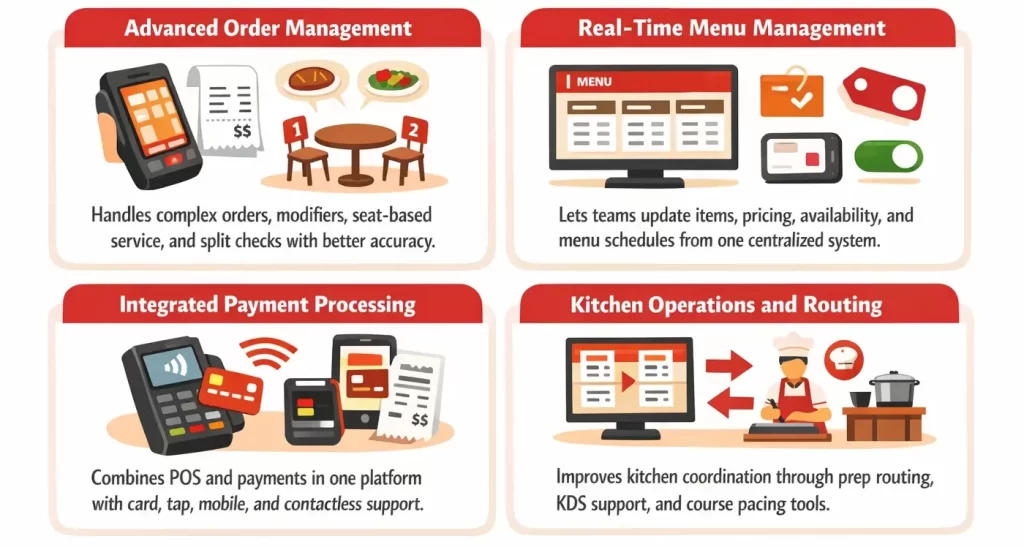
Toast POS offers a wide array of features designed to streamline workflows, enhance the guest experience, and provide actionable management insights.
The Toast Ecosystem: Add-ons and Integrations
While the core POS functionalities handle the immediate transactional needs of a restaurant, the broader Toast ecosystem extends into nearly every facet of restaurant management. Operators can choose to adopt various first-party modules or integrate with third-party software to build a customized technology stack.
First-Party Modules
To provide an all-in-one solution, the platform offers several native add-ons:
- Toast Payroll and Team Management: This module integrates directly with the POS time-clock data. It automates payroll processing, handles tax compliance, and assists with employee onboarding and benefits administration. By tying labor costs directly to sales data, managers can easily calculate labor percentage metrics in real-time.
- Toast Marketing and Loyalty: Building a repeat customer base is vital. The loyalty module allows restaurants to create points-based reward systems, while the marketing suite enables automated email campaigns based on guest behavior, such as sending a discount code to a customer who hasn’t visited in 30 days.
- Toast Online Ordering and Delivery: In the post-pandemic landscape, off-premise dining is non-negotiable. The native online ordering system allows restaurants to accept commission-free orders directly through their website, integrated seamlessly with the kitchen’s workflow. It also offers a native delivery dispatch network, allowing restaurants to utilize on-demand drivers without paying the exorbitant commissions of third-party marketplaces.
Third-Party Integrations
No single software can be everything to everyone. Recognizing this, the system features an open API (Application Programming Interface) and a robust partner network. Restaurants can integrate their POS with leading third-party applications, including:
- Accounting Software: Seamless data flow to platforms like QuickBooks or Xero for accurate financial reconciliation.
- Third-Party Delivery Aggregators: Direct integration with GrabFood, foodpanda, and Pick.A.Roo, funneling all marketplace orders directly into the POS and KDS, eliminating the need for multiple tablets cluttering the host stand (often referred to as “tablet hell”).
- Advanced Inventory Management: While Toast has native inventory features, operators with highly complex supply chains might integrate specialized platforms like MarketMan or Restaurant365.

Where Toast POS Works Well and Where It Falls Short
To make an informed decision, restaurant operators must objectively evaluate the strengths and limitations of the platform.
| Advantages | Limitations |
| Every feature is built with the restaurant workflow in mind, making it highly intuitive for hospitality professionals. | Because the platform requires users to utilize its in-house payment processing, restaurants lose the leverage to shop around for lower merchant service rates from third-party processors. |
| The proprietary Android hardware is durable and specifically designed to survive the rigors of a commercial kitchen. | For operators who strongly prefer iOS environments or already own a fleet of iPads, the mandatory switch to Android hardware can be a deterrent. |
| The ability to manage payroll, marketing, online ordering, and POS from a single dashboard significantly reduces software fatigue and administrative overhead. | While starter packages are accessible, fully outfitting a large, multi-location restaurant with handhelds, KDS, and premium software tiers requires a substantial financial commitment. |
| As a cloud-based SaaS platform, the system receives regular, automatic updates, ensuring users always have access to the latest features and security patches. | Restaurants that operate outside Toast’s strongest market may face integration gaps or workflow mismatches, especially when local delivery platforms, payment preferences, or regional compliance needs differ from Toast’s core ecosystem. |
Common Mistakes Using Toast and How to Avoid Them
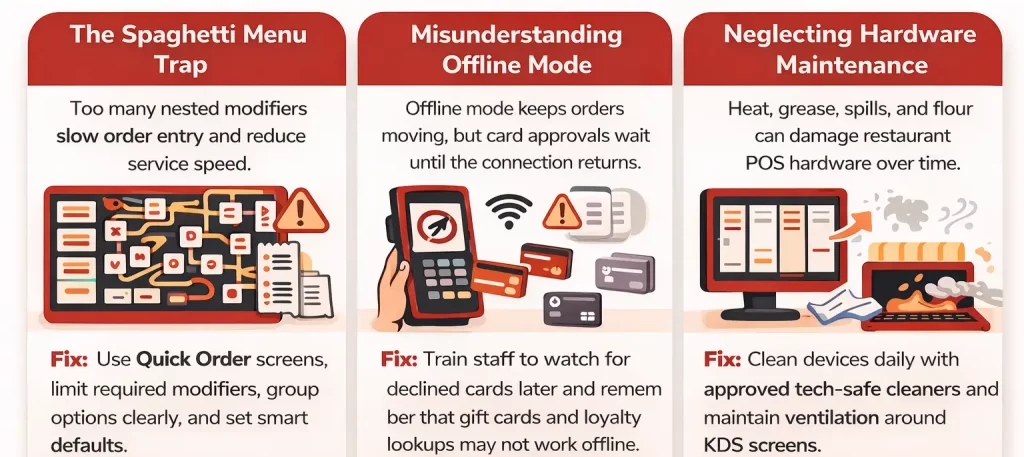
Even with a premium system like Toast, implementation and daily operations can suffer if best practices are ignored. Recognizing common pitfalls allows operators to proactively mitigate risks and protect their bottom line.
Alternatives to Toast POS: Finding the Right Fit
While Toast is a dominant force in the restaurant POS market, it is not the only solution. Depending on the specific operational model, size, and budget of a business, other platforms may offer a better fit. These are the four restaurant POS system that rivals Toast:
| Category | Square | Clover | Lightspeed | HashMicro |
|---|---|---|---|---|
| Price | Free: $0 Plus: $49/month Premium: $149/month |
Custom by plan Starter, Standard, and Advanced |
Starter: $69/month Higher tiers available |
Custom quote |
| Requirements | Best for simple setups Supports KDS and kiosk add-ons |
Uses Clover hardware Bundled software + device plans |
POS, menu tools, floor plans, payments, and online ordering | Web-based POS with accounting, inventory, purchasing, and mobile access |
| What makes it better than Toast |
|
|
|
|
| Limitation vs Toast | Weaker for complex dine-in workflows | Less transparent pricing | Costs can rise fast with upgrades | May feel too broad for small restaurants |
Which POS is the Best?
Between the three alternatives and Toast POS, which is the best for your business? Find it out here, where we will compare all four options based on features, pricing, payroll support, and overall value. This comparison highlights relevant strengths and weaknesses so you can decide which POS fits your restaurant or multi‑location business.
Comparison Table:
| Feature | Square | Clover | Lightspeed | HashMicro |
|---|---|---|---|---|
| Pricing | Free; $49/month; $149/month | Custom pricing | $69/month and higher tiers | Custom pricing |
| Best for | Simple setups, cafés | Mixed setups, flexible | Complex venues, large scale | Multi-branch, inventory control |
| Payroll | Not included | Not included | Not included | Included with HR features |
| Key Pros | Low entry cost, easy setup | Flexible hardware, app ecosystem | Strong inventory tools | Advanced back-office tools |
| Key Cons | Weaker dine-in workflows | Less transparent pricing | Higher upfront cost | Best for multi-branch businesses |
While Toast POS offers many useful features, HashMicro POS stands out as the best option for businesses looking for a comprehensive system. It includes everything for seamless operations and growth. Payroll, HR management tools, and robust inventory control make it ideal for multi-location restaurants that need advanced functionalities.
Conclusion
Toast speeds up service operations and gives the operator greater control over them. The platform offers order management, menu synchronization in real time, payment processing, kitchen operations, payroll management, marketing support, and even allows customers to place orders from their mobile devices. With cloud access and robust restaurant hardware, Toast enables restaurant owners to streamline their operations.
Choosing the right POS system matters because it affects transactions, kitchen communication, inventory flow, and customer experience. A strong platform should match your service model, budget, and growth plans. That is why a restaurant owner needs to find the best POS system.
FAQ for Toast POS
-
Can Toast POS be used by restaurants in the Philippines?
Yes, but restaurant owners should first confirm local payment support, hardware availability, and after-sales support before deployment.
-
Is Toast POS BIR-accredited in the Philippines?
Restaurants should verify current BIR accreditation/registration requirements directly with the vendor and BIR before using any POS for receipting
-
How does Toast POS handle payment processing?
Toast acts as its own payment processor, meaning it provides an all-in-one solution for both the software and the financial transactions. Restaurants using Toast must use their integrated payment processing, which typically operates on a flat-rate percentage plus a fixed cent amount per transaction.
-
Is Toast POS better than Square?
It depends on your restaurant’s needs. Toast POS often outperforms Square for full-service and complex dine‑in environments because of its restaurant workflows, kitchen routing, tableside ordering, and restaurant‑ready hardware. However, Square can be a more affordable and flexible choice for small cafés, retail‑hybrid businesses, or operators prioritizing simplicity and lower upfront costs.