

Precision Agriculture: The Ultimate Guide to Agribusiness Efficiency

In the dynamic landscape of modern agribusiness, staying competitive requires more than just traditional farming wisdom. Business leaders are increasingly turning to data and technology to navigate challenges like climate change, resource scarcity, and rising operational costs. At the forefront of this evolution is precision agriculture, a transformative approach that leverages advanced technology to optimize every aspect of farm management. This methodology is not just about adopting new gadgets; it is a fundamental shift towards a more intelligent, efficient, and sustainable way of farming that promises significant returns on investment.

This comprehensive guide is designed for agribusiness owners and managers seeking to understand and implement precision agriculture in their operations. We will delve into its core principles, explore the essential technologies driving its success, and provide a strategic roadmap for adoption. By understanding how to harness the power of data, from GPS mapping to AI-driven analytics, you can unlock new levels of productivity and profitability. This article will equip you with the knowledge needed to transform your agricultural practices and build a resilient business ready for the challenges of 2025 and beyond.

Key Takeaways

  • Precision agriculture is a farm management approach that uses advanced information technology to gather and analyze detailed field data.
  • Key technologies in precision agriculture include the global positioning system, geographic information systems, and remote sensing.
  • HashMicro Agriculture ERP software provides an integrated ERP system designed to automate and simplify the complex processes of modern agribusiness, including precision agriculture data management.

Click Here to Get the Free Demo!

Table of Contents

    Content Lists
      FreeDemo

      What Is Precision Agriculture?

      Precision agriculture, also known as precision farming or satellite farming, is a comprehensive farm management philosophy that uses information technology to collect and analyze temporal and spatial data from the field. This data is then leveraged to make highly accurate decisions regarding crop production. The primary objective is to optimize the application of inputsโ€”such as fertilizers, water, pesticides, and seedsโ€”to maximize crop yield and quality while minimizing environmental impact and operational costs. It moves away from the traditional, uniform approach to farming and instead treats different zones within a single field as distinct micro-environments, each with unique needs. This data-centric strategy enables more granular control, turning agricultural land into a highly managed, predictable production system.

      At its heart, the guiding principle of precision agriculture is to execute the right management practice, at the right place, at the right time, and in the right way. Imagine it as personalized medicine for crops; instead of applying the same treatment across an entire field, each specific area receives a tailored prescription based on its unique soil composition, moisture levels, nutrient content, and crop health. This targeted approach not only reduces the waste of valuable resources but also ensures that every plant has the optimal conditions to thrive. By transforming farming from a practice based largely on historical averages and intuition into a precise, data-driven science, precision agriculture empowers business leaders with unprecedented control and insight over their entire operation, laying the groundwork for a more profitable and sustainable future.

      Why Precision Agriculture Is Important for the Future of Agribusiness

      Precision Agriculture in 2025: The Ultimate Guide to Agribusiness Efficiency

      In today’s global market, the adoption of precision agriculture is transitioning from a competitive advantage to a strategic necessity. Agribusiness leaders are facing a confluence of immense pressures, including a growing global population that demands more food, the unpredictable effects of climate change on weather patterns, and increasing consumer and regulatory demands for sustainable practices. Understanding the fundamental benefits of precision agriculture is therefore essential for building a resilient, efficient, and profitable agribusiness. The following points highlight why this technological shift is critically important for the future.

      1. Enhanced efficiency and productivity

      One of the most significant impacts of precision agriculture is the dramatic improvement in operational efficiency. By using technologies like Variable Rate Technology (VRT), farmers can apply inputs with surgical precision, ensuring that resources are only used where and when they are needed. This targeted approach drastically reduces waste, leading to substantial cost savings. For instance, instead of blanket-fertilizing an entire field, sensors and GPS-guided machinery can apply more nutrients to deficient zones and less to already fertile areas. This optimization directly translates to higher productivity, as crops receive the exact resources required for optimal growth, leading to increased yields per hectare. Studies have shown that such practices can reduce fertilizer usage by up to 30% while simultaneously boosting crop yields by 15% or more, a clear win for both the budget and the harvest.

      2. Environmental sustainability

      The push for sustainability is a defining trend in modern industry, and agriculture is no exception. Precision agriculture offers powerful tools to make farming more environmentally friendly. By minimizing the overuse of chemical inputs like nitrogen fertilizers and pesticides, it significantly reduces nutrient runoff into nearby water sources, mitigating water pollution and protecting aquatic ecosystems. Furthermore, more efficient use of machinery and resources helps lower the overall carbon footprint of farming operations. As consumers become more environmentally conscious and regulations tighten, the ability to demonstrate sustainable practices is becoming a valuable market differentiator. Agribusinesses that embrace precision agriculture are better positioned to meet these demands, enhancing their brand reputation and gaining a competitive edge in a green-focused economy.

      3. Data-driven decision making

      Precision agriculture marks a pivotal shift from decision-making based on tradition and intuition to strategies grounded in hard data and real-time analytics. With an array of sensors, drones, and satellite imagery, farm managers can monitor crop health, soil conditions, pest infestations, and weather patterns with incredible detail. This continuous stream of information provides an unprecedented level of visibility into the entire operation, allowing for proactive rather than reactive management. For example, NDVI imagery from a drone can detect crop stress long before it is visible to the naked eye, enabling managers to intervene quickly and prevent significant losses. This capability transforms farm management into a strategic, evidence-based process, enabling better long-term planning and risk mitigation.

      4. Increased profitability and ROI

      Ultimately, all business benefits must translate to the bottom line, and precision agriculture delivers tangible financial returns. The combined effects of reduced input costs, increased yields, and improved operational efficiency directly contribute to higher profitability. By optimizing the use of expensive resources like fertilizer, fuel, and water, businesses can lower their cost of production significantly. Simultaneously, higher and more consistent yields mean greater revenue. In many markets, products grown using verifiable sustainable methods can command a premium price, further boosting income. While the initial investment in technology can be substantial, the long-term Return on Investment (ROI) is often highly compelling, making precision agriculture a sound financial strategy for forward-thinking agribusinesses.

      Key Technologies in Precision Agriculture

      The power of precision agriculture is derived from the seamless integration of several advanced technologies, each playing a distinct role in a sophisticated ecosystem of data collection, analysis, and application. These tools work in concert to provide a detailed, data-rich picture of the farm, enabling managers to make informed and precise decisions. Understanding these core technological components is the first step toward appreciating how this modern agricultural revolution functions.

      Here are the fundamental technologies that form the backbone of precision agriculture.

      1. Global Positioning System (GPS) and GNSS

      The Global Positioning System (GPS) and other Global Navigation Satellite Systems (GNSS) are the foundational technologies of precision farming. These systems provide highly accurate location data, enabling precise mapping of field boundaries, soil sample locations, and crop scout observations. Their most transformative application is in machinery guidance, where auto-steering systems use GPS signals to navigate tractors, combines, and sprayers with centimeter-level accuracy. This precision eliminates overlap during planting, spraying, and harvesting, which saves fuel, reduces operator fatigue, and ensures inputs are applied exactly where intended. In essence, GPS is the technology that makes the โ€œright placeโ€ principle of precision agriculture a practical reality on the ground.

      2. Geographic Information System (GIS)

      If GPS provides the location data, Geographic Information System (GIS) software is what gives that data meaning and context. GIS is a powerful tool used to create, manage, analyze, and visualize geospatial information in the form of layered maps. In agriculture, a GIS platform can integrate diverse datasets, such as yield maps from previous harvests, soil survey maps, topography data, satellite imagery, and nutrient analysis results. By overlaying these different layers of information, managers can identify patterns and relationships that would otherwise be invisible. For example, a GIS map can reveal a correlation between low-yield areas and specific soil types, allowing for the creation of targeted management zones.

      3. Sensors and Internet of Things (IoT)

      The Internet of Things (IoT) has brought the farm to life with a network of smart sensors deployed directly in the field. These devices collect a continuous stream of real-time data on critical variables affecting crop growth. Soil moisture sensors monitor soil moisture levels, helping optimize irrigation schedules and conserve water. In-situ weather stations provide hyper-local climate data, while soil sensors can measure nutrient levels like nitrogen (N), phosphorus (P), and potassium (K). Other sensors, often mounted on equipment, can measure crop health in real-time using optical technology. According to a report by MarketsandMarkets, the IoT in agriculture market is projected to grow significantly, underscoring its importance in providing the constant data flow needed for timely interventions.

      4. Remote Sensing (Drones and Satellites)

      Remote sensing technologies, primarily drones (UAVs) and satellites, provide a bird’s-eye view of the entire farm, enabling rapid monitoring of vast areas. These platforms are equipped with multispectral cameras that capture data beyond the visible light spectrum. This allows for the calculation of vegetation indices like the Normalized Difference Vegetation Index (NDVI), a key indicator of plant health. An NDVI map can quickly highlight areas where crops are under stress due to pests, disease, or nutrient deficiencies, often before symptoms are apparent to the human eye. Drones offer high-resolution imagery and flexible deployment for detailed scouting, while satellites provide cost-effective monitoring of large acreages on a regular schedule, making them complementary tools for large-scale farm management.

      5. Variable Rate Technology (VRT)

      Variable Rate Technology (VRT) is where data is translated into direct action in the field. VRT systems enable farm machinery, such as fertilizer spreaders, seed planters, and irrigation pivots, to automatically adjust the rate of input application as they move across a field. These machines are equipped with a controller that reads a digital โ€œprescription mapโ€ created from GIS data. This map divides the field into different management zones and specifies the exact amount of seed, fertilizer, or water to be applied in each one. VRT is the ultimate expression of the precision agriculture philosophy, ensuring that every part of the field receives a customized treatment designed to optimize its specific potential.

      6. Artificial Intelligence (AI) and Machine Learning

      Artificial Intelligence (AI) and machine learning are the analytical engines that process the massive volumes of big data generated by all the other technologies. These sophisticated algorithms can identify complex patterns, make predictions, and generate actionable insights that would be impossible for a human to uncover alone. AI applications in agriculture are vast and growing. Predictive analytics models can forecast crop yields with high accuracy based on historical data and current conditions. Machine learning algorithms can analyze images from drones to automatically detect and identify specific weeds or diseases. AI can also optimize irrigation and fertilization schedules by analyzing real-time sensor data and weather forecasts, ensuring resources are used with maximum efficiency.

      Implementation Stages of Precision Agriculture in Your Business

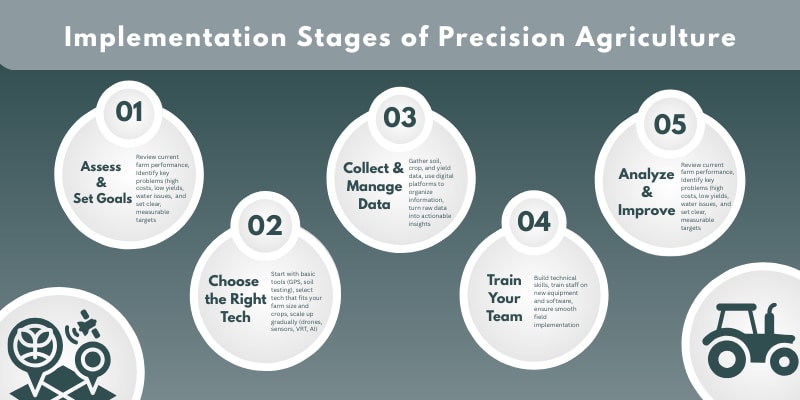
      Adopting precision agriculture is a strategic journey that transforms an agribusiness from the ground up. It is not about a one-time purchase of the latest technology but rather a phased, systematic integration into existing operations. For business leaders, a successful implementation requires careful planning to ensure that each investment is purposeful and contributes to measurable outcomes. A structured, multi-phase approach allows for a smoother transition, better user adoption, and a clearer path to achieving a positive return on investment. The following five-phase framework provides a strategic roadmap to guide your business through this transformation.

      1. Phase 1: Assessment and goal setting

      The journey begins with a thorough evaluation of your current operations. Before any technology is considered, it is crucial to identify the most significant pain points and opportunities for improvement. Are input costs, particularly for fertilizer, excessively high? Are there persistent low-yield zones within your fields? Is water management a constant challenge? Once these issues are identified, you can establish clear, specific, and measurable goals (KPIs) for your precision agriculture program. For example, a goal might be to โ€œreduce nitrogen fertilizer application by 20% in the next two seasonsโ€ or โ€œincrease yield in the southern quadrant by 10%.โ€ These defined objectives will serve as the guiding principles for all subsequent decisions.

      2. Phase 2: Technology selection

      With clear goals in place, the next step is to select the technologies that will best help you achieve them. It is critical to recognize that there is no one-size-fits-all solution; the right technology stack depends on your specific crop, scale, and objectives. A prudent strategy is often to start small and scale up. For instance, an initial investment could focus on foundational technologies like GPS for field mapping and grid-based soil sampling. This provides a baseline understanding of field variability. Based on these initial findings, you can then make more informed decisions about investing in more advanced systems like drones, real-time sensors, or VRT equipment. Thoroughly research vendors, prioritize solutions with strong support, and consider the long-term scalability of the technology.

      3. Phase 3: Data collection and management

      This phase is where the core activity of precision agriculture begins: the systematic collection of data. Using the selected technologies, you will start gathering information on soil properties, crop health, yield, and other variables. However, collecting data is only half the battle; managing it effectively is equally important. It is essential to have a centralized platform or software, such as an Agriculture ERP system, to store, organize, and visualize this information. Clean, well-structured data is the foundation of accurate analysis and effective decision-making. Without a robust data management strategy, you risk being overwhelmed by information without being able to extract valuable insights from it.

      4. Phase 4: Team training and execution

      Technology is only as effective as the people who use it. This phase focuses on equipping your team with the skills and knowledge needed to operate the new systems and interpret the data they generate. This involves providing comprehensive training for field operators on how to use GPS-guided machinery and for farm managers on how to read yield maps or analyze NDVI imagery. Successful adoption depends on buy-in from the entire team, so it is important to communicate the benefits and provide ongoing support. Once the team is prepared, you can begin executing precision agriculture practices in the field, such as creating prescription maps for variable-rate fertilization and using auto-steering for planting.

      5. Phase 5: Analysis, evaluation, and optimization

      Precision agriculture is not a static endpoint but a continuous cycle of improvement. After each growing season, it is crucial to analyze the collected data to evaluate the program’s performance against the goals set in Phase 1. Did you succeed in reducing input costs? Did yields improve in the targeted zones? The insights gained from this analysis are invaluable. They allow you to refine your strategies for the next season, perhaps by adjusting the boundaries of your management zones, tweaking your fertilizer prescriptions, or experimenting with different seed varieties. This iterative process of analysis, evaluation, and optimization ensures that your operation becomes progressively more efficient and profitable over time.

      Integrating Precision Agriculture Data with ERP Software

      The vast amount of data generated by precision agriculture technologiesโ€”from yield monitors, soil sensors, drones, and GPS trackersโ€”is incredibly powerful. However, its true strategic value is only unlocked when it is integrated with the core business management systems of the enterprise. When field data remains isolated, it creates information silos. Farm managers may know what is happening on the groundโ€”such as fertilizer application rates or real-time yield numbersโ€”but executives struggle to understand the immediate financial impact of these activities on inventory, production costs, and overall profitability. This disconnect hinders a holistic view of the business and makes agile, strategic decision-making difficult.

      This is where an Enterprise Resource Planning (ERP) system becomes the central nervous system of a modern agribusiness. By integrating precision agriculture data directly into an ERP, companies can create a single source of truth that connects field operations with financial and administrative functions. For example, data on fertilizer usage from a VRT applicator can automatically update inventory levels in the warehouse module and post the associated costs to the correct project in the accounting module, all in real-time. Similarly, yield data captured during harvest can seamlessly flow into sales and logistics modules to inform inventory forecasts and delivery schedules. A specialized system like HashMicro’s Agriculture ERP is specifically designed to bridge this gap, unifying disparate data streams to provide executives with accurate ROI analysis, precise cost tracking, and the sharp strategic insights needed to lead in a competitive market.

      Challenges in Adopting Precision Agriculture and How to Overcome Them

      While the benefits of precision agriculture are transformative, the transition to this data-driven model is not without its practical hurdles. Acknowledging these challenges from the outset allows agribusinesses to develop proactive strategies to mitigate them, ensuring a smoother and more successful adoption process. For leaders, anticipating these obstacles is key to managing expectations and allocating resources effectively. Here are some of the most common challenges encountered during the adoption of precision agriculture and practical approaches to overcome them.

      1. High initial investment cost

      The most immediate barrier for many is the significant capital required to invest in precision agriculture hardware and software. GPS-enabled tractors, drones, sophisticated sensors, and specialized software all come with a substantial price tag. To address this, a phased adoption strategy is often the most prudent approach. Start with foundational, lower-cost technologies like GPS mapping and soil sampling to prove the concept and generate initial returns. Additionally, explore alternative financing options, such as equipment leasing, or look for government grants and subsidies aimed at promoting sustainable agriculture technology. A thoroughly researched Return on Investment (ROI) analysis is your most powerful tool to justify the expenditure to stakeholders and secure the necessary funding for a scalable implementation.

      2. Technical skills gap

      Operating advanced technology and, more importantly, interpreting the data it produces requires a new set of skills that may not exist within your current workforce. This skills gap can be a major bottleneck to successful implementation. The solution lies in a commitment to human capital development. Invest in continuous training programs for your existing staff to build their digital literacy and analytical capabilities. Consider hiring specialists in ag-tech or data science who can lead the analytical efforts. Another effective strategy is to partner with third-party precision agriculture consultants who can provide expert guidance, technical support, and help translate complex data into actionable field strategies during the initial stages of adoption.

      3. Data interoperability and integration

      A common frustration in the ag-tech space is the lack of interoperability between different systems. Hardware and software from various vendors often use proprietary data formats, making it difficult to create a unified data ecosystem. This can lead to a fragmented collection of data that cannot be easily analyzed together. When selecting technology, prioritize vendors who adhere to open data standards or offer robust APIs (Application Programming Interfaces) for seamless integration. Investing in a flexible central management platform, particularly an ERP system with strong integration capabilities, is crucial. Such a platform can act as a hub, pulling data from multiple sources into a single, cohesive database for comprehensive analysis.

      4. Connectivity in remote areas

      Many agricultural regions suffer from poor or non-existent internet connectivity, which poses a significant challenge for cloud-based platforms and real-time IoT devices. This โ€œdigital divideโ€ can limit the effectiveness of technologies that rely on a constant connection to the internet. To overcome this, look for solutions designed to operate in low-connectivity environments. For example, many modern sensors and devices can store data locally (offline) and automatically sync it to the cloud whenever a connection becomes available. For critical operations that require uninterrupted connectivity, investing in alternative solutions like satellite internet can provide a reliable link, ensuring that your data flow remains consistent even in the most remote locations.

      The Future of Precision Agriculture: Trends to Anticipate

      Precision agriculture is a field in constant motion, with the pace of innovation accelerating each year. For agribusiness leaders, looking beyond the current landscape and anticipating future trends is essential for maintaining a competitive advantage and preparing for the next wave of technological disruption. These emerging developments promise to elevate precision, automation, and intelligence to unprecedented levels, further reshaping the agricultural industry. Here are some of the key trends that are set to define the future of precision agriculture in the coming years.

      1. Hyper-automation and autonomous robotics

      The evolution of farm machinery is moving rapidly from GPS-assisted steering to fully autonomous operations. The future will see fleets of smaller, lighter, and more specialized robots working in the field 24/7. These autonomous machines will be capable of performing highly precise tasks such as planting individual seeds at optimal depths, identifying and removing weeds mechanically or with micro-doses of herbicides, and selectively harvesting ripe produce. This trend, often referred to as hyper-automation, will not only address the persistent challenge of labor shortages in agriculture but will also enable a level of micro-management at the individual plant level that is currently unimaginable, maximizing the potential of every single crop.

      2. Blockchain for supply chain transparency

      As consumers demand greater transparency about where their food comes from, blockchain technology is poised to play a crucial role. Blockchain can create a secure, decentralized, and immutable record of a product’s entire journey, from the seed planted in the field to the final product on the supermarket shelf. Each transaction or eventโ€”such as planting date, fertilizer application, harvest time, and transportation detailsโ€”is recorded as a block that cannot be altered. This provides an unparalleled level of traceability, which is invaluable for ensuring food safety, verifying organic or sustainable claims, and building profound trust with consumers. According to a Deloitte report, blockchain can significantly enhance trust and efficiency across the food value chain.

      3. Increasingly sophisticated predictive analytics

      As the volume and variety of agricultural data continue to grow exponentially, the power of AI-driven predictive analytics will become even more profound. Future AI models will move beyond simply analyzing past performance to accurately forecasting future outcomes. For example, algorithms will be able to predict potential pest and disease outbreaks with high precision by analyzing complex patterns in weather data, satellite imagery, and in-field sensor readings. These models will also provide highly accurate yield forecasts, predict commodity price fluctuations, and recommend optimal planting and harvesting times to maximize profitability. This predictive capability will empower farm managers to make proactive, strategic decisions that mitigate risks and capitalize on opportunities before they arise.

      Optimize Your Agribusiness Management with HashMicro’s Solutions

      Optimize Your Agribusiness Management with HashMicro's Solutions

      HashMicro Agriculture ERP software provides an integrated ERP system designed to automate and simplify the complex processes of modern agribusiness, including precision agriculture data management. With our comprehensive solution, companies can overcome challenges such as disconnected data silos, inaccurate cost tracking, and inefficient resource allocation. By centralizing all operational and financial information, our platform empowers business leaders to make smarter, data-driven decisions that drive profitability and sustainability.

      Through our advanced Agriculture ERP software, businesses can seamlessly process data from the field to the back office. The system is equipped with powerful features for crop monitoring, yield analysis, and resource management, allowing for real-time tracking of operational performance. This enables companies to process transactions faster, reduce human error, and gain accurate, up-to-the-minute insights into every facet of their operation.

      HashMicro’s system is built with full integration between modules, ensuring that data from various departmentsโ€”including accounting, inventory, procurement, and salesโ€”is interconnected. This provides unparalleled visibility across the entire business operation and ensures that every decision is based on a single, unified source of truth. This holistic view is essential for accurate performance analysis and strategic planning in today’s competitive agricultural landscape.

      Features of HashMicro’s Agriculture ERP Software:

      • Crop Monitoring & Management: Helps track the entire crop lifecycle, from planting to harvest, with detailed monitoring of growth stages, health, and required treatments for better yield forecasting.
      • Integrated Financial Management: Provides a comprehensive accounting system to manage budgets, track project costs in real-time, and analyze the profitability of each field or crop.
      • Advanced Inventory Control: Manages the stock of seeds, fertilizers, and other inputs with precision, automating reorder points and ensuring resources are available when needed.
      • Comprehensive Reporting & Analytics: Generates detailed reports and visual dashboards on yield, costs, and operational efficiency, enabling managers to make informed decisions quickly.
      • Land Management & Activity Planning: Facilitates the planning and scheduling of all farm activities, from soil preparation to harvesting, ensuring optimal use of labor and machinery.

      With HashMicro, your company can significantly improve operational efficiency, data transparency, and business process automation. To see how our solutions can concretely help your business, do not hesitate to try our free demo now.

      SkemaHarga

      Conclusion

      Precision agriculture represents a paradigm shift in the agribusiness industry, moving it from a broad-scale practice to targeted, data-driven management. It is no longer just a technological trend but a fundamental business strategy for achieving greater efficiency, profitability, and sustainability. By leveraging a powerful Agriculture ERP software, business leaders can gain unprecedented control over their operations, optimizing inputs, maximizing outputs, and minimizing environmental impact. The ability to make decisions based on real-time, accurate data transforms farm management into a more predictable and resilient enterprise.

      While the journey toward full adoption has its challenges, including initial costs and the need for new skills, a strategic, phased approach makes it accessible to agribusinesses of all sizes. The future promises even greater automation, transparency, and predictive power, further solidifying the importance of this revolution. For leaders in the agricultural sector, embracing precision agriculture is a critical investment in building a competitive, robust, and future-proof business poised for success in the demanding landscape of 2025 and beyond. Get a free demo now!

      FreeDemo

      Frequently Asked Questions

      • What is the difference between smart farming and precision agriculture?

        These terms are often used interchangeably, but precision agriculture focuses more on managing in-field variability, while smart farming has a broader scope that includes off-field data management like financials and supply chain.

      • Is precision agriculture only suitable for large-scale farms?

        Although initially adopted by large enterprises, many technologies are now more affordable and modular, making them suitable for small to medium-sized farms. For instance, using drones for monitoring can offer significant benefits without a massive investment.

      • How do you measure the ROI of precision agriculture investments?

        ROI is measured by comparing revenue increases (from higher yields) and cost savings (from more efficient input use) against the total technology investment. An integrated ERP system is ideal for accurately tracking these metrics.

      • What are the data security risks in precision agriculture?

        Like other digital technologies, there are risks related to data privacy and security. Farm operational data can be a target for hacking. It is advisable to choose technology vendors with strong security protocols and keep software updated.

      • What is the easiest first step to start with precision agriculture?

        The most practical first step is to begin with basic data collection. This can be as simple as GPS mapping field boundaries and conducting zone-based soil sampling to understand fertility variations. This initial data can provide valuable insights for better decision-making.

      LEAVE A REPLY

      Please enter your comment!
      Please enter your name here

      HashMicro Banner

      HashMicro Banner

      Try and See the Difference

      Get Started Today
      Nicole

      Nicole
      Typically replies within an hour

      Nicole
      Looking for a Free Demo?

      Contact us via WhatsApp and let us know the software you are looking for.
      639952036894
      ร—

      Nicole

      Active Now

      Nicole

      Active Now