







Employee productivity and performance are the key to achieving business goals in the cut-throat market. However, there are times when employees may face challenges that prevent them from meeting the expected standards. That is why a more structured approach is needed to help them get back on track when it happens.
One of the most effective methods is implementing a Performance Improvement Plan (PIP). A PIP’s purpose is to guide employees, enhancing their efficiency and performance. In this article, we will examine in detail what a Performance Improvement Plan is, from its benefits to how you can implement it effectively to enhance performance within your organization. and how you can implement it using our free template.
Table of Contents
Key Takeaways
|
What is a Performance Improvement Plan?

A Performance Improvement Plan (PIP) is a structured and formalized document organizations use to help employees address and overcome performance challenges in their roles.
It serves as a roadmap for improvement, detailing specific areas where the employee’s performance does not meet expectations and providing clear, actionable steps to bridge those gaps. A PIP typically includes defined objectives, measurable outcomes, and a realistic timeline within which the employee is expected to show improvement.
A PIP helps maintain a high-performance culture, for it does not merely correct but also provides developmental opportunities by addressing issues proactively while demonstrating a commitment to employee growth. This system provides clearly outlined expectations and well-structured guidance, fostering an environment where employees feel empowered, making them committed to their growth, aligning with organizational goals.
Benefits of the Performance Improvement Plan
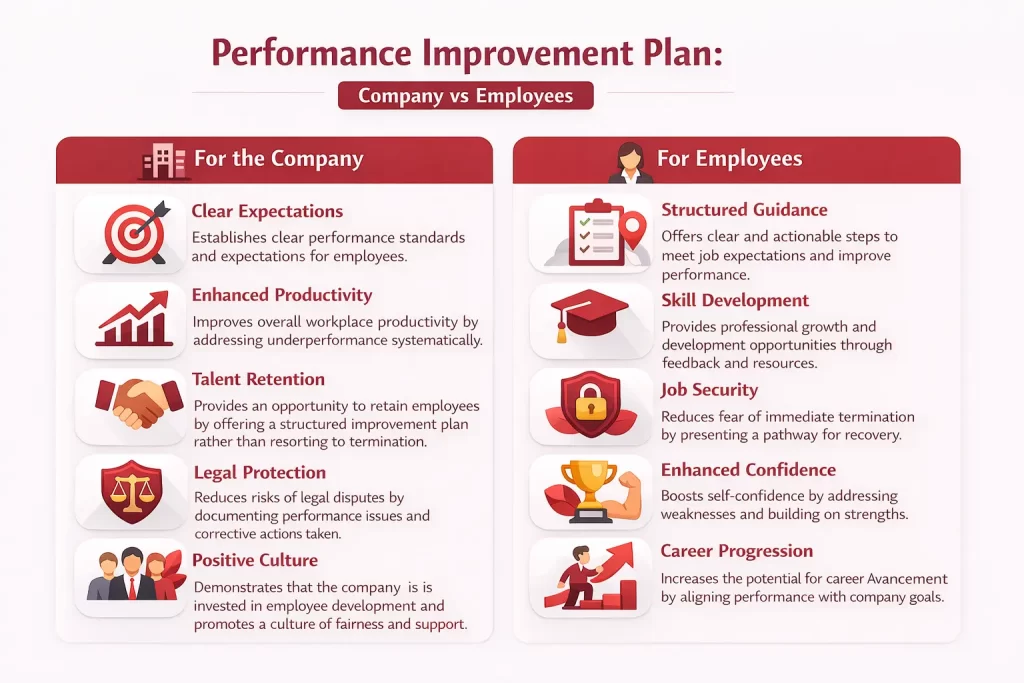
Implementing a Performance Improvement Plan (PIP) offers significant advantages for both the organization and its employees. By fostering accountability and providing structured pathways for improvement, PIPs serve as a valuable tool to enhance workplace efficiency and morale. Below are the key benefits for companies and employees:
Weaknesses Performance Improvement Plan
While Performance Improvement Plans (PIPs) are designed to help employees enhance their performance, they are not without their challenges and limitations. Understanding these weaknesses can help businesses address potential pitfalls and ensure a more effective approach. Narito ang ilan sa mga karaniwang kahinaan ng PIPs.
- Lack of clear objectives and goals: A common weakness of PIPs is when they lack well-defined objectives and measurable goals. Without clear expectations, employees may struggle to understand what is required of them, reducing the plan’s effectiveness.
- Insufficient resources and support: PIPs often fail when employees do not receive adequate resources, training, or support. Without access to necessary tools, guidance, or development opportunities, employees may be unable to meet the required performance standards.
- Poor communication and feedback: Ineffective communication and lack of consistent feedback can lead to confusion and misunderstandings. Employees need regular, clear feedback to understand their progress and identify areas for improvement.
- Failure to address root causes: Some PIPs focus too much on surface-level issues instead of addressing the root causes of underperformance. Without tackling these underlying problems, improvements may be temporary and not sustainable.
Examples of Items Evaluated in the Performance Improvement Plan

In a Performance Improvement Plan (PIP), various aspects of performance are typically assessed to ensure that employees meet the expected standards. Some common areas evaluated in a PIP include:
1. Productivity
Productivity is often a key focus in a PIP. This evaluation looks at how much work an employee completes within a set timeframe. If the employee falls short of the expected targets, the improvement plan guides to help them enhance their work output.
2. Quality of work
In addition to quantity, the quality of work is another aspect that is evaluated. This includes accuracy, attention to detail, and alignment with the company’s established standards. Improving performance in terms of quality may involve retraining or skill enhancement initiatives.
3. Compliance with deadlines
Time management is a crucial aspect of the workplace. A PIP typically assesses whether employees can complete their tasks within the assigned deadlines. If deadlines are frequently missed, improving time management becomes a key focus of the PIP.
4. Teamwork
The ability to collaborate effectively with the team is also evaluated. This includes assessing whether the employee communicates well and contributes positively to the team. If there are issues with communication or teamwork, the PIP will outline specific steps to address and improve these areas.
How is PIP Implemented in Your Company?
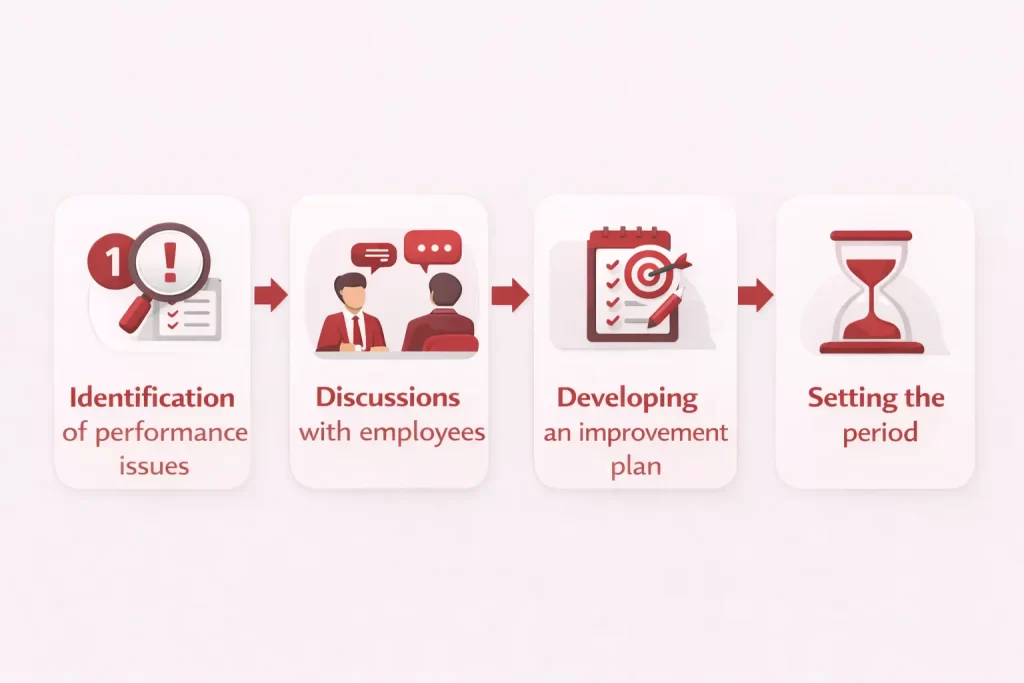
To successfully implement a Performance Improvement Plan, companies must ensure that the process is well-structured and transparent. Here are the steps for implementing an effective PIP:
1. Identification of performance issues
The initial step is to identify specific areas where the employee needs to improve their performance. These areas can be determined through regular performance reviews, direct observations, or feedback provided by their immediate manager. Clearly defining these improvement areas sets the foundation for a focused and effective plan.
2. Discussions with employees
Once the issues have been identified, the manager should hold a meeting with the employee to discuss the areas of concern. This discussion should be constructive, provide feedback, and set clear expectations for improvement.
3. Developing an improvement plan
The improvement plan should be specific and focused on the areas that require attention. It should include clear goals, actionable steps to be taken, and the resources that will be made available to support the employee in achieving these objectives.
4. Setting the period
Timelines are crucial in a PIP. Companies should allow a reasonable period, typically between 30 to 90 days, for employees to make improvements. Progress should be monitored regularly throughout this timeframe.
Free PIP Template
This straightforward performance review template evaluates key areas like job performance and goal achievement. It is ideal for companies seeking a quick and effective way to assess employees without overcomplicating the process.
The Right Time to Implement a Performance Improvement Plan

Setting the right timing for implementing a Performance Improvement Plan (PIP) is a crucial step in managing employee performance. The following situations are indicators that a PIP may be necessary:
1. Consistently substandard performance
If an employee consistently fails to meet performance expectations, a PIP can be implemented to help them address their areas of weakness. The PIP will provide guidance and support to help the employee get back on track.
2. Follow-up after performance evaluation
After regular performance evaluations are conducted, managers may find that some employees need improvement on the job. This is the right time to develop an improvement plan so that employees know the steps to take to improve performance.
3. Discipline or work ethic issues
PIPs can also be applied when there are discipline or attitude issues in the workplace. A PIP can be applied to improve the behaviours of an employee with inadequate behaviours, like frequently arriving late, not working well in a team, or exhibiting behaviours that are not in line with company values.
4. New employees who have difficulty adapting
For new employees who face challenges in adapting to the company’s culture and expectations, PIP can help them adjust faster. It also provides an opportunity for new employees to understand their roles and responsibilities better.
PIP Implementation Case Studies in Different Work Fields

Performance Improvement Plan (PIP) can be applied across hundreds of industries. The features and framework can be used in all sorts of different fields, but its focus and metrics vary depending on the nature of the job. The following case examples illustrate how PIPs are implemented in different work environments:
1. Sales underperformance
Sales is a very competitive environment; performance is measured by targets, conversion rates, and the step-by-step process of making a potential buyer into an actual buyer. A PIP is very appropriate as the feedback given can help them see how they can improve their selling technique. The plan may include weekly activity benchmarks and coaching sessions to ensure measurable progress.
2. Manufacturing operational errors
Consistency and speed are the two qualities that are crucial to manufacturing. Manufacturing workers are judged based on their accuracy, efficiency, and compliance with standard operating procedures. A PIP can turn an employee that kept making defects or fails to follow safety guidelines into a good guidelines-obeying and robot-like efficient worker by making them go through retraining, do checklist adherence, and be inspected with quality control checkpoints.
3. Customer service quality issues
In customer service roles, performance is tied to response time, resolution rates, and customer satisfaction scores. An employee that frequently receives complaints or escalations can be corrected by a PIP through outlining clear service standards and communication expectations. Regular monitoring and feedback sessions help the employee improve service delivery and rebuild trust with customers.
4. Administrative reporting delays
Missed deadlines and documentation errors are the bane of any company who want’s to finish any business processes in the proper time. A PIP can fix those administrative shortcomings by setting clear timelines, defining review checkpoints, and introducing workflow tracking tools. This set clear expectations and held the employees accountable, which would improve accuracy and time management.
Conclusion
A Performance Improvement Plan (PIP) is a very useful tool to help employees who are having difficulty in achieving their expected performance.
With proper implementation, PIP performance improvement plans help improve employee performance, prevent unnecessary turnover, strengthen communication, and increase employee productivity. This not only benefits the employees but also the company as a well-trained well trained workers will align better with their organizational goals.
A PIP can be as simple or complex as the company designed it. What kinds of standards, expectations, and methods are utilised can differ from one company and work field. For that reason, using management tools is advisable as it makes the process of planning and executing a PIP much easier and more efficient.
FAQ Performance Improvement Plan
-
How does a PIP benefit employees?
A PIP provides clear guidance and resources to support employees in improving their performance. It also offers an opportunity to realign with company goals and expectations, enhancing their professional growth.
-
How long does a PIP usually last?
The duration of a PIP varies depending on the performance issues and organizational policies. Typically, it ranges from 30 to 90 days.
-
How can organizations implement PIPs effectively?
Organizations should ensure PIPs are fair, transparent, and focused on supporting improvement. Regular communication, clear expectations, and a collaborative approach are essential to success.