







Managing employee time off goes beyond simply tracking days and is about creating a well-balanced workplace that promotes both productivity and employee well-being. Leave balance refers to the amount of time off an employee has left, including vacation days, sick leave, or other forms of time away from work.
Without the right tools and systems, managing leave can become complicated, leading to scheduling conflicts, compliance issues, and employee dissatisfaction.
In this article, we’ll explain what leave balance is, address common challenges, and offer practical solutions to make the process easier.
Table of Contents
Key Takeaways
|
What is Leave Balance?
Leave balance refers to the remaining time off an employee has from their approved annual leave allocation, covering various types such as vacation days, sick leave, personal days, and compensatory time. It provides a clear picture of how much leave has been used and how much is still available helping both employers and employees stay informed throughout the year. Tracking this accurately is an essential part of broader attendance management, ensuring that operations run smoothly while employees receive the time off they are entitled to.
Types of Leaves in the Company
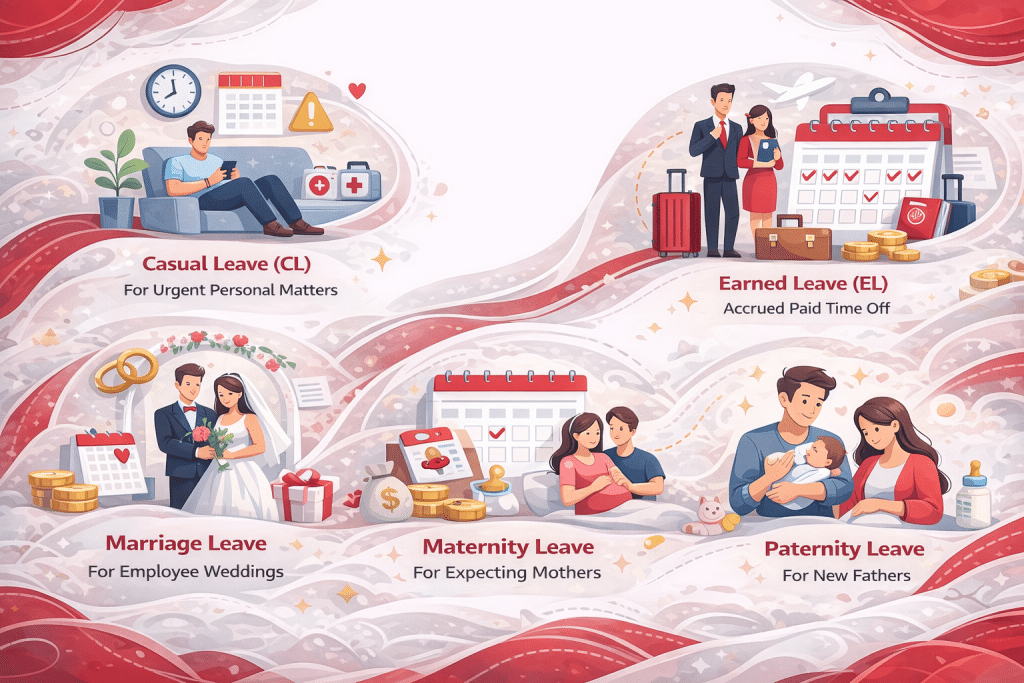
Understanding the different types of leave helps organizations create fair, consistent policies that address a wide range of employee needs.
1. Casual Leave (CL)
Casual leave is granted for short, unforeseen events or urgent personal matters that require immediate attention such as personal emergencies and does not fall under medical or planned leave categories. It is typically limited to a set number of days per year and can often be taken without prior approval, depending on company policy.
2. Earned Leave (EL)
Earned leave is paid time off that employees accumulate based on the number of days worked, usually at a fixed rate such as one day per month. Unlike casual leave, it is generally planned in advance and may be carried over to the following year or cashed out if unused, depending on company policy. This type of leave supports a healthy work-life balance while recognizing employee dedication and tenure.
3. Marriage Leave
Marriage leave is a special entitlement granted to employees who are getting married, allowing them to prepare for and celebrate the occasion without drawing from their regular leave allocation. The duration varies by company policy but typically ranges from a few days to one week.
4. Maternity Leave
Maternity leave is provided to female employees expecting a child, giving them time to recover from childbirth, care for their newborn, and manage their health and well-being. The duration depends on company policy and local labor regulations, but it generally spans from several weeks to a few months.
5. Paternity Leave
Paternity leave is granted to male employees to support their partner during childbirth and bond with their newborn during the early days of the child’s life. It is typically shorter than maternity leave but serves an equally important role in recognizing both parents’ involvement in family well-being.
Important Terms Related to Leave Balance

Familiarity with key leave management terms helps both HR teams and employees understand how leave balances are tracked and calculated:
- Carry over: Earned leaves that remain unused at the end of a cycle can be carried forward to the next period or encashed before they expire.
- Leave usage: The number of leave days an employee has consumed within a specific period, used to determine the remaining available balance.
- Opening balance: The leave balance reset at the start of a defined period, such as monthly, semi-annually, or annually giving employees a fresh allocation.
- Accrual rate: The rate at which leave is accumulated based on factors like tenure, hours worked, and the pay cycle.
- Leave encashment: The option for employees to convert unused earned leave into monetary compensation rather than carrying it forward to the next year.
A clear grasp of these terms is particularly important when implementing or auditing a Human Capital Management (HCM) system, as accurate leave data feeds directly into payroll and workforce planning decisions.
Common Leave Balance Mistakes to Avoid
Even with clear policies in place, organizations often run into recurring issues that disrupt leave management and create frustration for both HR teams and employees. One of the most common mistakes is failing to update leave balances in real time after an approval is processed, which leads to discrepancies between what employees see and what HR has on record. Outdated or mismatched data can quickly escalate into disputes, especially when employees plan time off based on incorrect balances.
Another frequent error is miscalculating carryover entitlements either by carrying over more days than the policy allows or by failing to notify employees before unused leave expires. This often happens when carryover rules are not clearly defined or are applied inconsistently across departments. Similarly, organizations sometimes overlook the importance of communicating leave policies to employees in plain, accessible language, leaving staff uncertain about how their balances are calculated, when they reset, and what options they have for encashment.
Avoiding these mistakes requires a combination of well-documented policies, regular audits, and reliable tracking systems. Understanding how HRIS tools support leave administration can help HR teams identify gaps in their current process and put more consistent, error-free practices in place.
Conclusion
Managing leave balance effectively is essential for maintaining a productive, fair, and compliant workplace. By understanding the different leave types, monitoring usage accurately, and applying consistent policies, organizations can support employee well-being while keeping operations on track. Errors in manual leave tracking such as miscalculated balances or delayed approvals, can quickly lead to disputes and operational disruptions, which is why many businesses turn to dedicated HRIS systems to automate and centralize their leave management processes. For organizations evaluating their options, reviewing the best HR software available in the Philippines can be a useful starting point for finding a solution that fits their workforce size and policy requirements.
FAQ Leave Balance
-
What is the difference between leave accrued and balance?
These are explained below. Accrued annual leave is accumulated during the year. Every pay your accrued balance will increase to reach, typically, 20 days / four weeks at the end of 12 months. Your Accrued balance will always show your current year’s accrual.
-
What is negative leave balance?
Negative leave occurs when an employee takes more leave than they have accrued, resulting in a negative leave balance. For this to occur, employees must be paid for this period of leave. This means that the employee has effectively borrowed leave from their future accruals.
-
What is the outstanding leave balance?
The term leave balance refers to the amount of unused time off a particular employee has left in their sanctioned annual leave quota. As it’s often referred to, the ratio is typically calculated by subtracting hours taken off from hours available or the days taken off from the days available.
-
How is leave balance calculated?
Leave balance is calculated by taking an employee’s total leave entitlement for the period, adding any carried-over days from the previous cycle, and subtracting the number of leave days already used. For example, if an employee is entitled to 15 days annually, carries over 3 days, and has used 5 days, their remaining leave balance would be 13 days. The exact calculation may vary depending on the company’s accrual rate, pay cycle, and carryover policy.