






Managing project timelines can feel overwhelming when unexpected delays and shifting priorities affect daily progress. Many construction teams struggle to coordinate tasks efficiently across contractors and workflows. Understanding the Critical Path Method helps you bring structure to complex timelines.
According to PMI’s 2020 Pulse of the Profession report, poor project scheduling contributes to 11.4% of project investment loss globally, highlighting how crucial accurate planning has become. The Critical Path Method supports teams in identifying essential tasks early. With better visibility, delays become easier to predict and control.
For construction companies aiming to enhance planning accuracy, the HashMicro Construction Suite offers tools that streamline scheduling and resource coordination. Its automation helps reduce manual errors and improve project flow. Explore the free demo to see how these features support smarter project execution and continue reading below.
Table of Contents

Key Takeaways
|
What Is the Critical Path Method (CPM)?
The Critical Path Method (CPM) helps managers plan projects by identifying the most crucial sequence of tasks. As a result, teams use resources more efficiently and avoid delays. Consequently, adopting CPM ensures better project outcomes and on-time delivery.
Beyond scheduling, CPM is a strategic tool for decision-making. It lets managers find the earliest and latest start and finish times for tasks. The gap is float or slack. Because tasks on the critical path have zero float, any delay affects the whole project. Now, let’s explore its main parts.
1. Key components of the critical path method
To begin, CPM uses a full task list from the Work Breakdown Structure (WBS). Then, each task gets a duration and its dependencies are mapped. Finally, milestones mark project phases. Thus, all tasks are connected, improving project planning.
2. Key terms you must know
To grasp CPM, first know key terms. While float is the allowed delay, critical tasks have zero float. Furthermore, a forward pass sets early dates and a backward pass sets late dates. Finally, crashing and fast tracking can speed up project completion.
3. Differences between CPM and other methods (PERT and Gantt Chart)
CPM uses fixed time estimates, so it’s great for familiar projects. Meanwhile, PERT (Program Evaluation and Review Technique) handles uncertainty with three estimates. On the other hand, Gantt charts just show schedules visually, while CPM diagrams reveal dependencies and the critical path.
Why Is the Critical Path Method Important for Your Business?

Adopting the Critical Path Method boosts efficiency and profits. Moreover, it gives leaders real project insights, turning chaos into clear, focused schedules. As a result, teams spend less time and resources on tasks that can wait.
The Critical Path Method is not only a scheduling tool, but also unites teams with one project language. When everyone knows which tasks are critical, urgency and teamwork increase. Thus, a company builds its reputation for on-time, high-value project delivery.
1. Improving planning and scheduling accuracy
Critical Path Method (CPM) helps managers identify and track key project tasks, so teams use resources wisely and avoid delays. As a result, CPM transforms complex projects into clear schedules. Ultimately, this method ensures on-time and efficient delivery.
2. Optimizing resource allocation
The Critical Path Method distinguishes between key and flexible tasks, guiding smart use of labor, equipment, and budgets. Therefore, managers can focus top resources on urgent tasks or shift resources to critical tasks as needed, boosting efficiency while avoiding extra costs.
3. Proactive risk mitigation and management
By finding the critical path, teams spot risk areas early. As a result, issues like labor shortages or delays can be addressed before they grow. With this foresight, CPM supports fast decisions and strong planning, making it vital for effective construction site management.
4. Enhancing team visibility and communication
The network diagram from the Critical Path Method is a powerful visual tool, helping all stakeholders see how each task leads to the final goal. Thus, it builds team accountability and sparks clear discussions about potential project roadblocks.
A 6-Step Guide to Finding the Critical Path in Your Project
Finding the critical path may seem tricky, yet breaking it into logical steps makes it manageable. By mapping each task and seeing how they connect, you reveal the longest sequence. This practical approach deepens your understanding of complex project schedules and helps you refine your workflow over time.
While software now automates these calculations, knowing the manual process is essential for building strong project intuition. This means you can confidently interpret software results, understand the reasons behind scheduling, and make far better decisions when surprises arise during a project. Next, let’s review the six main steps.
1. Step 1: Identify all activities (Work Breakdown Structure)
First, list every project task with the Work Breakdown Structure (WBS) to organize work from start to finish. Get input from all team members and stakeholders, so nothing is missed. Each activity must have clear start and end points for accuracy.
2. Step 2: Determine dependencies between activities
Next, map dependencies to set the right order for tasks. Identify which need to finish before others begin (a finish-to-start dependency), which run parallel, and any unique relationships. As a result, understanding dependencies ensures your network diagram and critical path are accurate.
3. Step 3: Create a network diagram
hen, create a network diagram by arranging all tasks as boxes and drawing arrows for their dependencies. This visual map clearly lays out the workflow from start to finish, highlights parallel paths, and provides the foundation for calculating early and late start and finish times for all activities.
4. Step 4: Estimate the duration of each activity
Afterwards, estimate how long each task will take using data from similar past work, team expertise, or industry benchmarks. Accurate durations prevent underestimating or overestimating time needs, which is crucial for a reliable project schedule and critical path calculations.
5. Step 5: Calculate the forward pass and backward pass
Now, calculate the earliest and latest dates for each task. Start with a forward pass, working from the beginning to set Earliest Start (ES) and finishes, then a backward pass starting from the last task, calculating the Latest Finish (LF) and Latest Start (LS). This reveals time constraints and scheduling options for every project activity.
6. Step 6: Identify the critical path and float
Finally, determine the critical path by finding tasks with zero float, the ones that can’t be delayed. Calculate float by comparing earliest and latest times, then track these tasks closely. Any delay here affects the whole project, so monitor them to keep everything on schedule.
Case Study: An Example of Critical Path Method Application
To see the Critical Path Method in action, let’s look at building a small warehouse. The project team identified eight main tasks, each with set durations and dependencies, like site prep before foundation or wiring after installing walls.
The mapped activities include: Site Preparation (3 days), Foundation (5 days), Steel Frame (7 days), Walls (4 days), Roof (3 days), Electrical & Plumbing (6 days), Painting (4 days), and Final Inspection (1 day).
After charting these in a network diagram, the team runs forward and backward pass calculations. As a result, they find two main paths. The longest—A-B-C-D-F-G-H—totals 30 days and is the critical path, so each task here must stay on schedule to avoid delays.
Meanwhile, Roof Installation (E) appears on a shorter path. Since its duration is less, it has 1 day of float and can be delayed without shifting the project deadline. Identifying these paths lets the team focus their attention and resources where they’re needed most.
Overcoming CPM Challenges with Project Management Software

While the Critical Path Method helps manage projects, manually tracking tasks and changes in large projects invites errors and delays. Therefore, teams may struggle to update schedules accurately, and as a result, fully using the Critical Path Method becomes difficult.
Technology makes the Critical Path Method more efficient. With project management software and ERP, teams automate work, get real-time updates, and boost collaboration. As a result, companies apply CPM easily and improve project success.
1. Automation of calculation and visualization
The main advantage of project management software is that it calculates the Critical Path Method, float, and start/finish dates instantly. Thus, with a task list and dependencies added, teams view live schedules and make quick, informed project decisions as changes occur.
2. Integrated resource management
Modern software pairs scheduling with resource management for the Critical Path Method. As a result, it helps managers assign people or equipment, spot conflicts early, and stay realistic about resources. According to a Harvard Business Review article, this integration makes the schedule logical and realistic for resources, preventing delays.
3. Real-time progress tracking
To excel in project management, use the Critical Path Method to map essential tasks. Thus, you clearly set priorities and timelines. As a result, teams avoid delays and allocate resources wisely, ensuring projects stay efficient and on track.
4. Easier team collaboration
A software platform gives the whole team a single, up-to-date schedule. As a result, miscommunication drops since everyone relies on the same data. Collaboration tools, like comments and notifications, keep team members aligned, especially on critical path tasks.
Optimize Your Project Management with Solutions from HashMicro
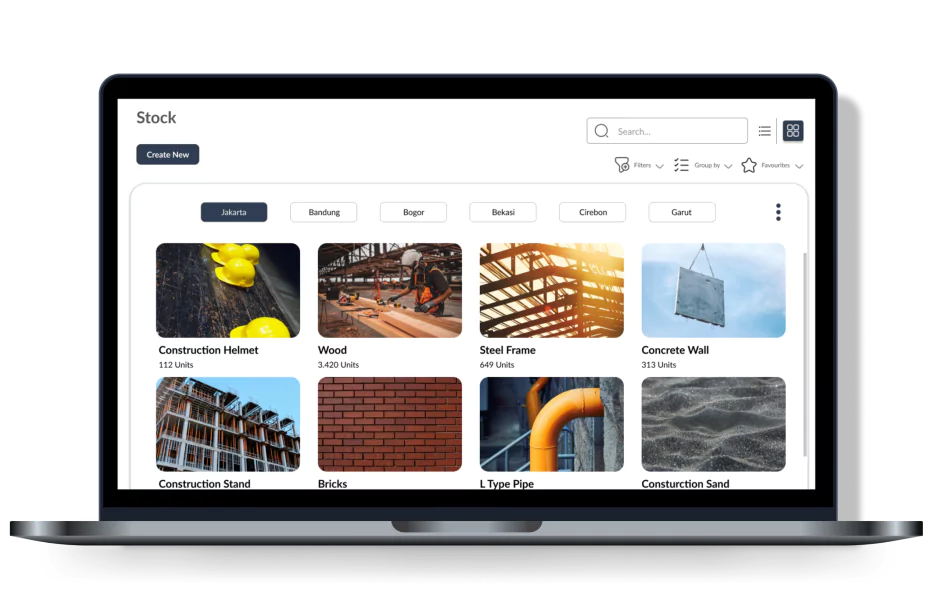
HashMicro offers an integrated ERP system to simplify complex processes like project management. As a result, companies avoid issues such as scheduling errors or lack of real-time data. This leads to smoother workflows and greater efficiency overall.
With the advanced HashMicro Construction Suite, businesses speed up tasks, reduce errors, and access real-time data. Moreover, features like automated approvals and accounting integration ensure milestones are tracked, so managers make informed, timely decisions.
HashMicro’s fully integrated system connects departments like accounting and project management. Consequently, data flows seamlessly, improving visibility and accuracy. Thus, every decision is based on up-to-date info, giving your business a competitive edge.
Features of HashMicro Construction Suite:
- Budget S-Curve Management: Allows for efficient monitoring and management of project budgets with clear S-curve visualizations, helping to identify budget deviations early.
- S-Curve Plan vs. Actual Project Progress: Compares planned project progress against actual achievements in real-time using S-curve visuals, ensuring projects stay on their target timeline.
- In-Depth Job Estimates (RAB): Facilitates the creation of detailed and accurate budget plans (RAB), contracts, and cost sheets (RAP) for comprehensive financial control.
- Real-Time Project Dashboard: Provides a visual and data-rich dashboard for real-time insights, helping managers make faster and more accurate decisions regarding project execution.
- Integration with Accounting & Inventory: Connects directly with accounting and inventory systems to ensure financial data and material stock levels are always synchronized without manual input.
With HashMicro, your company can significantly improve operational efficiency, data transparency, and business process automation. To see how our solutions can concretely help your business, do not hesitate to try the free demo now.
Conclusion
Mastering project timelines requires a clear understanding of how tasks connect, overlap, and influence overall progress. The Critical Path Method provides structure for planning, resource coordination, and delay prevention. With this approach, teams can deliver projects with greater accuracy and control.
For construction teams seeking stronger scheduling support, the HashMicro Construction Suite offers tools designed to simplify planning and execution. Its automation, integrated modules, and real-time insights help reduce errors and improve coordination. These features support smoother workflows across every project phase.
If you want to strengthen project planning and take control of your construction timelines, explore how HashMicro can streamline your operations. Book a free demo to experience the full capabilities of the Construction Suite and discover how it can enhance scheduling efficiency for your team.

FAQ about Critical Path Method
-
What is the main difference between Critical Path and Critical Chain?
Critical Path Method (CPM) focuses solely on task dependencies and duration, assuming unlimited resources. In contrast, Critical Chain Project Management (CCPM) accounts for resource limitations and adds time buffers to the end of the critical chain to protect the schedule from uncertainty.
-
Can a project have more than one critical path?
Yes, a project can have multiple critical paths if there are two or more paths with the same longest duration. This increases project risk, as a delay on any of these paths will delay the entire project.
-
What should be done if a task on the critical path is delayed?
If a critical task is delayed, the project manager must take corrective action, such as crashing (adding more resources to speed up the task) or fast-tracking (rearranging tasks to be done in parallel).
-
How does resource availability affect the critical path?
In traditional CPM, resources are not considered initially. However, resource leveling, the process of adjusting the schedule based on resource availability, can potentially change or extend the originally identified critical path.
-
Is the Critical Path Method suitable for all types of projects?
CPM is most effective for projects with well-defined and repeatable tasks, like in construction or manufacturing. It is less suitable for highly creative or research-based projects where tasks and durations are uncertain; for those, agile methodologies are often better.