


Rising input costs, unpredictable weather, and increasing market pressure are making farm management in the Philippines more challenging than ever. Many farmers are expected to produce more food while dealing with limited resources, unstable prices, and climate-related risks such as typhoons and droughts. Traditional farming by itself may not be enough in today’s changing market.
Instead of applying water, fertilizer, or pesticides evenly across the field, farmers can now use GPS, sensors, drones, and real-time data to manage crops more accurately with precision agriculture. With better visibility into soil conditions, crop health, and weather patterns, farmers are able to reduce waste, control costs, and respond faster to problems before they escalate.
As food demand continues to rise, using data in farming is no longer just an option, it’s becoming a necessity. Understanding how precision agriculture works, what tools are involved, and how it fits into local farming conditions can help agribusinesses make smarter long-term decisions.
Key Takeaways
|
Understanding Precision Agriculture
Precision agriculture, also known as precision farming, is a smarter way to manage farmland using real field data. Using modern technology and digital tools, farmers make more accurate decisions about how much water, fertilizer, or pesticides to use by collecting and analysing data from the field. That way, it allows farmers to treat different areas based on their specific needs.
Some parts of a farm may need more nutrients, while others need less. With soil data, crop health insights, and moisture monitoring, farmers can adjust their actions based on actual conditions and not by just assumptions. This cuts waste, boosts efficiency and helps farms become more productive and sustainable. These principles form the foundation of modern smart farming practices.
Why Precision Agriculture Matters for Agribusiness Growth

Precision agriculture is no longer just a competitive advantage, it’s becoming a core strategy for modern farms. Farmers are facing rising production costs, stronger environmental requirements, and increasingly unpredictable weather patterns. Because of these pressures, adopting precision agriculture is essential to improve farm performance and maintain long-term stability, especially in the Philippines, where typhoons and dry spells directly affect harvest cycles.
1. Improved Operational Efficiency
Precision agriculture improves efficiency by using inputs more accurately. Through technologies such as variable rate technology (VRT), and field monitoring systems, farmers apply water, fertilizers, and pesticides only where needed. This reduces resource waste, lowers production costs, and increases overall productivity.
2. Environmental Sustainability
Sustainability is a key focus in modern agribusiness. Precision agriculture supports environmental management by reducing chemical use and minimising soil and water contamination. These practices meet environmental regulations and support responsible business practices.
3. Data-Driven Farm Management
Precision agriculture supports data-based decision-making by using tools such as sensors, GPS systems, drones, and farm management software. Real-time data helps managers track crop performance and identify risks early, leading to better planning and improved control of farm operations.
4. Increased Profitability and Return on Investment (ROI)
By optimizing input use and boosting crop production, precision agriculture leads to higher profits. Although initial technology adoption may require initial investment, the long-term return on investment supports sustainable agribusiness growth and financial stability. For agribusinesses that sell directly to consumers, distributors, or operate farm retail stores, having a system to track sales and inventory in real time is just as important as improving field productivity.
Key Technologies Behind Precision Agriculture
1. Global Positioning System (GPS) and GNSS
GPS and other Global Navigation Satellite Systems (GNSS) are fundamental to precision agriculture. They provide accurate location data for mapping fields and guiding farm machinery. As a result, auto-steering systems reduce overlap, save fuel, lower labor fatigue, and ensure inputs are applied in the correct location, improving overall farm efficiency.
2. Geographic Information System (GIS)
While GPS provides location data, Geographic Information System (GIS) software provides analysis and meaning. GIS creates and manages layered digital maps that combine information about soil, land shape, crop production and health. As a result, farm managers can identify patterns and divide fields into specific management zones for better decision-making.
3. Sensors and Internet of Things (IoT)
The Internet of Things (IoT) connects smart sensors placed in fields to collect real-time data on soil moisture, temperature, nutrients, and crop health. This helps farmers adjust watering and input use more accurately, improving efficiency and crop management.
4. Remote Sensing (Drones and Satellites)
Remote sensing technologies, including drones and satellites, provide aerial images for large-scale field monitoring. These tools help detect early signs of crop stress, pest issues, and nutrient deficiencies. Drones give detailed images of fields, while satellites monitor large areas over time.
5. Variable Rate Technology (VRT) and Artificial Intelligence (AI)
Variable Rate Technology (VRT) and Artificial Intelligence (AI) work together to turn data into action. VRT allows machines to adjust seed, fertilizer, and water use in different parts of the field, while AI studies farm data to predict crop results and improve decisions. Together, they improve precision, productivity, and profitability.
Stages of Implementing Precision Agriculture
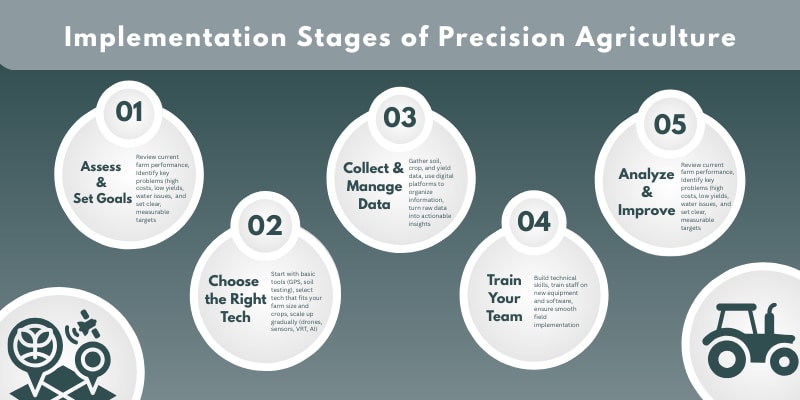
Adopting precision agriculture is a step-by-step process that requires careful planning and step-by-step implementation. A phased approach helps reduce risk, improve adoption, and ensure measurable results. The following five stages provide a clear roadmap for successful implementation.
1. Stage 1: Assessment and Goal Setting
The first step is to evaluate your current farm operations. Identify major challenges such as high farming costs, low crop yields, or poor irrigation systems. After identifying these issues, set clear and measurable goals, such as reducing fertilizer use or increasing crop production in specific field zones.
2. Stage 2: Technology Selection
Once goals are defined, select technologies that match your farm size, crops, and budget. Many farms begin with basic tools such as GPS guidance systems and soil testing. As confidence and experience grow, more advanced technologies such as drones, sensors, or Variable Rate Technology (VRT) can be introduced.
3. Stage 3: Data Collection and Management
Precision agriculture depends on accurate data. In this stage, farms collect information on soil conditions, crop performance, and yield results. It is important to store and organize this data using a digital farm management system so it can be easily analyzed and used for decision-making.
4. Stage 4: Training and Implementation
Technology is only effective when properly used, so farm managers and workers need training to operate equipment, understand digital maps, and interpret data. With proper guidance, the team can confidently apply precision farming practices in daily operations.
5. Stage 5: Evaluation and Continuous Improvement
Precision agriculture is an ongoing process and after each season, results should be reviewed to track goal progress. Based on the results, farms can adjust input use, improve management zones, and refine their strategies to boost efficiency and profitability over time.
Challenges of Adopting Precision Agriculture and Practical Solutions
Although precision agriculture offers many benefits, adopting this data-driven farming approach can come with challenges. Many farms, especially MSMEs in the Philippines, face real barriers such as high technology costs, limited technical skills, system integration issues, and weak rural connectivity. Understanding these challenges early can help businesses to plan better, reduce risks, and ensure a smoother transition to precision agriculture.
1. High Initial Costs
One of the biggest challenges is the upfront cost of technology, including GPS systems, sensors, drones, and farm software. For many farms in the Philippines, especially small and medium-sized operations, this can feel like a major financial commitment.
To manage this, farms can start with basic and affordable tools, such as GPS guidance or soil testing, before expanding gradually. Running a simple return on investment (ROI) check can also help determine if the savings on fertilizer, water, or fuel can cover the cost over time. Some agribusinesses also explore support programs from the Department of Agriculture (DA) or consider equipment leasing to reduce the financial burden.
2. Lack of Technical Skills
Precision agriculture requires knowledge of digital tools and data analysis. Many farms may face a skills gap when adopting new technologies. This challenge can be addressed by providing staff training, hiring skilled professionals, or working with agricultural technology consultants for support.
3. Data Integration Issues
Different technologies and software systems may not always work well together. This can lead to scattered data that is difficult to analyze. To overcome this issue, agribusinesses should select compatible technologies and use one platform to manage all data in one place for better decisions.
4. Limited Internet Connectivity
Many farms in rural areas of the Philippines still face unstable internet connections. This can affect cloud-based platforms and real-time monitoring tools. Solutions include using devices that store data offline and upload it later, or investing in satellite internet services to improve connectivity.
What’s Next for Precision Agriculture?
1. Automation and Autonomous Robotics
Precision agriculture is developing quickly with more automation and self-operating machines. Technologies like self-driving tractors, robotic harvesters, and automated irrigation systems reduce the need for manual labor and improve accuracy in farm operations. These innovations help farms work more efficiently and manage crops more effectively. For larger plantations and export-focused farms in the Philippines, automation can also improve consistency and reduce operational delays during peak seasons.
2. Blockchain for Supply Chain Transparency
Blockchain technology is expected to increase transparency in the agricultural supply chain. By safely recording information from farm to market, it improves product tracking and food safety while building consumer trust.
3. Advanced Predictive Analytics
As more farm data becomes available, AI-powered predictive tools are becoming more important in farming. They help farmers predict crop yields, spot possible pest problems, understand market trends, and choose the best time to plant or harvest. With these insights, agribusiness managers can make smarter decisions early and avoid costly mistakes.
Conclusion
Precision agriculture is transforming how modern agriculture is managed by using technology and data to make better decisions. Through tools such as GPS, sensors, drones, and AI, farmers can apply inputs more accurately and manage fields more efficiently. This leads to higher productivity while reducing waste and environmental impact.
Although adopting precision agriculture requires investment and learning new skills, the long-term benefits are clear. For farms in the Philippines, where rising production costs and climate risks like typhoons and droughts directly affect harvest cycles, a data-driven approach offers more control and stability. With proper planning, training, and step-by-step implementation, businesses and farms can successfully move toward data-driven farm management.
Looking ahead, technologies such as automation, blockchain, and AI-based predictions will continue to shape the agricultural industry. These innovations will strengthen transparency, improve risk management, and enhance operational performance. As food demand continues to rise, precision agriculture will become increasingly important for building a strong and sustainable agribusiness sector.
Precision Agriculture FAQs
-
What is precision agriculture?
Precision agriculture is a data-driven farming approach that uses technology to manage crops and resources more accurately. It helps farmers apply the right amount of water, fertilizer, and pesticides in the right place and at the right time. This improves farm management efficiency, crop yields, and sustainability.
-
What technologies are used in precision agriculture?
Precision agriculture uses technologies such as GPS, GIS mapping, soil sensors, drones, Variable Rate Technology (VRT), and artificial intelligence (AI). These tools collect and analyze field data to support better decision-making. Together, they improve accuracy, productivity, and resource management.
-
Is precision agriculture expensive to implement?
The initial investment in precision agriculture technology can be high. However, many farms start with basic tools and expand gradually over time. Increased efficiency and improved yields often lead to a strong return on investment (ROI).
-
What is the difference between smart farming and precision agriculture?
Smart farming is a broad term that refers to using digital technology, automation, and data to improve overall farm operations. Precision agriculture is a part of smart farming that focuses specifically on using field data to manage crops and inputs more accurately. In simple terms, precision agriculture is one important part of smart farming.