








In the highly competitive food and beverage industry, a restaurant often hinges on what happens before the ingredients even reach the kitchen. This critical backend process is known as restaurant procurement. It is the strategic engine that drives profitability, ensures consistency, and manages the volatile nature of food costs in an economy defined by fluctuating inflation rates.
However, true procurement is a comprehensive lifecycle that encompasses sourcing, negotiation, quality control, inventory management, and supplier relationship building. Without a structured approach to this cycle, restaurants face the risks of uncontrolled food waste, erratic profit margins, and supply chain disruptions that can paralyze operations during peak service hours.
Key Takeaways
Strategic sourcing reduces food costs by up to 15% through better supplier negotiation and demand forecasting.
Automated inventory tracking minimizes food waste and prevents overstocking of perishable ingredients.
Centralized purchasing data allows for real-time budget monitoring and prevents maverick spending.
Streamlined vendor management ensures consistent ingredient quality and compliance with safety standards.
What is Restaurant Procurement and Why Is It Important?

Restaurant procurement refers to process of acquiring the goods and services necessary, includes raw ingredients, beverages, cleaning supplies, kitchen equipment, and even service contracts like waste removal or linen cleaning. Procurement is strategic to help analyze consumption patterns, forecasting future needs, and establishing partnerships that offer long-term value rather than just the lowest immediate price.
The importance of a robust procurement strategy cannot be overstated in an industry with notoriously thin profit margins. Food costs typically consume 28% to 32% of a restaurant’s revenue. A slight inefficiency in sourcing or a failure to negotiate favorable terms can erode these margins significantly.
Furthermore, procurement is the first line of defense in quality assurance. The consistency of a signature dish depends entirely on the consistency of the raw materials used to create it. Effective procurement ensures that the restaurant maintains the delicate balance between high-quality offerings and operational cost-efficiency.
Step-to-Step of Restaurant Procurement Cycle
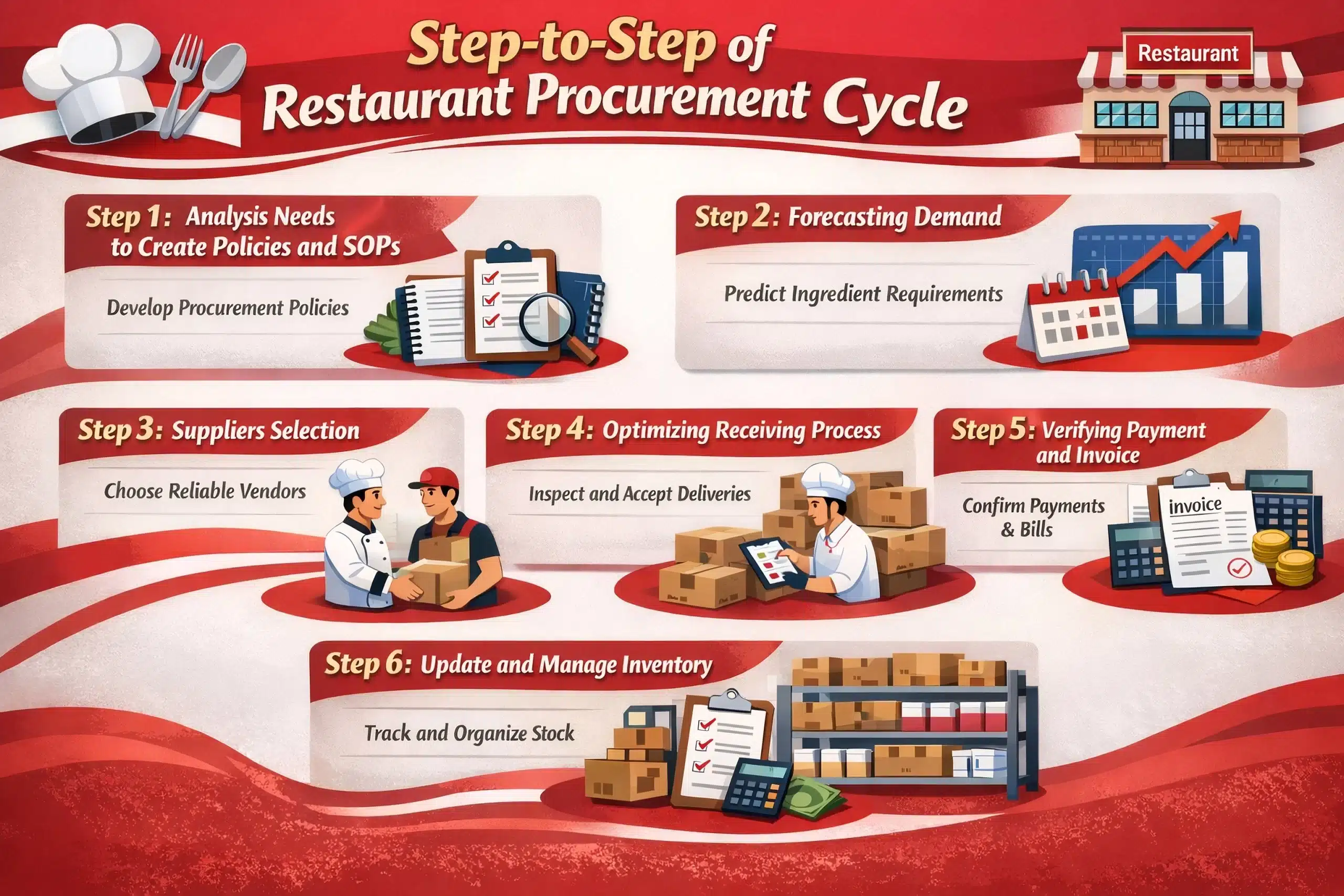
To move from reactive buying to proactive procurement, restaurant managers must understand the procurement cycle. This cycle is not linear but circular, with data from one phase informing the decisions of the next. Implementing a structured cycle reduces administrative chaos and creates a verifiable audit trail for every dollar spent.
Step 1: Analysis Needs to Create Policies and SOPs
The cycle begins with a internal audit, so, management can define restaurant needs and the rules governing how those needs are met. This involves creating Standard Operating Procedures (SOPs) that dictate who is authorized to place orders, what the spending limits are, and the specific quality standards for every menu.
Without these policies, “maverick spending” unauthorized purchases outside of agreed contracts resulting run rampant. By identifying high-margin and high-volume items, procurement teams can focus their negotiation on the ingredients.
Step 2: Forecasting Demand
Forecasting involves using historical sales data, upcoming reservation logs, and local event calendars to predict exactly how much of each ingredient will be needed for a specific period. This prevents the capital from being tied up in excess inventory sitting on shelves. It accounts for seasonality, weather patterns, and even holidays. By leveraging data, procurement managers can adjust par levels dynamically, ensuring freshness while minimizing waste.
Step 3: Suppliers Selection
A reliable supplier is an asset. When vetting potential vendors, price should not be the sole determinant. Factors such as delivery reliability, food safety certifications (HACCP, ISO), credit terms, and minimum order quantities (MOQ) play equally vital roles.
Restaurants often benefit from a mix of broadline distributors for staples and local specialists for fresh produce or proteins. Furthermore, for establishments that process their own raw materials, understanding the nuances of food manufacturing processes can help in selecting suppliers who adhere to compatible production standards.
Step 4: Optimizing Receiving Process
If the delivery does not match the purchase order (PO) in terms of quantity, weight, or quality, the restaurant pays for goods it cannot use. Optimizing this process requires a strict protocol, such as goods must be weighed, counted, and temperature-checked immediately upon arrival, never after the driver has left. Digital procurement systems can streamline this by allowing staff to check off items against a digital PO, instantly flagging discrepancies for credit notes.
Step 5: Verifying Payment and Invoice
The “Three-Way Match” involves verifying that the Purchase Order (what you asked for), the Receiving Note (what you got), and the Vendor Invoice (what you are being charged) all align perfectly. Discrepancies are common because suppliers may accidentally invoice for items that were out of stock or charge a higher price than the contracted rate.
It also ensures that payments are made on time for maintaining good credit terms with suppliers. Healthy cash flow management relies on accurate, timely invoicing that reflects the reality of the inventory received.
Step 6: Update and Manage Inventory
Procurement ends when the product is sold. A First-In, First-Out (FIFO) system ensures that older stock is used before new deliveries, reducing spoilage. Regular stock takes reveal variances between theoretical usage (what the POS says was sold) and actual usage (what is missing from the shelves). By closing the loop between procurement and inventory, managers can refine their future ordering, creating a leaner, more efficient operation.
Challenges in Restaurant Procurement and How to Overcome It
The culinary industry is currently facing significant operational hurdles. Here are some of the key challenges frequently encountered in resource management:
- Price Volatility
Challenges: Raw material costs can spike unexpectedly due to climate change, geopolitical instability, and fluctuating fuel prices.
Solution: Implement menu flexibility to allow for swapping expensive ingredients with seasonal alternatives. Additionally, lock in prices through futures contracts with suppliers to protect margins from sudden market shifts.
2. Supply Chain Transparency
Challenges: While consumers increasingly demand to know the origin of their food, restaurants often struggle to track ingredients back to their primary source.
Solution: Prioritize vendors with transparent tracking systems. Utilize digital tools to track lot numbers and origin data, ensuring both diner trust and strict safety compliance.
3. Communication Breakdowns
Challenges: Poor communication between the Back of House (BOH) teams and management can lead to critical errors in inventory procurement and ordering.
Solution: Establish regular meetings between the culinary team and the purchasing manager. Use integrated communication platforms to align procurement with culinary vision and operational reality.
Adapting Restaurant Procurement Strategy to Different Management Needs
Procurement is not a one-size-fits-all discipline. The strategy must be tailored to the specific business model of the establishment. For example, fine-dining restaurant, from niche artisans often requiring daily micro-orders and personal relationships with farmers.
Conversely, a Quick Service Restaurant (QSR) or a large chain prioritizes consistency and volume. Their procurement strategy relies on centralized purchasing, bulk contracts, and strict standardization to ensure that a burger tastes the same in every location. For these operations, utilizing top-tier restaurant management systems is non-negotiable, as manual spreadsheets cannot handle the complexity of multi-site logistics.
Fast-casual concepts sit somewhere in the middle, balancing the need for fresh, high-quality ingredients with the speed and volume of a chain. They often employ a hybrid model, using broadline distributors for dry goods and local partners for produce, requiring a flexible procurement system that can handle multiple vendor types simultaneously.
Comparison with Alternatives: Manual vs. Digital Procurement
Restaurant procurement has evolved significantly from traditional manual methods to modern digital solutions. In the past, many restaurants relied on pen-and-paper processes, manual inventory checks, and phone-based ordering systems. Today, digital procurement systems offer automation, real-time analytics, and better financial oversight, helping restaurants improve efficiency and profitability.
The comparison below highlights the key differences between manual and digital restaurant procurement systems.
| Aspect | Manual Restaurant Procurement | Digital Procurement Solutions |
|---|---|---|
| Method | Pen-and-paper, clipboard checks, phone/voicemail orders | Centralized digital system with automated processes |
| Initial Cost | Low initial cost | Requires initial investment |
| Risk Level | High risk of human error | Lower risk due to automation |
| Data Visibility | Limited or no data visibility | Real-time analytics and spending insights |
| Price Tracking | Difficult to track historical prices | Easy historical price tracking |
| Efficiency | Time-consuming and inconsistent | Automated PO generation based on par levels |
| Long-Term ROI | Low due to waste and errors | High ROI from labor savings and waste reduction |
| Competitive Impact in 2026 | Increasing competitive disadvantage | Competitive advantage for serious operators |
Common Procurement Pitfalls and Mitigation Strategies
Even with a strategy in place, restaurants often fall into operational traps that bleed revenue. Identifying these pitfalls early allows for the implementation of mitigation protocols.
1. Maverick Spending
The Pitfall: Maverick spending occurs when unauthorized staff purchase goods outside of established contracts or approved vendor lists. This often happens during a rush when a chef runs out of an item and orders from a non-preferred vendor at a higher price, or buys ad-hoc supplies from a supermarket.
The Mitigation: Implement a “Procure-to-Pay” (P2P) system that restricts ordering to approved catalogs. Digitizing the ordering process ensures that staff can only select from pre-negotiated items. Additionally, establish a strict petty cash policy and review credit card statements monthly to identify off-contract spend.
2. Ignoring Total Cost of Ownership (TCO)
The Pitfall: Selecting a vendor solely based on the lowest price per case. This approach ignores hidden costs such as delivery fees, fuel surcharges, minimum order requirements, and the labor cost of processing deliveries.
The Mitigation: Calculate the TCO for major contracts. If Vendor A sells tomatoes for $20 but requires a $500 minimum order and delivers at 10 AM (peak prep time), and Vendor B sells them for $22 but has no minimum and delivers at 6 AM, Vendor B may be cheaper operationally. Factor in receiving labor and storage efficiency when comparing bids.
3. Over-Reliance on Single Sourcing
The Pitfall: Using a single broadline distributor for 90% of goods. While this simplifies billing, it creates a single point of failure. If that distributor faces a strike, a warehouse fire, or a stockout, the restaurant is paralyzed.
The Mitigation: Adopt a “Primary plus Secondary” supplier strategy. Maintain a primary vendor for volume discounts (80% of spend) but keep active accounts with secondary specialty vendors (20% of spend). This keeps the supply chain warm and ensures you have a backup ready to step in immediately during disruptions.
4. Poor Receiving Protocols
The Pitfall: The most sophisticated procurement strategy fails if the receiving process is lax. If delivery drivers drop goods without inspection, or if the person signing the invoice doesn’t weigh the produce, the restaurant pays for goods not received or of poor quality.
The Mitigation: Enforce “Blind Receiving.” In this method, the receiving clerk is given a purchase order without quantities listed and must count/weigh items and fill in the numbers. This is then compared against the invoice. It prevents the “check-mark mentality” where staff simply tick boxes without verifying the actual product.
Advanced Best Practices: Technology and Collaboration
For restaurants looking to scale, manual spreadsheets and phone orders are insufficient. Advanced procurement involves leveraging technology and collective bargaining power.
Leveraging Group Purchasing Organizations (GPOs)
Independent restaurants often lack the buying power of major chains. GPOs solve this by pooling the purchasing volume of thousands of independent restaurants to negotiate contracts with manufacturers and distributors.
By joining a GPO, a single location can access pricing typically reserved for national chains. This can result in savings of 10-20% on staple items like flour, oil, and paper goods. However, restaurateurs must audit GPO pricing against local market rates, as GPOs are most effective for broadline commodities rather than niche, fresh produce.
Integration of Inventory Management Systems (IMS)
Modern procurement relies on IMS software that integrates directly with the Point of Sale (POS) system. This creates a closed-loop data ecosystem.
- Real-Time Depletion: When a server rings up a burger on the POS, the IMS automatically deducts one bun, 6oz of beef, and one slice of cheese from the virtual inventory.
- Par Level Alerts: The system tracks inventory against set “par levels” (minimum required stock). When stock dips below the par level, the system can auto-generate a purchase order for the manager to approve.
- Menu Engineering: By linking procurement costs to sales data, managers can see the real-time profitability of every menu item. If the price of avocados spikes, the system highlights which dishes are losing margin, allowing for immediate price adjustments or menu removal.
Sustainable and Ethical Procurement
Modern consumers are increasingly conscious of the supply chain behind their meals. Procurement is no longer just about price; it is about values. Implementing a sustainable procurement policy can be a powerful marketing differentiator.
- Food Miles Reduction: Prioritizing vendors within a 100-mile radius reduces carbon footprint and often improves product shelf-life.
- Ugly Produce Programs: Sourcing “imperfect” fruits and vegetables, produce that is cosmetically flawed but nutritionally identical, often comes at a significant discount. This reduces global food waste and lowers COGS.
- Supplier Code of Conduct: Advanced procurement involves auditing suppliers for fair labor practices. Ensuring your coffee or chocolate is fair-trade certified protects the brand from reputational damage associated with unethical labor practices in the supply chain.
Conclusion
Restaurant procurement is the backbone of a profitable food service operation. It transforms the chaotic act of buying into a strategic advantage that controls costs, ensures quality, and builds sustainable partnerships. From the initial analysis of needs to the final verification of invoices, every step in the cycle offers an opportunity to optimize and improve.
In an industry where margins are tight and competition is fierce, the ability to source smartly is just as valuable as the ability to cook beautifully. By embracing modern strategies, leveraging technology, and adapting to the specific needs of their business model, restaurateurs can build a resilient foundation for long-term success.
Frequently Asked Question
Restaurant procurement is the strategic, end-to-end process of sourcing, negotiating, purchasing, and managing the inventory of goods and services required for restaurant operations. It goes beyond simple buying to include supplier relationship management and quality control.
Sustainable procurement involves sourcing ingredients from suppliers who prioritize ethical farming, fair labor practices, and environmental responsibility. It includes minimizing food miles by buying local, choosing seasonal produce, and reducing packaging waste.
Technology improves procurement by automating purchase orders, providing real-time inventory tracking, and enabling three-way matching of invoices to prevent overpayment. It also offers data analytics for better demand forecasting and menu engineering.
Purchasing is the transactional act of ordering and paying for goods. Procurement is the broader strategic process that includes identifying needs, sourcing suppliers, negotiating contracts, and analyzing performance to maximize value.