









The global retail landscape has shifted from traditional stores to a borderless digital marketplace, a trend clearly seen in Malaysia’s rapidly maturing eCommerce sector. Consumers now explore products and discover brands without geographic limitations. This shift, powered by digital connectivity and infrastructure, has made cross-border eCommerce a key driver of modern business growth.
For businesses expanding beyond domestic markets, Malaysia’s strategic digital landscape opens new opportunities for revenue diversification and brand visibility. Companies reach wider audiences by leveraging the country’s cross-border readiness. As a result, international online selling is no longer optional but a strategic move for long-term growth.
However, entering global markets requires more than translating a website or offering international shipping. Businesses must understand local consumer behavior, comply with complex regulations, and manage logistics across multiple regions. This article will help you explore the key challenges and practical strategies to help businesses succeed in cross-border eCommerce.
Key Takeaways
|
What is Cross Border E-Commerce?

Cross-border eCommerce refers to the process of selling products or services online to customers located in different countries. Unlike domestic eCommerce, where transactions occur within the same national boundaries, this model involves international sales that require goods to move across borders.
As a result, businesses must handle additional complexities such as currency conversion, language localization, international tax regulations, and diverse shipping methods. These factors make cross-border operations more challenging, requiring careful planning and coordination across multiple markets.
Core Business Models in International Digital Trade
The international digital marketplace operates through several distinct business models, each with its own operational nuances:
- Business-to-Consumer (B2C): The most common model, where online retailers sell directly to individual international consumers. Examples include a fashion brand in the United Kingdom shipping garments directly to buyers in Japan or the United States.
- Business-to-Business (B2B): Transactions occurring between two businesses situated in different countries. This often involves larger order volumes, wholesale pricing, and more complex shipping arrangements, such as full container loads (FCL) or less than container loads (LCL).
- Consumer-to-Consumer (C2C): Facilitated by global marketplace platforms, this model allows individuals to sell goods to other individuals internationally. Vintage clothing, collectibles, and handmade crafts frequently dominate this sector.
- Direct-to-Consumer (D2C): Manufacturers or producers bypass traditional retail intermediaries to sell their products directly to international consumers, allowing for greater control over brand messaging and customer data.
Understanding these models is the first step in developing a comprehensive international strategy. A B2B enterprise will require vastly different warehousing and fulfillment capabilities compared to a D2C brand focusing on small, high-frequency parcel shipments.
Key Drivers Fueling International Online Shopping
Several interconnected macroeconomic and technological factors are driving the relentless growth of international online shopping. Recognizing these drivers is essential for businesses looking to capitalize on global demand.
1. Rising Middle Class in Emerging Markets
Emerging markets in Southeast Asia, Latin America, and parts of Africa are experiencing rapid middle-class growth, increasing purchasing power and driving stronger demand for foreign brands often seen as higher quality or more exclusive, creating new opportunities for international retailers.
2. Advancements in Payment Infrastructure
Payment processing was once a major barrier in international trade, but the rise of digital wallets, localized payment gateways, and Buy Now, Pay Later (BNPL) services has reduced cart abandonment by allowing consumers to pay in their local currency while merchants receive funds in their own.
3. Social Commerce and Influencer Marketing
Social media platforms have removed geographic barriers, enabling trends to spread globally within hours, while influencer marketing and social commerce features expose users to international brands and allow direct purchases, often creating sudden worldwide demand that requires fast and responsive supply chain operations.
The Role of Warehousing in Cross Border E-Commerce
A well-optimized warehousing infrastructure is essential for any successful international retail operation. As products move across borders, the distance between seller and customer increases, raising the risk of delays, damage, and higher costs. Strategic warehousing helps reduce these risks while supporting faster and more reliable delivery.
Strategic Inventory Placement
Relying on a single domestic warehouse to handle global orders is difficult to sustain as a business grows. High international shipping costs and long delivery times can reduce profit margins and discourage customers from completing purchases. To address this, many companies adopt distributed inventory strategies by placing stock closer to key international markets.
By working with regional fulfillment centers, businesses can offer more competitive shipping rates and faster delivery times similar to local sellers. For instance, a US-based brand targeting Europe may store inventory in a Netherlands warehouse, allowing orders to be processed and shipped within the region while avoiding long transit times and repeated customs delays.
Bonded Warehouses and Free Trade Zones
For international operations, bonded warehouses and Free Trade Zones (FTZs) offer significant financial and operational advantages. A bonded warehouse is a secure facility where imported goods can be stored without the immediate payment of customs duties or taxes. These fees are only paid when the goods leave the warehouse for domestic consumption.
This approach offers strong cash flow benefits by allowing businesses to import goods in bulk, store them in bonded warehouses, and delay tax payments until a sale occurs, while in some cases avoiding duties entirely if the products are re-exported, although it requires precise inventory tracking and strict compliance with local customs regulations.
Navigating Complex Logistics and Supply Chain Hurdles
Moving physical products across international borders is inherently complex. The logistics landscape is fragmented, involving multiple carriers, freight forwarders, customs brokers, and last-mile delivery providers. A disruption at any single node can ripple through the entire supply chain, resulting in delayed deliveries and dissatisfied customers.
Overcoming Geographic and Infrastructural Barriers
Logistics infrastructure varies greatly across countries, making delivery more challenging outside major urban areas. Businesses often face logistics issues such as poor road networks, unclear addressing systems, and limited carrier options. Using a multi-carrier strategy helps ensure more reliable deliveries by leveraging the strengths of different logistics partners.
The intricacies of Reverse Logistics
Handling returns internationally is complex and costly, as asking customers to ship items back overseas can hurt satisfaction, while covering those costs reduces margins. To solve this, many businesses use local return centers where items are collected, then either resold, processed, or shipped back in bulk to lower overall costs.
Optimizing Inbound and Outbound Operations for Global Reach
The efficiency of a global supply chain hinges on the seamless synchronization of goods entering the warehouse and goods leaving it. Mismanagement in either phase leads to stockouts, bloated inventory holding costs, and fulfillment bottlenecks.
Mastering International Inbound Logistics
Inbound operations in global commerce involve sourcing from overseas suppliers, managing international freight, and receiving goods into fulfillment centers, each requiring careful planning. Ocean freight is more cost-efficient for large volumes but slower and prone to disruptions, while air freight is faster but more expensive.
Strong coordination of inbound and outbound logistics helps maintain optimal inventory levels without overstocking. Businesses must use accurate forecasting that considers long transit times, ensuring orders are placed early to meet demand in international markets.
Optimizing Outbound Fulfillment
Outbound logistics in cross-border eCommerce covers picking, packing, and preparing orders for international delivery, all while following strict shipping regulations. Each package must be labeled accurately, include the required commercial invoices, and be packed securely to handle long-distance and multi-modal transport.
Warehouse Management Systems (WMS) play a key role by automating customs documentation and helping businesses choose the most cost-efficient shipping carrier based on destination, package weight, and delivery timelines.
Financial Considerations and Investment in Global Expansion
Expanding into international markets is a capital-intensive endeavor. From establishing regional warehousing and localizing digital assets to funding international marketing campaigns and managing currency fluctuations, the financial demands are substantial.
Funding the Global Leap
For many eCommerce brands, internal cash flow alone is often not enough to support rapid international growth. Expanding infrastructure to serve global markets typically requires external funding, such as venture capital, private equity, or strategic partnerships. Investors are more likely to support businesses that show strong domestic performance, scalable operations, and a clear strategy for entering international markets.
Managing Currency and Exchange Rate Risks
Operating across multiple countries means dealing with fluctuating exchange rates that can affect profit margins. A stronger home currency can make products more expensive for overseas buyers, while a weaker currency can reduce the value of international revenue. To manage this, businesses use strategies like forward contracts to secure exchange rates and multi-currency accounts to handle foreign earnings without frequent conversion costs.
Regulatory Compliance and Customs Clearance Strategies
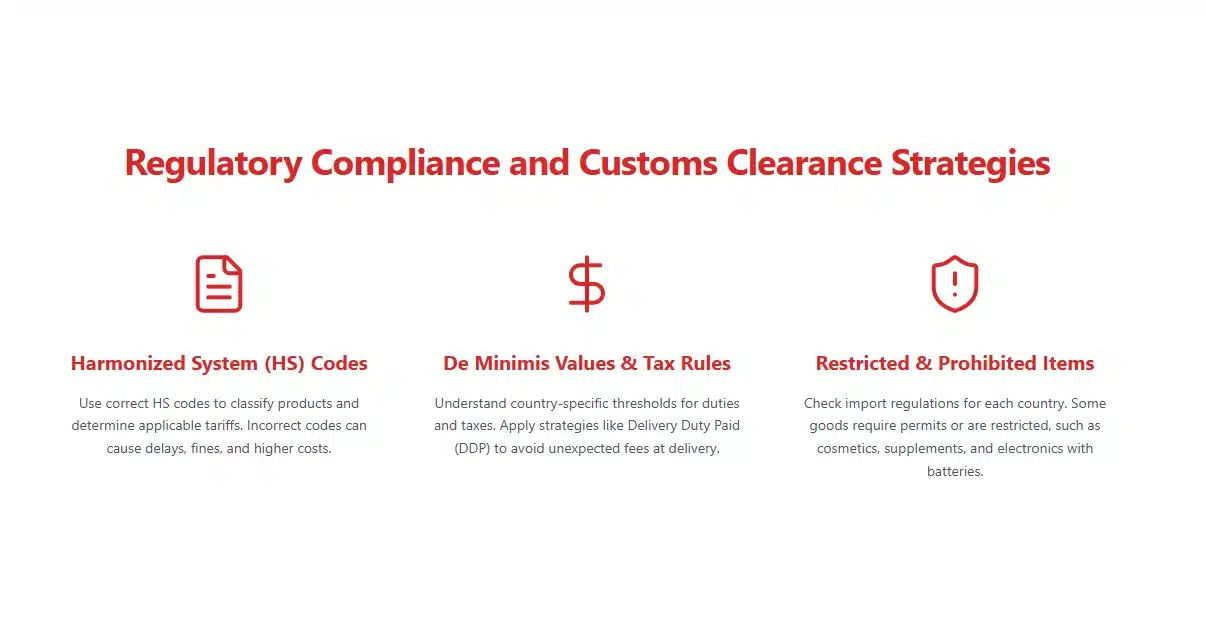
One of the biggest challenges in international eCommerce is dealing with complex customs regulations. Each country has its own rules on import restrictions, product labeling, and applicable taxes or duties. Failure to comply can lead to delays, shipment rejections, or additional costs for the seller.
1. Harmonized System (HS) Codes
The Harmonized System (HS) code is the foundation of international customs classification, used to categorize traded products globally. Assigning the correct code to each item is essential, as it determines the applicable tariffs in the destination country. Incorrect classification can result in fines, delays, or unnecessary costs that reduce profit margins.
2. De Minimize Values and Tax Reforms
De minimize thresholds determine when imported goods are subject to duties and taxes, and they vary by country. For example, the US allows many low-value shipments duty-free, while the EU applies VAT to all imports. To adapt, businesses often use a Delivery Duty Paid (DDP) approach by collecting taxes at checkout to prevent unexpected fees.
3. Restricted and Prohibited Items
Businesses must carefully review import regulations in each target market, as some products may face strict restrictions or complete bans. Items like cosmetics, supplements, electronics with batteries, and agricultural goods often require special permits. Failing to meet these requirements can lead to shipment seizures and additional losses.
Enhancing the International Customer Experience
In the highly competitive global marketplace, customer experience is the ultimate differentiator. International shoppers expect the same level of convenience, transparency, and support as they receive from domestic retailers. Building trust across borders requires a localized and customer-centric approach.
Website Localization and Cultural Nuance
Localization goes far beyond simple translation. While translating a website into the local language is essential, true localization involves adapting the entire shopping experience to align with regional cultural norms and preferences. This includes:
- Currency Display: Prices must be displayed in the local currency, dynamically updated to reflect current exchange rates.
- Sizing Standards: Apparel and footwear brands must provide clear conversion charts for international sizing standards (e.g., US vs. UK vs. EU sizing).
- Visual Merchandising: Imagery and marketing copy should resonate with the cultural aesthetics and values of the target demographic.
- Customer Support: Providing customer service in the local language, during the target market’s business hours, is crucial for resolving queries and building trust.
Transparent Shipping and Tracking
Uncertainty can reduce eCommerce conversions, especially for international buyers who need clear information on shipping costs, delivery times, and customs responsibilities. Providing a full landed cost at checkout, including product price, shipping, and all duties or taxes, helps prevent unexpected charges and builds customer trust.
In addition, end to end tracking is essential, allowing customers to follow their orders from the warehouse to final delivery. Integrating tracking systems from multiple carriers into one platform improves visibility and reduces “Where is my order?” (WISMO) inquiries.
Technological Innovations Driving Global Commerce
The sheer complexity of managing cross-border operations at scale makes reliance on manual processes impossible. Technology is the enabler that allows businesses to streamline global supply chains, automate compliance, and deliver exceptional customer experiences across continents.
Centralized Enterprise Resource Planning (ERP)
Enterprise Resource Planning (ERP) systems help eliminate data silos by centralizing inventory, financials, and order management in one platform. This improves visibility across international warehouses, prevents overselling, and supports better procurement planning.
Artificial Intelligence and Predictive Analytics
AI and machine learning help businesses forecast demand by analyzing sales data, trends, and market signals. This allows companies to position inventory closer to target markets, improve delivery times, and optimize pricing and customer service through automation.
Blockchain for Supply Chain Transparency
Blockchain technology offers better transparency in supply chains by creating secure and traceable transaction records. It can support product authenticity, ethical sourcing, and more efficient customs verification in global trade.
Conclusion
Mastering cross-border eCommerce is complex but offers significant growth potential, giving businesses access to a global customer base. However, expanding internationally comes with challenges such as logistics, regulations, and increasing competition. Companies need a clear strategy to manage these factors effectively.
Success depends on strong warehousing strategies, efficient inbound and outbound logistics, and the use of advanced technology to maintain compliance and improve customer experience. These elements help businesses handle operational complexity while staying competitive in global markets.
Companies that succeed internationally treat expansion as a dedicated strategy rather than an extension of domestic operations. See how our system supports your expansion through a free demo to build long-term resilience in an increasingly your borderless market.
FAQ about Cross Border E-Commerce Guide
-
What is the biggest challenge in cross border e commerce?
The biggest challenge is typically navigating complex and varied customs regulations, including calculating accurate duties and taxes, and ensuring seamless last-mile delivery across different international infrastructures.
-
How does a bonded warehouse benefit international sellers?
A bonded warehouse allows sellers to store imported goods without immediately paying customs duties or taxes. These fees are deferred until the items are sold domestically, which significantly improves cash flow and operational flexibility.
-
Why is localization important for global e-commerce?
Localization builds trust and removes friction from the buying process. It involves adapting currency, language, sizing charts, and marketing messages to fit the cultural and practical expectations of the target international market.
-
What does DDP mean in international shipping?
DDP stands for Delivered Duty Paid. It means the seller assumes all responsibility, risk, and costs associated with transporting goods until the buyer receives them, including paying for shipping, duties, and import taxes.