













In today’s fast-changing business environment, companies need more than ambitious sales goals and positive revenue forecasts to stay financially healthy. They also need a reliable cushion to absorb unexpected setbacks, shifting demand, and broader market uncertainty. This is why the margin of safety remains an essential concept for both business leaders and investors.
For businesses in Malaysia, understanding how far sales can fall before reaching the break-even point is an important part of financial risk management. Whether reviewing pricing, inventory costs, or investment plans, the margin of safety helps measure risk more clearly and supports better business decisions.
More importantly, this metric helps you see how much room your business has before profits start to decline. To manage risk better and make smarter financial decisions, keep reading because the next sections explain it in a simple and practical way.
Key Takeaways
|
To keep financial records accurate and daily processes more organized, many businesses now rely on integrated accounting software.



How to Read and Apply the Margin of Safety Formula
Calculating the margin of safety is a straightforward process, as long as your cost data is accurate and updated. Financial professionals typically express the margin of safety in three ways: in absolute dollar amounts, in physical units, or as a percentage of total sales. Each format provides a different view of your business risk.
1. Margin of Safety in Dollars or Local Currency
This is the most direct way to calculate the safety buffer, representing the exact amount of revenue that can be lost before you start facing an operating loss.
Formula: Margin of Safety ($) = Total Actual or Projected Sales − Break Even Sales
2. Margin of Safety in Units
For manufacturing companies or retailers dealing with physical products, expressing the safety margin in units is often more intuitive for production managers and inventory planners.
Formula: Margin of Safety (Units) = Actual or Projected Sales Volume − Break Even Sales Volume
3. Margin of Safety Percentage Ratio
The percentage format is arguably the most useful metric for comparative analysis. It allows you to compare the risk levels of different product lines, departments, or even competing companies, regardless of their absolute size.
Formula: Margin of Safety (%) = [(Actual Sales − Break Even Sales) / Actual Sales] × 100
To illustrate these formulas in action, consider this example. Imagine a specialized bicycle manufacturing company called Apex Cycles. Apex Cycles produces high end mountain bikes that sell for $2,000 each. The company’s accounting department has determined that the variable cost to produce one bicycle, including raw materials, direct labor, and variable overhead, is $1,200.
Furthermore, the company incurs total fixed costs, including factory rent, administrative salaries, and insurance, of $400,000 per month. To find the break even point, you first calculate the contribution margin per unit. The contribution margin per unit is $2,000 minus $1,200, which equals $800.
The break even point in units is $400,000 divided by $800, which equals 500 bicycles. The break even point in sales dollars is 500 units multiplied by $2,000, resulting in $1,000,000.
Now, let us assume that Apex Cycles currently sells 800 bicycles per month, generating total actual sales of $1,600,000. Using these formulas, you can calculate the company’s margin of safety:
Margin of Safety in Units = 800 Actual Units − 500 Break Even Units = 300 bicycles
Margin of Safety in Dollars = $1,600,000 − $1,000,000 = $600,000
Margin of Safety Percentage = ($600,000 / $1,600,000) × 100 = 37.5%
What does this 37.5% figure actually mean? It indicates that the company’s sales revenue can decline by up to 37.5% from its current level before the business stops making a profit and begins to lose money. That is a healthy buffer, giving you more room to invest in marketing, product development, or operational improvements without feeling too exposed to short term market changes.
Why the Margin of Safety is Critical for Business Survival
The margin of safety is more than a financial metric because it shows how much pressure your business can handle before profit starts to fall. This helps you spot risk earlier, respond faster to rising costs or weaker sales, and make better decisions around budgeting, expansion, and market uncertainty. In short, a healthy margin of safety gives your business more room to grow without taking unnecessary risk.
How Margin of Safety Influences Profitability
How Pricing Strategy Affects Your Safety Buffer
Pricing strategy is one of the most powerful ways to influence the margin of safety, but it also requires careful judgment. The price of a product or service affects the contribution margin, which then affects the break even point. If you raise the selling price while variable costs stay the same, the contribution margin per unit increases, so you need to sell fewer units to cover fixed costs. If sales volume stays stable, your margin of safety becomes wider.
However, that outcome depends on whether demand stays strong after the price increase. In reality, pricing is closely tied to price elasticity of demand. If customers are highly price sensitive, even a small increase can reduce sales volume sharply. When that happens, total contribution margin can fall and your safety buffer can shrink instead of improve.
That is why pricing decisions should never rely on price alone. Before making changes, managers need to study customer demand, competitor pricing, and brand strength. They also need to evaluate how pricing changes affect sales volume and understanding your profit margin so a drop in demand does not hurt net income more than expected.
On the other hand, some businesses lower prices to increase demand and win more market share. This reduces the contribution margin per unit and raises the break even point, but higher sales volume can still create a larger margin of safety overall. That is why high volume businesses can still grow with thin margins, as long as sales move fast enough to offset the lower profit per unit.
Practical Ways to Strengthen Your Margin of Safety
If a financial analysis reveals that your company’s margin of safety is uncomfortably tight, you need to act quickly. Improving this metric comes down to three core moves: increasing sales revenue, lowering fixed costs, or reducing variable costs. Here are several practical ways to widen your financial safety buffer.
1. Reduce Fixed Operating Costs
Since fixed costs determine the height of the break even hurdle, lowering them is often the most direct way to improve the margin of safety. Start with a careful review of overhead costs. Are there underused office spaces that can be cut or sublet? Can expensive short term debt be refinanced into lower interest long term loans?
Can non core functions such as payroll or basic IT support be outsourced at a lower monthly cost? Even small savings from insurance, utilities, or facility expenses can reduce the break even point and give your business more breathing room.
2. Optimize Variable Costs and Supply Chain Efficiency
Lowering variable costs directly increases the contribution margin, allowing the company to reach profitability faster. You can improve this through better sourcing and tighter supply chain control. Procurement teams should negotiate better supplier terms, while manufacturers can reduce waste through lean methods and smarter inventory planning.
Better labor efficiency also helps. Cross training employees, improving workflows, and reducing material waste can lower the variable cost per unit and strengthen the margin of safety.
3. Improve Product Mix and Focus on High Margin Offerings
Most companies sell more than one product or service, and each offering has a different contribution margin. One effective way to improve the margin of safety is to sell more items with stronger margins. Sales and marketing teams can focus more on premium products, add on services, or subscription based offerings instead of low margin options.
When more revenue comes from higher margin products, the overall contribution margin improves and the break even point becomes easier to reach.
4. Use Value Based Pricing Carefully
As discussed earlier, raising prices can be a powerful strategy, but it needs careful execution. Instead of applying broad price increases, focus on value based pricing. This means improving perceived value through stronger branding, better service, or more useful product features so customers are more willing to pay a premium.
Bundled offers or tiered pricing can also increase average order value without putting too much pressure on demand. This helps improve the margin of safety while keeping pricing decisions more strategic.
5. Diversify Revenue Streams
Relying too much on one product line, one market, or a few major clients creates serious risk. If one source of revenue weakens, your safety buffer can disappear very quickly. Businesses can reduce that risk by diversifying where revenue comes from.
How Different Industries Use Margin of Safety
While the fundamental formulas for calculating the margin of safety remain universal, the practical use and strategic meaning of this metric can vary across industries. That is why you need to read it based on your business model, cost structure, and day to day risk exposure.
Manufacturing and Heavy Industry
In the manufacturing sector, companies often deal with high fixed costs, including factory leases, machinery depreciation, and labor commitments. Because these costs stay in place regardless of output, the break even point is usually high. In this setting, the margin of safety helps management decide whether extra orders are worth taking, even at lower margins.
If the margin of safety is wide enough, accepting discounted bulk orders during slower periods may still help cover overhead and keep production running. But if the buffer is too thin, management may need to limit raw material purchases and focus on tighter inventory control to protect cash flow.
Software as a Service and Technology
The SaaS model works differently because it usually starts with high fixed costs, such as product development and server infrastructure, but much lower variable costs for each new user. That is why the margin of safety in SaaS is closely tied to recurring revenue and customer churn.
Finance teams often track how many subscribers the business can lose before recurring revenue falls below its fixed burn rate. When the safety buffer is healthy, SaaS companies usually have more room to invest in customer acquisition and product development without taking on too much short term risk.
Retail and E commerce
Retail and e commerce businesses operate in a fast moving environment shaped by demand shifts, seasonality, and changing consumer behavior. In this industry, the margin of safety helps you set pricing and discount limits more carefully.
During major sales periods, retailers need to know how far they can reduce prices before higher sales volume no longer covers the weaker contribution margin. With a clear view of the margin of safety by product category, you can clear slow moving stock more confidently without pushing overall profitability into danger.
How to Put Margin of Safety Into Practice
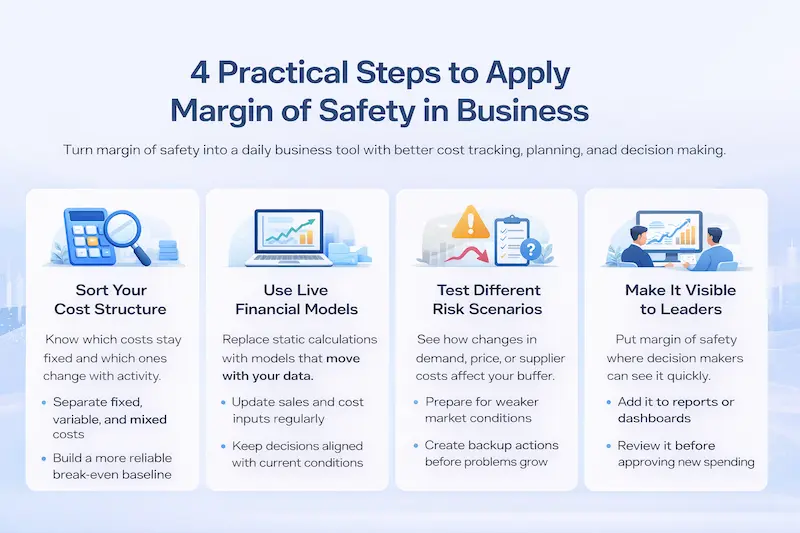
Transitioning the margin of safety from a theoretical concept into a practical business tool requires a structured approach. To make it useful, your team needs clear calculations, relevant data, and regular review.
Step 1: Rigorous Cost Classification
The foundation of any accurate margin of safety calculation is the precise separation of fixed and variable costs. Management must audit the general ledger to categorize expenses carefully. You also need to review mixed costs, such as utilities, because they often include both fixed and variable elements.
Methods like the high low method or regression analysis can help split these costs more accurately. This step matters because the break even point will only be reliable if the cost base is correct.
Step 2: Dynamic Break Even Modeling
Once costs are accurately classified, businesses should build dynamic break even models instead of relying on static spreadsheets. With the right FP and A tools, you can update the break even point and margin of safety automatically as sales data changes.
This gives management a more current view of risk and helps prevent decisions based on outdated numbers.
Step 3: Scenario Planning and Stress Testing
A calculated margin of safety becomes more valuable when tested under pressure. Companies should run what if scenarios to see how changes in cost, pricing, or demand could affect the business. For example, you can test what happens if supplier costs rise or market prices fall.
This helps leadership prepare backup plans early instead of waiting until the pressure becomes a real problem.
Step 4: Integration into Executive Dashboards
The margin of safety should not be buried in a quarterly financial report. It should be visible enough to support faster and better decisions. Integrating this metric into executive dashboards helps leadership stay aware of the company’s current risk buffer.
When a new spending proposal comes up, the real question is whether it strengthens your growth plan or puts more pressure on your margin of safety.