













Anticipating future business conditions is now a vital necessity for survival in the rapidly shifting global marketplace, including for businesses operating in Malaysia. ERP forecasting combines historical data with advanced predictive algorithms to transform raw information into highly accurate, actionable insights. This predictive power allows leaders to foresee market demand shifts and optimize resource allocation across every department.
Historically, businesses relied on fragmented spreadsheets and intuition, often leading to overstocking and severe cash flow disruptions. Modern ERP systems change this dynamic by acting as a centralized hub that continuously processes data from sales, finance, and external market indicators. This guide explores the mechanics of predictive planning and the best practices required to achieve consistent operational growth.
Key Takeaways
|
What is ERP Forecasting for Resource Management?
ERP forecasting represents a fundamental shift from reactive planning to proactive corporate management. For decades, businesses relied on historical calculations and intuition, which often led to human error and slow responses to market changes. Modern systems eliminate these risks by providing accurate data that helps leaders anticipate shifts and optimize their organizational strategy.
The Evolution from Spreadsheets to Integrated Systems
The transition from manual spreadsheets to integrated enterprise forecasting marks a significant leap in business technology. Historically, gathering data from disconnected systems took weeks, often resulting in obsolete reports that ignored real-time market variables. This reliance on static documentation made it impossible for organizations to stay agile or respond effectively to sudden global shifts.
Modern ERP systems eliminate these delays by unifying all business processes into a single database for real-time accuracy. This allows for dynamic planning, where the system instantly updates production schedules, labor needs, and cash flow forecasts as soon as market conditions change.
The Concept of a Single Source of Truth
Establishing a single source of truth is a vital foundation for effective business forecasting. Without a unified system, departments often rely on conflicting data, leading to friction and compromised decision-making during the planning process. Using a centralized data repository ensures that all teams work from the same information, fostering better collaboration across the organization.
An integrated predictive engine resolves these inconsistencies by pulling data from one reliable source. This alignment allows leaders to stop debating data accuracy and focus instead on high-level strategic implications. By ensuring every department moves in the same direction, businesses can execute cohesive strategies with much greater precision.
Why Proactive Planning Outperforms Reactive Management
Reactive management often leads to “firefighting,” where businesses struggle with inventory shortages or excessive stock liquidations. In contrast, proactive planning uses robust predictive tools to stabilize operations and eliminate these costly fluctuations.
By accurately forecasting demand surges, companies can secure better supplier rates through bulk purchasing and early negotiations. Furthermore, predicting cash flow gaps allows finance teams to arrange credit lines in advance, ensuring better interest rates and financial stability. Ultimately, this forward-looking approach increases profit margins and improves the overall customer experience.
Core Methodologies and Statistical Models

Modern enterprise software often includes forecasting tools that help businesses predict future trends. Behind the dashboards and reports, these systems use statistical models and algorithms to analyze data and estimate future outcomes. Understanding these forecasting methods helps businesses choose the right approach for different situations.
1. Quantitative vs. Qualitative Forecasting
Forecasting methods are generally divided into two types: quantitative forecasting and qualitative forecasting.
- Quantitative forecasting uses historical numerical data and mathematical models to predict future results. It assumes that patterns from past data will continue. This method works well for established products or markets where businesses have years of reliable sales data.
- Qualitative forecasting relies on expert opinions, market research, and industry insights. Businesses use this approach when there is little or no historical data available. For example, it is useful when launching a new product, entering a new market, or facing unusual events that disrupt normal patterns.
Many enterprise systems combine both approaches. Quantitative models provide the initial prediction, while managers and analysts adjust the results using their experience and market knowledge.
2. Time Series Analysis
Time series analysis is one of the most common techniques used in quantitative forecasting. It studies data collected over time to find patterns such as trends, seasonal changes, and cycles.
Several models are widely used in time series analysis:
- Simple Moving Average (SMA): This method calculates the average of data from several recent periods to estimate the next value. It helps reduce random fluctuations in data but may react slowly when trends change suddenly.
- Exponential Smoothing: This model gives more importance to recent data compared to older data. Because of this, it can respond faster to recent market changes, making it useful for industries with frequent demand shifts.
- ARIMA (Auto-Regressive Integrated Moving Average): ARIMA is a more advanced statistical model used to analyze complex data patterns over time. It combines several techniques to handle trends, seasonal changes, and forecasting errors.
3. Causal Models and Econometrics
Unlike time series models that focus only on past data, causal models examine how external factors affect business results. A common example is regression analysis, which measures the relationship between a target variable (such as sales) and other influencing factors. These factors could include marketing spending, economic conditions, or weather patterns.
For example, an umbrella company might analyze the relationship between rainfall levels and umbrella sales. If weather forecasts predict heavy rain, the company can increase production based on the expected demand.
4. Machine Learning and Heuristic Models
Many modern forecasting systems now use machine learning (ML) and artificial intelligence (AI). These technologies can analyze very large datasets and detect patterns that traditional statistical models may miss. Machine learning models improve over time. Each time a prediction is compared with the actual result, the system evaluates the difference and adjusts its calculations.
This continuous learning process helps increase forecasting accuracy in the future. Because of this ability to learn from data, machine learning has become an important tool for businesses that want more accurate demand predictions and better decision-making.
Key Types of Business Forecasting
A comprehensive enterprise system does not merely predict a single metric, it generates interconnected forecasts across every major functional area of the business. Because all departments are inextricably linked, the output of one forecast directly feeds into the input of another. Understanding the different types of ERP architectures is essential to ensure these data flows remain accurate and unified across the organization.
1. Demand Forecasting and Inventory Optimization
Demand planning is a vital predictive tool that identifies exactly what customers will buy and in what quantities. These accurate projections serve as the essential foundation for all other operational strategies.
By precisely predicting market needs, businesses can optimize inventory and reduce safety stock, which frees up working capital and lowers warehousing costs. Furthermore, effective planning prevents stockouts and ensures customer loyalty by maintaining product availability. Modern systems analyze historical data and seasonal trends to generate detailed profiles for every individual SKU.
2. Financial Forecasting and Cash Flow Management
Financial forecasting takes the operational projections generated by other departments and translates them into monetary terms. It predicts future revenues, expenses, capital expenditures, and, most importantly, cash flow. Even a highly profitable company can face bankruptcy if it suffers from a sudden liquidity crisis due to poor cash flow management.
The system automatically determines projected cash inflows by analyzing sales forecasts and historical customer payment patterns. At the same time, it tracks expected outflows from procurement, payroll, taxes, and debt obligations. This visibility enables Chief Financial Officers (CFO) to monitor their liquidity runway months ahead, supporting better decisions regarding investments, dividends, or short-term financing needs.
3. Sales and Revenue Projections
Sales forecasting evaluates team performance and expected revenue, differing from demand planning by focusing on actual deal closures rather than general market interest. By integrating sales modules software, businesses can monitor pipeline velocity and conversion rates to create precise revenue projections.
The system analyzes the sales funnel and assigns weights to deals, alerting managers to potential revenue gaps. This early warning empowers leadership to launch proactive marketing campaigns or adjust incentives to meet financial targets before the quarter ends.
4. Supply Chain and Procurement Forecasting
While demand planning focuses on the customer-facing side of the business, supply chain forecasting focuses on the supplier-facing side. It predicts the availability, lead times, and pricing of raw materials and components required for production. In an era of globalized, highly complex supply chains, this capability is vital for mitigating risk.
The system analyzes historical supplier performance, global commodity price trends, and even geopolitical data to anticipate potential disruptions. If the system predicts a sudden increase in the cost of a critical raw material, the procurement team can proactively lock in long-term contracts at current prices, protecting the company’s profit margins.
5. Human Resources and Capacity Planning
HR forecasting is a vital part of business planning, as labor remains one of the most significant organizational expenses. Through capacity planning, companies can accurately predict the workforce needed to satisfy upcoming operational demands. For instance, if a 30% surge in orders is expected, the system automatically identifies the necessary increase in warehouse, service, and logistics staff to manage the workload effectively.
This allows the HR department to begin recruitment, onboarding, and training processes months in advance, ensuring that the organization is fully staffed and ready to execute when the demand surge hits, rather than scrambling to hire untrained staff at the last minute.
Step-by-Step Implementation of ERP Forecasting
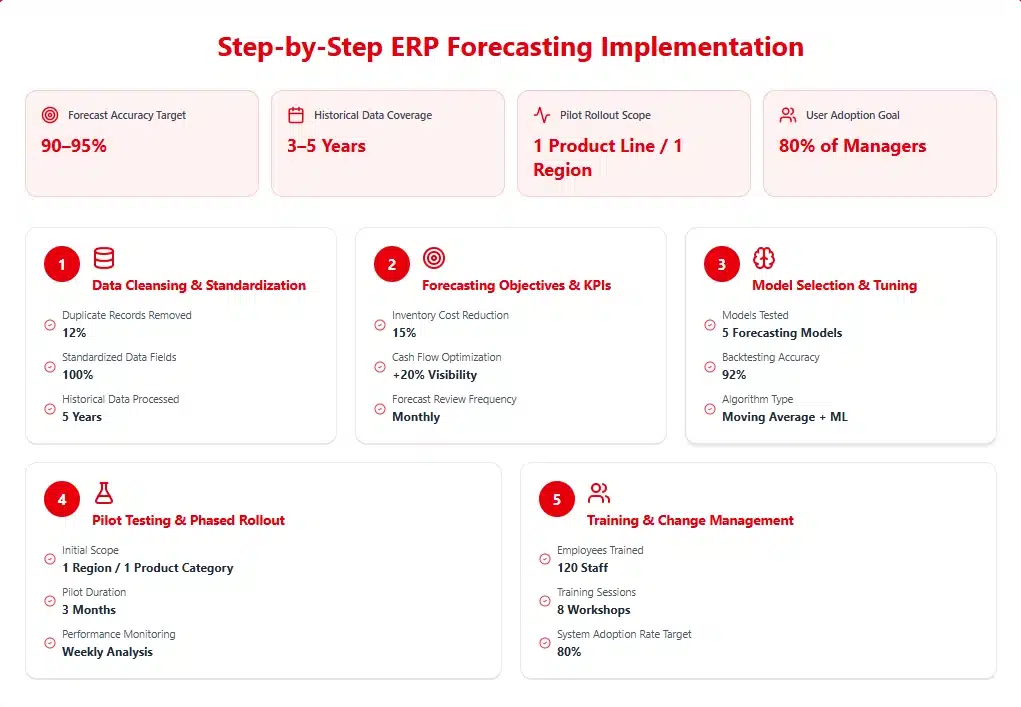
Deploying an ERP forecasting module is a comprehensive business transformation. A successful implementation requires meticulous planning, cross-functional collaboration, and a rigorous approach to data management. Organizations that rush this process often find themselves dealing with inaccurate predictions and low user adoption.
Step 1: Data Cleansing and Standardization
Reliable predictions depend on high-quality data, making a thorough audit essential before activating any algorithms. Organizations must remove duplicate entries, standardize measurements, and address missing historical information. It is crucial to filter out historical anomalies, such as one-time disruptions or unique large orders to prevent them from distorting future baseline forecasts.
Step 2: Defining Forecasting Objectives and KPIs
Leadership must establish clear goals for the system, such as reducing inventory costs or optimizing cash flow. Setting specific Key Performance Indicators (KPIs) allows the technical team to prioritize relevant datasets and choose the most effective statistical models. A unified strategy ensures that every department aligns with the overall corporate objectives.
Step 3: Selecting and Tuning the Right Models
Modern ERP platforms offer diverse mathematical models, ranging from simple moving averages to advanced machine learning. During implementation, experts perform backtesting by running historical data through these models to compare predicted results with actual past outcomes. This process allows teams to refine algorithms for maximum accuracy within their specific business environment.
Step 4: Pilot Testing and Phased Rollout
To minimize risk, businesses should introduce the forecasting system through a gradual rollout rather than an immediate enterprise-wide launch. Starting with a single product line or geographic region provides a controlled environment to monitor performance and identify unforeseen variables. This cautious approach allows for necessary adjustments without causing widespread operational disruption.
Step 5: Training and Change Management
The human element is the most challenging part of implementing ERP forecasting, as employees may resist replacing personal spreadsheets with automated systems. Effective training must explain the logic behind predictions to build confidence in data-driven results. Establishing this trust ensures that managers actually use the forecasts to guide their strategic decision-making.
The Impact of Predictive Analytics on Operations
ERP forecasting systems use predictive analytics to analyze historical data, identify patterns, and help businesses make better decisions about demand planning, inventory, and supply chain management. The operational impacts are profound, touching every aspect of efficiency, cost control, and customer satisfaction.
1. Reducing the Bullwhip Effect in Supply Chains
The bullwhip effect happens when small changes in customer demand create larger demand changes across the supply chain. For example, a small increase in retail sales may cause distributors and manufacturers to order much more inventory than necessary.
Predictive analytics reduces this problem by giving companies better visibility across the entire supply chain. When retailers, distributors, and manufacturers use the same data and forecasting system, they can make more accurate decisions. This helps prevent overproduction and reduces excess inventory.
2. Improving Working Capital Management
Working capital refers to the money businesses use for daily operations, including inventory and accounts receivable. When forecasting is inaccurate, companies may hold too much inventory that moves slowly, which ties up valuable capital.
Predictive analytics helps businesses estimate demand more accurately. With better forecasts, companies can maintain optimal inventory levels and avoid unnecessary stock. This allows businesses to use their capital for other priorities such as marketing, innovation, or business expansion.
3. Supporting Dynamic Pricing Strategies
Predictive analytics also helps businesses adjust product prices based on market conditions. By analyzing factors such as customer demand, competitor pricing, inventory levels, and external events, companies can determine the most effective price for a product.
For example, if demand for a product increases while inventory is limited, the system may recommend a higher price to improve profit margins. On the other hand, if demand decreases or a product is nearing the end of its lifecycle, the system may suggest price reductions to encourage sales.
4. Reducing Waste and Supporting Sustainability
Accurate forecasting is especially important in industries that sell perishable products, such as food, pharmaceuticals, and cosmetics. When companies produce more than the market demands, unsold goods may expire and become waste.
Predictive business analytics helps businesses match production levels with actual demand. This reduces product waste, lowers financial losses, and decreases environmental impact. As a result, companies can also support sustainability initiatives and improve their environmental responsibility goals.
Conclusion
Modern ERP forecasting has transformed from a luxury into an essential requirement for survival in today’s volatile global market. By replacing fragmented manual processes with advanced predictive algorithms, businesses can turn historical data into precise, actionable intelligence for every department. This shift toward proactive management allows leaders to anticipate market changes and optimize resource allocation with high accuracy.
Establishing a centralized hub for data ensures that your organization operates from a single source of truth for better decision-making. These integrated systems eliminate information silos, helping finance and operations teams prevent stockouts and manage cash flow disruptions effectively. Adopting these robust predictive business tools is the key to achieving sustainable growth and maintaining a competitive edge in the digital era.
Experience the power of precise business planning firsthand by scheduling your free demo with our experts today.

FAQ about ERP Forecasting
-
How can ERP forecasting improve business efficiency?
ERP forecasting can enhance business efficiency by providing accurate demand predictions, optimizing inventory levels, improving resource allocation, and enabling proactive decision-making.
-
What types of data are used in ERP forecasting?
ERP forecasting utilizes historical sales data, market trends, seasonality, customer behavior, and other relevant metrics to create accurate forecasts for future business performance.
-
How often should businesses update their ERP forecasts?
Businesses should regularly update their ERP forecasts, ideally on a monthly or quarterly basis, to reflect changes in market conditions, sales data, and other relevant factors that influence demand.