








Managing foreign worker payroll Malaysia is less about “running payroll” and more about getting statuses, contributions, and tax treatment right every month. One employee might fall under a different SOCSO scheme, another depends on tax residency days. So HR and finance need a workflow that stays consistent under pressure.
Foreign workers and expatriates also follow different rules on EPF, SOCSO coverage, and how PCB applies. Meanwhile, work pass details and onboarding documents affect what you can deduct and report, so it helps to align your process with the Malaysia’s New Expatriate Employment Policy. As a result, a small classification slip can create messy corrections later.
This guide breaks down the key differences, the mandatory payroll components, and the end-to-end process you can follow for 2026. It also highlights common payroll pitfalls and how teams typically fix them with clearer data checks and better systems. That way, you can run payroll confidently without second-guessing each cycle.
Key Takeaways
|
Understanding Payroll Differences: Foreign Workers vs. Expatriates in Malaysia
Before proceeding, it is crucial to understand the key distinction between a foreign worker and an expatriate in Malaysia. This status difference affects payroll, mandatory contributions, and taxes. Thus, clear classification helps prevent penalties and ensures accurate, compliant payroll each cycle.
Proper classification protects the company from legal issues and ensures each employee’s rights and obligations follow regulations. In turn, this knowledge streamlines administration and builds trust. The next section explains how each status affects payroll in Malaysia.
1. Definition and categories of foreign worker
Foreign workers generally refer to non-citizen labour employed in specific sectors such as manufacturing, construction, plantation, agriculture, and services. They typically hold a Visit Pass (Temporary Employment) and their recruitment is strictly regulated by the Ministry of Human Resources and the Immigration Department of Malaysia.
From a payroll perspective, their mandatory contributions differ significantly from local workers. For instance, they are covered under a specific SOCSO scheme and are generally not required to contribute to the EPF unless they voluntarily opt-in, which alters the payroll calculation process.
2. Definition and categories of expatriate
An expatriate is a foreign professional, managerial, or technical worker possessing specific qualifications and experience required by a company in Malaysia. They usually hold an Employment Pass, which is categorized (Category I, II, III) based on their salary level and contract duration.
The payroll treatment for expatriates is more complex, particularly in determining their tax residency status. This status directly impacts their Monthly Tax Deduction (PCB) rate and their obligation to contribute to the Employees Provident Fund (EPF) in the same manner as local employees, making accurate status tracking essential for compliance.
3. Implications of status differences on the payroll process
The primary implication of this status difference lies in the type and amount of mandatory contributions payable by both the employer and the employee. For example, employers must register foreign workers under PERKESO’s Employment Injury Scheme, whereas qualifying expatriates are registered under the same scheme as local workers.
Furthermore, the income tax calculation (PCB) for an expatriate heavily depends on their tax residency status, determined by their physical presence in Malaysia for 182 days or more in a calendar year, which dictates whether they are subject to progressive tax rates or a higher flat rate.
Mandatory Payroll Components for Foreign Workers in Malaysia
Managing payroll in Malaysia, especially for foreign employees, requires a clear grasp of each statutory contribution. Each has its own rules, rates, and purpose, so employers must comply to avoid sanctions. Ultimately, these components create a social safety net that protects workers.
Failure to calculate or remit these contributions on time can lead to heavy fines and legal issues. Therefore, HR and finance must master each component. This section explains the key mandatory contributions for foreign workers and expatriates in Malaysia to keep your payroll compliant.
1. Employees Provident Fund (KWSP/EPF)
The Employees Provident Fund is a compulsory retirement scheme for Malaysian employees. For foreign workers, contributions are optional. However, for some expatriates, EPF can become mandatory once they opt in, so employers must verify each employee’s status to avoid errors and penalties.
2. Social Security Organisation (PERKESO/SOCSO)
For foreign workers, SOCSO contributions under PERKESO’s Employment Injury Scheme are mandatory. This scheme offers medical and financial protection for workplace accidents and diseases. Therefore, employers must apply the correct 1.25% rate to ensure proper coverage and compliance.
3. Employment Insurance System (SIP/EIS)
The Employment Insurance System (EIS) provides temporary financial support to workers who lose their jobs. However, only Malaysian citizens must contribute. Foreign workers and expatriates are exempt, so EIS should be excluded from non-citizen payroll to avoid over-contribution.
4. Monthly Tax Deduction (PCB/MTD)
The Monthly Tax Deduction (MTD), or Potongan Cukai Bulanan (PCB), deducts income tax from monthly salary. PCB for foreign workers and expatriates depends on tax residency. Residents (182 days or more) face progressive rates, while non-residents face a 30% flat rate without any reliefs from the Inland Revenue Board of Malaysia (LHDN).
5. Human Resource Development Corporation (HRD Corp Levy)
Companies in certain sectors with at least 10 employees must register with HRD Corp and pay a monthly levy, usually 1% of wages. This obligation includes foreign workers and expatriates, and it funds training programs that help upskill the workforce.
The End-to-End Payroll Process for Foreign Workers
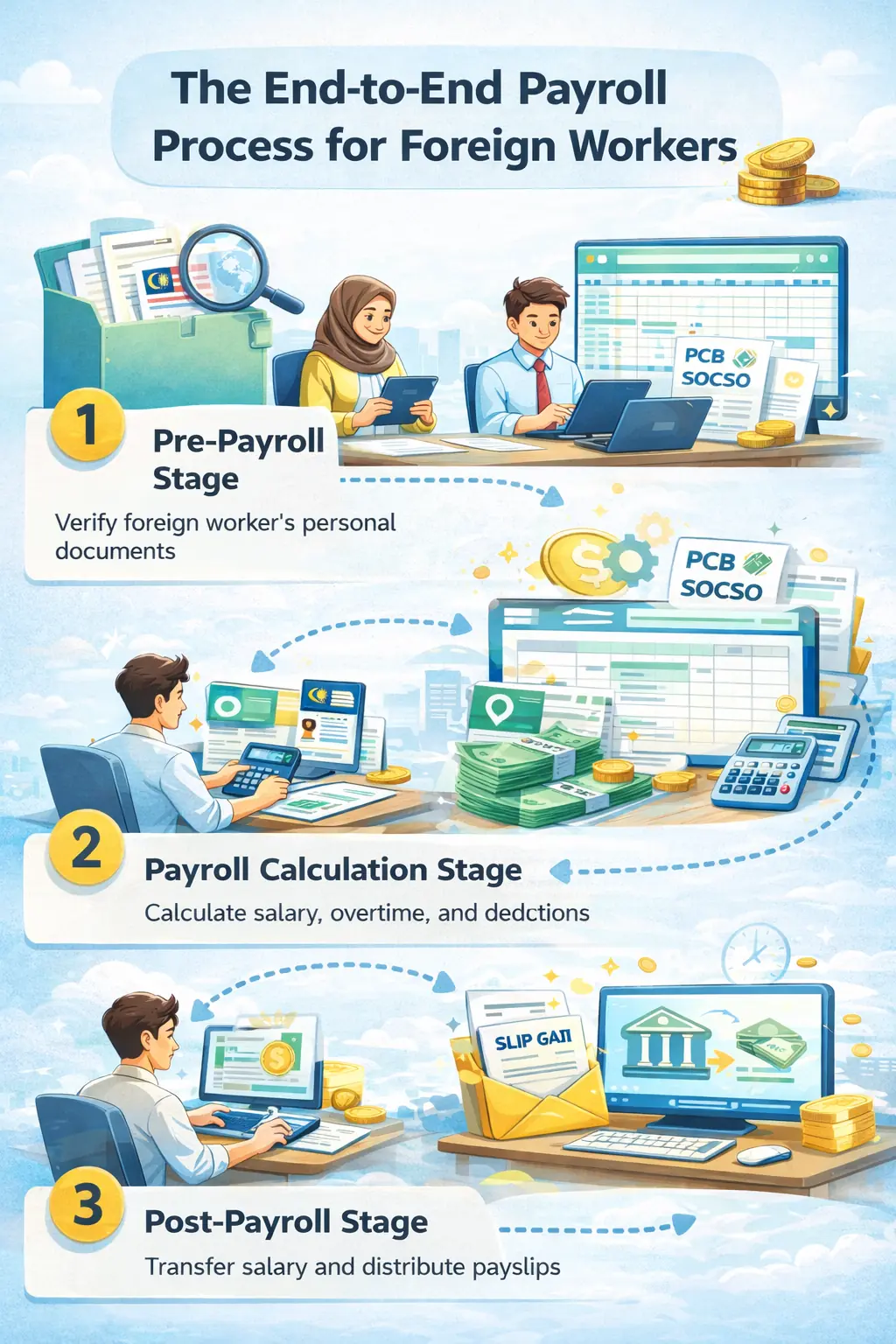
Executing payroll for foreign workers is more than calculating numbers. Instead, it is a monthly cycle that requires precision from data collection to final reporting. When each step is handled carefully, it ensures accuracy, compliance, and trust with employees.
By fully understanding this workflow, companies can build an efficient system, reduce human error, and keep operations smooth each month. In addition, a structured workflow gives management peace of mind and strengthens employee confidence in how their pay is managed.
1. Pre-payroll stage (onboarding and data verification)
This stage is the foundation of payroll and starts when a foreign employee joins. HR must collect and verify key documents, then enter them accurately into the system. Otherwise, errors in IDs or visa status can cause calculation and reporting issues, leading to non-compliance and dissatisfaction.
2. Payroll calculation stage (accurate computation)
This is the core of payroll, where all salary components are calculated. It covers basic pay, allowances, overtime, and deductions. For foreign workers, calculations must include SOCSO and PCB based on status and tax residency to ensure correct net pay and full compliance.
3. Post-payroll stage (payment and reporting)
Once calculations are verified, the company disburses salaries via bank transfer. At the same time, it issues detailed payslips for transparency. Finally, it must remit SOCSO, PCB, and HRD Corp Levy on time to avoid penalties and keep good standing with the authorities.
Common Challenges in Managing Foreign Worker Payroll and Their Solutions
While hiring foreign talent can boost innovation and productivity, payroll administration brings unique challenges, from shifting regulations to data security risks. If not managed with the right strategies, these issues can waste time, drain resources, and increase legal and financial risk.
However, each of these challenges has a practical solution, especially with modern technology. By spotting issues early and applying proactive fixes, companies can turn a cumbersome payroll process into an efficient, compliant, and well-managed operation.
1. Complex and frequently changing regulations
Employment and tax regulations in Malaysia change frequently, so HR must track updates from LHDN, KWSP, and PERKESO. Instead, companies can subscribe to official updates, join HR seminars, or use payroll software that auto updates, which reduces manual monitoring and keeps payroll compliant.
2. Complicated tax and contribution calculations
Determining tax residency and the correct PCB rate for expatriates is one of the most complex payroll tasks. Even small errors can cause audit issues. Therefore, using automated payroll software with LHDN based formulas helps reduce human error and protects the company from penalties.
3. Data management and information security
Managing sensitive data for many foreign employees requires secure, centralized storage. Relying on scattered spreadsheets increases breach and inconsistency risks. Therefore, a cloud-based HRIS with payroll, encryption, and role-based access is vital to protect data and ensure integrity.
4. Limitations of manual processes
Manual payroll using spreadsheets is prone to data entry mistakes, formula errors, and wasted time. It also complicates tracking and reporting. Therefore, using robust payroll software to automate calculations, payslips, and reports saves time and greatly improves accuracy and efficiency.
The Role of HR Software in Optimizing Payroll Processes
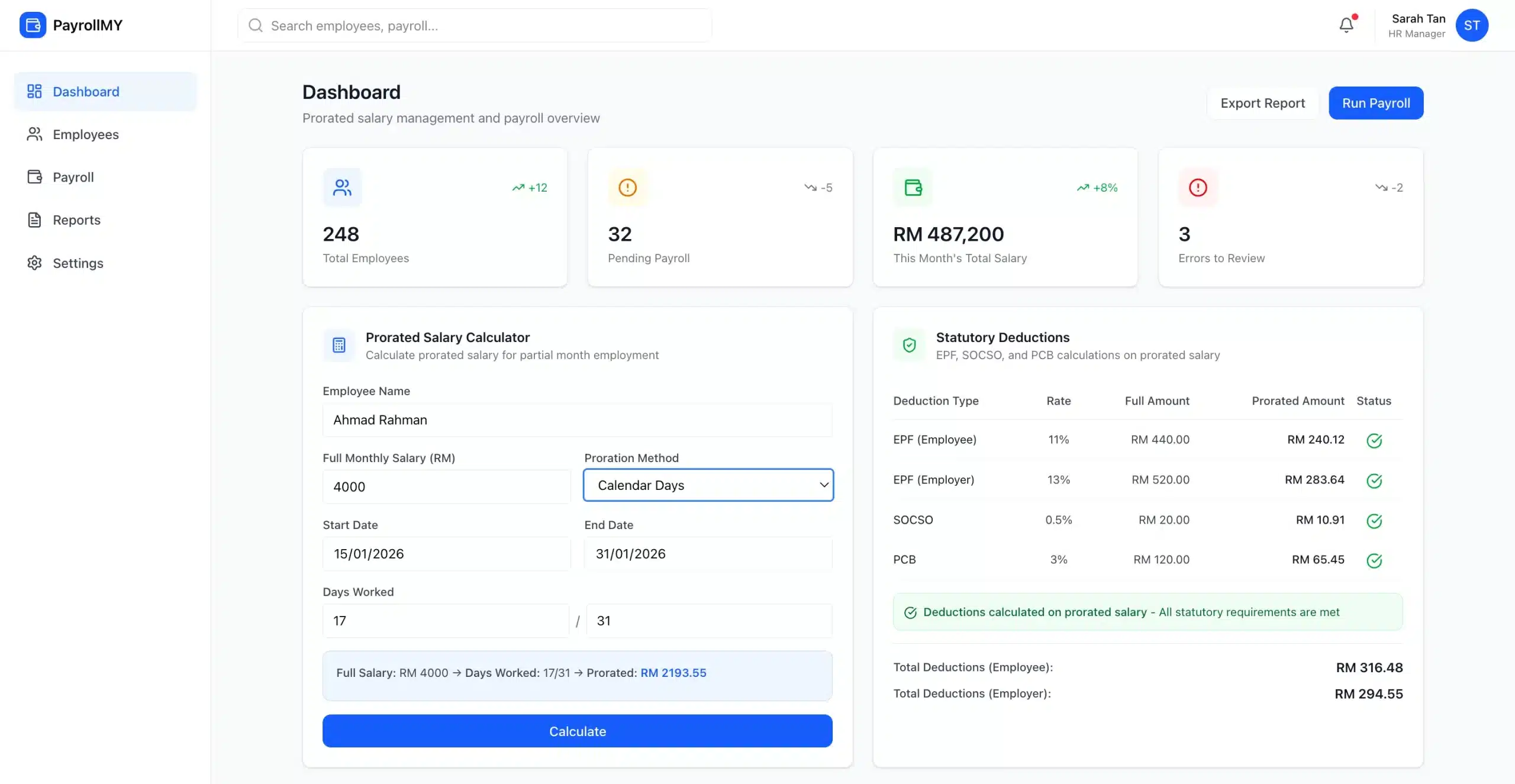
Regulations are complex, so manual foreign worker payroll often slows teams down and increases rework. Many businesses switch to integrated HR software with payroll modules for faster, more accurate processing. HashMicro offers HR and integrated payroll software to support a smoother, more automated workflow.
1. Automation of tax and mandatory contribution calculations
One key advantage of payroll software is its ability to automate complex calculations. For example, HashMicro’s Payroll Software computes PCB, SOCSO, and HRD Corp Levy from stored data and current rules. This removes manual errors, keeps payslips accurate, and saves time.
2. Maintained regulatory compliance
Leading payroll software providers keep their systems aligned with the latest Malaysian labour and tax laws. When new tax rates or rules are announced, the system updates automatically. This reduces manual tracking, maintains compliance, and helps lower overall regulatory risk..
3. Secure centralization of employee data
An integrated HR software centralizes all employee data, from personal details and work permits to payroll history. With a secure cloud system, authorized staff can access updated records easily, which strengthens data security and keeps information consistent across departments.
4. Comprehensive and automated report generation
Payroll software makes monthly and audit reporting much easier. With a few clicks, you can generate salary summaries, statutory contribution reports, and Form E. This cuts report prep time and provides accurate, real time data for decisions and on time filings.
Conclusion
Running foreign worker payroll Malaysia for 2025 works best when you treat classification and documentation as part of payroll, not a separate admin task. Work pass status, tax residency, and statutory treatment shape what you calculate and what you must report. So, a consistent process matters as much as the pay run itself.
The biggest takeaway is simple: payroll becomes predictable when HR and finance agree on one source of truth. When employee status changes, contribution settings, PCB treatment, and reporting fields should update in the same workflow, not through scattered emails. This reduces retroactive corrections and keeps compliance checks calmer.
To keep things steady, standardize onboarding data, set clear approvals, and run a brief checklist each cycle. Then review exceptions early, especially for status changes. If you want a second opinion, a free consultation can help map steps and spot gaps before they hit payroll.
FAQ about Foreign Worker Payroll Malaysia
-
Is EPF/KWSP contribution mandatory for all foreign workers in Malaysia?
No, EPF contribution is not mandatory for foreign workers holding a Visit Pass (Temporary Employment), though they can opt-in. However, it is mandatory for expatriates on an Employment Pass, similar to Malaysian citizens.
-
How is tax (PCB) calculated for an expatriate working less than 182 days?
Expatriates in Malaysia for less than 182 days are non-tax residents and are subject to a flat tax rate of 30% on their income. They are not eligible for the tax reliefs available to residents.
-
What primary documents are needed for a foreign worker’s payroll onboarding?
Key documents include a valid passport copy, a valid work permit or employment pass, an active local bank account number, and a completed personal data information form for system entry.
-
Can payroll software handle salaries paid in foreign currency?
Yes, many modern payroll systems, including HashMicro’s, feature multi-currency capabilities. This allows companies to set salaries in a foreign currency and automatically convert it to MYR for statutory calculations based on prevailing exchange rates.