









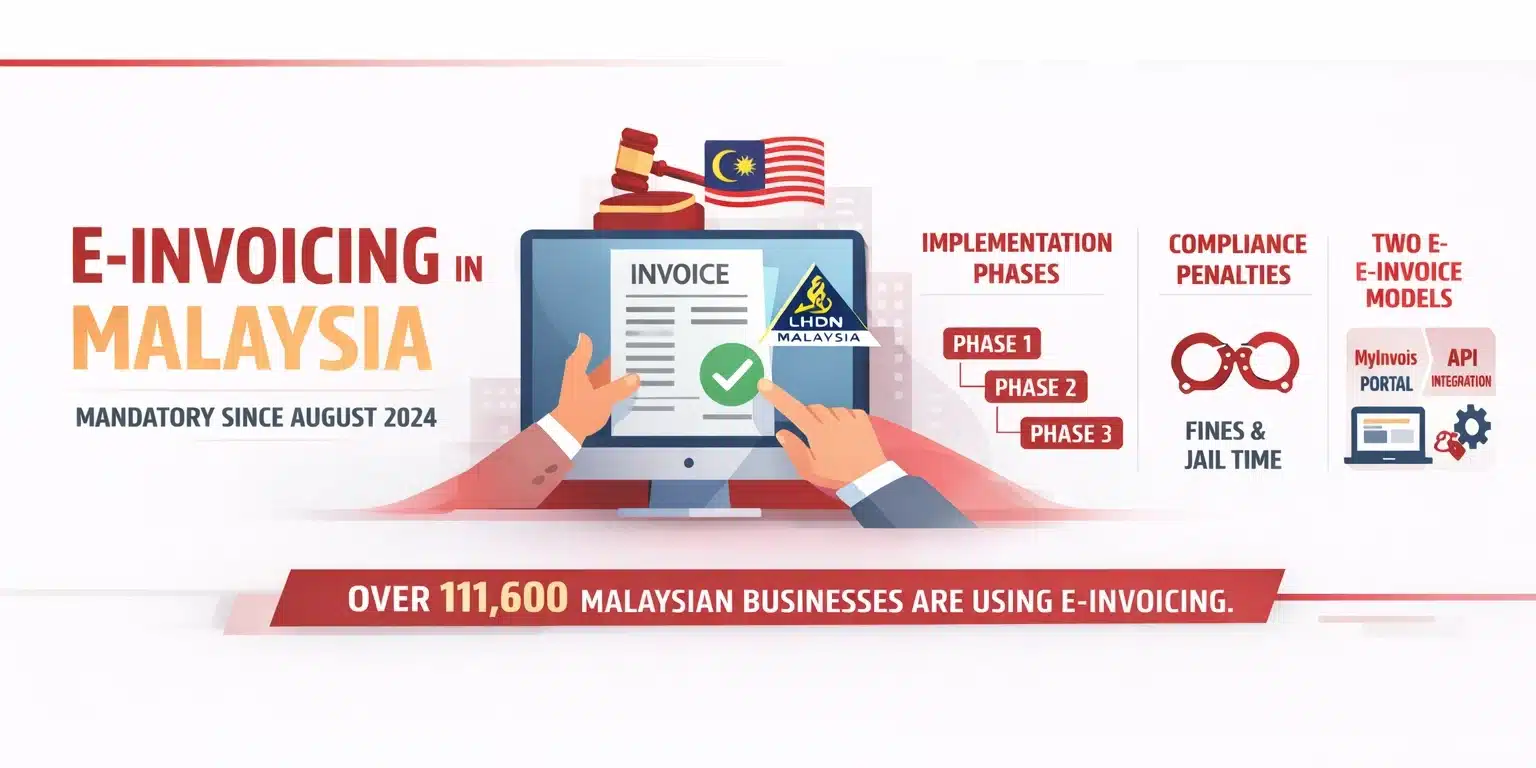
E-invoicing has become a legal obligation for Malaysia’s businesses, ever since August 2024, when the Inland Revenue Board of Malaysia (LHDN) mandated E-invoicing. According to a report by them in December 2025, around 111.600 businesses in Malaysia are using E-invoicing, highlighting the shift in Malaysia’s business landscape.
Failing to comply with this change will bring consequences, such as fines up to RM20,000 or time in prison for up to 6 months.
As a responsible business owner in Malaysia, you can understand the importance in adapting to these changes. For this reason, we will tell you everything you need to know about e-invoicing regulations and how you can implement e-invoicing in your business, so you may thrive even further in this new digital age.
Key Takeaways
|
What Is E-Invoice and Why Is It Crucial for Businesses in Malaysia?
E-invoices are the digitization of an invoices, or documents issued by a seller to request payment for transactions. E-invoices are validated and authenticated in real-time by the LHDN Malaysia. E-Invoices is also apply to multiple purchases at once.
This structure matters because it allows different systems to read and process invoice data automatically, no manual entry. The goverment’s push toward e-invoicing is part of a broader goal to modernizetax administration, reduce fraud, and bring malaysia’s financial reporting in line with global standars.
But beyond compliance, the shift also changes how businesses track transactions, manage cash flow, and generate financial reports.
5 Document Required For E-Invoicing
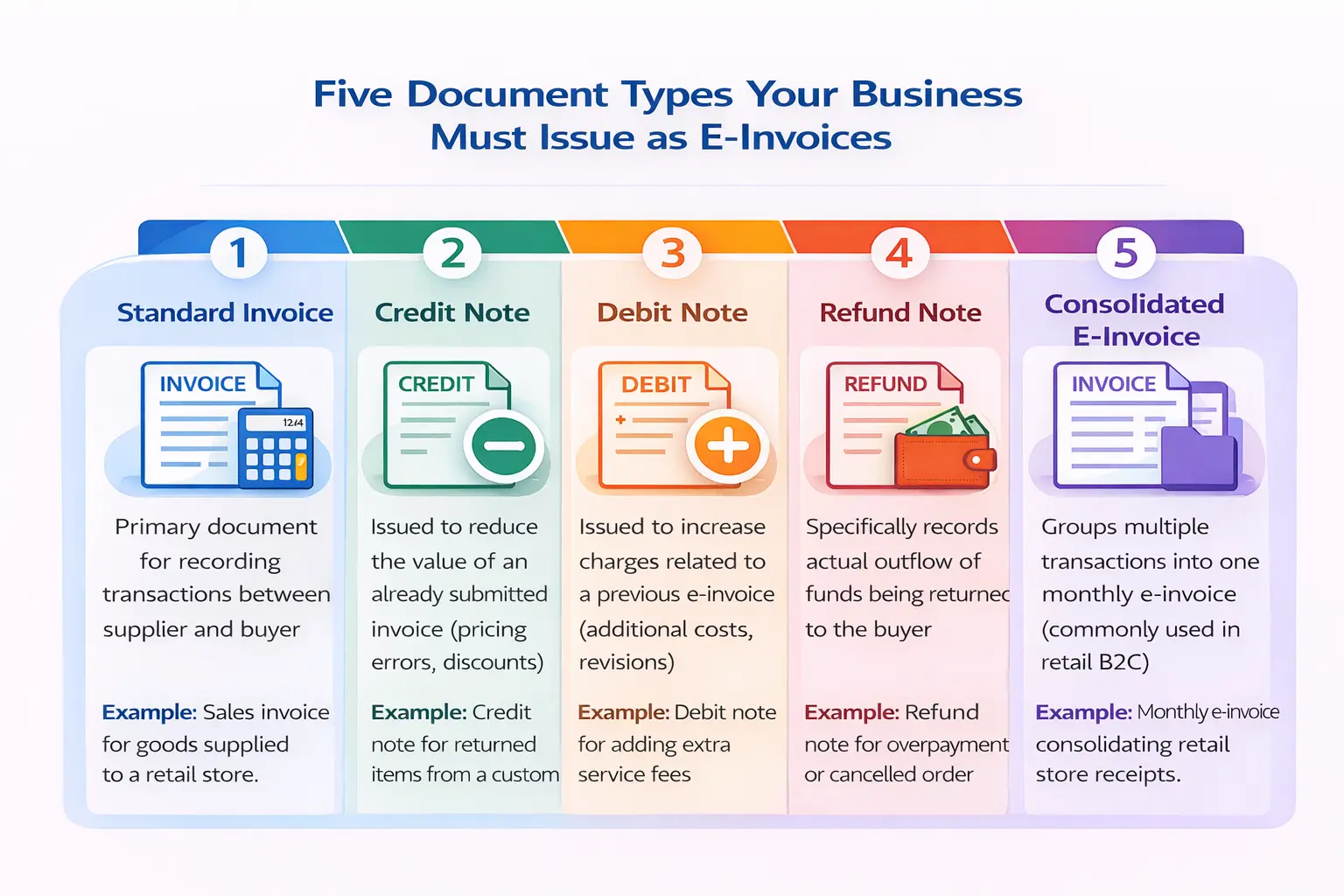
Most people think e-invoicing only applies to sales invoices. In practice, LHDN requires five distinct document types to be issued in electronic format. Each one serves a different purpose, and using the wrong document for a situation can create reconciliation problems down the line.
here is a general overview:
Phases and Timeline for Mandatory E-Invoice Implementation in Malaysia
The LHDN has established a phased implementation timeline for e-invoicing to ensure a smooth transition for all taxpayers.
This approach is structured around companies’ annual revenue thresholds, providing businesses of various sizes adequate time to prepare their systems and processes. Thus, you can use this structured rollout to mitigate disruption and enable smaller businesses to learn from larger corporations’ experiences.
1. Phase 1: Annual revenue exceeding RM100 million
Beginning on August 1, 2024, the first phase targets the group of taxpayers with the highest annual revenue. These companies typically have the most significant transaction volumes and more complex existing systems.
These Businesses in this category are expected to be pioneers in e-invoice adoption, setting a precedent and providing valuable lessons for the subsequent phases. In other words, their readiness is crucial as they will serve as the initial benchmark for the success of this national program.
2. Phase 2: Annual revenue between RM25 million and RM100 million
The second phase commenced on January 1, 2025, targeting the mid-sized companies that form the backbone of Malaysia’s economy. This group of businesses will have several months following the first phase to learn from the pioneers’ experiences and finalize their own preparations.
For companies in this category, the primary challenge lies in balancing technology investment with available resources. Consequently, selecting a scalable and cost-effective e-invoicing solution becomes paramount for a successful and smooth transition into the new digital tax framework.
3. Phase 3: All taxpayers
On July 1, 2025, e-invoice implementation is fully enforced for all taxpayers, regardless of their annual revenue. Therefore, this phase marks the complete integration of Malaysia’s business ecosystem into the digital tax framework.
While LHDN provides the MyInvois portal as a basic, free solution for small-scale businesses. You should consider an integrated software solution for a more strategic choice in the long-term efficiency, scalability, and operational excellence as the company grows.
B2B E-Invoicing Process Works in Malaysia
Under Malaysia’s Continuous Transaction Control (CTC) model, every B2B invoice must be validated by LHDN before it is legally issued.
Here is how the process works step by step:
Step 1: Generate the E-Invoice
The supplier prepares the invoice in structured format (XML or JSON) with 55 mandatory data fields. Submission can be done via:
- MyInvois portal (manual), or
- API-integrated accounting/ERP system (automated).
Step 2: Submit to LHDN for Validation
The invoice is sent to MyInvois for near real-time validation. If approved, LHDN issues:
- A Unique Identifier Number (UIN)
- A QR Code for verification
- Only after this step is the invoice officially valid.
Step 3: Notification to Both Parties
Once validated, supplier and buyer will get notification and then the invoice becomes legally recognized
Step 4: Share the Validated Invoice
The supplier forwards the invoice to the buyer in readable format (PDF or print).
The invoice must include:
- UIN
- QR Code
This allows authenticity verification.
Step 5: 72-Hour Review Window
After validation buyer may request rejection (with written reason) and supplier may cancel (with written reason)
- After 72 hours:
Cancellation or rejection is no longer allowed, corrections must be made via credit note, debit note, or refund note referencing the original UIN
Step 6: Record Retention (7 Years)
Both supplier and buyer must retain all validated e-invoices and related documents for at least seven years.
Understanding the Two E-Invoice Transmission Models Provided by LHDN
To accommodate different business needs, LHDN offers two primary models for the transmission and validation of e-invoices. Correspondingly, the effectiveness of these models heavily depends on your company’s transaction volume, operational complexity, and existing technological maturity. Choosing one of these models is a strategic decision that should align with both your current capabilities and your long-term growth ambitions.
Each model offers its own advantages and limitations, ranging from a simple, no-cost solution for small businesses, to large enterprises. Here is a detailed explanation of both models to help you make the most strategic choice for your organization, ensuring a seamless transition to the new e-invoicing system.
1. MyInvois portal
MyInvois portal is a web-based platform provided directly by LHDN, accessible for free to all taxpayers. This model is specifically designed for micro, small, and medium-sized enterprises (MSMEs) or companies with a relatively low volume of transactions. Users can create, submit, and manage their e-invoices by manually inputting data into the portal. This makes it an accessible solution that does not require significant technological investment, offering a straightforward path to compliance for smaller businesses that may not have sophisticated accounting systems already in place.
2. Application Programming Interface (API) integration
The API integration model allows a company’s existing accounting system or Enterprise Resource Planning (ERP) software to connect directly with LHDN’s system. This is the ideal solution for medium to large-scale enterprises with high transaction volumes, as the entire process of managing e-invoices can be fully automated.
Although it requires an initial investment in development and integration, the API model offers better operational efficiency, data accuracy, and long-term scalability, positioning a business for greater productivity and growth.
Strategic Preparation for E-Invoice Implementation in Your Company
Transitioning from traditional invoices to e-invoicing is not risk-free, careful planning is required for effective implementation. Better preparation will ensure compliance and enable your company to maximize the benefits.
To guide you through the transition, we will provide all the necessary details and information. These are the steps you can follow to ensure the e-invoice implementation in your company proceeds successfully.
- Evaluate current business and financial processes
Conduct an internal audit of your current accounting workflows. Identify all data points required for an e-invoice; map out how data is collected and evaluate your systems. This will help you identify the gaps between your current processes and the new e-invoice requirements, forming the basis of your implementation plan. - Educate the team and internal stakeholders
It is vital to socialize the importance of e-invoice transition to all relevant departments. Explain how this change will impact their workflows, provide training on new tools and procedures, and form a project team responsible for overseeing the entire process. - Choose the right service provider
You should look for an ERP or accounting solution that complies with LHDN, and also offers seamless integration, scalability, and responsive support. Ensure the software can automate the all 53 data fields mandated by LHDN and integrate well with other business modules. - Plan for data and system integration
Collaborate with your team and your chosen software to design the integration plan between your system and the LHDN API. Standardize your data and establish data security protocols. Your system may need adjustments to ensure full compatibility with the API. - Conduct thorough testing and validation
Lastly, you simulate various invoicing processes. This will ensure all functions work as expected and to identify potential issues before the system fully runs.
Long-Term Benefits of E-Invoice Adoption Beyond Tax Compliance
Although driven by regulation, the implementation of e-invoicing offers strategic advantages that extend far beyond mere tax compliance. This implementation is a great opportunity for Malaysian business owners to digitalize their operations and modernise their businesses.
By transitioning to a structured, digitized invoicing system, companies can transform processes that were once time-consuming and error-prone into streamlined, automated, and data-driven workflows. These benefits will be felt across organizations, from increased productivity in the finance team to smarter, more informed decision-making at the executive level.
Here are some of the long-term benefits your company can realise from this pivotal shift.
1. Enhanced operational efficiency
Automating the invoicing process significantly reduces manual tasks such as data entry, printing, and physical document delivery. This frees up the finance team’s time to focus on more strategic activities, like financial analysis and planning. Furthermore, the real-time validation process by LHDN minimizes the risk of errors and invoice rejections, effectively shortening the conversion of invoices to cash, improving overall process speed.
2. Optimized cash flow management
With a faster, more accurate process, customers can send and process invoices more efficiently, ultimately accelerating the payment cycle. Furthermore, visibility into the status of all issued and received invoices also allows cash flow forecasting with greater accuracy.
3. Improved data accuracy and analytics
Structured transaction data in digital format unlocks deeper, more powerful analytics. Companies can easily track sales patterns, analyze customer purchasing behaviour, and identify market trends in real-time.
4. Support for environmental initiatives (ESG)
By eliminating the need for paper invoices, ink, and physical delivery, e-invoicing directly reduces a company’s carbon footprint. This is a tangible step that supports ESG goals and strengthens the company’s image as a responsible business entity.
Common Challenges in E-Invoice Implementation and How to Overcome Them
Despite the benefits, the transition to e-invoicing isn’t always easy. Companies may face a variety of challenges, whether technical, operational, or human resources-related. Here are some common challenges companies often encounter, along with practical solutions for you to address them head-on.
1. Integration with legacy systems
Many companies still rely on older accounting or ERP systems that may not be compatible with modern API technology. You can overcome this by choosing a modern ERP software provider that offers flexible integration capabilities or by planning a system upgrade.
2. Data security and privacy
The digital transmission of sensitive financial data raises valid concerns about cybersecurity and privacy. It is important to ensure you select a service provider that aligns with industry-standard security protocols, such as data encryption and recognized security certifications.
3. Employee training and change management
Resistance to change is a natural human challenge. As a matter of fact, employees accustomed to manual processes may struggle to adapt to new digital workflows. For this reason, The solution lies in a comprehensive training program, transparent communication about the benefits of the change, and selecting software with a user-friendly interface.
4. Initial implementation costs
For some businesses, particularly SMEs, the initial investment for new software and integration services can be a significant concern. However, it is crucial to view this as a long-term investment rather than a mere cost. The benefits of increased efficiency, reduced errors, and accelerated cash flow often yield a rapid return on investment (ROI), outweighing the initial expenditure in the long run.
Conclusion
The implementation of e-invoicing in Malaysia is a necessary and transformative step for all business owners. It’s a strategic opportunity for you to drive efficiency, enhance transparency, and accelerate the digitization of your company.
Companies that view e-invoicing as a catalyst for improvement will emerge as winners in Malaysia’s new economy. Choosing the right e-invoicing API can be complicated at times, with how much research needed to make the right choice. We are always ready to assist you through our business insight that will take your business to a step beyond.
FAQ About E-Invoice Implementation in Malaysia
-
What are the penalties for not complying with the e-invoice timeline?
Companies failing to issue e-invoices on schedule may face penalties under Section 112(3) of the Income Tax Act 1967, including fines from RM200 to RM20,000, imprisonment, or both.
-
Does e-invoicing also apply to B2C transactions?
Yes, e-invoicing applies to B2C transactions. However, sellers can issue a consolidated e-invoice monthly to LHDN for these transactions instead of one for each customer.
-
How does e-invoicing affect the tax audit process?
E-invoicing significantly streamlines tax audits because all transaction data is pre-validated by LHDN. As a result, the process becomes faster and more transparent, reducing reliance on manual document reviews.