








In today’s competitive business landscape, standing out is not just about having a great product. It is about understanding how every activity in your business creates value for customers. Whether you’re a lean startup or a global giant, the secret to sustainable profitability often lies in the value chain.
You can think of it as a practical way to see how your business turns resources, processes, and ideas into something customers are genuinely willing to pay for. It also helps you spot inefficiencies, reduce wasted costs, and improve operational performance.
In the digital era, understanding your value chain is no longer optional. This matters even more in Malaysia, where businesses often need to balance price sensitivity, service quality, and fast changing customer expectations. In this guide, you will learn how each part of the value chain shapes growth, efficiency, and long term advantage, so it is worth reading through to the end.
Key Takeaways
|
As supply chain activities become more complex, businesses need clearer visibility across sourcing, inventory, logistics, and fulfillment. In this context, supply chain management software helps connect those processes so they can be managed more accurately and consistently.
What is a Value Chain?
A value chain is the full set of activities your business uses to turn an idea into a product or service that customers are willing to pay for. The concept, introduced by Michael Porter, shows that a business is built not only on products or operations, but also on how each activity adds value along the way. The goal is to create more value than the total cost required to deliver it. That difference is called margin, and it shows how efficiently your business turns effort, resources, and processes into profit.
This concept is not limited to manufacturing. It also applies to service and software businesses, where value is created through product development, operations, marketing, sales, and customer support. When one part underperforms, the customer experience and overall business value can drop with it. In simple terms, a value chain helps you see which activities improve efficiency, strengthen customer value, and support long term growth.
For businesses in Malaysia, value creation is closely tied to service consistency, customer trust, and responsible data handling. If your business collects customer data across sales or support activities, parts of your value chain should also align with Malaysia’s Personal Data Protection Act 2010.
Why is Value Chain Analysis (VCA) Important?
Value Chain Analysis matters because it helps you see which activities improve margin, which ones hold performance back, and where investment is most likely to pay off. This is even more relevant in Malaysia, where ICT and e commerce contributed RM427.7 billion, or 23.5 percent of GDP, in 2023. That signals one clear thing: business growth is increasingly shaped by how well companies manage connected operations and customer value.
VCA also helps directors make better calls. Instead of improving processes based on assumptions, you can see which parts of sourcing, operations, delivery, sales, or service create the most value and which ones need attention first. That is also why MDEC continues to position business digitalisation as a way to improve efficiency, productivity, and competitiveness for Malaysian businesses.
Just as importantly, VCA helps protect customer trust. If customer data moves across sales, support, or marketing, those activities should be reviewed not only for efficiency, but also for compliance. Under Malaysia’s Personal Data Protection Act 2010, personal data used in commercial transactions must be handled responsibly, so improving the value chain should also mean keeping customer trust intact.
Value Chain vs. Supply Chain: What’s the Difference?
| Aspect | Supply Chain | Value Chain |
|---|---|---|
| Main focus | Product flow and operational efficiency | Customer value and competitive advantage |
| Priority | Cost control, speed, and reliability | Differentiation, experience, and business growth |
| Point of view | Internal operations | Customer and market impact |
The table above highlights the difference between supply chain and value chain in a simpler way. A supply chain focuses on keeping products moving efficiently across sourcing, inventory, and delivery, which is why many businesses use specialized supply chain software to manage those processes with better visibility and control.
A value chain, on the other hand, looks beyond operational flow. It focuses on how each activity adds value to the customer, from product quality and service experience to brand perception and long term loyalty.
This is why both matter. The supply chain helps keep operations stable, while the value chain helps the business build stronger positioning, customer trust, and sustainable growth.
The 5 Primary Activities in Porter’s Model
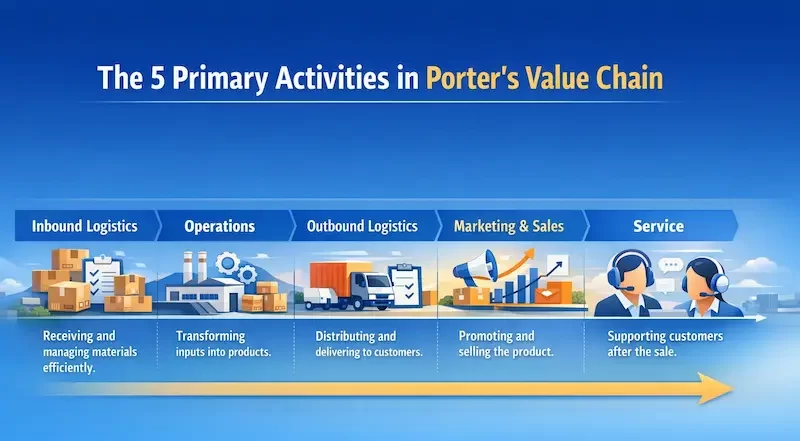
Michael Porter divides the value chain into five primary activities that directly shape how a business creates, sells, and supports its products or services. These activities matter because each one affects cost efficiency, customer value, and overall business performance.
1. Inbound Logistics
Inbound logistics covers how your business receives, stores, and manages the materials or data needed for operations. When this stage runs efficiently, your business can reduce waste, control stock levels, and avoid delays in production or service delivery. For many businesses, better supplier coordination and inventory visibility already create measurable value at this stage.
2. Operations
Operations is the stage where inputs are turned into the final product or service. This is where efficiency, consistency, and quality have the biggest impact on cost and output. When operations are well managed, your business can improve productivity, maintain quality standards, and increase margin more effectively.
3. Outbound Logistics
Outbound logistics focuses on how products are stored, processed, and delivered to customers. A smooth outbound process helps your business meet delivery expectations, reduce fulfillment issues, and improve customer satisfaction. In competitive markets, fast and reliable delivery can strengthen customer trust and influence repeat purchases.
4. Marketing and Sales
Marketing and sales focus on how your business communicates value and turns demand into revenue. This includes positioning, pricing, promotion, and sales execution. If this activity is strong, your business can attract the right customers, improve conversion rates, and compete more effectively without relying only on lower prices.
5. Service
Service covers the support customers receive after a purchase, including assistance, issue resolution, and ongoing engagement. Strong service helps your business build trust, improve retention, and increase long term customer value. It also shapes how customers talk about your brand, which can directly affect future sales.
Support Activities: The Backbone of Your Business
Support activities strengthen the entire value chain by making sure every primary activity can run with better control, efficiency, and consistency. Without strong support activities, even a good product or smooth operation can struggle to deliver sustainable business value.
- Firm Infrastructure: Firm infrastructure covers the systems and functions that support business control, including management, finance, legal, compliance, and quality oversight. When this area works well, your business can make faster decisions, manage risk more effectively, and support growth without creating internal bottlenecks. For businesses in Malaysia, this also matters from a compliance perspective, especially when customer data, contracts, and service standards are involved.
- Human Resource Management: Human resource management affects how well your business attracts, develops, and retains the people behind every core activity. The right hiring and training strategy improves execution, supports service quality, and helps teams adapt when the business grows or changes direction. In other words, strong people management does not only improve performance, but also reduces the long term cost of weak productivity and high turnover.
- Technology Development: Technology development supports innovation, process improvement, and better decision making across the business. This can include product development, automation, system integration, and data analysis that help your teams work faster and with fewer errors. When used well, technology does not only improve efficiency, but also gives the business more room to scale, respond to market changes, and deliver a stronger customer experience.
- Procurement: Procurement is the strategic process of selecting and managing the resources, suppliers, and services your business depends on. Its role is not only to control purchasing costs, but also to protect quality, supply continuity, and operational reliability. When procurement is handled strategically, it improves the performance of multiple business functions at once because better inputs often lead to better outputs.

How to Conduct a Value Chain Analysis (VCA) in 4 Steps
A Value Chain Analysis works best when it helps you make clearer business decisions, not just document internal activities. The point is to understand where value is created, where costs build up, and which areas deserve attention first. To keep the process practical, you can break it into four focused steps.
1. Identify the activities behind your value chain
Start by mapping the key activities across your business, from sourcing and operations to sales and service. This helps you see how value is actually delivered, instead of looking at each department in isolation. Once the full chain is visible, it becomes easier to spot overlap, inefficiency, or activities that no longer support business priorities.
2. Assess cost against value
After identifying the activities, review what each one costs and what it contributes to the customer or the business. Some activities are essential but expensive, while others consume time and budget without adding much value. This step helps you decide where to reduce waste, where to improve efficiency, and where higher investment may still be worth it.
3. Look at how activities affect one another
A value chain should not be reviewed as separate tasks. You also need to see how one activity strengthens or weakens another. For example, better operational control can reduce service issues, while stronger handovers between sales and support can improve customer retention. These links often reveal the real source of performance gains or operational friction.
4. Turn insights into action
Once the weak points and high value areas are clear, the next step is to act on them. That may mean improving processes, reallocating resources, strengthening systems, or refining how teams work together. What matters is making sure every change supports a clear business outcome, whether that is better margin, stronger customer value, or more scalable growth.
This process is especially useful when growth depends on balancing efficiency, service quality, and customer trust at the same time. If customer data is involved across sales, service, or marketing activities, any improvement should also stay aligned with Malaysia’s Personal Data Protection Act 2010 where relevant.