






In accounting, ensuring every figure is recorded correctly is the primary foundation for a company’s financial health, and accounting software plays a key role in supporting this accuracy. One of the most fundamental yet crucial tools in this process is the trial balance.
This document serves as an initial verification step to confirm data integrity before the main financial statements are prepared. With the help of accounting software, this process becomes faster, more accurate, and easier to track within the accounting cycle.
Understanding the trial balance is not just for accountants; it is also vital for business owners and managers who rely on accounting software to gain a clear and reliable picture of their company’s financial standing. It acts as a critical checkpoint, highlighting potential errors early so financial reports remain accurate and decision-making stays on track.
Key Takeaways
|

What Is a Trial Balance?
A trial balance is an internal report that lists all the accounts in the general ledger along with their final balances at a specific accounting period. This report is compiled to verify that the total of all debit balances equals the total of all credit balances within a double-entry accounting system.
If the totals of these two columns are not equal, it indicates a mathematical error in the recording of transactions that needs immediate investigation and correction. This document is not a formal financial statement shared with external parties like investors or banks.
The importance of a trial balance lies in its role as a bridge between daily transaction recording and the preparation of formal financial statements such as the income statement and balance sheet.
By presenting all account balances on a single worksheet, the trial balance provides a preliminary overview of the company’s financial position. It simplifies identifying errors before the data is processed further.
Without this verification process, the risk of errors in the final financial reports would increase significantly, potentially leading to misguided business decisions and compliance issues.
What Is the Main Purpose of a Trial Balance?
The primary purpose of preparing a trial balance is to ensure that the sum of all debit balances in the general ledger is precisely equal to the sum of all credit balances. This equality is a fundamental principle of the double-entry accounting system, in which every transaction affects at least two accounts, with equal values on the debit and credit sides.
Besides being an error-detection tool, the trial balance also serves a strategic purpose as the basis for preparing more complex and formal financial statements. The verified account balance data from the trial balance will be the primary source for preparing the income statement, statement of owner’s equity, and the balance sheet.
Without a balanced trial balance, preparing these reports would be extremely difficult and inaccurate, thereby hindering performance analysis and strategic decision-making by management.
1. Identifying mathematical errors
The most fundamental function of a trial balance is to find an imbalance between total debits and credits, which signals an error in journalizing or posting to the general ledger. These errors can include miscalculations, transposition of numbers, or mistakes in entering account balances.
By identifying a discrepancy, accountants can immediately trace the source of the error before moving to the next stage of the accounting cycle. This process saves time and prevents larger issues from arising later on, ensuring the integrity of the financial data from the outset.
2. Serving as a basis for preparing financial statements
Once all account balances are listed and their totals are proven to be balanced, the trial balance becomes a solid foundation for preparing the main financial statements. The balances of revenue and expense accounts will be used to create the income statement.
This process becomes more efficient and structured because all necessary data is collected and verified in one document, ensuring consistency between internal records and external reports.
3. Assisting in internal and external audit processes
For auditors, both internal and external, the trial balance is a critical starting point for the audit process. The report provides a summary of all the company’s financial activities over a period, allowing auditors to quickly get an overview and plan their subsequent audit procedures.
Auditors use the trial balance to trace sample transactions, verify account balances, and ensure that the resulting financial statements present information fairly and in accordance with applicable accounting principles.
Types of Trial Balance in the Accounting Cycle
In accounting practice, a trial balance is not created just once, but at several key stages of the accounting cycle for different purposes. Each type of trial balance reflects the state of the general ledger at a specific point in time, from before to after the final period-end adjustments.
Understanding the differences between these types is crucial to ensure that every step in the accounting cycle is executed correctly and accurately, leading to reliable financial reports.
Generally, there are three main types of trial balances prepared sequentially: the unadjusted trial balance, the adjusted trial balance, and the post-closing trial balance. Each has a specific role in ensuring that financial data is ready for reporting and that the general ledger is prepared for the next accounting period.
This systematic process ensures that all revenues and expenses are recognized in the correct period (accrual principle) and that temporary accounts are properly closed at the end of the period, maintaining the integrity of the accounting system.
1. Unadjusted trial balance
This is the first trial balance prepared in the accounting cycle after all transactions for the period have been recorded in the general ledger. Its purpose is to verify the equality of total debits and credits before adjusting entries are made.
This report is still in its raw form because it does not yet include the recognition of revenues or expenses that have occurred but have not been recorded, such as asset depreciation, prepaid expenses, or unearned revenue.
2. Adjusted trial balance
After the unadjusted trial balance is prepared and adjusting entries are made, the adjusted trial balance is compiled. This report includes all account balances after adjustments, thus reflecting a more accurate financial picture in accordance with accrual-based accounting principles.
The data from the adjusted trial balance is then used directly to prepare the income statement and balance sheet, as all revenues and expenses have been recognized in their proper periods. This step is critical for producing accurate and compliant financial statements.
3. Post-closing trial balance
This type of trial balance is the last one created in the accounting cycle, after the closing entries have been recorded. Its purpose is to ensure that all temporary accounts (nominal accounts such as revenue, expenses, and withdrawals) have been closed and have zero balances.
Therefore, the post-closing trial balance will only contain permanent accounts (real accounts such as assets, liabilities, and equity), whose balances will be carried forward to the next accounting period, ensuring a clean start for the new cycle.
How to Create a Trial Balance?
 The process of creating a trial balance is a systematic and logical step that follows the recording of all transactions into the general ledger. Although many companies now rely on accounting software to automate this process, understanding the manual steps is essential to appreciate the principles behind it and to be able to troubleshoot if problems arise.
Essentially, preparing a trial balance involves four main steps: listing all accounts from the general ledger, calculating the final balance of each account, placing those balances in the appropriate debit or credit column, and finally, summing both columns to ensure their totals are equal.
Accuracy is key in every step, as even a small mistake can cause an imbalance that takes time to track down. Here is a more detailed breakdown of the steps involved in this crucial accounting procedure.
1. Step 1: Prepare a list of all General Ledger accounts
The first step is to identify and list all the accounts present in the company’s general ledger. This includes all types of accounts, ranging from assets (cash, accounts receivable, inventory), liabilities (accounts payable, bank loans), and equity (owner’s capital), to revenues (sales) and expenses (salaries, rent).
You must ensure that no account is missed to ensure the resulting report is complete and accurate. This list forms the backbone of the trial balance worksheet and sets the stage for the subsequent steps of calculation and verification.
2. Step 2: Calculate the final balance of each account
For each account that has been listed, calculate its final balance at the end of the accounting period. This is done by summing up all the debit transactions and all the credit transactions recorded in that account, and then finding the difference.
The normal balance of an account (whether it is a debit or a credit) will determine where this final balance is placed. For instance, asset accounts normally have a debit balance, while liability accounts normally have a credit balance, and this rule guides the next step.
3. Step 3: Transfer the balances to the debit or credit columns
After the final balance of each account is calculated, transfer that figure into the trial balance format, which typically consists of three columns: Account Name, Debit, and Credit. Place the final balance of each account in the appropriate column based on its normal balance.
As an example, the balance of the Cash account will be entered into the debit column, while the balance of the Accounts Payable account will be entered into the credit column. This segregation is the core of the verification process.
4. Step 4: Sum the totals of the debit and credit columns
Once all account balances have been placed in the correct columns, the next step is to separately sum all the figures in the debit column and all the figures in the credit column. This process will yield two total figures: the total debit and the total credit from all general ledger accounts.
5. Step 5: Verify the equality of the totals
The final and most crucial step is to compare the total of the debit column with the total of the credit column. If these two totals are identical, the trial balance is considered balanced, and you can proceed to the next stage of the accounting cycle with confidence.
However, if the two totals do not match, it means an error has occurred in the bookkeeping process that must be found and corrected before moving forward. An imbalanced trial balance halts the accounting cycle until the discrepancy is resolved.
Simple Trial Balance Example
To provide a clearer picture, let’s look at a simple trial balance example for a fictional company named “Creative Solutions Ltd.” as of the end of the period, December 31, 2026. This example will show how the balances of various general ledger accounts are arranged in debit and credit formats to verify mathematical equality.
The table below illustrates the standard format of a trial balance. The first column contains the account name, followed by the debit and credit columns. Each account will have a balance in only one of the columns, corresponding to its normal balance.
Ultimately, the totals of both columns must be exactly the same, which indicates that the transaction recording process has correctly followed the double-entry accounting principle in a mathematical sense.
This visual representation makes it easy to understand the core function of this essential accounting document.
| Account Name | Debit (RM) | Credit (RM) |
| :— | :— | :— |
| Cash | 150,000 | |
| Accounts Receivable | 75,000 | |
| Inventory | 120,000 | |
| Office Equipment | 80,000 | |
| Accounts Payable | | 90,000 |
| Owner’s Capital | | 250,000 |
| Service Revenue | | 180,000 |
| Salary Expense | 55,000 | |
| Rent Expense | 20,000 | |
| Total | 500,000 | 500,000 |
Common Errors That Often Occur in a Trial Balance
Although the primary purpose of a trial balance is to detect errors, it is important to understand that not all types of errors can be identified through this process. A balanced trial balance is not an absolute guarantee that the accounting records are completely free of errors.
There are several types of mistakes that will not cause an imbalance between total debits and credits, thus requiring other checking methods to uncover them. Recognizing these limitations is crucial for a thorough financial review.
These errors can generally be categorized into two types: those that cause the trial balance to be unbalanced, and those that do not affect the balance. Errors that cause an imbalance are usually easier to detect, such as addition mistakes or posting to the wrong side.
However, errors that do not affect the balance, such as omitting a transaction or misclassifying an account, are far more dangerous because they go undetected by the trial balance and can lead to misleading financial statements.
1. Transposition errors
This error occurs when two digits are accidentally swapped during recording, for example, the number 54,000 is recorded as 45,000. Such a mistake will always result in a difference that is divisible by 9, making it a quick way to identify the possibility of a transposition error.
Although simple, this error is quite common in manual data entry and will cause the trial balance to be unbalanced. Automated systems significantly reduce this risk, but understanding the pattern is useful for manual checks and reconciliations.
2. Posting errors
This is an error where an entry that should have been recorded as a debit is instead recorded as a credit, or vice versa. For example, a cash receipt from a customer of RM10,000, which should debit the Cash account and credit the Accounts Receivable account, is recorded the other way around.
This error will cause a discrepancy in the trial balance equal to twice the amount of the incorrectly recorded transaction. It directly violates the double-entry principle and is a clear indicator that a journal entry was posted incorrectly.
3. Omission of a transaction
This is a type of error that will not be detected by the trial balance. If a transaction is not recorded at all, then no debit or credit entry is made to the general ledger. As a result, the balance between total debits and credits remains intact.
This omission will ultimately affect the correctness of the financial statements, as it understates the activity and balances of the accounts involved, making it a particularly insidious error.
4. Duplicate transactions
Similar to the omission of a transaction, recording the same transaction more than once will also not cause the trial balance to become unbalanced. Because each duplicate entry will include equal debit and credit amounts, the overall totals will remain balanced.
However, this error will cause the balances of some accounts to be overstated, which will certainly lead to inaccurate financial statements. This type of error often occurs due to system glitches or manual oversight and requires careful review of transaction logs to identify and correct.
The Role of Trial Balance in Modern Financial Automation
In today’s digital era, the role of the trial balance has been significantly transformed thanks to financial automation. Previously the preparation of a trial balance was a time-consuming manual task prone to human error.
Modern accounting software and Enterprise Resource Planning (ERP) systems have taken over these repetitive tasks, allowing finance teams to focus on analysis and strategy rather than manual data entry and reconciliation.
System integration is the key to this transformation. In a modern business ecosystem, data from various departments such as sales, purchasing, and inventory automatically flows into the general ledger.
An ERP system ensures that every transaction is recorded immediately under the double-entry principle, so the general ledger is always up-to-date. Consequently, a trial balance can be generated at any time with just a few clicks, providing real-time visibility into the company’s financial health.
Automation with HashMicro Accounting Software
Systems like HashMicro’s Accounting Software fundamentally change how companies manage their trial balance. This software automatically posts every transaction from various modules into the general ledger in real-time.
When a user needs to view the trial balance, the system can generate it instantly without any manual calculations, which drastically reduces the risk of transposition or posting errors.
With integrated financial tools, managers can access accurate data at any time for faster and more informed decision-making, transforming a once-tedious task into a powerful analytical resource.
Optimize Your Business Financial Management with Solutions from HashMicro
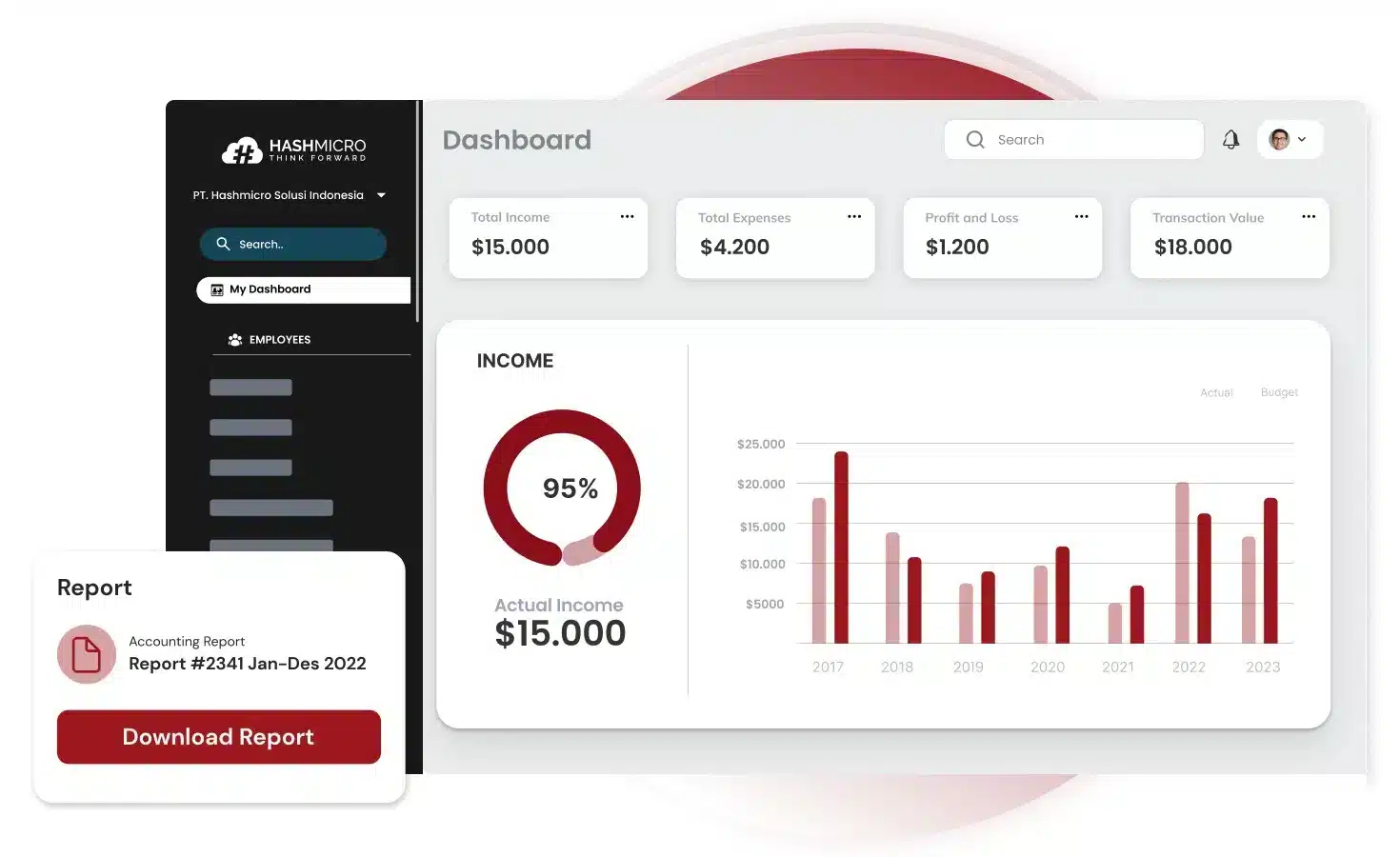
HashMicro provides an integrated ERP system specifically designed to automate and simplify business processes, including trial balance management. With a comprehensive solution, companies can overcome challenges such as slow reporting, manual data errors, and the difficulty of tracking financial status in real-time.
Through its advanced Accounting Software module, companies can process transactions faster, reduce human error, and obtain accurate data in real-time. The system is equipped with features for automatic approval workflows, real-time tracking, and direct integration with other modules.
HashMicro’s Accounting System is designed with full integration between modules, so data from various departments such as accounting, inventory, purchasing, and sales can be interconnected. This provides better visibility into the entire business operation and ensures that every decision is based on accurate and up-to-date information.
Features of HashMicro’s Accounting Software:
- Real-Time General Ledger: Automatically updates all accounts as transactions occur, ensuring the trial balance can be generated instantly with the most current data.
- Automated Bank Reconciliation: Streamlines matching bank statements with company records, reducing manual effort and ensuring cash balances are always accurate.
- Comprehensive Financial Reporting: Generates a wide range of financial reports, including the trial balance, income statement, and balance sheet, with just a few clicks.
- Multi-Currency Management: Supports transactions in multiple currencies and automatically handles conversions and revaluations, which is ideal for businesses operating internationally.
- Seamless Integration with Other Modules: Connects flawlessly with sales, purchasing, and inventory modules to ensure data flows smoothly across the business, eliminating data silos.
With HashMicro, your company can enhance operational efficiency, data transparency, and business process automation. To see how our solutions can concretely help your business, do not hesitate to try our free demo now.

Conclusion
The trial balance is an indispensable component of the accounting cycle, serving as a primary pillar for ensuring the accuracy and integrity of financial data. Although its concept is simple, which is to verify the equality between total debits and credits, its role is crucial as an early error-detection tool.
Amid technological advancements, the process of preparing a trial balance has evolved from a manual task to an automated function integrated within modern accounting systems.
Solutions like HashMicro’s Accounting Software not only speed up this process but also significantly enhance its accuracy, freeing up finance teams to shift from administrative duties to more strategic roles. Get a free demo today!
Frequently Asked Questions
-
Is a trial balance the same as a financial statement?
No, a trial balance is not a formal financial statement. It is an internal working report used by accountants to verify the mathematical accuracy of the general ledger before preparing official financial statements like the balance sheet and income statement.
-
What should be done if a trial balance does not balance?
If the total debits and credits do not match, the first step is to find the difference. Then trace the recording process from the journal back to the general ledger to identify errors, such as summation mistakes, number transpositions, or incorrect debit/credit placements.
-
Does a balanced trial balance guarantee there are no errors?
No. A balanced trial balance only guarantees mathematical equality between debits and credits. Other errors, such as transaction omissions, duplicate entries, or account misclassifications, will not be detected because they do not affect the total balance.
-
What is the main difference between a trial balance and a balance sheet?
A trial balance is a list of all ledger accounts (assets, liabilities, equity, revenues, and expenses) to check the debit-credit balance. In contrast, a balance sheet is a formal financial statement that presents only permanent accounts (assets, liabilities, and equity) to show a company’s financial position at a specific point in time.”
-
What is the main difference between a trial balance and a balance sheet?
A trial balance is a list of all ledger accounts (assets, liabilities, equity, revenues, and expenses) to check the debit-credit balance. In contrast, a balance sheet is a formal financial statement that presents only permanent accounts (assets, liabilities, and equity) to show a company’s financial position at a specific point in time.”
-
How often should a company prepare a trial balance?
A trial balance is typically prepared at the end of each accounting period, whether monthly, quarterly, or annually, as part of the closing process. However, with modern accounting software, a trial balance can be generated at any time for real-time monitoring.