







The modern agribusiness landscape faces unprecedented challenges, from a growing global population and climate change to increasing operational costs and labor shortages. In this demanding environment, traditional farming methods are no longer sufficient to ensure both profitability and sustainability.
Modern technology smart farming emerges as a powerful farming software solution, anchorage technology and data to revolutionize the agricultural industry. By integrating advanced tools, businesses can optimize operations, boost yields, and make more informed decisions than ever before. This comprehensive guide will explore every facet of smart farming, moving beyond mere definitions to provide a practical roadmap for transformation.
We will delve into the core concepts, the essential farming technologies driving this revolution, the tangible benefits for your bottom line, and a step-by-step implementation plan. Whether you manage a large-scale plantation or a specialized agricultural enterprise, understanding and adopting these principles will be crucial to building a resilient, competitive business for the future.
Key Takeaways
|
What Is Smart Farming?
Smart farming represents a fundamental shift in agricultural management, moving beyond simple technology adoption to create an integrated, data-driven ecosystem. It is an approach that uses modern Information and Communication Technologies (ICT) to optimize every aspect of the farming operation, from planting and irrigation to harvesting and supply chain management.
The core of this paradigm is connectivity. A network of sensors, drones, autonomous vehicles, and software platforms works in unison to collect, process, and act upon vast amounts of data. This allows farm managers to gain unprecedented insight into their operations, enabling them to respond proactively to challenges and opportunities.
The Difference Between Smart Farming, Precision Agriculture, and Digital Farming
To navigate the future of agribusiness, it is essential to distinguish between the three core pillars of modern farming. The different scale and focus between aspect precision agriculture, digital farming, and smart farming shown in the table below:
| Feature | Precision Agriculture | Digital Farming | Smart Farming |
|---|---|---|---|
| Core Focus | In-field accuracy (specific spots). | Data & Tools across the value chain. | Integrated Ecosystem & Holistic management. |
| Primary Goal | Pinpoint application of inputs (water, fertilizer). | Digitalizing data for better accessibility. | Strategic decision-making and business optimization. |
| Scope | Observation and measurement of field variability. | Broad use of digital tools in the agricultural chain. | The most comprehensive concept (combining both Precision & Digital). |
Smart farming, however, is the most comprehensive concept, encompassing both precision and digital farming to create a fully integrated ecosystem in which data from across the business is connected and used for holistic management and strategic decision-making, including operations across a cocoa plantation in Malaysia.
Why is Smart Farming Important for the Future Agribusiness?
 The adoption of smart farming is rapidly becoming a strategic imperative for any agribusiness aiming to thrive amidst global pressures. The world’s population is projected to reach nearly 10 billion by 2050, creating an immense demand for increased food production on finite arable land.
By providing real-time data and predictive analytics, smart farming empowers businesses to shift from a reactive to a proactive and predictive model. This capability enables better risk management, optimized planning, and a more stable supply chain, ultimately securing the enterprise’s long-term profitability and viability.
1. Addressing global food security challenges
As the global population continues to grow, the demand for food is escalating dramatically, putting immense pressure on the agricultural sector. Smart farming directly addresses this challenge by enabling significant yield increases on existing farmland.
Through precision management of inputs and real-time monitoring of crop health, farmers can maximize the potential of every hectare. This enhanced productivity is not just about growing more, it is about growing more efficiently, playing a crucial role in ensuring a stable and sufficient food supply for future generations as documented by the Food and Agriculture Organization (FAO).
2. Drastically improving efficiency and productivity
One of the most immediate and impactful benefits of smart farming is the dramatic improvement in operational efficiency. By leveraging data-driven insights, agribusinesses can optimize the use of essential resources like water, fertilizer, and pesticides, often reducing consumption by 30-40%. This precision minimizes waste and significantly lowers operational costs.
Consequently, this efficiency translates directly into higher productivity per unit of input, enabling businesses to achieve greater profitability and a stronger competitive edge in the market.
3. Promoting sustainable farming practices
Sustainability is no longer a niche concern but a core business requirement, and smart farming is a key enabler of environmentally friendly agricultural practices. The precise application of inputs prevents the overuse of chemicals, reducing runoff that can contaminate soil and water sources.
Furthermore, technologies such as soil moisture sensors enable optimized irrigation, conserving vast amounts of water. By minimizing the environmental footprint of farming activities, smart farming supports the long-term health of ecosystems and helps businesses meet growing consumer and regulatory demands for sustainability.
4. Reducing dependency on manual labor
The agricultural sector worldwide is facing a critical shortage of manual labor, a trend that threatens to hinder production capacity. Smart farming offers a powerful solution by automating many of the repetitive, labor-intensive tasks inherent in agriculture.
Autonomous tractors, robotic harvesters, and automated monitoring systems can perform these jobs tirelessly and with high precision. This not only compensates for labor shortages but also improves workplace safety and allows human workers to shift their focus to more strategic, value-added roles within the operation.
Core Technologies Powering Smart Farming
A synergistic suite of advanced technologies drives the innovative farming ecosystem, each playing a vital role in the data-driven agricultural revolution. Therefore, system integration is the linchpin of a successful smart farming implementation, creating a unified platform that enables information to flow freely, enabling holistic and intelligent management of the entire agricultural operation.
1. Internet of Things (IoT) and smart sensors
The Internet of Things (IoT) forms the foundation of data collection in smart farming. This technology involves a network of smart sensors deployed across the farm to gather real-time data on a multitude of environmental and biological factors.
For example, soil sensors can continuously measure moisture levels, pH, and nutrient content, enabling precision irrigation and fertilization. Similarly, wearable sensors on livestock can monitor vital signs such as heart rate and body temperature, providing early warnings of illness and enabling proactive veterinary care and improved animal welfare.
2. Drones and satellite imagery
Aerial imaging from drones and satellites provides a powerful bird’s-eye view of agricultural operations. Drones equipped with multispectral cameras can capture detailed imagery to create health maps of crops, identifying areas of stress from pests, diseases, or nutrient deficiencies long before they are visible to the human eye.
This allows for targeted interventions, saving resources and protecting yields. On a larger scale, satellite imagery helps monitor weather patterns, assess land use across vast areas, and forecast regional crop yields.
3. Artificial Intelligence (AI) and machine learning
Artificial Intelligence (AI) and machine learning are the analytical engines that turn raw data into valuable, predictive insights. AI algorithms can analyze historical and real-time data from sensors and imagery to forecast crop yields, predict disease outbreaks, and recommend optimal planting times.
Machine learning models continuously refine these predictions as more data is collected, improving their accuracy over time. This predictive capability allows farm managers to make proactive, data-backed decisions that minimize risk and maximize profitability.
4. Robotics and automation
Robotics and automation are bringing a new level of efficiency and precision to physical farm tasks. This includes everything from autonomous tractors that can plow fields 24/7 with GPS guidance to robotic harvesters that can delicately pick fruits and vegetables, reducing labor costs and minimizing crop damage. Automated systems, such as smart irrigation grids, use sensor data to deliver water directly to plants exactly when needed, conserving water and ensuring optimal crop growth without manual intervention.
5. ERP software as the integrated data hub
The most critical technology for unifying the entire smart farming ecosystem is a specialized Agriculture ERP (Enterprise Resource Planning) software. This system acts as the central command center, integrating all the data streams from IoT sensors, drones, financial records, and operational activities into a single, cohesive platform.
By doing so, it transforms complex data into intuitive dashboards, financial reports, and profitability analyses. This provides managers with a comprehensive, 360-degree view of the business, empowering them to make strategic decisions that drive growth and efficiency across the entire organization.
A Step-by-Step Guide to Implementing Smart Farming
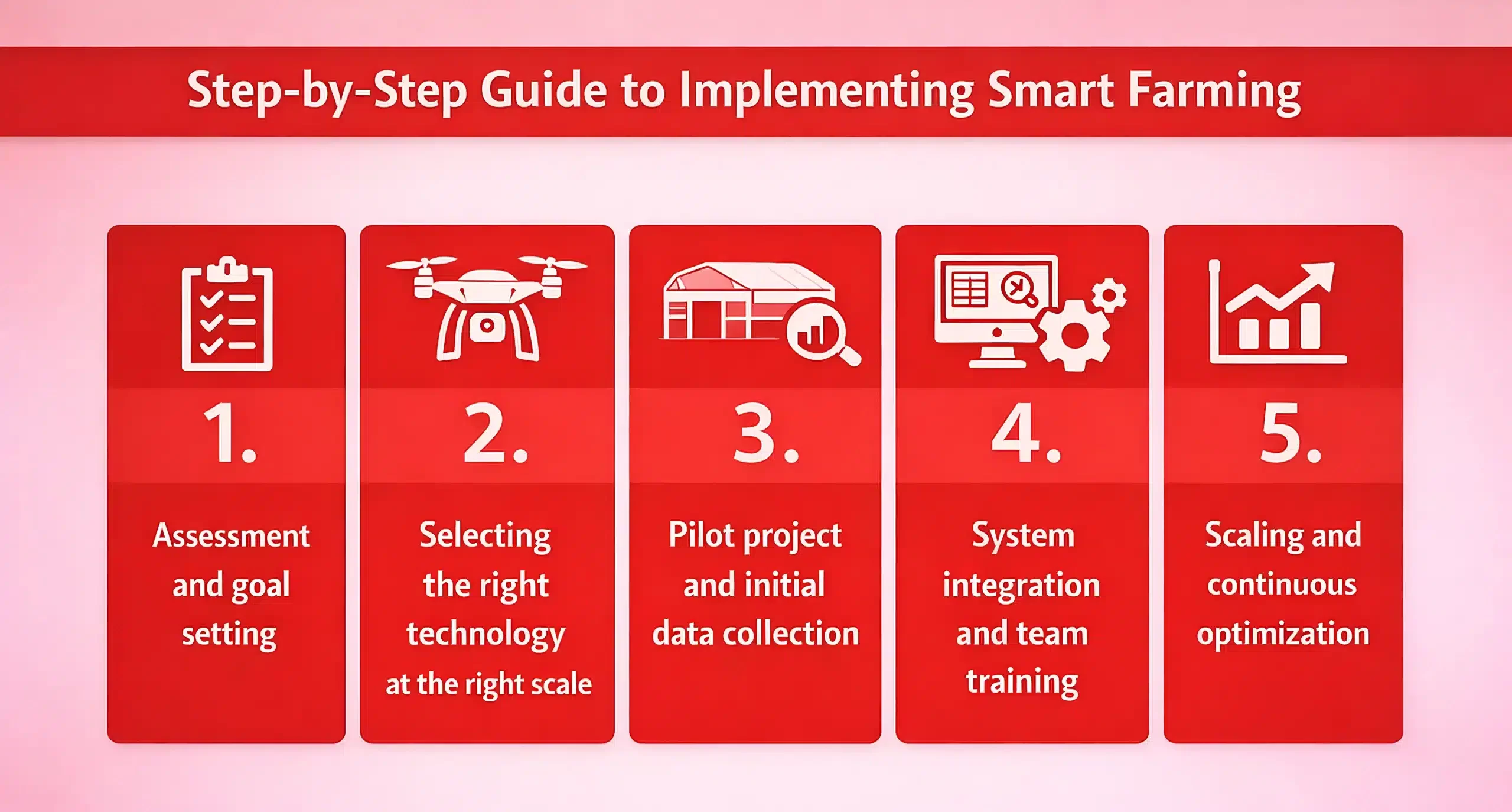
Start with small and focus on measurable outcomes to have successful implementation with identify a specific problem area within your operation and use it as a testing ground for a targeted innovative farming solution. A successful pilot project will provide tangible results and a clear return on investment. This success provides a powerful justification for expanding the implementation to other areas of the business in the future.
Stage 1: Assessment and goal setting
The first step in any transformation journey is a thorough assessment of your current operations to identify the most significant challenges and opportunities for improvement. Are you struggling with high water costs, inconsistent crop yields, or inefficient labor management?
Once you have identified a key pain point, establish a clear and measurable (SMART) goal. For instance, a clear objective could be ‘to reduce irrigation water consumption by 20% within the next six months’ or ‘to improve early disease detection in livestock by 30% in one year’.
Stage 2: Selecting the right technology at the right scale
With a clear goal in mind, the next step is to research and select the technology best suited to achieve it. If your goal is water conservation, a combination of soil moisture sensors and an automated irrigation system would be a logical choice.
It is crucial to match the technology to your business scale because a large commercial farm might benefit from investing in an agricultural drone. Smaller operation might find a more affordable set of IoT sensors and a mobile app to be a more practical starting point, partner with vendors who understand your goals and can recommend scalable solutions.
Stage 3: Pilot project and initial data collection
Before committing to a full-scale rollout, implement your chosen technology in a limited, controlled area, known as a pilot project. This could be a single field, one greenhouse, or a specific section of your livestock herd.
Use this phase to test the technology, gather initial data, and measure its impact against the goals you set in the first stage. This crucial validation step allows you to understand the technology’s real-world performance, refine your processes, and build a strong business case for wider adoption without exposing the entire operation to risk.
Stage 4: System integration and team training
Once your pilot project has proven successful, the next phase is to integrate the new technology’s data stream into your central management platform, such as an Agriculture ERP system. This integration is vital for ensuring that the new data is not siloed but contributes to a holistic view of your business.
Simultaneously, invest in comprehensive training for your team. Ensure they not only know how to operate the new tools but also understand how to interpret the data they generate, empowering them to anchorage these new insights in their daily tasks.
Stage 5: Scaling and continuous optimization
With a validated solution and a trained team, you can now confidently begin scaling the implementation across other areas of your operation. However, the journey does not end here. Smart farming is a process of continuous improvement.
Regularly analyze the expanding dataset to identify new opportunities for optimization and efficiency gains. The insights from one area of your farm might reveal new ways to improve another, creating a virtuous cycle of data-driven innovation and growth.
Challenges in Smart Farming Adoption and How to Overcome Them
The key is to view them not as insurmountable roadblocks but as predictable elements of the transformation journey that require diligent management. A proactive and informed approach will enable your agribusiness to navigate these complexities and unlock the full potential of smart farming.
1. High initial investment costs
The upfront cost of hardware such as sensors, drones, and robotic equipment can be a significant barrier for many businesses. To overcome this, adopt a phased approach by starting with a small-scale pilot project to prove ERP technology Return of Investment (ROI) before committing to larger investments.
Explore financing options, government grants, or subsidies specifically aimed at promoting agricultural technology. Additionally, consider Technology-as-a-Service (TaaS) models, where you pay a recurring subscription fee instead of a large upfront capital expenditure, making the technology more accessible.
2. Infrastructure and connectivity limitations
Many rural and remote agricultural areas suffer from poor or non-existent internet connectivity, which is a major obstacle for real-time data transmission. Solutions to this include leveraging alternative connectivity technologies like LoRaWAN (Long Range Wide Area Network) or satellite internet, which are designed for low-power, long-range communication ideal for IoT devices.
Another strategy is to choose devices that can store data locally (edge computing) and synchronize it with a central system whenever a network connection becomes available.
3. Lack of digital literacy and technical expertise
A significant hurdle is the skills gap within the existing agricultural workforce. Overcoming this requires a dedicated focus on human resources. Invest in ongoing training programs to upskill your current team, and collaborate with agricultural colleges to develop relevant curricula.
When selecting a technology provider, prioritize those who offer comprehensive implementation support, user-friendly interfaces, and extensive training as part of their package to ensure your team is fully equipped to use the new systems effectively.
4. Data security and privacy concerns
As farms become more connected, they also become more vulnerable to cybersecurity risks. Protecting sensitive operational data is paramount. To mitigate this, partner with reputable technology providers who adhere to high security standards, including data encryption both in transit and at rest.
Implement strong internal security policies, such as multi-factor authentication and strict user access controls. Staying informed about data privacy regulations and ensuring your systems are compliant will protect your business from both cyber threats and legal risks.
Optimize Your Agribusiness Management with ERP System
 ERP system specifically designed to automate and simplify complex business processes, including comprehensive management for the agricultural sector. With our holistic solution, companies can effectively overcome challenges such as slow reporting, manual data entry errors, and the difficulty of tracking operational status in real time. Our system is engineered to bring clarity and control to every aspect of your agribusiness.
Through the advanced Agriculture ERP software module, companies can process transactions faster, significantly reduce human error, and gain access to accurate, real-time data. The system is equipped with features for automated approvals, shipment tracking, and direct integration with accounting modules to ensure every transaction is meticulously recorded. This empowers managers to make timely and informed decisions based on reliable information.
Farming system can designed with full integration between modules, allowing data to flow seamlessly between departments such as finance, inventory, procurement, and sales. This interconnectivity provides unparalleled visibility into the entire business operation and ensures that every decision is based on up-to-date, synchronized information. This integrated approach is fundamental to achieving the efficiency and agility required in modern smart farming.
Key Features Agriculture Software:
- Crop Management & Yield Prediction: Helps plan and monitor all stages of crop cultivation, from planting to harvest, using historical data to forecast future yields accurately.
- Livestock Management: Centralizes the monitoring of livestock health, feeding schedules, and breeding cycles to ensure optimal productivity and animal welfare.
- Budget & Cost Control: Provides comprehensive tools for managing project budgets, tracking actual expenses against plans, and analyzing costs to identify savings opportunities.
- Real-Time Monitoring Dashboard: Provides a visual, interactive dashboard that displays key operational metrics in real time, enabling managers to identify issues and make data-driven decisions quickly.
- Supply Chain & Inventory Management: Automates inventory stuff tracking, from raw materials to finished goods, ensuring optimal stock levels and a smooth, efficient supply chain from farm to market.
Enhance operational efficiency, data transparency, and business process automation. To see how our solutions can concretely benefit your business, do not hesitate to try our free demo today.
Conclusion
Smart farming represents an inevitable and essential evolution for the global agribusiness industry. It is a strategic response to the pressing challenges of our time, offering a clear path toward greater efficiency, sustainability, and profitability. The journey is not merely about adopting new gadgets, it is about embracing a new mindset. One that prioritizes data-driven, decision-making, and integrated management to unlock the full potential of agricultural operations.
The transition may present challenges, but with a strategic, phased approach, they are entirely surmountable. By starting small with a pilot project, focusing on clear objectives, and investing in technologies, any agribusiness can begin its transformation journey. The future of agriculture is intelligent, connected, and automated.
Try our free demo today! Your first step is crucial to securing a prosperous and sustainable future in this dynamic industry.
FAQ About Smart Farming
-
What is the initial cost to start implementing smart farming?
The cost varies widely depending on the scale and technology chosen. A pilot project with a few IoT sensors can start from a few hundred to several thousand dollars, while a full-scale implementation with drones and robotics can reach tens of thousands of dollars or more.
-
Is smart farming only suitable for large agribusiness companies?
No. Many innovative farming technologies, especially those based on IoT sensors and mobile apps, are becoming increasingly affordable and adaptable for small and medium-sized farms. The key is to choose technology that solves your specific problems and matches your operational scale.
-
What is the most practical first step to get started?
The most practical first step is to conduct an operational audit to identify the single most inefficient or costly area. Focus your initial efforts on solving that one problem with one or two relevant technologies as a pilot project.