









Malaysia’s construction industry is experiencing an unprecedented surge. Following MIDA’s recent report of a record-breaking RM426.7 billion in approved investments, the pipeline is now flooded with thousands of active projects.
For local contractors and project managers, this massive economic expansion is both a tremendous opportunity and a formidable operational challenge. Winning multiple tenders simultaneously sounds like success, but without the right systems, juggling several job sites can quickly lead to budget overruns and costly delays. Understanding how to manage multiple construction projects in Malaysia now requires technology that unifies teams, financial data, and procurement.
In this article, we explore why Malaysian contractors are turning to Construction ERP solutions to stay ahead of the curve. We also examine the hidden costs of mismanagement and how the right software architecture transforms chaotic multi-project operations
Key Takeaways
|
A localized construction ERP addresses the specific requirements of the Malaysian market by automating complex compliance and streamlining on-site operations. By integrating project data with real-time financial oversight, businesses can eliminate data silos and maintain total control over project margins and delivery timelines.
To capture the full potential of local infrastructure opportunities, explore this specialized suite:

The Impact of Malaysia’s Infrastructure Expansion on Multi-Site Contractors
Under the Twelfth Malaysia Plan, the government has allocated RM426.7 billion to drive infrastructure modernisation and affordable housing initiatives. Current projects range from rural road upgrades in East Malaysia to mass rapid transit extensions within the Klang Valley. This massive volume of active tenders means medium and large contractors are now routinely managing up to fifteen project sites.
Such scaling creates significant operational pressures that traditional spreadsheet-based management systems simply cannot absorb effectively. Research surveying CIDB-registered professionals highlights that poor communication and fragmented information flow between project parties is a leading cause of construct ion delays in Malaysia.
When a site manager makes a materials substitution in the field, the finance team in Kuala Lumpur needs this data in real time. Contractors who deploy integrated, intelligent systems will be best positioned to capture the largest share of this construction pipeline.
Why Managing Multiple Job Sites Demands Absolute Precision
Running several projects simultaneously multiplies your operational and financial risks. If multi-site management is not handled with absolute precision, a minor material shortage or scheduling error on one site can easily cascade, draining the profit margins of your entire portfolio. While basic scheduling tools like Gantt charts might track individual task completion, they completely fail to integrate with your company’s broader financial systems or procurement workflows.
Managing multiple sites shouldn’t feel like a constant game of catch-up with scattered spreadsheets and endless email chains. Teams need a shared digital workspace where the field and the office are finally looking at the same live data, turning fragmented updates into a clear, and a unified picture of progress to really stay in control.
For Malaysian contractors, properly managing these sites also means strictly adhering to local regulations. These centralized systems provide a controlled framework from pre-tender estimation to project handover, ensuring critical localization like Ringgit-denominated accounting, CIDB (Construction Industry Development Board) levy calculations, and LHDN e-invoicing compliance are handled flawlessly. Ultimately, this architecture empowers project directors to view the real-time progress and financial health of all active sites through a single, unified dashboard.
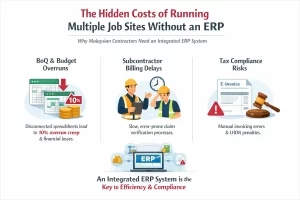
Many Malaysian contractors operate for years without an integrated ERP, relying instead on a patchwork of spreadsheets and WhatsApp chats. Without centralized data, companies face significant opportunity costs and increasing vulnerability to compliance penalties. Transitioning to a unified system is essential for contractors looking to scale their operations profitably in the current market.
Disconnected Bill of Quantities (BoQ) and Sudden Budget Overruns
The Bill of Quantities (BoQ) translates project specs into costs. When managed in disconnected spreadsheets, site updates often fail to reach central finance, causing systemic budget overruns. This “10% overrun creep” turns minor site errors into major financial losses. An integrated ERP eliminates this risk by maintaining a single, live BoQ that updates all modules in real-time
Bottlenecks in Subcontractor and Progress Billing
Subcontractor management is complex as main contractors typically engage dozens of specialist trades per project with unique claim schedules. Without a centralised system, verifying progress claims against actual site milestones is slow and prone to significant error. Construction real-time progress is directly linked to how quickly a contractor can generate accurate, documentation-backed progress claims for clients.
LHDN E-Invoicing and Tax Compliance Vulnerabilities
Malaysia’s LHDN e-invoicing mandate requires contractors to format and submit every transaction through the MyInvois portal for approval. For companies managing multiple projects, the administrative burden of matching invoices to specific contracts and tax codes is enormous. Manual data entry increases the risk of errors that can trigger audits, financial penalties, and delayed payments from clients.
Strategies for Managing Multiple Job Sites
Managing multiple active tenders across regions like the Klang Valley and East Malaysia requires moving away from reactive troubleshooting. To prevent the “10% overrun creep” and subcontractor bottlenecks mentioned earlier, contractors must enforce strict operational discipline across all locations.
To successfully juggle multiple sites, contractors need to focus on three core operational shifts:
- Standardize Workflows: Every site must operate on the exact same baseline for daily reporting, safety protocols, and procurement. This eliminates the reliance on fragmented WhatsApp chats and ensures head office receives consistent data.
- Dynamic Resource Allocation: Heavy equipment, skilled trades, and raw materials cannot be isolated to a single project. They must be tracked and shifted fluidly between sites based on real-time critical path requirements.
- Unified Communication: The gap between field site managers and the central finance team must be closed. A single source of truth ensures that any site-level variation immediately reflects in the master BoQ.
- Enabling These Strategies Through an Integrated System: While the strategies above are critical for scaling, executing them manually across a growing portfolio is completely unsustainable. Institutionalizing these operational shifts requires a centralized system.
By deploying a fully integrated Construction ERP, contractors transform theoretical management tips into automated, enforceble workflows. Instead of patching together disconnected spreadsheets, an ERP provides the necessary digital architecture to lock in standardized processes, execute dynamic resource leveling, and maintain absolute financial oversight across every active construction site.
Let’s break down exactly how this technology resolves the specific bottlenecks of the Malaysian construction landscape.
How a Construction ERP in Malaysia Streamlines Multi-Site Operations
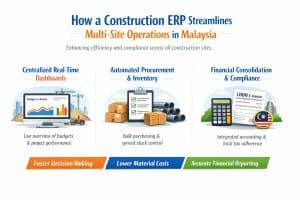
Understanding how a construction ERP operates is crucial for contractors wanting to improve the accuracy of their day-to-day decisions. The value of these systems is found in specific, measurable improvements to procurement speed and financial compliance. By creating a unified data environment, an ERP ensures that information flows seamlessly between the job site and the boardroom.
This connectivity allows project managers to respond to issues immediately rather than waiting for monthly reports to be compiled. Ultimately, an ERP provides the operational backbone needed to handle the complexities of the modern Malaysian construction environment.
Centralized Real-Time Project Dashboards
The most immediate benefit of a construction ERP is the centralized project dashboard that provides a real-time view of all active sites. Instead of waiting for weekly reports, project directors can access key metrics like budget vs. actual cost and schedule performance. This visibility allows for immediate investigation into budget overruns, such as sudden price increases in material supply. For Malaysian contractors managing sites in Johor or Sabah, construction management system reduces the need for constant travel.
Automated Multi-Site Procurement and Inventory
Procurement is a major controllable cost that is often difficult to manage across multiple locations. An integrated ERP centralizes demand, allowing companies to aggregate material needs and negotiate volume discounts that site-by-site ordering misses. Additionally, inventory modules monitor real-time stock levels at each site, automatically triggering replenishment to prevent project delays.
Seamless Financial Consolidation and Local Compliance
A construction ERP synchronizes project accounting with the company’s general ledger for real-time financial accuracy without manual entry. It automatically manages Malaysian-specific mandates like CIDB (Construction Industry Development Board) levies and LHDN e-invoicing. Furthermore, the system stabilizes cash flow by projecting future requirements based on payment schedules and subcontractor claims
Cloud vs. On-Premise ERP vs. Hybrid ERP: Which Deployment Fits Your Sites?
Conclusion
Malaysia’s RM426.7 billion construction, presents extraordinary opportunities for contractors with the operational capability to manage multiple sites. Relying on fragmented, manual processes creates hidden costs that accumulate rapidly as a contractor’s project portfolio scales beyond spreadsheets.
A purpose-built construction ERP addresses these challenges by connecting every job site, financial transaction, and procurement workflow in real time. This results in not just operational efficiency but the organizational capability to deliver more projects with better margins. The decision between cloud and on-premise deployment should be based on practical site realities and future growth ambitions.
HashMicro provides a construction ERP built specifically for Malaysian requirements. To see how this technology can help you capture local infrastructure opportunities, book a free demo today and experience the system in action.

Frequently Asked Questions About Multiple Construction Projects
-
What is the best way to manage multiple construction projects simultaneously in Malaysia?
The most effective approach is to implement a construction ERP system that centralises scheduling, BoQ management, procurement, and financial reporting across all active sites. This eliminates data silos and manual reconciliation that cause cost overruns when managing projects through spreadsheets.
-
How does a construction ERP help with LHDN e-invoicing compliance in Malaysia?
A construction ERP automates the generation and submission of LHDN-compliant e-invoices directly from project records via the MyInvois portal. This ensures every invoice is matched to the relevant contract and tax category while maintaining an audit trail for regulatory compliance.
-
Is a cloud-based or on-premise ERP better for Malaysian construction companies?
Cloud ERP is generally better for companies with dispersed sites, providing real-time accessibility without requiring on-site servers. On-premise ERP may be preferred by contractors with sensitive government data or established internal IT teams, though hybrid models are also available.
-
How does construction ERP software improve subcontractor management in Malaysia?
Construction ERP software centralises subcontractor agreements, progress claim verification, and CIPAA compliance documentation in one system. This reduces processing time from weeks to days, improves payment accuracy, and satisfies Malaysia’s regulatory framework.
-
Can a construction ERP help with procurement savings across multiple project sites in Malaysia?
Yes, a construction ERP allows companies to aggregate material demand across all active sites to negotiate volume discounts with suppliers. The system also enables inter-site inventory transfers to utilize surplus materials, further reducing overall procurement costs and waste.