








In the modern human resources landscape, clarity is the primary engine that drives high performance. When employees understand their overarching outcomes rather than just a checklist of daily tasks, they transform from passive executors into strategic contributors. This is the fundamental role of Key Result Areas (KRAs). By defining the broad categories of accountability for every role, organizations can transform vague job descriptions into focused, high-impact mandates that drive genuine business success.
In Malaysia, the pressure to improve workforce performance has never been greater. According to the Department of Statistics Malaysia (DOSM), labour productivity grew only 2.4% in 2024, a figure that highlights the gap between hiring more people and actually getting more out of them. For businesses looking to close that gap, the answer often starts with one foundational HR tool: Key Result Areas (KRAs).
Key Takeaways
Table of Content
|
What Is a Key Result Area?
A Key Result Area represents a critical function that directly contributes to the success of a specific role and the organization as a whole. Unlike a granular to-do list, which tracks activity, a KRA focuses on ultimate deliverables. This shift from activity-based to outcome-based management is what makes KRAs a powerful tool for modern leaders.
Rooted in goal-setting theory, KRAs reduce cognitive load by clarifying an individual’s primary responsibilities. This fosters a culture of accountability where employees own their results. It is important to note that KRAs are not exhaustive lists; a single role should typically have no more than three to five KRAs. This limitation ensures that employees maintain a laser focus on the most vital aspects of their position, preventing burnout and “priority dilution.”
Defining KRAs is only the first step. The real challenge is keeping them active connected to your team’s day-to-day performance, appraisal cycles, and payroll without adding administrative overhead to your HR team.

How KRAs Came to Be
As work became more complex and less linear, Drucker’s Management by Objectives (MBO) laid the essential groundwork for what we now recognize as KRAs. Key Result Areas emerged as a refinement to define ongoing areas of accountability that remain constant even as short-term objectives or weekly projects change.
In today’s volatile, uncertain, complex, and ambiguous (VUCA) business environment, KRAs provide a necessary anchor. They ensure that even during rapid strategic pivots or organizational restructuring, teams remain aligned with their core purpose and value proposition.
The Differences Between KRAs vs. KPIs vs. OKRs
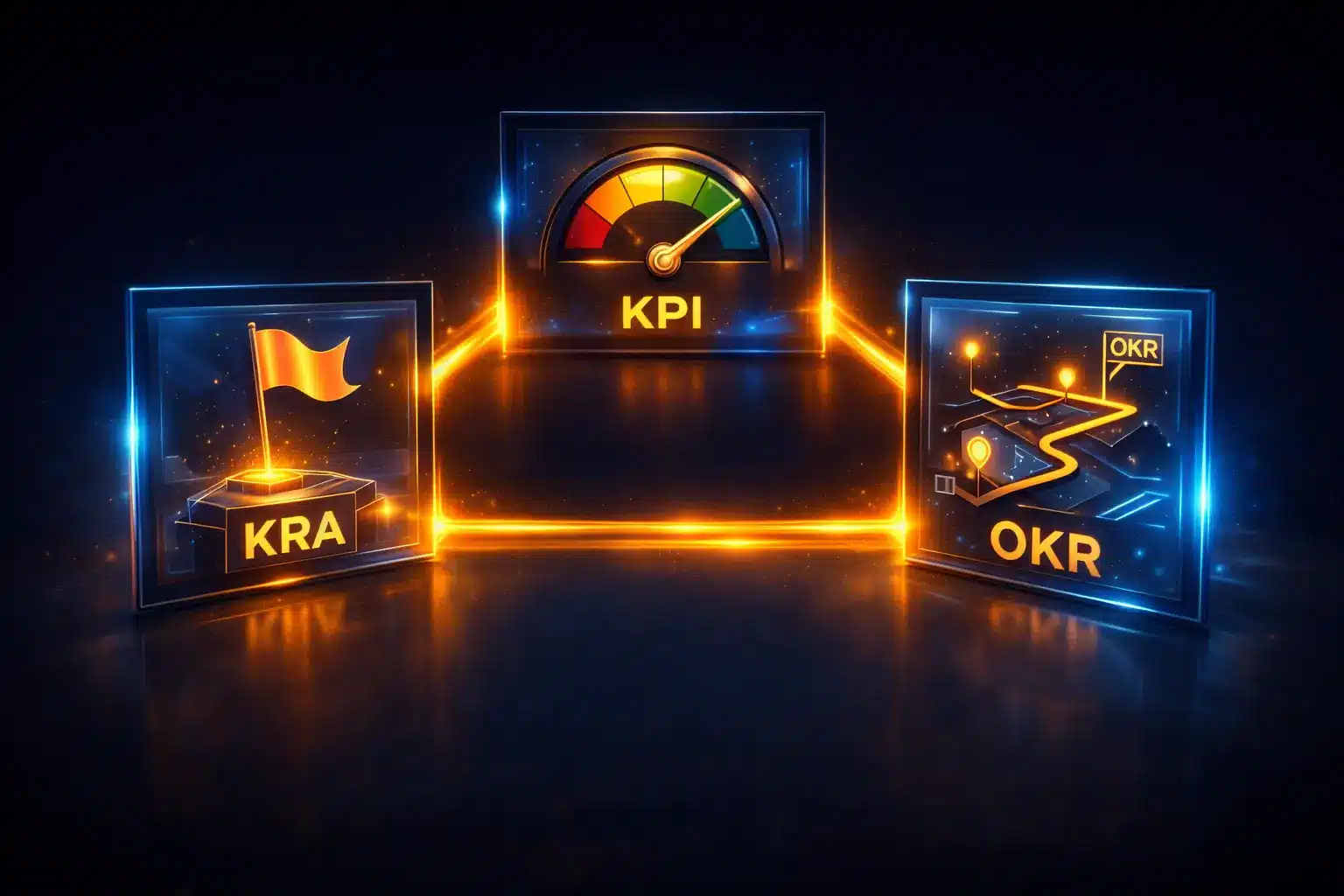
A common mistake in human resources is using KRA, KPI, and OKR interchangeably. However, understanding the nuances between these three metrics is vital for creating a high-performance architecture:
| Concept | Stands For | Focus | Example |
|---|---|---|---|
| KRA | Key Result Area | The “What” qualitative area of accountability | Customer Satisfaction & Retention |
| KPI | Key Performance Indicator | The “How Much” quantitative success metric | Achieve NPS of 75 or higher |
| OKR | Objective & Key Result | The “Where We Are Going” time-bound strategic goal | Deploy AI chatbot to handle 40% of queries by Q4 |
- KRAs (The “What”): These are the qualitative areas of responsibility. They define the scope. Example: “Customer Satisfaction and Retention.”
- KPIs (The “How Much”): These are the quantitative metrics used to measure success within a KRA. Example: “Achieve a Net Promoter Score (NPS) of 75 or higher.”
- OKRs (The “Where We Are Going”): These are ambitious, time-bound goals for strategic growth and innovation. Example: “Objective: Revolutionize customer support via automation. Key Result: Implement AI chatbot to handle 40% of queries by Q4.”
In short: The KRA is the destination, the KPI is the speedometer, and the OKR is the roadmap for a specific journey.
Why KRAs Matter for Your Business
Implementing KRAs is not just an admin task; it is a strategic imperative that improves the entire employee lifecycle and bolsters organizational health:
- Precision Talent Acquisition: Clear KRAs allow HR to create targeted job postings, leading to better candidate matching and higher quality of hire.
- Accelerated Onboarding: New hires reach “full productivity” faster when they are given a clear roadmap of their primary outcomes from day one.
- Objective Performance Appraisals: By using KRAs, performance reviews shift away from subjective personality traits and focus on tangible, documented results.
- Targeted L&D Interventions: Learning and Development programs can be specifically designed to address underperformance in certain KRAs, ensuring a better ROI on training.
- Burnout Mitigation & Boundary Setting: By defining what an employee is responsible for, KRAs implicitly define what they are not responsible for, helping to maintain professional boundaries.
How to Set KRAs for Your Team

To implement Key Result Areas successfully across your organization, follow this methodical four-step process:
| Step | Stage | Key Actions |
|---|---|---|
| 1 | Job Analysis & Strategic Alignment | Identify core outcomes that would be lost if the role were eliminated; cross-reference with departmental goals |
| 2 | Collaborative Drafting | Co-create KRAs with the employee; avoid top-down imposition to build psychological ownership |
| 3 | Define Success Metrics | Link each KRA to 2 – 4 quantitative KPIs; refine any KRA that cannot be measured |
| 4 | Formal Integration & Review | Enter KRAs into your HRIS or performance management system; review annually or quarterly |
KRA Examples by Role and Department
KRAs vary significantly depending on the department and industry. Here are a few detailed examples:
| Role | Key Result Areas |
|---|---|
| Sales Director | Revenue Generation, Sales Team Leadership & Development, Strategic Key Account Expansion, Market Share Growth |
| Software Engineering Manager | Product Delivery Timelines, Code Quality & Reliability, Technical Debt Management, Team Innovation & Research |
| HR Manager | Talent Pipeline Sourcing, Quality of Hire, Employer Branding, Employee Engagement & Retention |
| Marketing Manager | Brand Awareness, Lead Generation Quality, Marketing ROI, Content Strategy Execution |
| Nursing Director | Patient Care Quality, Resource & Staff Allocation, Regulatory Compliance, Patient Safety Protocols |
Common KRA Mistakes to Avoid
- KRA Overload: Assigning more than 5 KRAs dilutes focus. If everything is a priority, nothing is. Prioritize the outcomes that move the needle most significantly for the business.
- Activity-Based Language: Avoid verbs like “helping,” “assisting,” or “doing.” Use outcome-oriented nouns instead such as “Revenue Growth,” “System Uptime,” or “Customer Loyalty.”
- The “Set it and Forget it” Mentality: KRAs must be integrated into daily operations and one-on-one meetings. They are living benchmarks, not documents filed away after onboarding.
- Misalignment with Business Strategy: KRAs that do not connect upward to departmental or company-level goals become meaningless silos. Always validate KRAs against the broader strategic direction.
How to Track KRAs with the Right Tools
Modern HRIS platforms have made it significantly easier to formalize, track, and review KRAs across an entire organization. Rather than managing KRAs in disconnected spreadsheets or static PDF templates, a centralized HR system allows managers to link each KRA directly to individual performance records, compensation reviews, and succession planning data.
When KRA data flows directly into your payroll process and performance appraisal cycles, the administrative burden on HR teams decreases substantially. Automated reminders for quarterly KRA reviews, dashboard visibility into team-wide performance trends, and integration with talent management modules transform KRAs from a once-a-year exercise into a continuous performance conversation.
For organizations managing large or distributed workforces, an integrated HRIS that connects KRA tracking to leave management, compensation planning, and employee engagement surveys provides the most complete picture of organizational health.
Conclusion
Key Result Areas are far more than HR jargon, they are the essential tools for organizational clarity and strategic success. By shifting the focus from mundane tasks to meaningful outcomes, KRAs empower employees to work with purpose and precision.
When integrated with quantitative KPIs and strategic OKRs, KRAs provide the foundation for a high-performance culture that can adapt and thrive in any market condition. For organizations looking to scale, defining KRAs is the first step toward building a truly accountable and autonomous workforce.
For HR teams ready to move beyond manual tracking, the right performance management system one that connects KRA definition to appraisal cycles, payroll, and succession planning is what turns strategy into sustainable results.

FAQ About Key Result Areas (KRA)
-
How many KRAs should an employee have?
Most performance management experts recommend no more than three to five KRAs per role. Fewer KRAs force prioritization and prevent the cognitive overload that comes from trying to excel across too many dimensions simultaneously.
-
Are KRAs the same as job descriptions?
No. A job description typically lists tasks and responsibilities. A KRA defines the outcomes that matter most the end results that justify the role’s existence. KRAs answer “what must be achieved,” while job descriptions often answer “what must be done.”
-
How often should KRAs be reviewed?
KRAs should be reviewed at minimum annually, and ideally aligned with quarterly business reviews. They should be updated whenever the business strategy shifts significantly, a role’s scope changes, or when KPIs consistently indicate misalignment between the KRA and actual performance.
-
Can KRAs be used for team performance, not just individuals?
Yes. Team-level KRAs are increasingly common, particularly in agile environments. When defined at the team level, KRAs foster collective accountability and ensure that individual contributions align with shared outcomes reducing siloed thinking and improving cross-functional collaboration.