








In Malaysia’s rapidly evolving business landscape, managers are under constant pressure to maintain liquidity and ensure compliance. Relying on manual accounting processes can create costly errors, data silos, and slow decision-making, making it harder to stay competitive.
This challenge becomes even more critical as businesses face fluctuating economic conditions and increasing operational complexity. Companies that cannot access real-time financial insights risk inefficiencies that directly impact profitability and growth.
So, how can businesses simplify financial operations while ensuring accuracy and compliance? Advanced cloud-based accounting solutions offer automation, real-time visibility, and integrated reporting, helping leaders make smarter decisions and respond quickly to changing market conditions.
Key Takeaways
|
What Are Finance Tools and Why Are They Crucial for Your Business?
Finance tools are specialized software applications designed to help organizations manage their monetary operations with greater precision and speed. These systems range from basic bookkeeping applications to advanced platforms that handle complex forecasting and data analysis.
The primary function of these tools is to convert raw transactional data into structured, actionable insights that drive strategic decision-making. By automating repetitive tasks, they eliminate human error and free up finance teams to focus on high-value analysis.
Implementing robust finance tools provides real-time visibility into cash flow and profitability, which is essential for maintaining financial health. This technological foundation empowers leaders to mitigate risks and capitalize on growth opportunities with confidence.
Key Categories of Finance Tools Every Business Leader Should Know
Understanding the specific functions of different financial tools is the first step toward building a robust, integrated financial ecosystem. By mapping these categories to your operational needs, you can construct a scalable technology stack that supports long-term business growth.
- Accounting software: This serves as the backbone of your financial system, recording all transactions and ensuring compliance with tax regulations. It automates essential tasks, such as journal entries and financial statement generation, to provide an accurate snapshot of the company’s health.
- Budgeting and forecasting tools: These solutions utilize historical data and market trends to build predictive models that help management plan for the future. They enable companies to set realistic financial targets and allocate resources effectively to minimize risks.
- Invoicing and billing platforms: Focused on accelerating cash inflow, these platforms streamline the creation and delivery of professional invoices to customers. They reduce payment delays through automated reminders and integration with various payment gateways.
- Expense management software: This software controls outgoing cash flow by automating the employee expense claim process and monitoring vendor payments. It provides real-time visibility into spending, helping businesses enforce policies and prevent budget overruns.
- Business intelligence (BI) and data analytics tools: BI tools transform complex financial data into interactive visualizations that reveal trends and actionable insights. Leaders use these dashboards to answer critical business questions and make informed strategic decisions based on data.
- Enterprise resource planning (ERP) systems: An ERP system unifies finance with other departments like sales and inventory into a single, centralized platform. This holistic approach eliminates data silos and ensures a single source of truth for consistent reporting across the organization.
Top Finance Tool Recommendations by Category
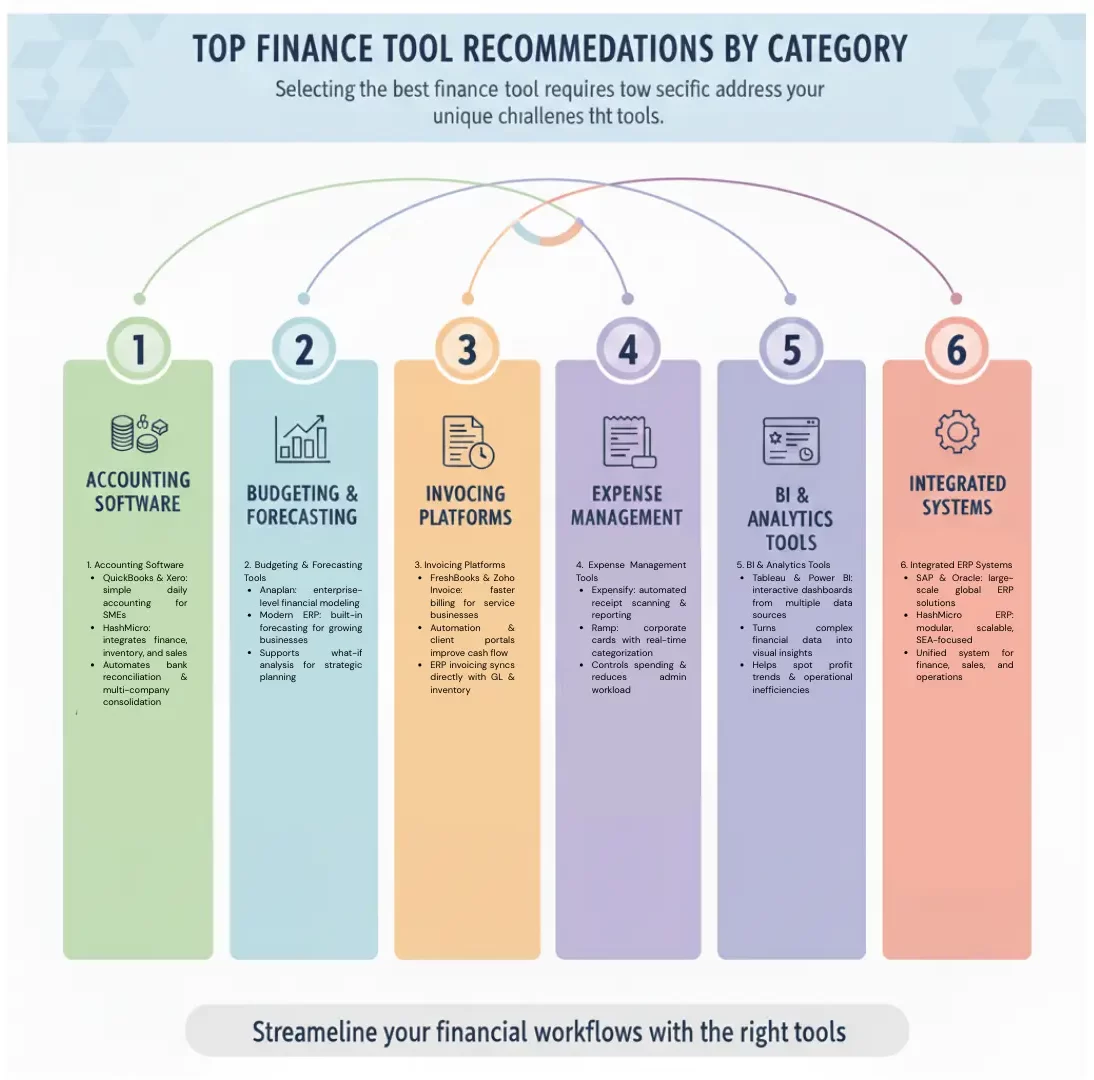
Selecting the best finance tool requires evaluating how specific features address your company’s unique challenges and operational scale. For businesses seeking a customizable and integrated solution, HashMicro Accounting Software stands out as a top choice for streamlining complex financial workflows.
1. Examples of accounting software
For SMEs, QuickBooks and Xero are popular for their simplicity, covering essential daily financial tasks effectively. However, for growing enterprises requiring deeper integration, HashMicro offers advanced modules that connect finance directly with inventory and sales for holistic control.
HashMicro’s solution is particularly beneficial for businesses that need to automate bank reconciliation and multi-company consolidation. This level of automation ensures that financial data remains accurate and up-to-date across all business units.
2. Examples of budgeting and forecasting tools
Enterprise-grade platforms like Anaplan facilitate complex financial modeling and cross-departmental collaboration for large corporations. Growing businesses can also benefit from modern ERP systems that include built-in forecasting modules to predict future performance accurately.
These tools allow finance teams to run sophisticated “what-if” scenarios to prepare for various market conditions. By integrating these capabilities, companies can pivot their strategies proactively rather than reacting to financial distress.
3. Examples of invoicing platforms
FreshBooks and Zoho Invoice excel at helping service-based businesses and freelancers accelerate their billing cycles with user-friendly features. They focus on automation and client portals to ensure payments are received promptly, and cash flow remains steady.
For larger organizations, integrating invoicing within a broader ERP system is often more efficient than using a standalone tool. This ensures that billing data is immediately reflected in the general ledger and inventory records.
4. Examples of expense management tools
Tools like Expensify streamline the reporting process with intelligent receipt scanning, making them ideal for teams with frequent travel expenses. Platforms like Ramp offer further control by combining corporate cards with software to categorize transactions automatically in real-time.
Automating expense management significantly reduces the administrative burden on employees and finance teams alike. It also provides immediate visibility into company spending, preventing unauthorized expenditures before they impact the bottom line.
5. Examples of BI and analytics tools
Market leaders like Tableau and Power BI allow users to create sophisticated, interactive dashboards from various data sources. These tools are essential for transforming dense financial spreadsheets into visual reports that stakeholders can easily understand.
By visualizing data, finance leaders can quickly identify profitability trends and operational inefficiencies. This clarity enables faster, data-driven decision-making that can significantly improve overall business performance.
6. Examples of integrated ERP systems
Global giants like SAP and Oracle provide comprehensive ERP suites suitable for large-scale multinational operations. For Southeast Asian businesses needing local customization, HashMicro’s ERP System offers a modular, scalable platform that centralizes data efficiently.
HashMicro stands out by offering a solution that grows with your business, allowing you to add modules as needed. This flexibility ensures that you have a unified system for finance, sales, and operations without the complexity of disjointed software.
How to Choose the Right Finance Tools for Your Company
Choosing the right finance tool is a strategic decision that significantly impacts your operational efficiency and future scalability. To ensure a successful investment, you must adopt a structured evaluation process that involves key stakeholders from various departments.
- Identify key needs and pain points: Conduct an internal audit to pinpoint specific challenges, such as manual reconciliation errors or delayed reporting. Create a prioritized list of these issues to serve as the primary criteria for evaluating potential software solutions.
- Consider scalability and business growth: Select a tool that can handle increased transaction volumes and multi-entity operations as your company expands. A flexible solution prevents the need for costly and disruptive system migrations in the future.
- Evaluate ease of use and the learning curve: Prioritize software with an intuitive interface to ensure high user adoption rates across your team. A system that is difficult to navigate can lead to frustration and ultimately result in implementation failure.
- Check for integration capabilities with other systems: Ensure the chosen tool connects seamlessly with your existing CRM, HR, or e-commerce platforms to eliminate data silos. Integrated systems allow for automatic data flow, reducing manual entry errors and ensuring consistency.
- Analyze the total cost of ownership (TCO): Look beyond the monthly subscription fee to consider implementation costs, training, and potential hidden charges. Understanding the full cost structure ensures the investment remains within budget while delivering long-term value.
- Utilize free trials and product demos: Test the software firsthand through trials or personalized demos to validate its functionality against your real-world scenarios. This hands-on experience is crucial for verifying that the tool can genuinely solve your specific business problems.
The Future of Financial Management: The Role of Automation and Integrated Systems
The future of financial management is defined by a decisive shift from isolated tools to fully integrated ecosystems that ensure seamless data flow. Companies relying on disconnected systems will struggle with fragmented information, while those adopting unified platforms gain a significant competitive edge.
Financial automation, powered by artificial intelligence, is transforming the industry by handling complex tasks like predictive analysis and anomaly detection. This evolution moves beyond simple data entry, allowing finance teams to focus on strategic initiatives that drive business value.
Modern ERP systems act as the central nervous system for this transformation, unifying operational data to support real-time decision-making. By leveraging these intelligent insights, businesses can navigate market uncertainties with agility and sustain long-term growth.
Case Study: Brink’s Enhances Financial Processes with Automated Systems
Brink’s, a global leader in secure cash management and logistics, has adopted automated financial and operational tools to improve efficiency and control across its complex service offerings. As a company managing cash flows, reconciliations, and reporting for banks and retail clients, Brink’s faced challenges caused by manual handling of large data volumes and fragmented systems that slowed financial operations and risk monitoring.
To address these challenges, Brink’s implemented automated data integration and control systems that consolidate transaction feeds, validation routines, and exception management across multiple countries. By centralizing financial data and automating reconciliation processes, the company gained faster visibility into cash positions and improved accuracy in reporting across its global network.
Conclusion
Adopting the right financial tools is no longer just a system upgrade — it’s a strategic move that shapes how efficiently your business can grow in Malaysia’s fast-changing market. Replacing manual spreadsheets with automated, integrated platforms enables better accuracy, stronger control, and faster decision-making across your organization.
Solutions like HashMicro help businesses simplify complex financial processes through features such as automated reconciliation, intelligent reporting, and multi-company consolidation. With clearer financial visibility and streamlined workflows, leaders can focus less on fixing errors and more on planning sustainable growth.
If you’re exploring ways to modernize your financial operations, consider discussing your business needs with a solution consultant to find the right approach. A tailored consultation can help you understand how an integrated system can support your goals and long-term efficiency.
Frequently Asked Questions about Finance Tools
-
What is the main difference between accounting software and an ERP system?
Accounting software focuses specifically on financial functions like bookkeeping and reporting. An ERP system is much broader, integrating finance with other business operations like inventory, sales, and HR into a single, unified platform for a holistic business view.
-
Are free finance tools good enough for a small business?
Free tools can be a good starting point for freelancers or very small businesses for basic tasks. However, they often lack scalability, advanced features, and support, which can hinder growth. Investing in a paid solution is recommended as your business expands.
-
How do finance tools improve a company’s decision-making process?
Finance tools improve decision-making by providing accurate, real-time data on key metrics like cash flow and profitability. This replaces guesswork with data-backed insights, allowing leaders to identify trends, forecast future performance, and respond to market changes more quickly and effectively.
-
What is the most important feature to look for in a finance tool?
While it varies, robust and customizable reporting capabilities are universally critical. The ability to generate accurate, real-time reports is the core of any good finance tool, as it transforms raw data into actionable insights for strategic planning.