










When goods arrive at the dock but take hours to become available in storage, the impact goes beyond lost time. In high-volume warehouses, small delays per inbound shipment can quickly turn into congestion, higher labor costs, and repeated handling.
One performance indicator that directly affects warehouse flow is dock-to-stock cycle time. It measures the total time from when inventory is received at the dock to when it is recorded, stored in its designated location, and ready for the next operational step.
When dock-to-stock time runs longer than expected, the consequences spread across the operation. Putaway slows down, inventory records lag behind physical stock, and downstream processes such as picking and replenishment lose accuracy. Over time, this reduces efficiency, increases operational costs, and weakens service reliability.
Key Takeaways
|
What Is Dock to Stock?
Why Is an Efficient Dock-to-Stock Process Crucial?
Optimizing the dock-to-stock workflow isn’t just about speeding up one operational step, it’s a strategic investment that impacts the entire supply chain. When inbound goods are processed and stored quickly, inventory control, fulfillment, and delivery schedules become more predictable, which supports higher profitability.
1. Increasing inventory velocity
A fast dock-to-stock process makes newly arrived products available for sale or production sooner, giving businesses a real competitive edge. It shortens internal lead times and helps teams respond more quickly to market demand without waiting for stock to clear receiving.
Faster availability also means customer orders can be fulfilled without unnecessary delays, which improves satisfaction and repeat purchases. It reduces the risk of lost sales due to stockouts by ensuring items are not stuck in the receiving process.
2. Reducing operational costs
Every extra minute a shipment sits at the receiving dock increases costs, especially labor and space usage. A more efficient workflow reduces the man-hours required to receive, verify, and put away goods, resulting in direct savings.
By limiting how long goods stay in a transient, high-traffic area, businesses also reduce the risk of damage, loss, or theft. These hidden costs can quietly erode margins over time, which is why optimization is financially worth it.
3. Improving stock accuracy
The longer items remain in a busy receiving area, the greater the risk of recording errors or incorrect placement. A structured, quick dock-to-stock process, supported by barcode scanning or RFID, helps ensure every item is logged correctly and stored in the correct location.
Poor inventory accuracy can lead to significant financial losses, as highlighted in GS1 US reporting. Accurate stock data supports better planning, more reliable demand forecasting, and stronger decision-making across the organization.
4. Optimizing warehouse space
When goods pile up at the dock, they consume valuable space that could be used for smoother movement and more productive activities. Accelerating dock-to-stock keeps receiving lanes clear and ready for the next arrival, improving throughput capacity.
A clear dock area also creates a safer, more organized, and more efficient environment for the whole team. It’s often a visible indicator that the warehouse is well-managed and performing at a high level.
5. Enhancing customer satisfaction
At the end of the day, warehouse efficiency matters because it affects service quality. A fast dock-to-stock cycle helps customer-ordered products move into picking and shipping sooner, significantly reducing wait times.
Consistently fulfilling orders quickly and accurately becomes a key differentiator in competitive markets. In an on-demand environment, a responsive receiving process isn’t optional, it’s a requirement for customer-centric operations.
How to Measure Dock to Stock Performance (Key KPIs)
To drive warehouse efficiency, you must move beyond guesswork and rely on precise data. Measuring dock-to-stock performance allows you to establish accurate baselines, pinpoint operational bottlenecks, and quantify the ROI of your process improvements. While cycle time is your primary metric, a holistic view of your receiving health requires monitoring a broader set of Key Performance Indicators (KPIs).
1. The dock to stock formula
The core metric for this process is the Cycle Time Duration. However, simply knowing the start and end times is often insufficient for deep analysis. To get actionable insights, you should measure the total time relative to the specific phases of receiving.
The core formula:
Total Dock to Stock Time = Time Goods are Available for Sale – Time Goods Arrived at Dock
Granular breakdown for analysis:
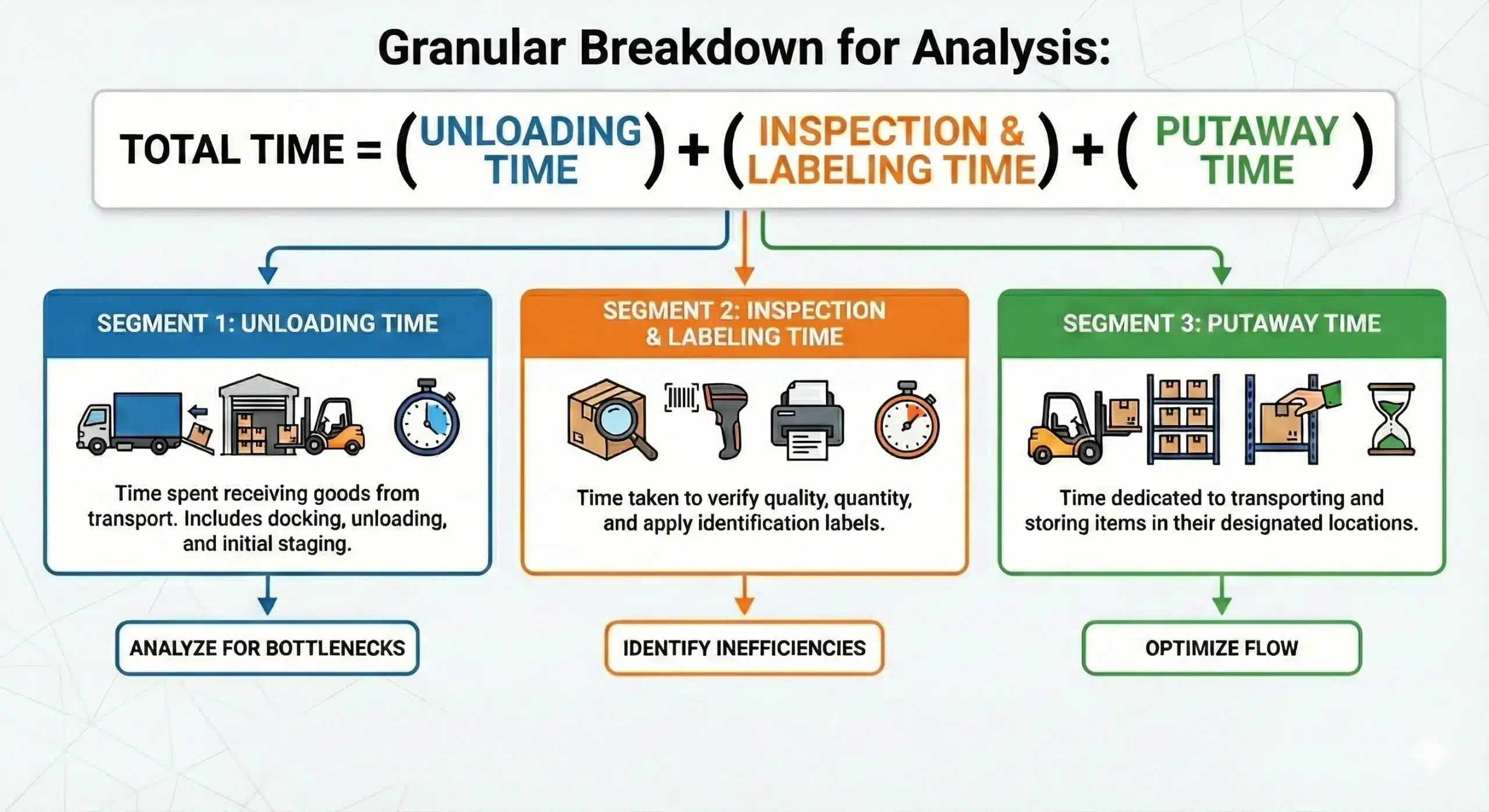
To find where you are losing time, break the formula down into these three segments:
Simulation example (Calculation):
- 10:00 AM, Truck arrives at the dock.
- 10:15 AM, Unloading complete (15 mins).
- 10:45 AM, Quality check and labeling complete (30 mins).
- 11:10 AM, Goods scanned into the rack and marked “Available” in the WMS.
- Result: Your Dock to Stock time is 70 Minutes (1 Hour 10 Minutes).
By tracking these timestamps, you can see if the delay lies in the manual inspection (30 mins) or the forklift travel time (25 mins).
2. Benchmark Standards: Where Should You Aim?
There is no “one-size-fits-all” standard, as targets vary by industry (e.g., cold chain logistics requires faster speeds than construction materials). However, general industry standards suggest:
- Average performance: 2 to 8 hours.
- Good performance: 1 to 2 hours.
- Best-in-class (top tier): Under 30 minutes (Cross-docking scenarios).
Strategy Tip: Do not strictly obsess over global averages. Instead, calculate your average performance over the last 30 days to set an Internal Benchmark, then aim to reduce that time by 10-15% quarter-over-quarter.
3. Critical Supporting KPIs
Speed means nothing if the data is wrong or the goods are damaged. Balance your speed metrics with these quality indicators:
- Receiving accuracy: The percentage of received goods that perfectly match the Purchase Order (PO). Low accuracy leads to inventory discrepancies later.
- Dock utilization rate: Measures how effectively your dock doors are being used. High congestion indicates a need for better scheduling software.
- Receiving damage rate: Tracks the percentage of items damaged during unloading or putaway. High rates often signal rushed labor or improper handling of equipment.
- Cost per item received: A financial metric combining labor, equipment wear, and overhead, divided by the total volume of goods received.
7 Effective Strategies to Accelerate the Dock to Stock Cycle
Speeding up dock-to-stock isn’t about rushing people, it’s about removing friction at every handoff, from the yard to putaway. With the right mix of planning, workflow design, and smart tools, even small tweaks can cut hours of waiting, reduce double-handling, and keep inventory available faster.
Below are seven practical strategies that help warehouses turn receiving from a bottleneck into a smooth, repeatable flow:
1. Pre-schedule receiving appointments
Dock congestion often starts with a simple issue, such as too many trucks arriving at once. A receiving appointment system spreads arrivals across the day, so teams can pre-assign labor, staging space, and equipment before the truck even rolls in.
When unloading starts immediately, you reduce idle time at the dock and prevent inbound queues that spill into the yard. The result is a receiving area that runs on a plan—not on surprises.
2. Implement cross-docking
For fast-moving or urgent goods, cross-docking skips the “park it in storage” step entirely. Items move directly from receiving to shipping, dramatically cutting cycle time and reducing space pressure in the warehouse.
This approach is especially effective for retail and e-commerce distribution where speed matters more than long-term storage. It also supports lean operations by reducing unnecessary touches and handling.
3. Optimize warehouse layout (and slotting)
Dock-to-stock performance is heavily influenced by how far people need to move products after receiving. Make sure the receiving zone has enough space for staging, inspection, and labeling without blocking traffic lanes or creating clutter.
Then, apply smart slotting: store frequently received items closer to the dock and in easier-to-reach locations. Less travel time means faster putaway, fewer delays, and less fatigue for the team.
4. Standardize the receiving process with clear SOPs
Receiving gets slow when every shift does it differently. Clear SOPs, covering unloading, verification, labeling, exception handling, and putaway, keep the workflow consistent and reduce avoidable errors.
Standardization also makes onboarding easier and sets a baseline for improvement. Once the process is repeatable, it becomes easier to measure, audit, and optimize over time.
5. Strengthen execution with targeted training
Even the best process design fails if the team doesn’t know how to execute it efficiently. Regular training on SOPs, safety practices, and device usage (like handheld scanners) helps staff work faster and more accurately.
Well-trained teams also spot issues sooner, wrong labels, misroutes, or recurring supplier errors, and can proactively suggest fixes. That ownership mindset is what keeps improvements from fading after a few weeks.
6. Use barcode scanning or RFID to reduce manual work
Manual checks and typing are usually the biggest time sinks in receiving, and they’re also where most errors start. Barcode scanning and RFID let teams identify, verify, and record goods in seconds, which speeds up confirmation and putaway while reducing human error.
Because every scan/tag read creates a timestamped trail, inventory visibility updates as items move, not hours later. Forbes has highlighted how RFID is reshaping inventory management by improving accuracy and making inventory data far more reliable at scale.
For impact benchmarks, Auburn University’s RFID Lab has been widely cited for raising SKU-level inventory accuracy from roughly the low-60% range to about 95% with RFID. In a related Forbes retail case study, RFID was also linked to a 50% drop in out-of-stocks, showing how accuracy improvements translate into real operational wins.
7. Integrate Yard Management with dock operations (YMS)
Dock-to-stock delays often begin outside the building, trucks waiting, misdirected, or stuck in a yard queue. A Yard Management System (YMS) helps you track inbound vehicles, assign docks more intelligently, and prioritize unloading based on urgency or slot availability.
When yard flow is controlled, trucks reach the right dock at the right time with less waiting. This creates a smoother transition from yard → dock → staging → putaway, which directly improves total cycle time.

The Role of Technology in Automating the Dock-to-Stock Process
Manual checks and scattered updates often create delays and data gaps in dock-to-stock. With the right technology stack, receiving and putaway become more standardized, traceable, and faster, because every movement is recorded in real time.
1. Warehouse Management System (WMS)
A WMS acts as the “control center” that coordinates receiving tasks from unloading to putaway. It helps teams follow a consistent workflow by assigning tasks, prioritizing workloads, and reducing guesswork on the floor.
For dock-to-stock, the system can automatically recommend the best storage location based on factors such as item velocity, product category, temperature zone, and expiry date. Each step is validated through scanning, so inventory location and status are updated immediately without relying on manual input.
2. Barcode and RFID systems
Barcode scanning speeds up receiving by capturing item and quantity data instantly during unloading and verification. It also reduces errors because staff match goods against purchase orders in real time instead of reconciling later.
RFID takes automation further by reading multiple items at once without needing direct line-of-sight. This shortens verification time at the dock and helps items move into storage faster, especially when inbound volumes are high.
3. Multi-warehouse inventory management
In multi-site operations, dock-to-stock improvements only matter if they connect to a centralized inventory view. A multi-warehouse system consolidates stock data from every location, so teams don’t rely on separate files or delayed updates.
With network-wide visibility, businesses can plan transfers, replenishment, and order allocation more accurately. This reduces overstock in one warehouse while another runs out, and improves fulfillment decisions based on real-time availability.
Common Challenges to Dock-to-Stock Efficiency and How We Fix Them
Getting goods from the dock door to the rack sounds simple, but in day-to-day operations, it rarely goes perfectly. In reality, we deal with supplier mismatches, surprise arrivals, manual paperwork, and sudden resource gaps, and if we ignore them, costs and delays build up fast.
Below are four common roadblocks and practical ways we can tackle them without overcomplicating the process.
1. The discrepancy trap, inaccurate shipping information
Impact: High (can trigger inventory errors downstream)
The challenge: Nothing slows receiving faster than goods that don’t match the ASN, wrong quantities, wrong SKUs, or missing details. When that happens, we end up stopping the line to check manually, fix records, and sort out what’s really arrived.
The solution: We push accuracy upstream instead of fixing everything at the dock. A vendor portal connected to the WMS helps suppliers submit shipping data before dispatch, so our team can scan against pre-validated information and flag mismatches immediately without disrupting the whole flow.
2. The “Blindside” arrival
Impact: Medium–High (often leads to overtime and waiting time costs)
The challenge: When we don’t know what’s arriving and when, the receiving bay turns reactive. We might have idle labour during slow hours, then scramble during peak arrivals, usually with more mistakes and longer queues.
The solution: We run the dock like an appointment calendar. With a dock scheduling system or YMS, we can plan labour and equipment ahead of time, so if a heavy container lands at 2 PM, we’ve already got crews ready and forklifts available.
3. Paperwork Paralysis or Manual Processes
Impact: Medium (delays data availability and increases errors)
The challenge: Clipboards and manual key-in work slow everything down and create a gap between “goods received” and “stock visible in the system.” On top of that, manual entry is where small typing errors turn into stock discrepancies later.
The solution: We capture data at the point of activity. When staff use handheld scanners or rugged tablets, every scan instantly validates the item, updates the system in real time, and eliminates the end-of-shift paperwork pile that delays inventory availability.
4. The Resource Crunch (Staff & equipment shortages)
Impact: Medium (creates bottlenecks during peak periods)
The challenge: During seasonal peaks, such as pre-Ramadan stock builds or year-end sales, normal staffing and equipment levels often don’t keep up. When forklifts, checkers, or staging space aren’t enough, goods sit on the dock longer, increasing congestion and risk exposure.
The solution: We plan based on patterns, not guesswork. By reviewing past receiving volumes and forecasting peak windows, we can roster extra manpower earlier, adjust shift planning, and arrange additional equipment before the bottleneck forms, keeping operations smooth even when trucks line up.
Optimise Dock-to-Stock with an Integrated and Automation-Ready Setup
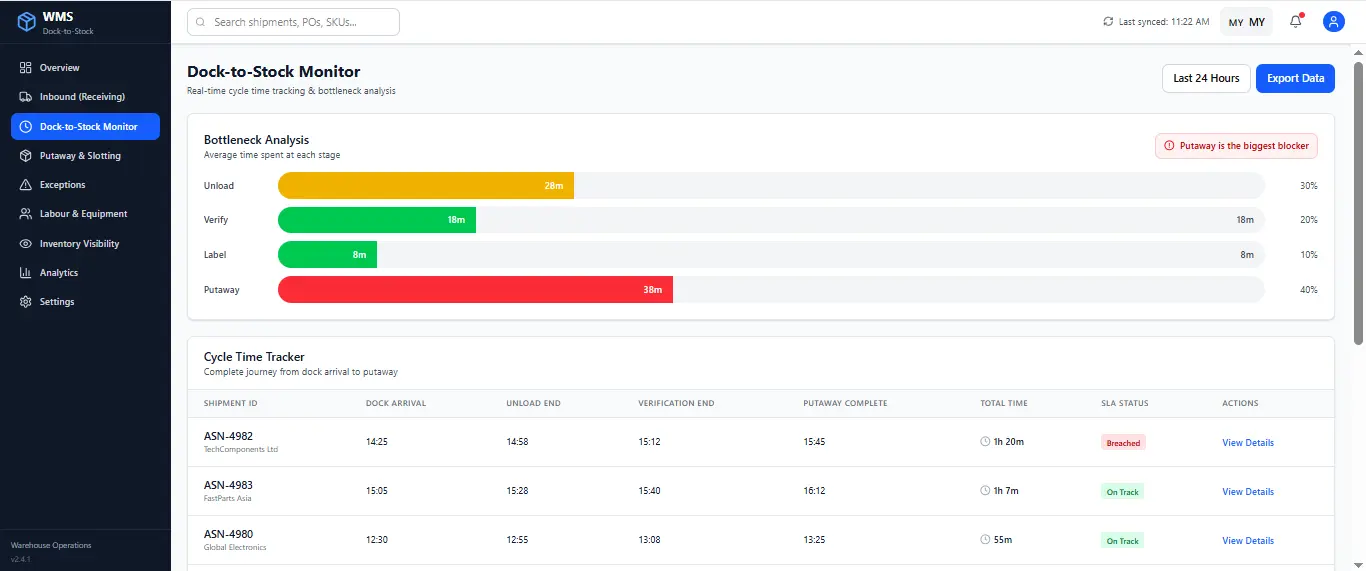
Execution is where logistics strategies prove their value. For companies managing complex supply chains, disconnected systems—where inventory doesn’t sync with accounting—create bottlenecks, delays, and costly errors. This is why integrated digital ecosystems are no longer optional but essential. A strong example is Yokohama Rubber Company, a global tire manufacturer that faced fragmented data across procurement, warehouse, and finance. To unify operations, Yokohama implemented the ecosystem, transforming warehouse management into a fully connected business process.
With an integrated system, procurement data flows directly into inventory upon goods receipt, eliminating manual re-entry and reducing errors. Every stock movement—from dock to final storage is automatically synchronized with accounting records, giving finance teams real-time visibility into asset values. This seamless integration not only improves data accuracy but also accelerates the dock-to-stock cycle, ensuring inventory becomes available for production or sales faster.
Through automated putaway, barcode and RFID-based real-time updates, and linked Inventory and Supply Chain modules, enables holistic operational visibility and smarter resource planning. By centralizing these processes in a single platform, businesses can reduce dock congestion, minimize delays, and turn warehouse operations into a strategic growth driver.
Conclusion
FAQ About Dock-to-Stock
-
What is a good dock-to-stock time?
While it varies by industry and inbound complexity, a common benchmark is around one to two hours from receiving to final putaway. High-performing warehouses can achieve under 30 minutes when processes are standardised and supported by real-time data capture.
-
What are the steps in the dock-to-stock process?
The main steps typically include receiving at the dock, unloading, verifying against the purchase order or ASN, labelling if needed, and completing putaway to the final storage location. Once putaway is confirmed, the inventory status should update so stock is ready for picking, sales, or production.
-
How can technology improve dock-to-stock time?
Tools like a WMS, barcode scanners, and RFID reduce manual entry, validate receipts faster, and guide staff to the right putaway locations based on rules such as zone, velocity, or expiry. As a result, warehouses cut errors, speed up confirmation, and gain real-time visibility from the moment goods arrive.