






A temperature issue in transit can do more than delay a shipment. For businesses handling food, pharmaceuticals, or other sensitive goods, one disruption can lead to spoilage, rejected deliveries, compliance issues, and losses that are harder to recover later.
That is why cold chain logistics is not only about keeping products cold. It is about protecting product quality, reducing waste, and maintaining better control across storage, transport, and handoff points, especially when one weak link can affect margins and customer trust.
As supply chains become more complex, businesses need a clearer view of where cold chain risks usually start and how to prevent them before they turn costly. This guide breaks down the key challenges and practical considerations, so it is worth reading through to the end.
Key Takeaways
|
When cold chain inventory is handled through disconnected processes, visibility and control become harder to maintain. This is why many businesses turn to warehouse management software to improve coordination and daily warehouse accuracy.
Why Cold Chain Fails
Cold chain issues usually start when temperature control breaks at one point in the journey, whether during storage, transport, loading, or customs clearance. Once that happens, sensitive goods can lose quality, fail compliance checks, or become unusable before they even reach the customer.
Keeping products stable from origin to destination takes more than refrigerated trucks. Businesses need the right mix of cold storage, insulated transport, and real time monitoring across different temperature ranges such as frozen, chilled, and controlled room temperature.
The biggest risk often appears during handoffs. A delayed unload, a faulty cooling unit, or poor coordination between facilities can disrupt the entire shipment, which is why strong SOPs, continuous monitoring, and accurate documentation matter so much in cold chain operations.
Cold Chain Essentials
The Role of Warehousing
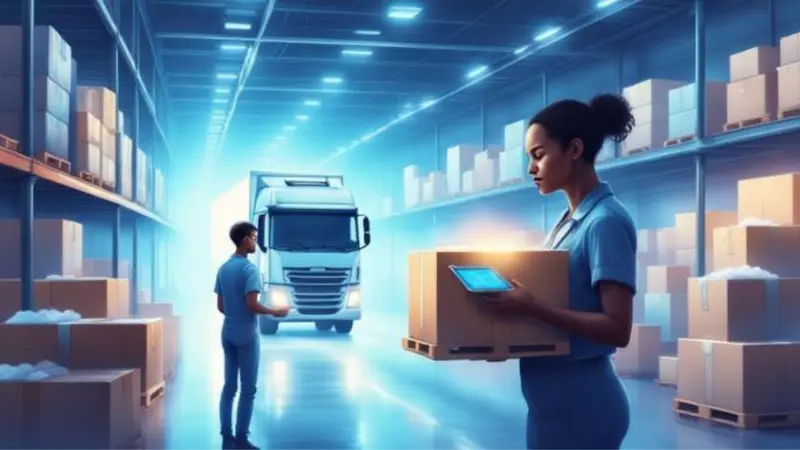
In cold chain operations, warehousing does more than store inventory. It helps preserve product quality, maintain temperature stability, and keep goods compliant while they move through different stages of the supply chain. If warehouse conditions are poorly controlled, even a short delay can affect product safety, shelf life, and overall distribution performance.
That is why businesses need to look beyond storage capacity alone. They also need to assess layout, airflow, insulation, and handling processes, especially when evaluating warehouse models used for efficient storage and logistics. A public cold storage facility may suit businesses that need flexible space during peak periods, while a dedicated facility offers tighter control for operations with stricter compliance requirements.
Some businesses also turn to automated systems such as ASRS to reduce manual handling in freezing environments and improve energy efficiency. In practice, the right warehouse setup depends on how much control, speed, and consistency the operation needs on a daily basis.
Key Industry Uses
Common Cold Chain Risks
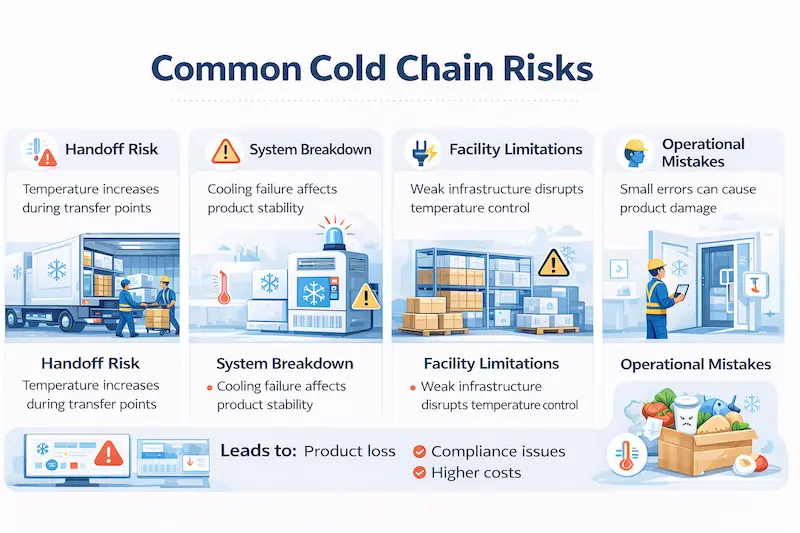
Running a cold chain operation is not just about having the right equipment. It also depends on how well a business manages the moments where temperature control is most likely to fail. Below are some of the most common complex logistics challenges and the practical steps that help reduce the risk.
The Broken Link Problem
The highest risk in cold chain usually appears during handoffs. Moving goods from a refrigerated truck to a loading dock, or leaving shipments too long on an airport tarmac, can cause temperatures to rise within minutes. Tighter coordination, better timing, and added protection during transfers help reduce these gaps.
Equipment Failure
Refrigeration breakdowns can happen without much warning, and one failure can affect an entire shipment in a short time. That is why preventative maintenance, backup power, and real time temperature alerts are basic safeguards, not optional additions.
Infrastructure Gaps
Cold chain performance also depends on local infrastructure. In areas with unstable electricity, limited cold storage, or weak transport access, businesses often need to rely on shorter delivery routes, stronger insulation, or alternative cooling solutions to keep goods protected.
Human Error
Small mistakes can be just as costly as technical failure. A door left open too long or the wrong temperature setting can quickly affect product quality, which is why regular training and clearer handling procedures remain essential across the operation.
Cold Chain Technology
The modern cold chain is driven by data and technology. The days of relying on manual temperature checks and paper based tracking are long gone. Today, supply chain visibility is achieved through a sophisticated ecosystem of interconnected hardware and software, enabling proactive decision making and better control across temperature sensitive operations.
At the heart of this technological revolution is the Internet of Things (IoT). IoT sensors are deployed throughout the supply chain, inside individual packages, within transport containers, and across warehouse storage racks. These sensors continuously monitor temperature, humidity, and location, transmitting data in real time. This allows teams to respond faster before product quality is affected.
To synthesize and act upon this massive influx of data, organizations must rely on advanced software solutions. Implementing a warehouse management system that supports cold storage visibility is critical for orchestrating the complex internal logistics of a temperature controlled facility. This helps teams manage inventory movement, temperature zones, and stock rotation more accurately.
Furthermore, artificial intelligence (AI) and machine learning are beginning to transform how logistics providers anticipate and mitigate risks. These tools help businesses spot likely disruptions earlier, improve route planning, and reduce avoidable delays for time sensitive goods.
Blockchain technology is also emerging as a powerful tool for ensuring the authenticity and integrity of the cold chain. For businesses with stricter compliance requirements, it can strengthen traceability by creating a clearer record of product movement, temperature history, and custody changes.
Cold Chain Fulfillment
The final stage of the supply chain, fulfillment and last mile delivery, presents unique challenges for temperature sensitive goods. As e commerce and direct to consumer models grow, businesses face more pressure to deliver perishable products quickly without losing temperature stability along the way.
Operating a fulfillment warehouse for temperature sensitive goods requires a layout that supports fast and accurate picking in chilled or frozen conditions. To reduce fatigue and improve productivity, businesses often use picking methods and worker support tools that shorten handling time inside low temperature zones.
Cross docking is a highly effective strategy utilized in temperature controlled fulfillment. In a cross docking operation, inbound shipments are unloaded from transport vehicles, immediately sorted, and loaded directly onto outbound vehicles with little to no storage time in between. This is especially useful for highly perishable products because it reduces storage time, lowers holding costs, and helps limit temperature exposure.
Last mile delivery is widely considered the most complex and expensive segment of the supply chain. At this stage, temperature control depends heavily on suitable packaging, accurate transit planning, and efficient delivery routes. The less time goods spend waiting or moving through uncontrolled conditions, the lower the risk of spoilage and delivery failure.

Compliance and Standards
Cold chain compliance is not only about operational discipline. It also protects product safety, reduces recall risk, and helps businesses avoid penalties, shipment rejection, or reputational damage when temperature sensitive goods move across regulated markets.
In the pharmaceutical sector, Good Distribution Practice or GDP sets the baseline for how medicines should be stored, transported, and handled. This usually requires validated equipment, complete documentation, and regular audits to prove that temperature conditions remain consistent throughout the journey.
For food and beverage products, compliance is just as important because temperature failures can quickly affect safety and shelf life. Standards such as FSMA and HACCP push businesses to monitor risks earlier, document control points more clearly, and keep temperature handling consistent from storage to delivery.
Cross border shipments add another layer of complexity because requirements can differ by country, product type, and inspection process. That is why businesses need accurate documents, faster clearance planning, and access to temperature controlled holding areas so goods stay protected while waiting at ports or checkpoints.
Cold Chain Sustainability
Sustainability is becoming a bigger issue in cold chain because temperature controlled operations consume large amounts of energy and still rely on systems that can increase emissions. For businesses, this is no longer only about environmental responsibility. It also affects operating costs, compliance pressure, equipment strategy, and long term supply chain resilience.
One major area of change is refrigerant use. Traditional hydrofluorocarbon refrigerants have a high global warming impact, which is why more operators are moving toward natural alternatives such as ammonia and carbon dioxide. Although these options require stricter handling and the right infrastructure, they can help reduce environmental impact while improving refrigeration efficiency over time.
Energy efficiency inside cold storage facilities is also becoming a priority because warehousing is one of the biggest cost centers in cold chain operations. Better insulation, LED lighting, smarter energy controls, and renewable power sources such as solar can reduce waste while helping facilities maintain more stable temperature conditions. Some operators also use thermal energy storage to manage cooling loads more efficiently during peak hours.
Transport is also changing as businesses look for ways to lower emissions without weakening product protection. Electric refrigerated vehicles are gaining traction in last mile delivery, while alternative fuels and reusable packaging are becoming more relevant in longer distribution networks. The real challenge is not simply becoming greener, but doing so without compromising product quality, compliance, or delivery reliability.
To see which setup fits your operational needs more closely, you can review the pricing scheme below. This gives a clearer view of the available options before making any further decision.
Expanding Use Cases
Cold chain logistics is no longer used only for basic perishables. It now supports a broader range of industries that depend on precise temperature control because even a minor deviation can affect product safety, shelf life, regulatory compliance, and commercial value.
In the pharmaceutical and biotechnology sectors, the stakes are especially high. The growth of personalized medicine, cell and gene therapies, and complex biologics has increased the need for ultra low temperature environments, sometimes at cryogenic levels. In this setting, one temperature excursion can do more than damage a shipment. It can compromise treatment effectiveness and create serious risks for patient safety.
The same level of precision is becoming more important in high value agriculture and floriculture. Sensitive products such as export flowers need controlled humidity and chilling conditions to slow biological aging and preserve quality during long distance transit. Premium seafood and meat products also rely on chilled or rapid freezing methods to prevent bacterial growth and protect freshness, texture, and market value from origin to destination.
Implementation Steps
Building a resilient temperature controlled network requires a more structured approach, because weak planning early on can lead to spoilage, compliance issues, and unnecessary losses later. Organizations looking to implement or upgrade their cold chain operations should follow these critical steps:
- Audit Thermal Requirements: Map out the exact temperature and humidity tolerances for every product in your portfolio, accounting for seasonal variations along the transit route.
- Procure Specialized Equipment: Invest in the right mix of active cooling units like reefer trucks and passive packaging such as phase change materials and vacuum insulated panels, based on the actual needs of the product.
- Deploy Continuous Monitoring: Integrate Internet of Things (IoT) sensors and data loggers to provide real time visibility into the thermal environment throughout the journey.
- Establish Standard Operating Procedures (SOPs): Create strict, documented protocols for loading, unloading, and emergency response to ensure all personnel are aligned on best practices.
Conclusion
Cold chain logistics is no longer just a supporting function in the supply chain. For businesses handling temperature sensitive goods, it directly affects product quality, compliance, waste levels, and customer trust. As supply chains grow more complex, maintaining control across storage, transport, monitoring, and fulfillment becomes far more important than simply moving goods from one point to another.
The challenge is that cold chain performance depends on consistency at every stage. A weak handoff, equipment issue, poor visibility, or delayed response can quickly create losses that are difficult to reverse. That is why businesses need a more structured approach, supported by stronger SOPs, better monitoring, and the right operational systems to keep temperature sensitive goods protected from end to end.
If your business is looking for a more practical way to improve cold storage visibility, inventory control, and day to day warehouse coordination, this is a good time to explore what that setup should look like in practice. A free demo can help you see how the right system fits your operational flow before cold chain issues turn into larger business risks.
Frequently Asked Questions About Cold Chain Logistics
-
What happens if cold chain temperature is interrupted?
When temperature control breaks, products can lose quality, fail compliance checks, or become unsafe before reaching the customer. This is especially critical for food, pharmaceuticals, and other sensitive goods that depend on stable handling from storage to delivery.
-
Which industries depend the most on cold chain logistics?
The biggest users are usually pharmaceutical, food and beverage, agriculture, seafood, and other sectors that rely on strict temperature control to protect safety, shelf life, and product value throughout the supply chain.
-
Why is real time monitoring important in cold chain operations?
Real time monitoring helps businesses detect temperature shifts earlier, respond faster, and maintain clearer traceability during storage and transport. This improves visibility, reduces spoilage risk, and supports stronger compliance.
-
What are the most common causes of cold chain failure?
The most common causes usually include poor handoff coordination, equipment failure, infrastructure limitations, and weak monitoring during storage or transit. In many cases, human error and delayed response also increase the risk of spoilage and product loss.