


Running a central kitchen in Malaysia means you’re not just managing one kitchen, you’re the backbone of every outlet that depends on you for consistent food, accurate portions, and on-time delivery. Whether you’re supplying five F&B outlets in Klang Valley or managing distribution across a growing franchise network in Johor and Penang, the complexity compounds fast.
Across Malaysia, many multi-outlet restaurants face the same hidden issues, such as stock levels that don’t reflect reality, ingredient usage that’s hard to track, and production plans that change too late. When these gaps pile up, costs creep up through avoidable waste, emergency purchasing, and inconsistent quality, risking customer loyalty.
That’s where a centralized kitchen software system becomes useful, giving teams one place to plan production, monitor inventory movement, and coordinate distribution with real-time visibility. A practical kitchen management system helps connect these daily tasks so teams can work from the same data without constant back-and-forth.
Key Takeaways
|
Your outlets are waiting on the kitchen. The kitchen is waiting on stock that wasn’t tracked. Fix the gap at the source.
Shortlisted Best Central Kitchen Management System
Based on my research, the following are the best central kitchen management systems, excelling in efficiency, scalability, and ease of integration. These solutions have been carefully evaluated for their ability to streamline operations, improve inventory control, and enhance overall productivity.



Best Because
Goods transfer, cost control, and optimized inventory.


After reviewing the top central kitchen software options, you may need a clearer comparison of each solution’s strengths and ideal use cases. The table below highlights key advantages and the types of F&B operations each system is best suited for, helping you choose the right solution for your kitchen and production workflows.
| Software | Strength | Why we choose this software | Pricing Model |
|---|---|---|---|
HashMicro |
End-to-end central kitchen system with inventory, production planning, and multi-outlet integration | Supports SST compliance, real-time stock tracking, and integration with POS and ERP systems in Malaysia | Custom Pricing |
Melba |
Recipe management and food costing platform for central kitchens | Helps standardize recipes, control costs, and manage kitchen operations efficiently | Custom Quote |
Restroworks |
Cloud-based kitchen and restaurant management platform | Ideal for multi-outlet F&B businesses needing centralized kitchen control and analytics | Subscription |
Apicbase |
F&B operations platform with inventory and recipe management | Supports centralized production, supplier management, and cost control | Custom Pricing |
Gofrugal |
Retail and restaurant software with central kitchen capabilities | Suitable for SMEs needing integrated POS and kitchen management | Subscription |
LS Retail |
Unified retail and F&B system with central kitchen integration | Strong ERP integration with Microsoft Dynamics for large operations | Custom Quote |
Supy |
Inventory and procurement platform for restaurants | Helps reduce waste and manage supplier orders efficiently | Subscription |
Inresto |
Restaurant management platform with central kitchen features | Supports order management, inventory tracking, and kitchen coordination | Subscription |
Sharva POS |
POS system with backend kitchen and inventory management | Affordable solution for small to mid-sized F&B businesses | Custom Pricing |
Linga ROS |
Cloud-based restaurant operating system with kitchen management tools | Supports multi-location F&B operations with real-time data insights | Subscription |
What is Central Kitchen Software?
Central kitchen software is a specialized tool used to manage central kitchens that supply food and ingredients to multiple outlets. It combines inventory, order processing, production planning, and distribution tracking in one system to ensure consistent food supply across branches.
If it connects with an integrated cloud POS system, the software helps optimize food production, reduce waste, and track inventory in real time. It also enables managers to schedule production, manage suppliers, and monitor goods distribution across outlets, improving coordination and efficiency across the supply chain.
What are the Benefits of a Kitchen Management System?
Central kitchen software is a vital tool for businesses seeking to optimize their operations and foster collaboration between outlets and headquarters. It offers a range of benefits that simplify processes, reduce inefficiencies, and improve overall business performance. Here are some key advantages:
- Streamlined Ordering Process: Central kitchen software centralizes order management, improving communication between outlets and headquarters. This ensures orders are processed accurately and efficiently, minimizing delays and errors.
- Seamless Integration with Accounting Systems: The software integrates directly with accounting systems for businesses to automate the generation of critical documents like sales invoices, delivery orders, and stock receipts. This reduces manual data entry, saving time and enhancing accuracy.
- Enhanced Inventory Management: With real-time inventory tracking, businesses can monitor stock levels across multiple locations. This helps prevent overstocking or shortages, optimises stock levels, and reduces waste.
- Improved Operational Efficiency: By automating repetitive tasks and streamlining workflows, the software enables teams to focus on strategic activities while ensuring seamless operations across procurement and documentation.
- Accurate Reporting and Analytics: Real-time reporting tools provide valuable insights into business performance. These analytics enable trend identification, effective cost management, and informed, data-driven decision-making.
- Enhanced Customer Satisfaction: With consistent stock availability and efficient order processing, businesses can better meet customer demands, resulting in improved customer service and satisfaction. Also when daily workflows run on a reliable kitchen management system, teams spend less time fixing errors and more time serving customers.
This comprehensive tool enables businesses to achieve operational excellence while maintaining scalability and adaptability in a competitive environment.
Key Features to Look For in a Central Kitchen System
Kitchen management software helps improve and organize daily activities in restaurants, catering services, and other food-related businesses. To choose the right system, it’s important to understand the essential features that support smooth and efficient kitchen operations.
| Feature | Description |
|---|---|
| Smart Inventory Control | If integrated with inventory automation tools, this software can monitor ingredient levels, usage history, and expiry dates in real time. Sends alerts before stock runs low, helping prevent overordering or spoilage. |
| Central Operations Hub | Provides a unified dashboard to oversee all outlets, so managers can access performance data, update menus, and adjust settings across branches from a single place. |
| Recipe and Production Management | Stores standardized recipes, helps adjust serving sizes, and tracks ingredient requirements for each dish to ensure consistent quality and accurate production planning. |
| Order Progress Monitoring | Tracks customer orders from placement to delivery and shows preparation stages and estimated completion time to help teams prioritize tasks efficiently. |
| Kitchen Workflow Details | Displays full order information, including item modifications, special requests, and quantities, with filters and alerts when orders are ready to be served or dispatched. |
| Menu and Cost Planning Tools | Helps plan menus, calculate food costs, and suggest ingredient alternatives when supplies are limited so you can control costs and keep menus profitable. |
| Purchase and Supplier Coordination | Lets you create purchase orders, track delivery status, and automate replenishment for frequently ordered items to improve purchasing accuracy and control. |
| Staff Scheduling and Activity Tracking | Restaurant automation scheduling system helps organize employee data, work schedules, attendance, and shift changes, while supporting leave requests and labor compliance to streamline team management. |
| Business Insights and Reporting | Generates reports on sales, inventory, order performance, and customer trends so decision makers can reduce waste, refine menus, and identify growth opportunities. |
| Cloud-Based Accessibility | As a cloud-based system, it can be accessed from any device with an internet connection and receives automatic updates for easier multi-outlet management. |
| Integrated Restaurant Ecosystem | Connects with POS, accounting, inventory, and delivery platforms to reduce manual data entry and keep information consistent across the entire F and B operation. |
| Scalable Platform Design | Supports business growth, whether you expand to new branches or introduce new concepts, and can adapt to restaurants, catering services, cloud kitchens, and delivery brands. |
| Real Time Order and Delivery Tracking | Provides up-to-date order and delivery status so the kitchen team can minimize delays while customers receive more accurate expectations and timely service. |
10 Recommended Kitchen Management Software in Malaysia
Now that you understand the importance of central kitchen software, it’s time to find the right solution for your business. Here’s a list of the top central kitchen software providers in Malaysia for your reference.
1. HashMicro Central Kitchen Management System
HashMicro is a robust and comprehensive solution trusted by over 1,750 world-class enterprises, including McDonald’s and Banban. It offers a range of modules and software solutions tailored to different business needs.
One of HashMicro’s business solutions is Central Kitchen Software. It is designed to be user-friendly, enabling even those with minimal technical expertise to navigate and use the system effectively. This is particularly beneficial for Malaysia’s diverse workforce.
The ability to customize features and integrate with existing systems makes this ERP software a versatile choice for Malaysian businesses looking to enhance their central kitchen operations.
For Malaysian F&B operators, HashMicro’s central kitchen module supports halal ingredient traceability from supplier to production stage, helping businesses maintain compliance with JAKIM’s chain restaurant certification requirements. The system also integrates with SST reporting and supports multi-outlet distribution across Klang Valley, Penang, and Johor Bahru networks.
Here’s how HashMicro’s Central Kitchen Software can benefit companies in Malaysia through its key features:
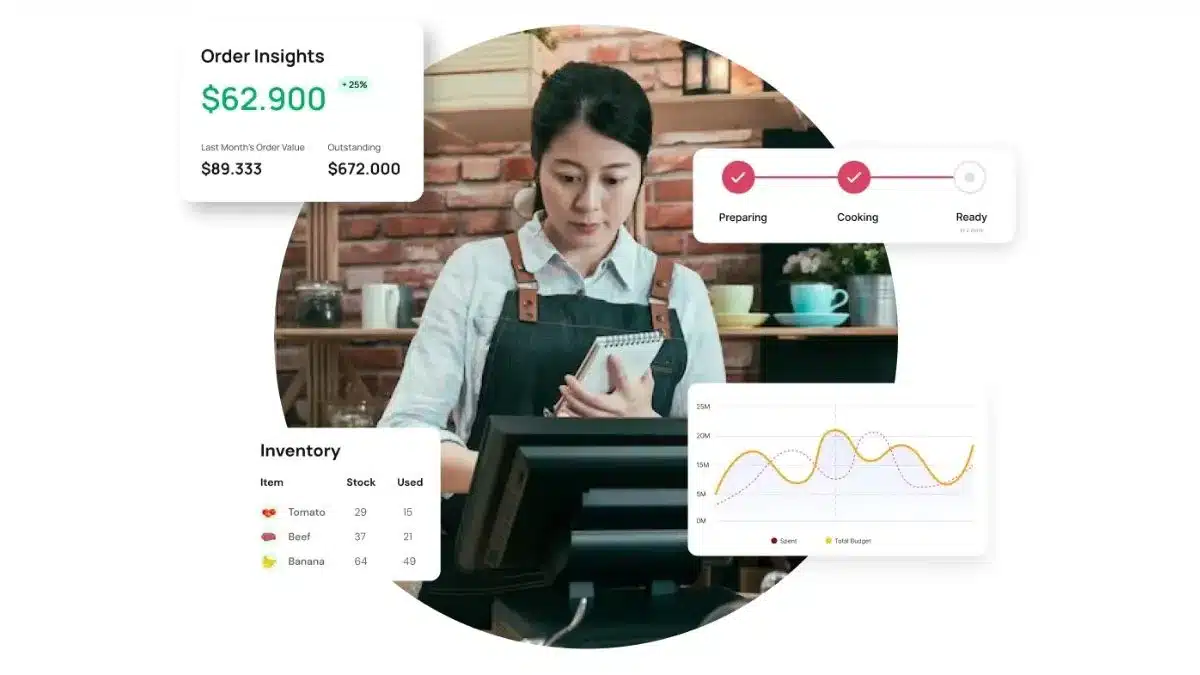
- Ordering portal: This portal streamlines customer ordering, ensuring effortless transactions, improved satisfaction for Malaysian businesses, and efficient order processing.
- Supplier management: The software tracks supplier contracts and inventory costs, enabling businesses to select optimal deals, a crucial factor for cost control in Malaysia’s competitive market.
- Kitchen screen: Kitchen screens provide real-time updates to chefs, enabling efficient food prep management and ensuring prompt service in Malaysia’s bustling central kitchens.
- Delivery management: Efficient ingredient shipment tracking enables faster delivery, which is crucial for business success in Malaysia’s expansive market.
- Inventory management: The system automatically tracks stock levels, quality, and expiry dates, alerting users to low inventory levels to help Malaysian firms avoid shortages, minimize waste, and optimize costs.
- Central kitchen reports: The system’s reporting on kitchen operations, sales, and logistics, complete with analytics, empowers Malaysian businesses to make informed decisions, crucial for staying competitive in the food service sector.
Why this suits Malaysian businesses: HashMicro is well-suited for Malaysian F&B chains operating central kitchens and multiple outlets, as it offers integrated production planning, inventory control, and POS connectivity in one system. Its support for SST compliance and real-time stock tracking helps businesses maintain accurate cost control while managing high-volume kitchen operations across locations.
Price: Contact the team for a cost estimate aligned with your workflow.
| Pros | Cons |
|---|---|
|
|

To explore the best solutions for your business, discover our Central Kitchen Software pricing schemes below and find the right package for your needs.
2. Melba
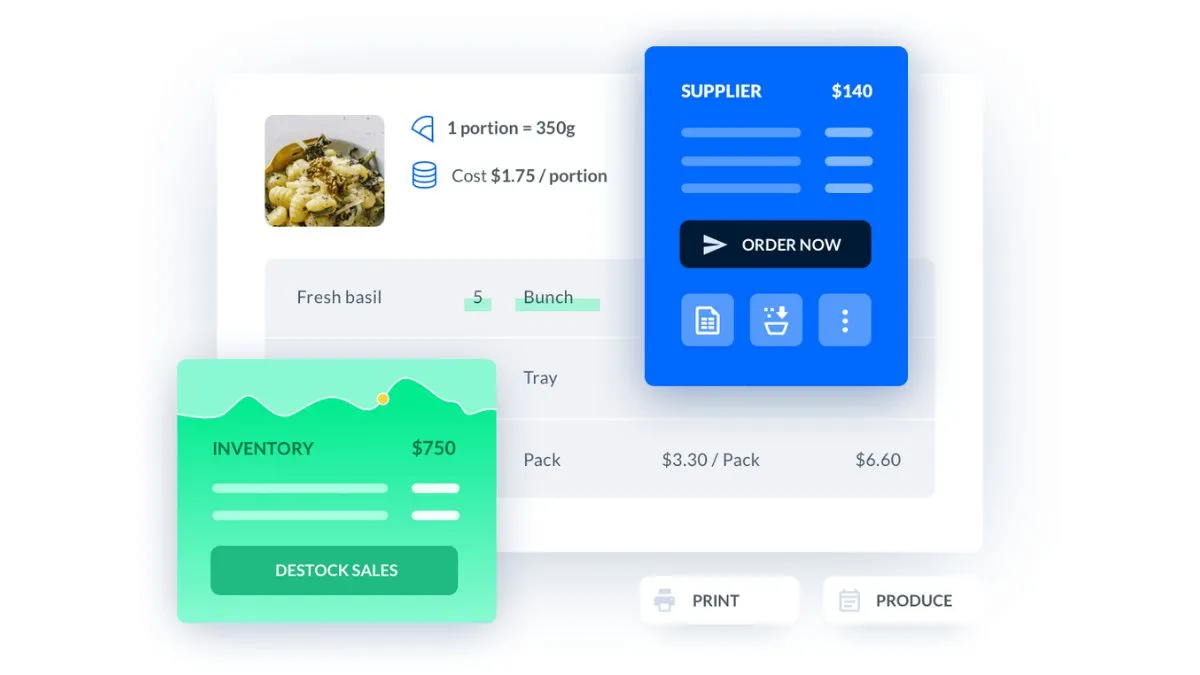
Central kitchen management software, Melba, is a tool designed to optimize operations in central kitchens, which serve as hubs of food production for various dining establishments. Melba central kitchen software streamlines processes such as ingredient and recipe management, production scheduling, and order organization.
Melba’s recipe synchronization works well for standardizing menus across outlets, though Malaysian operators should note that halal traceability and GrabFood/Foodpanda direct integration are not natively available and may require third-party connectors. SST compliance reporting should be verified directly with the vendor before deployment.
This central kitchen system enables centralized control over food production, helping to save time, reduce waste, and increase profit margins.
Here are the main features of the Melba Central Kitchen System:
- Ingredient and recipe management: Create and manage ingredient and recipe databases to ensure uniform quality and standards across all outlets.
- Dynamic recipe data: Work with dynamic data that can be synchronized with multiple sales points.
- Production for multiple sales sites: Organize production by merging identical needs and dispatching finished products to various points of sale.
- Operational management: Optimize supply operations to various sales sites.
- Inventory optimization: Manage stocks of ingredients, recipes, and drinks efficiently, and conduct inventory with precision.
- Supplier order placement: Place orders with suppliers directly through the software.
Why this suits Malaysian businesses: Melba is ideal for Malaysian central kitchens that prioritize recipe standardization and food cost accuracy. With rising ingredient costs and supply fluctuations, its ability to manage recipes and calculate precise food costs helps F&B businesses maintain consistent margins and portion control.
Price: From around RM235/month (Core) up to RM475/month (Pro/Premium)
| Pros | Cons |
|---|---|
|
|
3. Restroworks
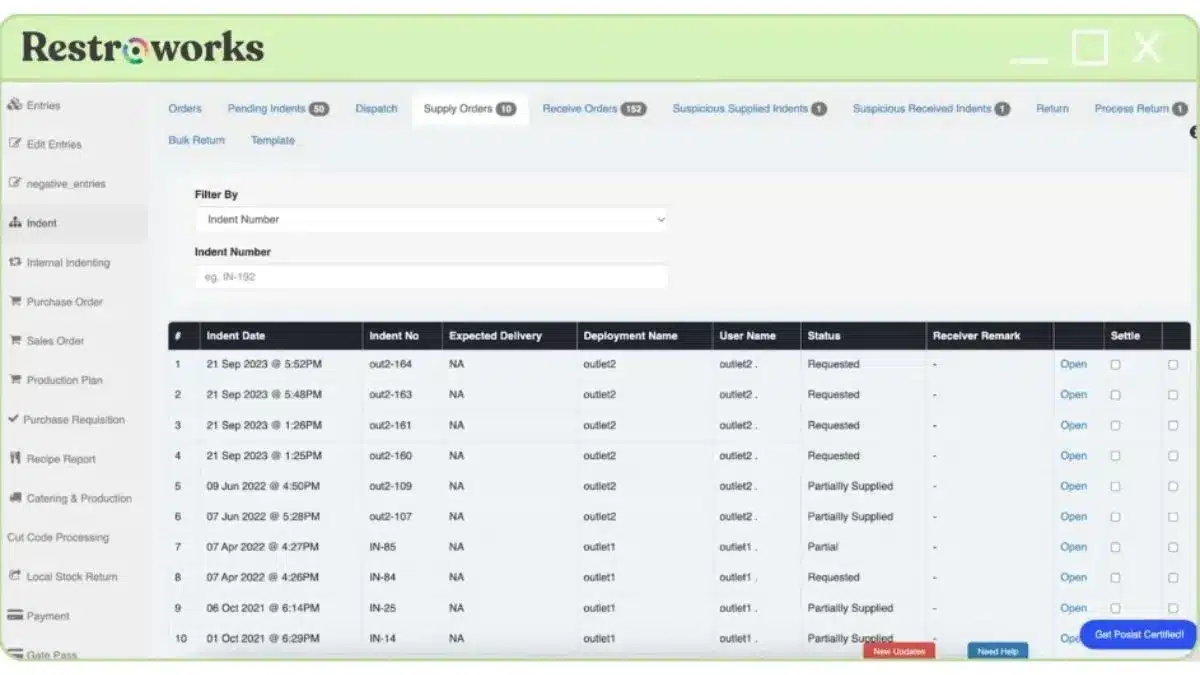
Restroworks is designed to optimize the operations of a central kitchen, the core facility that prepares and supplies food to various dining locations. This central kitchen software ensures efficient goods transfer, cost control, and optimized inventory for a restaurant’s central kitchen and outlets.
Restroworks also supports integration with major delivery platforms including Foodpanda, making it a practical option for Malaysian F&B operators running hybrid dine-in and delivery models or cloud kitchen operations. The platform’s ISO 27001 and SOC2 certifications also support data security requirements for multi-outlet chains. SST compliance and halal traceability features should be verified with the local partner.
Here are the key features of the Retroworks central kitchen system:
- Inventory Management: inventory to minimize waste and enhance profitability.
- Recipe management: Accurate ingredient tracking to reduce kitchen waste.
- Base kitchen: Centralized kitchen software to optimize operations.
- Kitchen Display System: Organize Kitchen Chaos.
- Kitchen production system: A future-ready system to enhance kitchen productivity.
Why this suits Malaysian businesses: Restroworks is a strong fit for Malaysian restaurant groups managing multiple outlets and delivery channels. Its centralized kitchen management and analytics tools help businesses monitor operations, improve order coordination, and adapt to the growing demand for food delivery services.
Price: Custom quote available based on business needs.
| Pros | Cons |
|---|---|
|
|
4. Apicbase
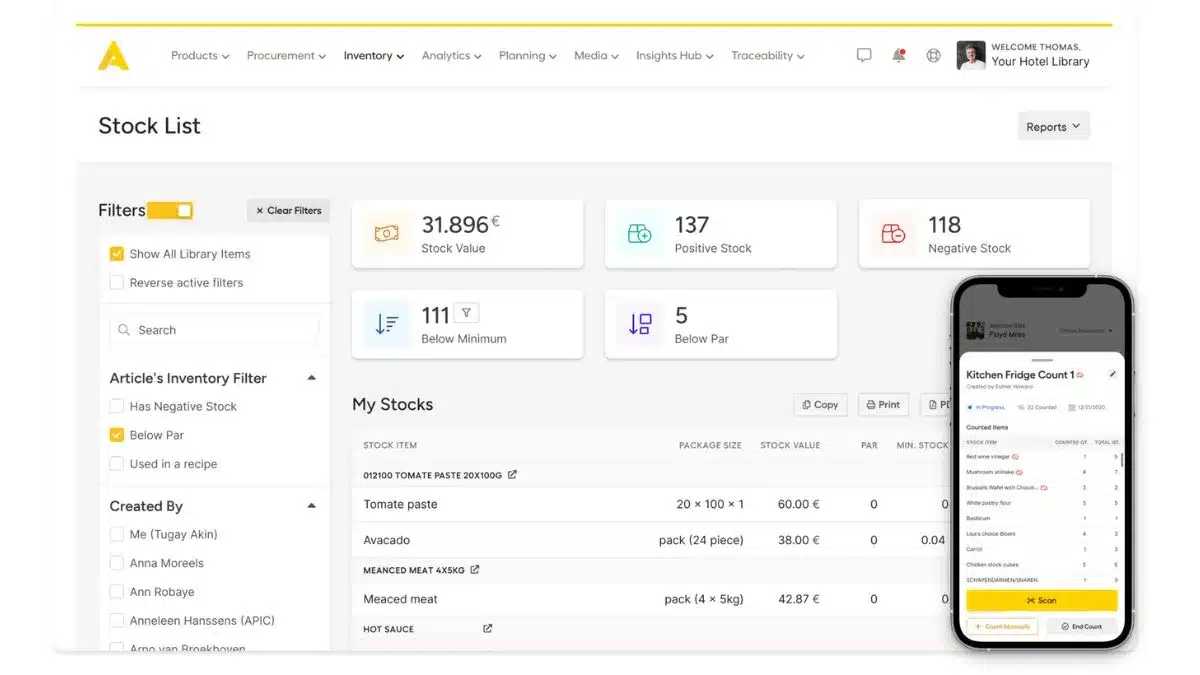
Apicbase is a comprehensive food and beverage (F&B) management platform designed to drive operational excellence across multi-site restaurant operations. It centralizes crucial food and beverage (F&B) data and provides insights into processes that impact profitability.
The central kitchen system aims to reduce staff and management workloads through automation, enabling businesses to increase profitability, enhance customer experience, grow sustainably, and ensure regulatory compliance.
Apicbase’s allergen compliance and ingredient-level tracking features can be adapted to support halal ingredient documentation, making it relevant for Malaysian restaurant chains working toward or maintaining JAKIM halal certification for their central kitchen operations.
GrabFood and Foodpanda direct integration is not native verify with vendor for available connectors.
Here are the core features of the central kitchen system:
- Menu engineering: A central hub for managing recipes, menus, and data group-wide.
- Production planning: Tools for planning production, generating Bills of Materials (BOMs), and monitoring execution.
- Inventory management: Inventory automation tools can prevent waste and shortages and monitor stock levels across all locations.
- Sales analytics: Analytics to identify top-performing and underperforming products, helping to develop profitable and popular items.
Why this suits Malaysian businesses: Apicbase suits Malaysian F&B operators that need better control over inventory, suppliers, and kitchen processes. Its detailed tracking of ingredients and procurement helps reduce waste and improve cost efficiency, which is essential in a competitive food service market.
Price: Get a tailored plan based on locations, users, and integrations.
| Pros | Cons |
|---|---|
|
|
5. Gofrugal
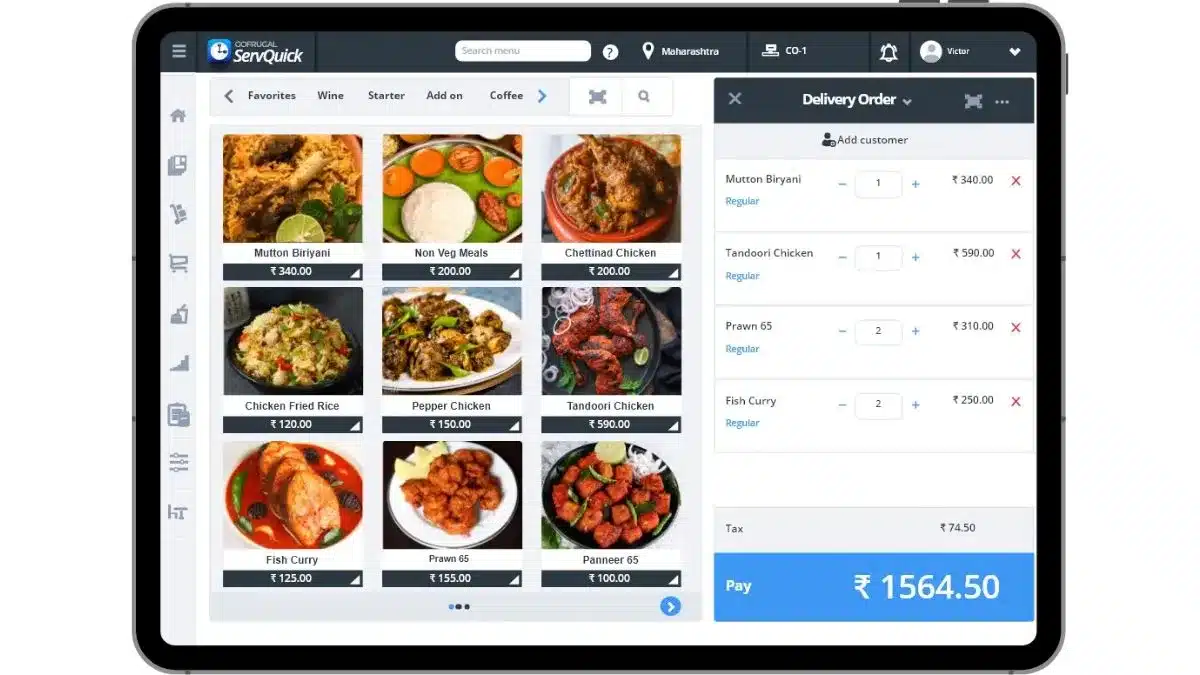
Gofrugal is a management system designed to enhance the efficiency and profitability of central kitchen management system operations. This central kitchen system manages production planning, stock transfers, franchise management, waste reduction, and vendor collaboration.
Gofrugal supports Foodpanda integration through its POS and ecommerce connectivity layer, which is useful for Malaysian F&B outlets managing delivery orders alongside dine-in operations from the same central kitchen. Its franchise management module also aligns with JAKIM’s requirement for centralized halal control across chain restaurant outlets.
Here are the main features of central kitchen management software:
- Franchise management: Ensure brand-taste consistency across franchises through unified recipes.
- Menu engineering: Analyse sales and trends to refine menus and identify opportunities for cost savings.
- Vendor management: Centralise vendor data, streamline procurement, and monitor supplier performance.
- Wastage management: Minimise waste and maximise profits by tracking recipe ingredient utilisation and shelf life.
- Integrated accounts module: Simplify audits by ensuring price consistency across restaurants.
Why this suits Malaysian businesses: Gofrugal is a practical option for small to mid-sized Malaysian F&B businesses looking for an affordable system that combines POS and kitchen management. It supports daily operations such as billing, inventory tracking, and basic kitchen coordination without requiring complex setup.
Price: Starting from around RM29/month.
| Pros | Cons |
|---|---|
|
|
6. LS Retail
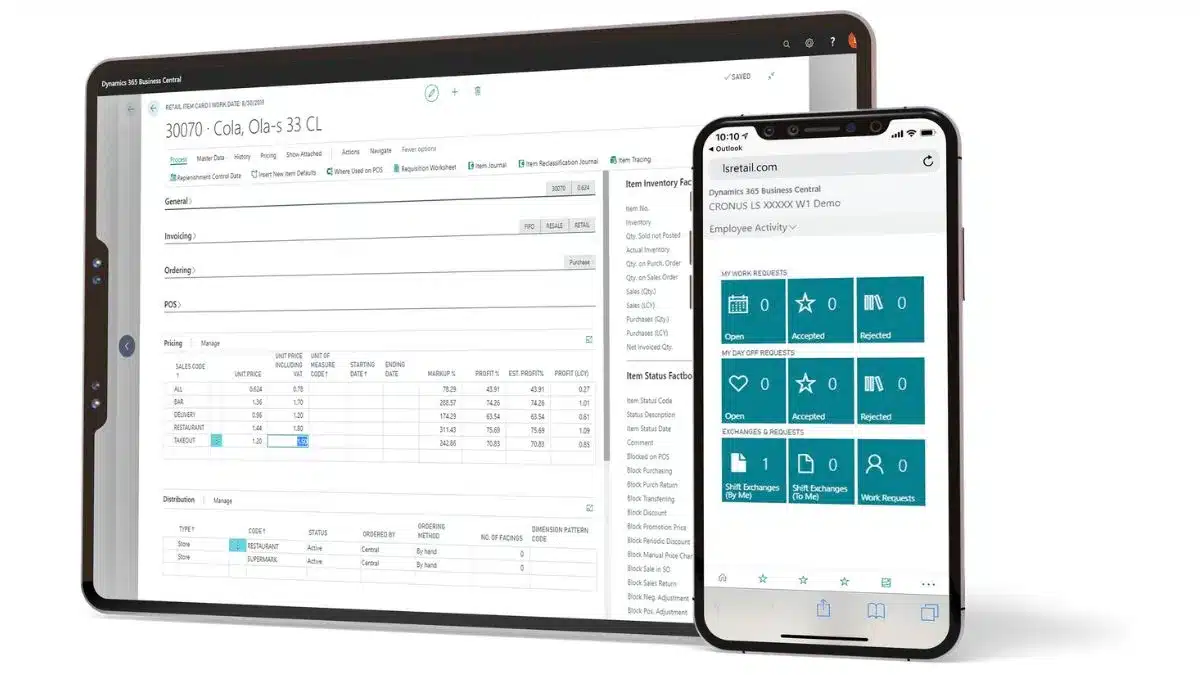
The LS central kitchen software is a comprehensive solution designed to optimise the operations of a central kitchen, which serves as the hub for food preparation and distribution for restaurants, cafes, and other food service establishments.
It’s part of the LS Retail suite of products and is specifically tailored to improve efficiency and communication between the front house (where customers are served) and the back house (where food is prepared).
LS Retail’s KDS and POS ecosystem can be connected to third-party delivery aggregators including GrabFood and Foodpanda through middleware integrations. For Malaysian operators, its scalability across food service formats makes it viable for franchise groups managing central kitchen supply to multiple outlet types.
Here are some key features of LS Retail’s central kitchen software:
- Kitchen Display System (KDS): Streamlines order organisation and recipe management, ensuring correct display sequencing at kitchen stations.
- Efficient workflow: Enhances workflow, links house areas, and facilitates consistent dish preparation in accordance with guest specifications.
- Order management: A KDS enables kitchen staff to prioritise food preparation over ticket management, thereby enhancing customer service through faster and more precise order processing.
- Digital order-viewing screens eliminate the need for printers and paper, directing POS orders to the corresponding prep stations.
Why this suits Malaysian businesses: LS Retail is suitable for large Malaysian F&B enterprises that require integration between central kitchens, retail outlets, and financial systems. Built on Microsoft Dynamics, it supports complex operations and provides strong control over supply chain and production workflows.
Price: Flexible pricing packages available upon consultation.
| Pros | Cons |
|---|---|
|
|
7. Supy
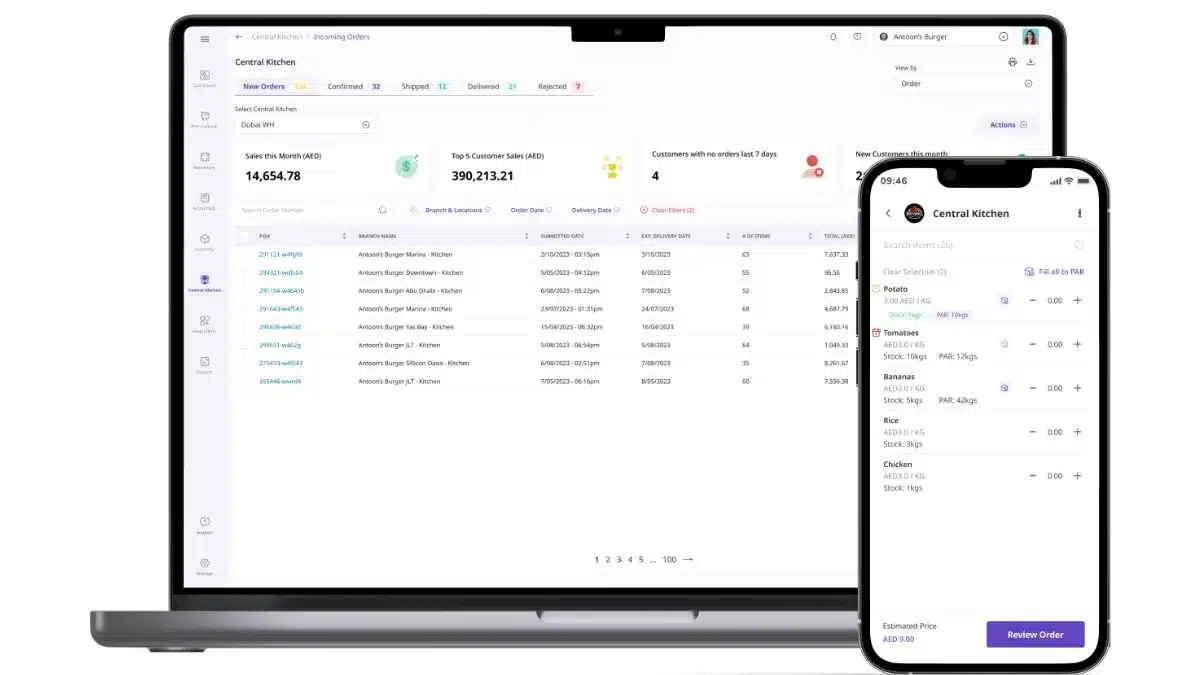
Supy is designed to streamline operations for food and beverage businesses by enabling internal ordering and transfers between branches and the central kitchen.
Supy’s internal ordering module is well-suited for Malaysian central kitchen operators managing branch distribution across multiple cities. However, direct integration with GrabFood or Foodpanda is not a core feature operators relying heavily on delivery platform volumes should evaluate this gap before adopting Supy as their primary central kitchen
system.
The key features of Supy’s central kitchen software are:
- Internal ordering: Enables branches to place orders with the central kitchen.
- Batch production and transfers: Enable mass production and bulk shipping.
- Dedicated central kitchen module: Offers a specialised module for central kitchen operations.
- Clear order statuses: Provides real-time updates on order statuses.
Why this suits Malaysian businesses: Supy is ideal for Malaysian restaurants focused on improving procurement and reducing food waste. Its supplier management and inventory tracking features help businesses optimize purchasing decisions and maintain better control over ingredient usage.
Price: Request a demo to receive a pricing plan that matches your production volume.
| Pros | Cons |
|---|---|
|
|
8. Inresto
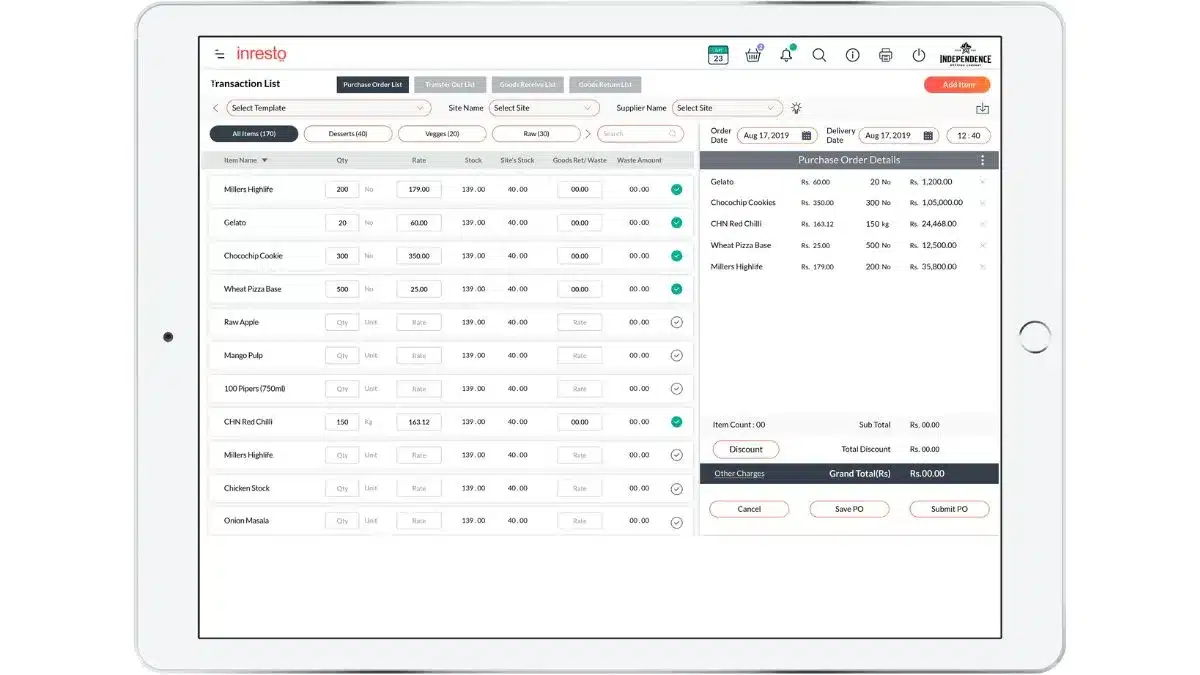
Inresto is a specialised solution designed to manage and streamline operations in a central kitchen, the core facility for preparing and distributing food across various outlets of a restaurant chain or food service business.
The key features of Inresto central kitchen management software include:
- Vendor management: Digitizes records and schedules vendors via texts.
- Inventory tracking: Provides real-time monitoring of recipes and sub-recipes.
- Stock management: Automatically updates inventory status based on orders and sends notifications to manage stock levels effectively.
- Purchase order management: Generates and sends purchase orders to relevant vendors from the central kitchen.
Note: For Malaysian operators: Direct GrabFood/Foodpanda integration, SST compliance, and JAKIM halal traceability support for this platform should be verified directly with the vendor before purchase, as local Malaysia-specific compliance features are not publicly documented.
Why this suits Malaysian businesses: Inresto fits Malaysian restaurant operators seeking better visibility into their kitchen and outlet performance. Its centralized reporting and operational tools support decision-making across multiple locations, especially for growing F&B brands.
Price: Pricing is customized for restaurant size and required modules.
| Pros | Cons |
|---|---|
|
|
9. Sharva POS
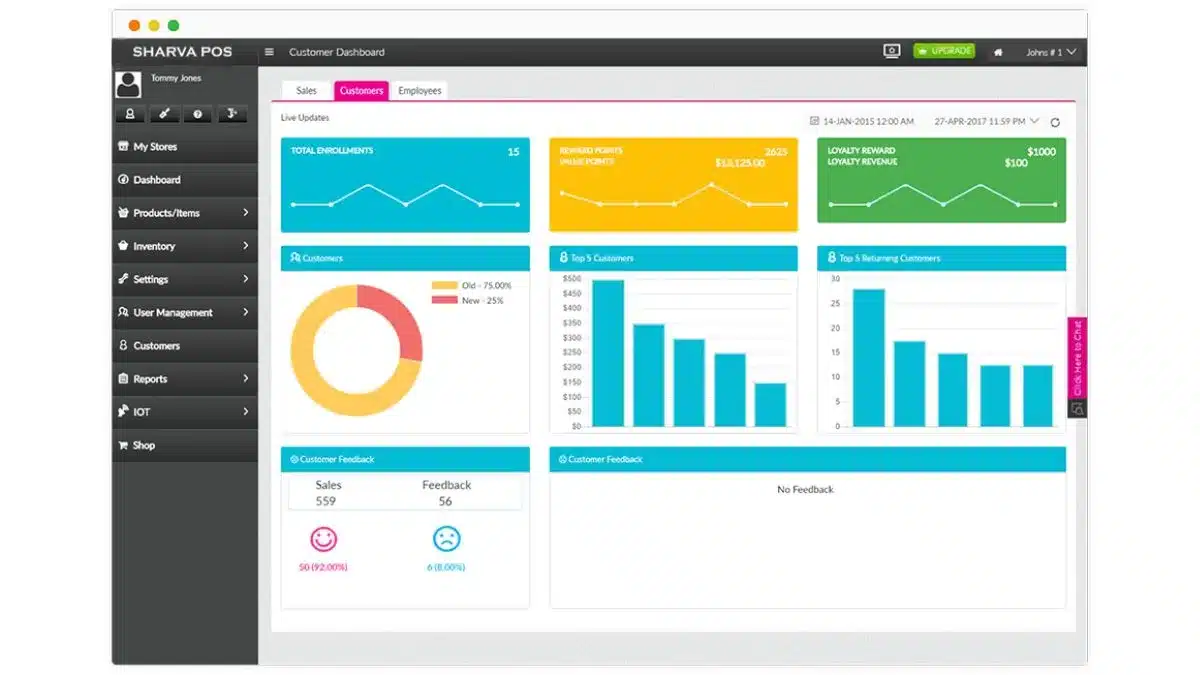
Sharva POS is a solution designed to help food service businesses streamline their central kitchen operations. This central kitchen system integrates central kitchen and warehouse management to cut costs and improve food production efficiency.
Here are the key features of Sharva POS:
- Inventory management: Automatically tracks low stock and generates POs for out-of-stock items.
- Vendor management: A vendor automation management system manages vendor relationships and schedules deliveries.
- Quality and Safety Control: Maintains stricter control over food quality and kitchen hygiene.
- Consistency in food production: Ensures a consistent taste for customers’ favourite food items across different locations.
Note: For Malaysian operators: Direct GrabFood/Foodpanda integration, SST compliance, and JAKIM halal traceability support for this platform should be verified directly with the vendor before purchase, as local Malaysia-specific compliance features are not publicly documented.
Why this suits Malaysian businesses: Sharva POS is suitable for small Malaysian F&B businesses that need a simple system to manage both front-end sales and back-end kitchen operations. Its affordability and ease of use make it a practical entry point for digitalizing kitchen workflows.
Price: Scalable pricing depending on features and kitchen workflow complexity.
| Pros | Cons |
|---|---|
|
|
10. LINGA ROS
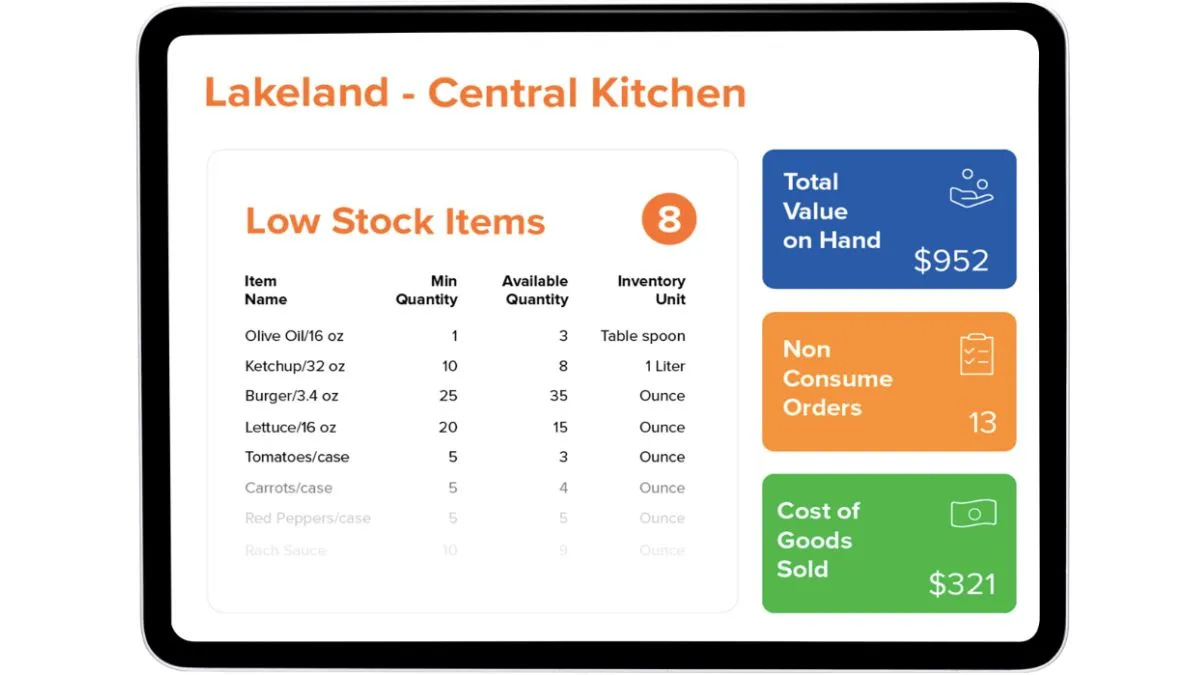
LINGA ROS, which stands for Restaurant Operating System, is a comprehensive point-of-sale (POS) system designed for the restaurant and retail industry.
It’s a cloud-based central kitchen software suite that offers applications to manage various business functions, including central kitchen operations.
Here are the key features of LINGA ROS central kitchen management system:
- Cloud-based system: Ensure automatic updates and upgrades, and that the system can adapt to the business’s changing needs.
- Inventory management: It provides real-time tracking of inventory levels, sets reorder points, and receives live updates on inventory shipments.
- Quality control: The software maintains high standards of food quality and safety.
- Order management: Streamlines the process of managing orders from different outlets.
Note: For Malaysian operators: Direct GrabFood/Foodpanda integration, SST compliance, and JAKIM halal traceability support for this platform should be verified directly with the vendor before purchase, as local Malaysia-specific compliance features are not publicly documented.
Why this suits Malaysian businesses: Linga ROS is a good fit for Malaysian F&B businesses operating multiple outlets or delivery-focused models. Its cloud-based system enables real-time monitoring of kitchen performance and order flow, helping businesses manage operations more effectively across locations.
Price: From around RM124/month (Core) to RM371/month (Enterprise), billed annually.
| Pros | Cons |
|---|---|
|
|
Overall Comparison of Central Kitchen Management Software in Malaysia
| Provider | Multi-Outlet Support | Halal Ingredient Traceability | GrabFood/Foodpanda Integration | SST Compliance | JAKIM Chain Restaurant Ready | Local MY Support |
|---|---|---|---|---|---|---|
| HashMicro | ||||||
| Restroworks | ||||||
| Apicbase | ||||||
| LS Retail | ||||||
| Supy |
Why Malaysian F&B Businesses Must Use Central Kitchen Software?
The Malaysian food and beverage industry is growing rapidly, but faces challenges. F&B businesses need tools to ensure consistency, reduce waste, and maintain smooth operations. Using a central kitchen software system is an effective solution.
Here’s why this solution has become increasingly vital for restaurant operations:
- Ensure food consistency and protect brand reputation: Central kitchen software helps standardise recipes and preparation methods, making sure every outlet delivers the same quality and taste. This consistency helps maintain the brand’s reputation and aligns customer expectations.
- Accurately manage inventory and reduce waste: With automated inventory control and usage forecasting, the software prevents both overstocking and shortages. It also tracks expiry dates and stock levels to reduce spoilage and improve supply accuracy.
- Avoid operational bottlenecks across branches: Businesses that operate without integrated systems often face delivery delays, communication breakdowns, and inconsistent supply levels. This software connects all locations in real time, helping teams work more efficiently.
- Automate workflows and gain better visibility: From supplier coordination to production schedules, central kitchen software streamlines routine tasks. Managers can track everything in one place and make timely adjustments when demand shifts.
- Achieve sustainability goals while cutting costs: Research shows that adopting central kitchen systems can help kitchens reduce food waste and energy consumption by 40-70% in just 6-12 months. This supports long-term savings and environmental responsibility.
- Increase profitability through data insights: Businesses using this system benefit from advanced analytics, better planning, and tighter cost control. In some cases, profits have grown by up to 50 percent thanks to more efficient resource management.
Who Uses Kitchen Management Software?
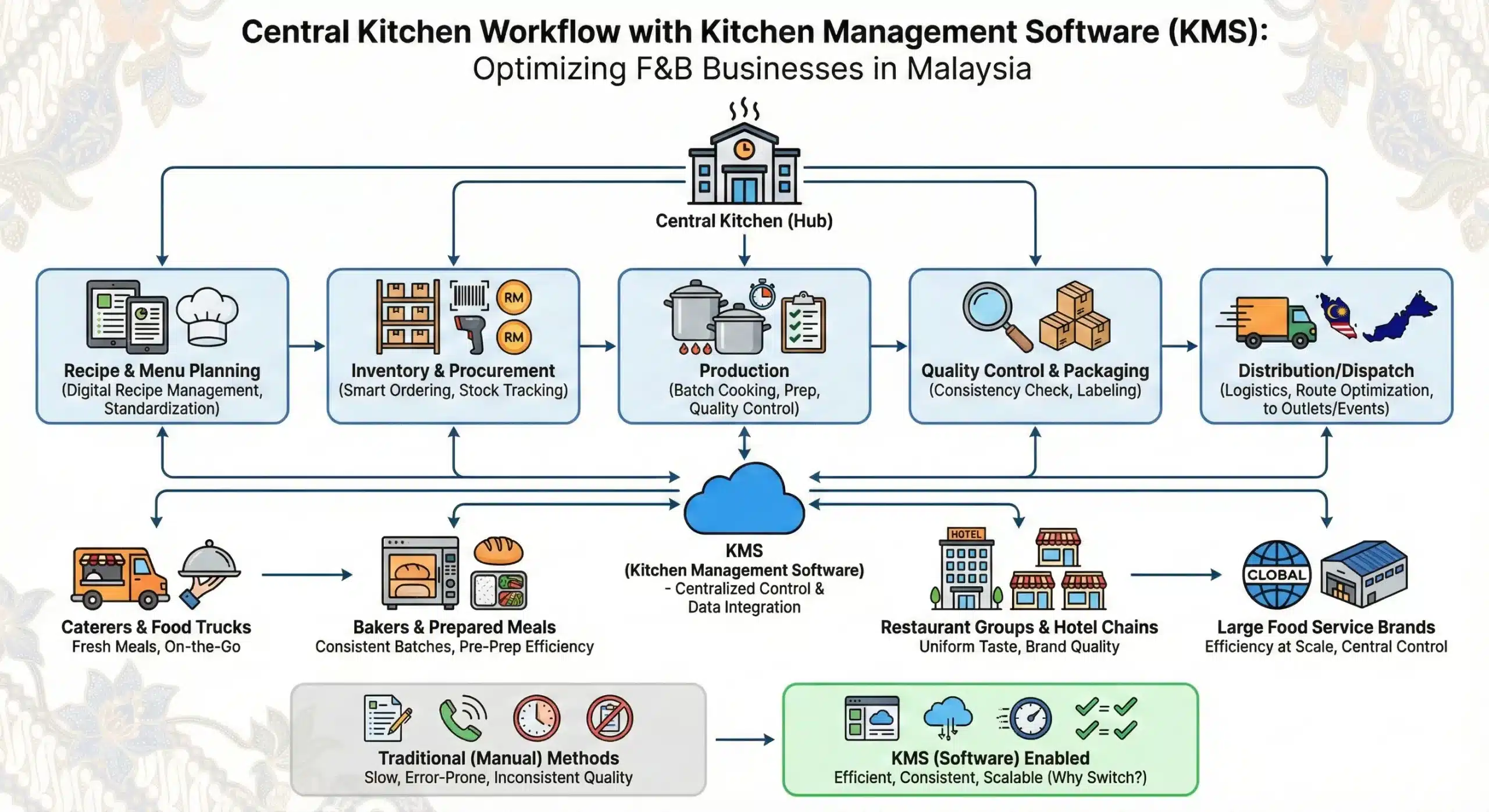
Central kitchen management software is widely adopted across Malaysia’s growing F&B sector, particularly among businesses running multi-outlet operations where consistency, cost control, and supply coordination are non-negotiable. Here’s how different segments of the Malaysian F&B industry are using it:
- Caterers and food trucks: Use central kitchen software for food preparation, inventory management, and menu planning, and restaurant software for workforce management, including staff scheduling, shifts, and labor allocation.
- Bakers and prepared meal companies: use it for batch production, recipe consistency, and ingredient traceability essential for businesses supplying to retailers like Aeon or Jaya Grocer, or running halal-certified operations that require strict documentation at every production stage.
- Restaurant groups and hotel chains across KL, Penang, and Johor Bahru depend on it to enforce standardized recipes across branches and accurately track stock particularly important when navigating Malaysia’s volatile raw ingredient prices and supplier variability.
- Large food service and QSR brands operating commissary kitchens for high-volume mall and transit-hub outlets use it to coordinate production schedules, manage inter-outlet transfers, and reduce waste directly protecting margins in an environment where labor costs are rising and delivery platforms like GrabFood and Foodpanda are raising customer expectations.
Central kitchen software enables these businesses to operate efficiently, maintain consistency, and compete in a growing F&B landscape.
But why do they have to use central kitchen software instead of continuing to use traditional (manual) central kitchen management system methods?
Which Central Kitchen Software Suits Your Operation?
Not every central kitchen has the same priorities. A franchise chain with 20 outlets has different pain points than a standalone catering business or a cloud kitchen supplying delivery-only brands. Use this decision matrix to identify which software best fits your specific operational profile.
| Business Scenario | Recommended Software | Why It Fits |
|---|---|---|
Small F&B business or cloud kitchen with limited budget |
Sharva POS or Gofrugal | Both are easy to implement with basic kitchen and inventory features, suitable for small-scale operations in Malaysia. |
Growing F&B business needing centralized recipe and cost control |
Melba or Apicbase | Both help standardize recipes, manage food costing, and control inventory across kitchen operations. |
Restaurant chain managing multiple outlets with central kitchen production |
HashMicro or Restroworks | HashMicro offers full ERP integration with production and inventory, while Restroworks supports centralized kitchen control and outlet coordination. |
F&B businesses needing strong inventory and procurement management |
Supy or Apicbase | Both focus on supplier management, stock tracking, and reducing food waste for better cost efficiency. |
Multi-outlet F&B brands requiring integration with POS and backend systems |
LS Retail or HashMicro | LS Retail integrates with Microsoft Dynamics, while HashMicro connects kitchen operations with POS, accounting, and inventory systems. |
Cloud kitchen or delivery-focused business |
Restroworks or Linga ROS | Both support order aggregation, delivery integration, and real-time kitchen performance tracking. |
Mid-sized restaurant groups needing operational visibility and reporting |
Inresto or Restroworks | Provides centralized dashboards, reporting tools, and operational insights across outlets. |
F&B businesses prioritizing standardization and consistency across branches |
Melba or HashMicro | Ensures consistent recipes, portion control, and production planning across all kitchen locations. |
Enterprise-level F&B operations with complex supply chain and production |
HashMicro or LS Retail | Both offer scalable solutions with full integration across procurement, production, and distribution. |
F&B businesses aiming to reduce waste and improve cost efficiency |
Supy or Apicbase | Helps monitor inventory usage, reduce overstocking, and optimize purchasing decisions. |
How to Choose the Right Kitchen Management System for Your Business
Choosing the right central kitchen management software for Malaysian F&B companies requires careful consideration of several factors to ensure it meets the business’s specific needs. Here are some key points to consider:
- Identify core features: Central kitchen software must have key features such as inventory management, recipe standardisation, production planning, procurement, and real-time analytics.
- Software’s credibility: Verify software credibility through customer feedback, case studies, and industry certifications. Ensure it provides strong customer support and frequent updates.
- Scalability and integration: Select software that scales with your business and integrates seamlessly with integrated systems such as restaurant POS, CRM, and supply chain tools, enabling effective communication and centralised data management.When comparing vendors, check whether their kitchen management system can connect with your current POS, accounting, or delivery platforms without heavy custom work.
- User-friendly interface: Search for software with an intuitive, user-friendly interface that minimises training time and boosts staff productivity.
- Customisation and flexibility: Ensure the software can be customised to meet unique business needs, with flexible features and payment options to support effective cost management.
- Data security and compliance: Prioritise software that prioritises strong data security, adheres to data protection laws, and employs encryption to protect sensitive information.
Before wrapping up this section, it’s important to highlight the key factors Malaysian F&B companies should consider when evaluating central kitchen software. These criteria will help ensure the system not only streamlines operations and adapts to evolving business needs but also supports long-term growth across multiple outlets.
| Selection Criteria | Why It Matters for Your F&B Business |
|---|---|
| Comprehensive Core Features | Includes inventory, ordering, production, and distribution management tools. |
| Scalability and Integration | Grows with your business and connects seamlessly with POS, CRM, and supply systems. |
| Vendor Credibility | Backed by strong reviews, case studies, and relevant industry certifications. |
| User-Friendliness | An intuitive interface boosts team efficiency and reduces training time. |
| Data Security and Compliance | Ensures business data protection and supports regulatory compliance with encryption. |
Conclusion
Choosing the best central kitchen software means finding a system that fits how your kitchen works today while staying flexible as operations grow. The right tool helps protect food consistency, improve inventory accuracy, and reduce waste that quietly eats into margins.
To compare options, prioritize what matters most to your team, production planning, real-time stock visibility, outlet distribution tracking, and smooth integration with your POS or accounting system. Also consider scalability, support quality, and data security to avoid rework later.
For businesses managing multiple outlets or high-volume production, a dedicated kitchen management system can reduce daily friction and support steadier growth.
If you want help narrowing the shortlist, book a free consultation to map your workflow and identify the features you actually need. That way, you can choose with clear benchmarks.

FAQ about Central Kitchen Management Software
-
Can a kitchen management system handle real-time inventory management?
Yes, the kitchen management system provides real-time inventory management features. These tools allow businesses to track stock levels continuously, ensuring that ingredients are always available when needed.
-
How does central kitchen software improve compliance and food safety?
Central kitchen software helps businesses comply with food safety regulations by standardising processes and maintaining accurate records. The software ensures that all recipes and procedures are followed correctly, reducing the risk of contamination and ensuring consistent quality.
-
Is it possible to integrate a kitchen management system with other business systems?
Yes, a kitchen management system can be integrated with various other business systems, including point-of-sale (POS) systems, accounting software, and supply chain management tools. This integration enables seamless data flow between different business components, enhancing overall efficiency and minimising the need for manual data entry.
-
What role does a Kitchen Display System (KDS) play in a central kitchen management system?
A Kitchen Display System (KDS) is essential for enhancing kitchen workflow and improving order accuracy. It replaces traditional paper tickets with digital screens that display orders in real-time. This system organises orders by preparation station, ensuring that dishes are cooked and served in the correct sequence.
-
How can I reduce food waste in my restaurant and save money?
Use FIFO labeling, clear date stickers, and proper storage zones to prevent spoilage, and train staff on correct prep cuts and batch cooking. Standardize recipes and portions, offer flexible sides/portion sizes, and repurpose safe trim into specials (e.g., stocks, sauces, staff meals). Finally, monitor menu performance and remove low-selling, high-waste items while promoting profitable, low-waste dishes.