












Analyzing talent movement is essential for long-term success in today’s rapidly changing business environment. Global economic shifts and evolving employee expectations have forced leaders to look deeper than simple headcount figures. To ensure workforce sustainability, organizations must prioritize a comprehensive understanding of how talent flows through their operations.
With Malaysia’s attrition rates around 18%, local firms face talent scarcity as workers prioritize upskilling and work-life balance. This trend forces the manufacturing and tech sectors to implement stronger retention strategies to stay competitive. Navigating these shifts is essential for any business operating within Malaysia’s high-value, knowledge-driven economy.
Monitoring the Attrition Rate provides high-value data for strategic planning and cultural health to prevent operational gaps. Proactively evaluating these departure patterns helps companies build resilient, high-performing teams and maintain a competitive advantage.
Key Takeaways
|
Don’t let a rising attrition rate disrupt your business growth. Use HRM Software to monitor employee patterns and implement proactive retention tools before talent slips away.

What is Attrition Rate? A Fundamental of HR Metric
Attrition rate is an HR metric that shows how many employees leave a company over a certain period without being immediately replaced. It helps businesses understand whether their workforce is shrinking and how that may affect overall operations.
More than just a number, attrition rate can reflect the health of an organization. A high attrition rate may indicate problems such as poor management, low employee engagement, limited career growth, or uncompetitive compensation. On the other hand, a stable attrition rate can suggest that employees feel supported and are more likely to stay with the company. In comprehensive human capital management, monitoring it is key to assessing organizational health, workforce planning, and efficiency.
Tracking attrition rate is also important for workforce planning and budgeting. When roles remain vacant for too long, the workload often shifts to existing employees, which can lead to stress, lower productivity, and even more resignations. For this reason, attrition rate is often used by HR teams to support better decisions in hiring, retention, and employee development.
Attrition vs. Turnover: Clarifying the Confusion
Although the terms attrition and turnover are often used interchangeably, they describe different workforce dynamics within an organization. Understanding the distinction helps HR teams analyze employee movement more accurately and design appropriate workforce strategies. The comparison table below highlights the key differences between attrition and turnover in a clear and practical way.
| Attrition |
Turnover |
| Attrition occurs when employees leave an organization and their positions are not replaced, resulting in a gradual reduction in the total workforce. | Turnover refers to employees leaving a company and being replaced by new hires, creating a continuous cycle of recruitment and onboarding. |
| It can happen through resignation, retirement, or termination when the organization decides to eliminate or redistribute the role. | It typically occurs when employees resign, are terminated, or move to other opportunities and the company fills the vacancy. |
| This process leads to a permanent decrease in headcount because the role is no longer required or is automated. | The total number of employees usually remains stable because each departing employee is replaced. |
| Attrition is sometimes intentional, such as during organizational restructuring or cost-reduction strategies. | Turnover is generally considered a negative metric because it increases recruitment, training, and onboarding costs. |
| Example: A company with 100 employees loses 10 workers and chooses not to replace them, reducing the workforce to 90. | Example: A company with 100 employees loses 10 workers but hires 10 new employees, keeping the workforce size the same. |
Understanding the difference between attrition and turnover plays an important role in workforce planning and financial forecasting. High turnover usually signals the need for stronger recruitment efforts and more effective onboarding to help new employees become productive faster. In contrast, high attrition often requires organizations to reassess their structure, workload distribution, and talent strategies to ensure business operations remain stable.
The Different Types of Employee Attrition

Employee departures are rarely identical and stems from a variety of complex organizational factors. Identifying these specific exit types is essential for diagnosing systemic issues and creating targeted retention strategies. HR professionals must develop unique responses for each category to maintain a healthy and productive workforce.
1. Voluntary Attrition
Voluntary attrition occurs when an employee actively chooses to leave for reasons like better pay, career growth, or flexible work conditions. This category is often the most concerning for HR leaders because it involves losing high-performing talent to competitors. Organizations must analyze these departures to understand why their current value proposition is no longer appealing to top performers.
High rates of voluntary turnover serve as a critical warning sign that the company culture or leadership may be failing. To address this, firms should prioritize competitive market analysis and conduct thorough exit interviews to gather actionable feedback. Actively listening to the current workforce helps prevent further talent loss and improves long-term engagement.
2. Involuntary Attrition
Involuntary attrition happens when an organization decides to terminate the employment relationship due to performance issues or policy violations. While initiated by the company, frequent terminations can highlight deep-rooted problems in the initial recruitment or onboarding processes. It often suggests that new hires are not receiving the necessary training to succeed in their specific roles.
When these departures result from broader restructuring or economic shifts, the HR focus must change to compassionate management. Providing outplacement support and clear communication is vital for maintaining the morale of the employees who remain. Balancing operational needs with empathy ensures the company’s reputation stays intact during difficult transitions.
3. Retirement Attrition
Retirement is an inevitable and predictable phase of the professional lifecycle as the workforce ages. While these departures are usually amicable, they present unique logistical challenges for companies with many long-tenured staff members. The primary risk involves losing decades of specialized expertise and deep institutional knowledge in a short period.
To mitigate this loss, forward-thinking organizations implement robust succession planning and mentorship programs well in advance. Phased retirement options and detailed documentation processes help preserve operational capabilities during the transition. Ensuring a structured knowledge transfer prevents critical gaps in client relationships and internal procedures.
4. Internal Attrition
Internal departure is a slightly different concept, referring to the movement of employees within the same organization. This occurs when an employee leaves one department or team to take a new role in a different area of the company. From a macro, company-wide perspective, the overall headcount remains unchanged. However, from a micro, departmental perspective, the original team has experienced a loss.
Internal career mobility retains talent by allowing employees to grow professionally without leaving the company. However, high turnover in specific teams often signals leadership flaws or poor conditions that HR must address. Monitoring these trends prevents certain departments from becoming mere “training grounds” for the rest of the business.
How to Calculate Attrition Rate: Formulas and Practical Examples
Accurately measuring the shrinkage of your workforce requires a clear understanding of the mathematical formulas involved. While the concept is straightforward, ensuring consistency in how the data is collected and calculated is vital for generating meaningful insights. The calculation relies on identifying vital key performance indicators related to headcount over a specific timeframe.
The most standard and widely accepted formula for calculating this metric is:
Attrition Rate = (Number of Employees Who Left During the Period / Average Number of Employees During the Period) x 100
To utilize this formula effectively, you must follow a step-by-step process to gather the correct data points:
- Determine the Time Period: Decide whether you are calculating the rate for a month, a quarter, or a full calendar year. Annual calculations are the most common for high-level strategic planning, while monthly or quarterly calculations are useful for spotting immediate trends.
- Count the Departures: Tally the total number of employees who left the organization during that specific period. Remember, for a strict attrition calculation (as opposed to turnover), you should focus on roles that were left unfilled or eliminated. However, many organizations use this formula broadly to measure all departures.
- Determine the Starting Headcount: Note the total number of employees on the very first day of your chosen time period.
- Determine the Ending Headcount: Note the total number of employees on the very last day of your chosen time period.
- Calculate the Average Headcount: Add the Starting Headcount and the Ending Headcount together, then divide the sum by two.
- Apply the Formula: Divide the number of departures by the average headcount, and multiply the result by 100 to get a percentage.
A Practical Example: Annual Calculation
Let’s walk through a hypothetical scenario to illustrate the calculation. Imagine a mid-sized technology firm, “TechNova Solutions.”
- On January 1st, TechNova had 500 employees.
- Throughout the year, 45 employees resigned, 10 retired, and 5 were terminated due to restructuring. The total number of departures is 60.
- The company decided not to fill these 60 roles, aiming to streamline operations.
- On December 31st, TechNova’s ending headcount was 440.
First, we calculate the Average Headcount:
(Starting Headcount 500 + Ending Headcount 440) / 2 = 470 Average Employees.
Next, we apply the main formula:
(60 Departures / 470 Average Employees) = 0.1276
Finally, multiply by 100 to get the percentage:
0.1276 x 100 = 12.76%
In this scenario, TechNova Solutions experienced an annual workforce shrinkage rate of 12.76%. Leadership can then take this percentage and compare it against industry benchmarks and historical company data to determine if this rate is acceptable or cause for concern.
Monthly and Annualized Calculations
If you want to track trends more closely, you might calculate the rate on a monthly basis. The formula remains exactly the same, but the time parameters are restricted to a single month. For example, if you start April with 200 employees, end with 196, and 4 people left, your average headcount is 198. Your monthly rate is (4 / 198) x 100 = 2.02%.
Sometimes, HR leaders want to take a monthly rate and project what the annual rate will be if the current trend continues. This is known as the Annualized Rate. To calculate this, you take the cumulative number of departures year-to-date, divide it by the average headcount year-to-date, divide that result by the number of months that have passed, and then multiply by 12 (and then by 100 for the percentage).
While formulas provide the raw data, the true value lies in the analysis. A single percentage point does not tell the whole story. HR teams must segment this data by department, tenure, demographics, and performance levels to uncover the hidden narratives driving employee behavior.
Analyzing the Root Causes of High Attrition
Sustainable retention requires a deep analysis of why employees leave rather than offering quick office perks. The decision to exit is usually the result of ongoing frustrations and unmet expectations within the workplace ecosystem. Identifying these root causes helps organizations build a more stable and committed team.
1. Inadequate Compensation and Benefits
Competitive pay remains a foundational requirement of the employment contract in any industry. If salaries fail to keep pace with inflation or market standards, talented professionals will inevitably seek better financial opportunities elsewhere. Modern workers also evaluate total rewards packages, including health insurance and retirement plans, as a primary reason to stay or leave.
2. Toxic Workplace Culture and Poor Leadership
A toxic workplace culture characterized by micromanagement and poor communication is a leading driver of voluntary resignations. When employees feel disrespected or undervalued by their supervisors, their loyalty to the broader organization quickly evaporates. Leadership sets the daily tone, and ineffective managerial practices often push top talent out the door.
3. Stagnant Career Progression
High-performing individuals prioritize growth, learning, and clear pathways for professional advancement. Ambitious staff members often feel stifled when an organization lacks mentorship programs or internal promotion opportunities. If employees perceive a “glass ceiling” regarding their skill acquisition, they will look for external roles that invest in their future.
4. Burnout and Poor Work-Life Balance
Constant connectivity and excessive overtime demands frequently lead to chronic stress and physical exhaustion. Organizations that fail to respect personal boundaries inadvertently create a culture of burnout that decimates long-term productivity. For many, leaving a high-pressure job becomes a necessary act of self-preservation to protect their mental health.
5. Misalignment with Organizational Values
Modern workers, particularly younger generations, want their professional roles to align with their personal ethics and purpose. If a company’s actual practices contradict its stated values regarding social responsibility or diversity, employees often experience significant cognitive dissonance. People want to feel proud of their employer, making a lack of shared purpose a powerful repellant.
Step-by-Step Guide to Managing and Mitigating Attrition
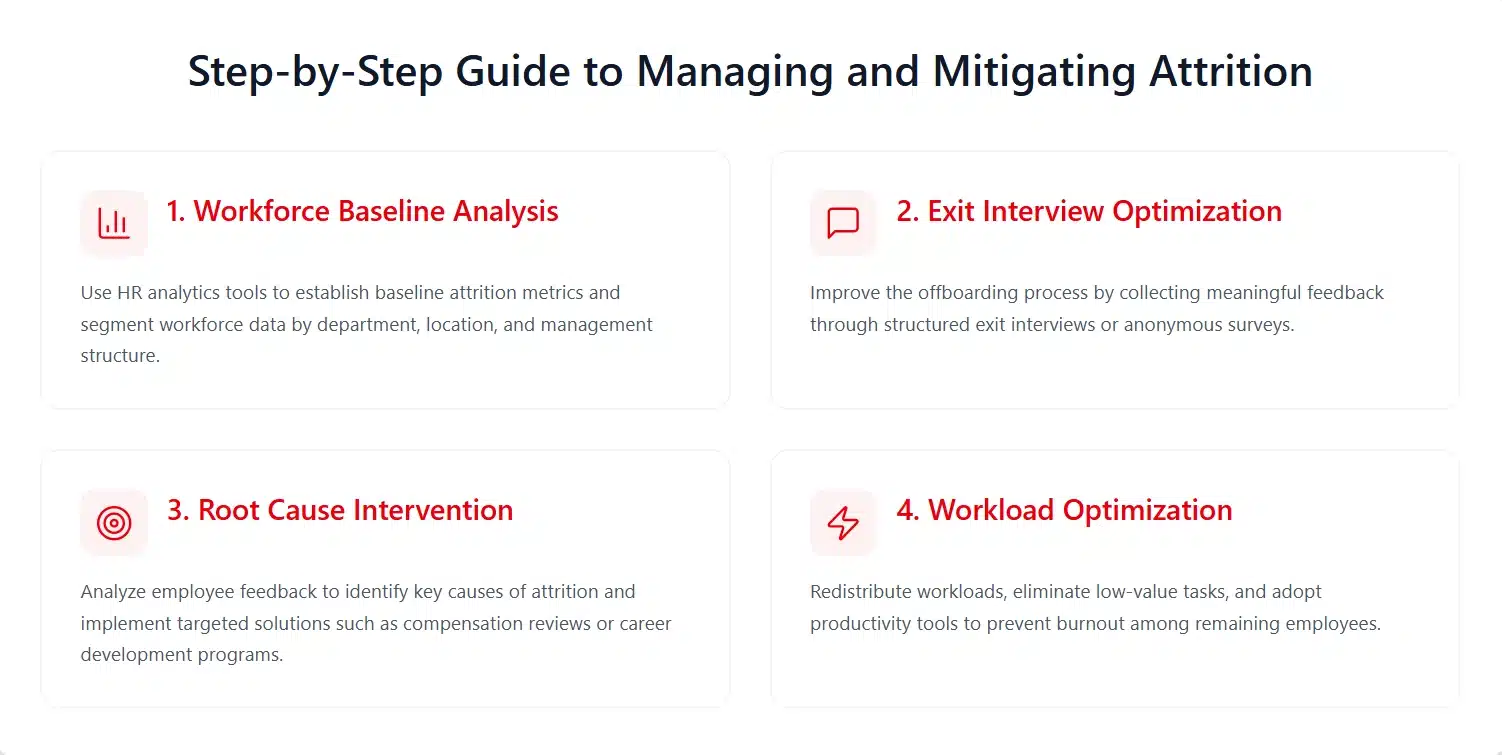
Recognizing a rise in unreplaced departures is only the initial step toward organizational stability. Implementing a robust management strategy requires a systematic, data-driven approach that aligns HR initiatives with core business objectives. This framework helps leaders move beyond observation and into proactive workforce optimization.
Step 1: Establish Comprehensive Baselines and Segmentation
HR leaders must first establish accurate baseline metrics using a dedicated Human Resources Information System (HRIS). It is vital to segment this data by department, geographic location, and specific managers to uncover hidden turnover hotspots. Granular analysis might reveal that while company-wide rates are stable, a single team is experiencing a mass exodus.
Step 2: Revamp the Offboarding and Exit Interview Process
Gathering authentic feedback from departing staff is essential to understanding the root causes of a shrinking workforce. Traditional exit interviews often feel like administrative formalities, leading to vague or overly polite responses from employees. Using third-party interviewers or anonymous post-exit surveys can yield much more honest and actionable insights.
Step 3: Target Interventions Based on Root Cause Analysis
Once feedback is collected, organizations should conduct a root cause analysis to identify the primary drivers of unwanted departures. If data points to compensation issues, leaders must initiate market benchmarking to ensure salaries remain competitive. Interventions should always address specific pain points, such as career progression or upskilling, rather than relying on guesswork.
Step 4: Optimize Workload Distribution for the Remaining Team
When positions remain unfilled, the increased workload on the remaining team can trigger a dangerous domino effect of burnout. Managers must rigorously prioritize tasks and eliminate low-value projects to protect the well-being of their staff. This transition is an ideal time to adopt new digital tools that help maintain productivity without sacrificing work-life balance.
Building a resilient workforce requires moving beyond reactive fixes toward a proactive, data-driven strategy. By addressing the root causes of departures, organizations can foster long-term loyalty and maintain a competitive edge in any market.
Advanced Practices for Modern Attrition Analysis
As human resources evolves into a highly strategic, data-centric discipline, standard spreadsheet tracking is no longer sufficient. Forward-thinking organizations are adopting advanced practices and leveraging cutting-edge technology to stay ahead of workforce trends and proactively manage their talent pipelines.
1. Predictive Analytics and Machine Learning
Advanced HR teams now use machine learning algorithms to identify complex patterns that precede an employee’s departure. These AI models analyze various factors, such as changes in vacation usage, promotion history, and engagement scores, to flag high-flight-risk individuals. This technology allows management to intervene with personalized support before a resignation letter is even drafted.
2. Continuous Listening and Stay Interviews
Relying on annual surveys is an outdated practice that often misses rapid shifts in employee sentiment. Forward-thinking companies use frequent pulse surveys and “stay interviews” to understand what keeps their high-performing talent engaged. This proactive dialogue helps identify current frustrations and motivations, preventing regrettable losses before they happen.
3. Organizational Network Analysis (ONA)
Organizational Network Analysis (ONA) maps informal collaboration networks to identify key influencers who hold a team together. These central figures often serve as vital nodes for mentorship and problem-solving, regardless of their official job titles. By recognizing these critical linchpins, HR can focus retention efforts on the individuals most essential to maintaining team cohesion.
4. Agile Workforce Planning
Agile organizations view workforce shrinkage as an opportunity to reshape the company rather than a sudden crisis. They use dynamic scenario planning to adjust talent strategies rapidly in response to changing economic conditions. This fluid approach allows businesses to upskill current staff and reallocate resources in real-time to meet global market demands.
Conclusion
Effectively monitoring and managing the attrition rate is essential for strategic workforce planning and long-term organizational health. While some level of natural shrinkage is inevitable, high rates of voluntary departure often signal deeper issues like poor leadership or uncompetitive compensation.
By accurately calculating this metric and identifying root causes, HR professionals can transition from reactive responses to proactive strategies. Ultimately, a deep understanding of why employees leave allows businesses to build a more resilient, engaged, and high-performing workforce that can adapt to the challenges of the modern market.
Build a high performing workforce by automating your attrition rate tracking and book a free demo today to explore actionable retention strategies.

FAQ about Attribution Rate
-
What is a good attrition rate for a company?
A healthy attrition rate varies by industry, but typically, a rate below 10% is considered standard. It is vital to benchmark against competitors in your specific sector for accuracy.
-
How is attrition different from turnover?
Attrition occurs when an employee leaves and the role is not refilled or is eliminated, reducing headcount. Turnover involves replacing departed staff with new hires, maintaining the total headcount.
-
What is a healthy attrition rate?
A healthy attrition rate varies by industry, but generally, an annual attrition rate of 10-15% is considered acceptable, while rates above 20% may indicate potential problems within the organization.
-
What does a 10% attrition rate or above mean?
A 10% attrition rate means 10% of your workforce has left and their positions remain unfilled. This is generally a red flag indicating systemic issues such as poor management, uncompetitive pay, or a lack of career growth that requires immediate attention.
-
How can a business increase its attrition rate?
To increase attrition intentionally during restructuring, businesses use natural reduction methods: implement a hiring freeze for vacant roles, offer early retirement packages, or provide voluntary separation schemes (VSS) to reduce headcount without active layoffs.