











In a volatile global market, vertical integration is a strategic shield against supply chain disruptions and unpredictable costs. By bringing outsourced operations in-house, companies can transform potential vulnerabilities into a distinct competitive advantage, gaining total control over their value chain.
However, successful integration requires more than just an acquisition; it demands deep operational restructuring and heavy capital investment. To manage this new complexity, a sophisticated digital nervous system (like an ERP) is essential to centralize data and ensure that expanded operations remain both streamlined and profitable.
- Vertical integration is a strategic expansion model where a company assumes control over multiple stages of its supply chain.
- Rather than seeking total industry control, companies target specific supply chain risks where external dependencies create instability or inflate final prices.
- There’s multiple types for Vertical Integration, including : Upstream,Downstream, and Balanced
- Vertical integration is more than just acquiring a supplier or a storefront it is an operational challenge that adds massive complexity to daily business.
What is Vertical Integration?
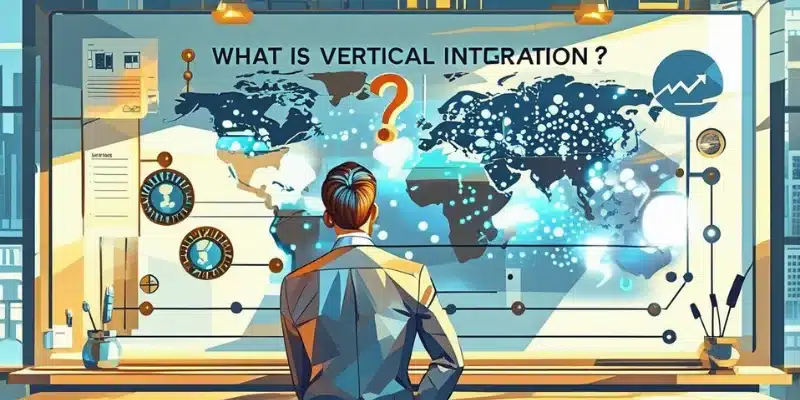
Vertical integration is a strategic expansion model where a company assumes control over multiple stages of its supply chain. By managing production and distribution internally rather than relying on third parties, the company oversees the entire product lifecycle. This approach allows a single entity to govern everything from raw material procurement to the final sale.
To grasp this strategy, one must understand the value chain the series of steps that add value to a product. For example, while a traditional furniture maker only handles manufacturing, a vertically integrated firm might own the forests, processing mills, and retail showrooms. By controlling every link from timber harvesting to the final sale, the company captures more value at every stage.
How Vertical Integration Works in the Modern Business Landscape

Modern vertical integration is a data-driven strategy used to eliminate operational bottlenecks and high third-party costs. Rather than seeking total industry control, companies target specific supply chain risks where external dependencies create instability or inflate final prices. By bringing these functions in-house, businesses can better protect their margins and streamline their operations.
Companies typically expand their control through organic growth or external acquisition (M&A). Organic expansion involves building new capabilities from scratch—like a software firm constructing its own data centers—to create a custom-fit infrastructure. In contrast, M&A involves buying established businesses for immediate capacity and expertise.
The ultimate success of vertical integration depends on synchronization. Information must flow seamlessly between every stage, from the manufacturing floor to retail outlets, so that real-time demand directly informs raw material orders. Without this level of coordination, a company is simply a collection of disconnected businesses rather than a unified, efficient value chain.
Types of Vertical Integration
The direction in which a company expands along its supply chain determines the type of integration it is undertaking. Business strategists generally categorize these movements into three distinct classifications: backward, forward, and balanced integration. Each serves a different strategic purpose and addresses different operational challenges.
Backward Integration (Upstream)
Backward integration occurs when a company expands upstream to produce the raw materials or components it previously purchased from suppliers. The primary goal is to secure a reliable supply of inputs, stabilize costs, and improve profit margins by eliminating third-party markups.
For instance, a coffee chain might acquire its own roasting facilities or coffee farms to protect itself from wholesale price volatility and ensure consistent quality. This strategy is particularly common in industries where raw materials are scarce, volatile, or require specialized processing that external vendors cannot consistently provide.
Forward Integration (Downstream)
Forward integration involves expanding downstream by taking control of distribution and retail sales. By bypassing third-party wholesalers, a company moves closer to the end consumer to capture retail margins, control brand presentation, and gain direct feedback.
A classic example is an electronics manufacturer opening its own branded stores or e-commerce platforms instead of relying on big-box retailers. In the digital age, this trend—often called disintermediation—has surged as online platforms make it easier for brands to sell directly to their audience.
Balanced (Complete) Integration
Balanced, or complete, integration is the most aggressive and resource-intensive form of this strategy. It occurs when a company successfully executes both backward and forward integration, effectively owning the entire lifecycle of its product. The company controls the raw materials, the manufacturing processes, the logistics network, and the final retail distribution.
Historically, the Ford Motor Company’s River Rouge complex in the 1920s was the ultimate example of balanced integration. Iron ore, coal, and rubber went into one end of the massive facility, and fully assembled automobiles came out the other. Today, achieving total balanced integration is exceedingly rare due to the sheer complexity and capital required, but highly dominant tech and energy companies often come close by controlling their proprietary hardware, software ecosystems, and retail distribution channels.
Vertical Integration vs. Horizontal Integration
The Role of ERP Systems in Vertical Integration
Vertical integration is more than just acquiring a supplier or a storefront; it is an operational challenge that adds massive complexity to daily business. Managing different workforces, inventory types, and regulations through fragmented spreadsheets or legacy databases often leads to “data silos.” These silos create expensive blind spots, resulting in misaligned schedules and inventory errors that can negate the benefits of integration.
To manage this, companies use an Enterprise Resource Planning (ERP) system as a “centralized brain.” This software creates a single source of truth, linking every stage of the supply chain in real-time. For example, a single retail sale can instantly trigger a manufacturing request and a raw material purchase order. Because different departments have specialized needs—like manufacturing’s production tracking versus retail’s customer management—companies must carefully evaluate the various types of ERP systems available to ensure the software can handle their entire vertical footprint.
Advantages of Implementing a Vertically Integrated Strategy
When executed correctly, bringing the supply chain in-house offers transformative benefits that can propel a company to industry leadership. The advantages extend far beyond simple cost-cutting, fundamentally altering a company’s strategic positioning.
Unprecedented Supply Chain Control and Certainty
In an era characterized by global shipping delays, raw material shortages, and geopolitical instability, reliance on third-party suppliers is a massive liability. Vertical integration provides a business with absolute certainty regarding its supply lines. By owning the production of critical components, a company guarantees its access to necessary materials, ensuring that manufacturing lines never sit idle waiting for delayed shipments. This control allows for highly accurate production forecasting and reliable delivery promises to end consumers.
Significant Cost Reduction and Margin Capture
Every time a product moves from one independent company to another along the supply chain, a profit margin is added. The raw material supplier marks up their goods; the manufacturer marks up the finished product; the distributor marks up the delivery. By internalizing these stages, a vertically integrated company avoids paying these external markups. Furthermore, the company eliminates the transactional costs associated with negotiating contracts, auditing external vendors, and managing third-party logistics. These cumulative savings can be reinvested into R&D or used to lower consumer prices, undercutting non-integrated competitors.
Superior Quality Assurance
When outsourcing production, maintaining strict quality control is a constant challenge. Miscommunications, differing standards, and corner-cutting by external vendors can result in substandard products reaching the market, severely damaging brand reputation. Vertical integration allows a company to implement and enforce rigorous, uniform quality standards across every single stage of production. From the precise chemical composition of raw materials to the final packaging, the company retains total oversight, ensuring a consistently superior end product.
Protection of Intellectual Property
For companies built on proprietary technology, unique manufacturing processes, or secret recipes, outsourcing presents a significant risk of intellectual property (IP) theft. Sharing blueprints, schematics, or formulations with third-party manufacturers inherently increases the chances of that information leaking to competitors. Bringing production in-house creates a closed ecosystem, drastically reducing the risk of corporate espionage and safeguarding the company’s most valuable intangible assets.
Challenges and Risks of Vertical Integration
Despite the compelling advantages, vertical integration is not a universal panacea. It is a high-risk, high-reward strategy that carries significant potential downsides. Business leaders must carefully weigh these risks before committing to such a profound structural transformation.
Massive Capital Intensity
The most immediate barrier to vertical integration is the astronomical financial cost. Acquiring existing companies, building new manufacturing facilities, establishing logistics networks, and hiring specialized talent requires massive capital expenditures (CapEx). This ties up significant financial resources that could otherwise be used for marketing, product innovation, or horizontal expansion. If the integrated venture fails to generate the expected efficiencies, the financial burden can cripple the parent company.
Loss of Strategic Flexibility
One of the hidden dangers of owning your entire supply chain is a severe loss of agility. In a traditional outsourced model, if a new, cheaper, or more innovative raw material becomes available, a company can simply switch suppliers when their contract expires. A vertically integrated company, however, is locked into its own infrastructure. If a technological breakthrough renders their newly built manufacturing plant obsolete, they are stuck with a massive sunk cost and cannot easily pivot to modern methods without incurring further massive expenses.
The Complexity of Managing Disparate Operations
Running a successful retail brand requires a vastly different skill set than running a chemical processing plant or managing a fleet of long-haul trucks. When a company vertically integrates, executive leadership is suddenly tasked with overseeing highly diverse operations outside their core competency. This organizational complexity can lead to bloated management structures, bureaucratic inefficiencies, and a loss of focus on the company’s original value proposition. Without exceptionally strong leadership and robust management systems, the sprawling integrated enterprise can collapse under its own weight.
Key Indicators Your Business Needs Vertical Integration
Deciding to pursue this strategy should never be based on a whim or a desire for corporate vanity. It must be a calculated response to specific market conditions and internal operational bottlenecks. How do executives know when the time is right? There are several key indicators that suggest a business could significantly benefit from internalizing its supply chain.
- First indicator is persistent supplier unreliability. If a company’s growth is constantly stunted because suppliers cannot meet volume demands, frequently miss delivery deadlines, or consistently fail quality audits, the cost of third-party reliance has become too high. Taking control of that production stage becomes a matter of operational survival.
- Second indicator is the presence of exorbitant supplier margins. If market analysis reveals that the suppliers of critical components are enjoying massive, disproportionate profit margins while the manufacturing company struggles to maintain profitability, backward integration is a logical step to capture that lost value.
- Third indicator is a critical need for rapid innovation often necessitates integration. When a company relies on external vendors for components, the pace of their product development is limited by the vendor’s R&D capabilities. By bringing component design and manufacturing in-house, a company can iterate faster, tightly couple hardware and software development, and bring cutting-edge products to market faster than competitors.
Recognizing these indicators is only the first step; acting on them requires the right technological foundation. Before embarking on an integration journey, companies must evaluate their digital readiness and invest in a ERP software capable of scaling alongside their physical expansion, ensuring that newly acquired divisions can be seamlessly incorporated into the corporate data ecosystem.
Vertical Integration in Software: The Best-of-Breed Approach
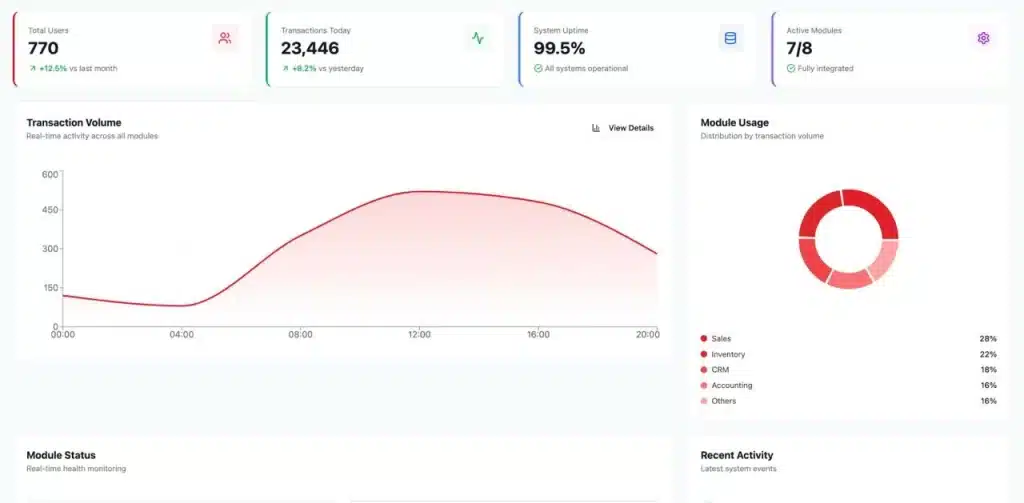
Physical vertical integration removes external bottlenecks, digital integration removes data silos. As a company expands its physical footprint, it often outgrows generic, all-in-one software. A system designed for general accounting frequently lacks the technical depth required to manage a high-velocity production line or complex global distribution.
Modern digital strategy mirrors physical integration by creating a unified ecosystem of specialized tools. Connecting best-of-class applications into a single data stream ensures that high-level strategy and ground-level execution remain perfectly aligned. This transparency allows management to monitor every stage of the value chain without the friction of manual data entry.
Achieving this requires a sophisticated approach to ERP software integration. Utilizing Application Programming Interfaces (APIs), middleware, and advanced data mapping, IT teams can create a unified digital ecosystem out of disparate applications. This mirrors physical vertical integration: different specialized entities (software applications) are brought under a single, unified chain of command (the central data architecture) to optimize the overall output of the enterprise.
Real-World Examples of Vertical Integration
To truly understand the power and application of this strategy, we must examine how some of the world’s most successful corporations have utilized it to achieve market dominance.
The Technology Sector: Apple Inc.
Apple is arguably the modern master of balanced vertical integration. Historically, computer companies bought processors from one vendor, operating systems from another, and sold the final product through third-party electronics retailers. Apple systematically dismantled this model. They design their own proprietary silicon chips (backward integration), build their own operating systems, construct the hardware, and sell the finished devices through their massive network of branded Apple Stores and their digital App Store (forward integration). This absolute control over the entire user experience is the foundation of their premium brand positioning and unparalleled profit margins.
The Retail and Fashion Sector: Zara (Inditex)
The fast-fashion giant Zara revolutionized the apparel industry through aggressive vertical integration. While most clothing brands design items and then outsource manufacturing to factories in Asia—a process that takes months—Zara owns a significant portion of its manufacturing facilities, primarily located in Spain and surrounding countries. They also own their entire distribution network and retail storefronts. This tightly controlled, integrated supply chain allows Zara to identify a new fashion trend, design a garment, manufacture it, and have it on store shelves globally in less than three weeks. Their integration provides an unbeatable advantage in speed-to-market.
The Entertainment Industry: Netflix
Netflix provides a fascinating example of digital backward integration. Originally, Netflix was purely a distributor, licensing movies and television shows created by traditional Hollywood studios. As those studios realized the value of streaming and began pulling their content to start their own platforms, Netflix faced an existential threat to its supply chain. In response, Netflix aggressively integrated backward, spending billions to become a major production studio. By creating “Netflix Originals,” they secured a permanent, exclusive supply of content, transforming from a mere distribution channel into a vertically integrated entertainment powerhouse.
Steps to Execute a Vertical Integration Strategy
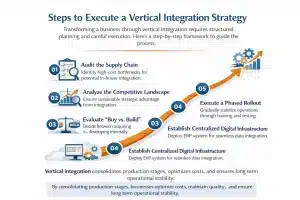
Transforming a business through vertical integration is a monumental undertaking. It requires meticulous planning, precise execution, and a phased approach to mitigate risks. Business leaders should follow a structured framework when embarking on this journey.
-
Audit the supply chain : to pinpoint high-cost bottlenecks, thereby identifying the specific stages that offer the highest ROI if brought in-house.
-
Analyze the competitive landscape : to consequently ensure the proposed integration provides a sustainable strategic advantage rather than just operational complexity.
-
Evaluate “buy vs. build” : Compare the speed of M&A against the granular control of organic growth to determine the most cost-effective path to expansion.
-
Establish a centralized digital infrastructure : by subsequently deploying a unified ERP system to ensure seamless data transparency across all newly linked departments.
-
Execute a phased rollout : by gradually stabilizing each individual operational tier through training and testing before moving further along the value chain.
Vertical integration replaces external supply chain dependencies with internal control. By consolidating multiple production stages, businesses optimize costs, maintain quality, and ensure long-term operational stability.

Conclusion
Vertical integration remains one of the most potent strategic maneuvers available to modern enterprises. In a global economy defined by unpredictability, the ability to internalize the supply chain, dictate production timelines, and capture maximum value at every stage provides an undeniable competitive moat. Whether a company chooses to integrate backward to secure vital resources or forward to own the customer relationship, the resulting control can fundamentally transform its market trajectory.
However, the physical consolidation of assets is only the beginning. The true power of vertical integration is unlocked when those assets are seamlessly connected through robust, centralized technology. Without the ability to track data, manage resources, and communicate across newly acquired divisions, integration becomes a liability rather than an asset.
That’s why having the right software is so essential it’s the glue holding your newly unified supply chain together. If you’re curious to see how this digital integration actually plays out in the real world, you can grab a free demo to watch it connect everything from end to end.
FAQ About Vertical Integration
-
How does digital vertical integration differ from physical integration?
Physical integration involves owning actual factories and stores. Digital integration focuses on software, weaving together specialized “best-of-breed” applications (like WMS and CRM) into a single unified data ecosystem so every department has the exact tools it needs.
-
Can vertical integration actually make a company less agile?
Yes, this creates “strategic inflexibility.” Because you are locked into your own infrastructure and sunk costs, it becomes much harder and more expensive to quickly pivot to a cheaper external supplier or a new manufacturing method.
-
What are “data silos,” and why are they dangerous for integrated companies?
Data silos happen when different supply chain stages use disconnected databases. They are dangerous because they cause misaligned schedules and inventory errors. A centralized ERP system is required to create a single source of truth across all integrated departments.
-
Is vertical integration the same as a monopoly?
No. Vertical integration aims for operational efficiency, whereas horizontal integration (buying competitors) often faces monopoly scrutiny for reducing consumer choice. However, if an integrated company hoards vital raw materials to block competitors, it can trigger antitrust investigations.