













Building a strong oversight framework is essential for business survival. In today’s complex economic environment, companies face higher risks of financial mismanagement. According to the Association of Certified Fraud Examiners (ACFE), organizations lose an estimated 5% of their annual revenues to occupational fraud. Without a structured approach, small errors can easily escalate into significant financial damage.
A well-designed internal controls system acts as the central nervous system of an organization. It ensures that they record transactions accurately, protect company assets , and align daily operations with strategic objectives . More importantly, it provides management with confidence that financial reports are reliable and that the business complies with applicable laws and regulations.
This guide explores the core components of effective internal control procedures, including the different types of controls and practical examples across departments. It also outlines a step-by-step implementation approach based on the globally recognized COSO framework, examines the role of technology in strengthening controls, and discusses common challenges during adoption, helping you build and maintain an internal controls system that safeguards your business.
Key Takeaways
|
Understanding Internal Control Procedures.
Internal control procedures are a series of systematic rules, policies, and practices that management designs and implements to achieve specific business objectives. Their primary goal is to protect company assets from theft or misuse and ensure accuracy.
This system acts as an internal line of defense, helping the organization manage risks, prevent fraud, and maintain the integrity of all business processes from start to finish. Without effective controls, a business becomes highly vulnerable to financial losses.
Essentially, internal control procedures are not about creating restrictions or bureaucracy, but rather about establishing a structured framework for healthy and sustainable operations.
This framework encompasses everything from the authorization process for transactions and the separation of duties among employees to the regular reconciliation of bank statements.Ultimately, a solid internal control system is the foundation that allows a company to grow stably, build trust with investors, and operate with a higher degree of predictability amidst market uncertainties.
Why Are Internal Control Procedures Crucial for Your Business?
Understanding the importance of internal control procedures is the first step for any business leader aiming to build a strong and resilient organization. Often perceived as an administrative burden, the role of internal control is far more strategic.
Without this system, a company operates in a reactive mode, constantly putting out “fires” caused by inefficiencies or even fraudulent actions. Regardless of its size, every business should prioritize internal control procedures for several key reasons that collectively fortify its operations.
1. Prevent fraud and protect assets
Procedures such as segregation of duties and layered authorization are designed to minimize opportunities for internal fraud. For instance, ensuring that the person responsible for receiving cash is different from the one recording it in the accounting system significantly reduces the risk of embezzlement.
Asset protection extends beyond cash to include physical assets like inventory and equipment, as well as intangible assets such as customer data and intellectual property, all of which are crucial for a company’s advantage in their market.
2. Increase the accuracy and reliability of financial reports
Accurate financial reports are the bedrock of sound strategic decision-making by both internal management and external stakeholders like investors and creditors. Internal control procedures, including monthly bank reconciliations, invoice verification and periodic internal audits.
This data reliability is vital for producing income statements, balance sheets, and cash flow statements that truly reflect the company’s financial health, thereby preventing business decisions based on flawed information.
3. Ensure compliance with laws and regulations
Every industry is subject to a host of laws and regulations, from tax codes and labor laws to environmental and safety standards. Internal control procedures help ensure that all operational activities are conducted within the legal framework.
This compliance also extends to internal company policies, ensuring that all employees adhere to the ethical standards and procedures established by management, which fosters a culture of accountability and integrity throughout the organization.
4. Improve operational efficiency
Internal controls are not just about preventing negative outcomes; they also actively promote efficiency in daily business processes. With clear Standard Operating Procedures (SOPs) for every task, companies can reduce redundancy and minimize errors.
This allows employees to be more productive as they have clear guidance on how to complete their tasks effectively. This enhanced efficiency ultimately leads to lower operational costs and improved profitability for the company as a whole.
3 Main Types of Internal Control Procedures
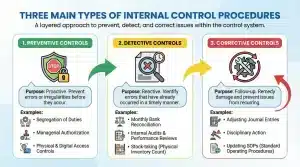
To design an effective control system, it is essential to understand that not all controls serve the same function. Internal control procedures can be categorized based on their purpose, whether they aim to prevent, detect, or correct issues that have already occurred.
This layered approach ensures that if one type of control fails, another layer of defense is in place to identify or address its impact. Generally, internal control procedures are classified into three main types.
1. Preventive Controls
Preventive controls are the most proactive type, designed to stop errors or irregularities from occurring in the first place. Their objective is to prevent problems before they happen, making them the first line of defense for a company.
A classic example is segregation of duties, in which no single individual controls the entire transaction cycle. Other common preventive controls include requiring managerial authorization for expenditures above a certain threshold and implementing physical and digital access controls.
2. Detective Controls
When preventive controls fail, detective controls come into play to identify errors or irregularities that have already occurred. These controls are reactive but are crucial for discovering problems in a timely manner before their impact escalates.
The most prominent example of a detective control is the reconciliation process, such as a monthly bank reconciliation that compares the company’s cash records to the bank’s statement.
Other activities like internal audits, performance reviews, and physical inventory counts (stock-taking) are also effective detective controls for uncovering anomalies and discrepancies that may indicate underlying issues.
3. Corrective Controls
After a detective control has identified a problem, corrective controls are implemented to remedy the damage and prevent similar issues from happening in the future. These controls are the follow-up actions that ensure the company learns from its mistakes and strengthens its processes.
Examples of corrective controls include creating and adjusting journal entries to fix accounting errors found during reconciliation, taking disciplinary action against employees who violate policies, and updating or revising Standard Operating Procedures (SOPs).
Examples of Effective Internal Control Procedures in a Company,
The theory behind internal control becomes far more meaningful when applied to daily business operations. Implementing the right procedures in the right departments is key to transforming concepts into tangible actions that protect your business.
These procedures do not need to be overly complex, but they must be consistently applied and integrated into existing workflows. Here are several concrete examples of internal control procedures that can be effectively implemented across various departments.
1. Segregation of duties
This is one of the most fundamental controls, aimed at preventing fraud by dividing the responsibilities for a critical process among multiple people. In the finance department, for instance, the employee who approves payments should be different from the person who processes them.
In a warehouse, the individual who receives goods from suppliers should be separate from the one who records the inventory, preventing theft or manipulation of stock records and ensuring a check-and-balance system is always in place.
2. Access controls
Access controls serve to limit who can access a company’s physical and digital assets, ensuring only authorized personnel can use them. Physical access controls can be as simple as locking server rooms or warehouses storing valuable goods.
Meanwhile, logical (digital) access controls include using multi-factor authentication and assigning role-based access rights within software systems, such as an accounting ERP system, to ensure employees can only view and modify data relevant to their job functions.
3. Transaction authorization
This procedure requires approval from an appropriate level of management before a transaction can be executed. Its purpose is to ensure that every expenditure or company commitment has been reviewed and deemed legitimate and in line with company policy.
Examples include requiring a manager’s signature for any purchase request over $500, approval from the finance director for any loan application, or validation from the HR head for employee salary and bonus payments, which adds a crucial layer of oversight.
4. Regular reconciliations
Reconciliation is the process of comparing two different sets of records to ensure the figures match and are accurate. The most common process is the monthly bank reconciliation, where the cash balance in the company’s general ledger is matched.
Additionally, reconciliations can be performed for accounts receivable, accounts payable, and inventory to identify and correct any discrepancies or recording errors in a timely manner, maintaining the integrity of financial data.
5. Physical controls over assets
These procedures include using surveillance cameras (CCTV) in vital areas like cashier stations or warehouses, conducting periodic physical inventory counts, and keeping valuable equipment in secure locations.
Furthermore, using serial numbers and asset tags to track equipment such as laptops and vehicles is an essential part of physical control, providing a clear audit trail for high-value items.
A Guide to Implementing Internal Control Procedures (COSO Framework)
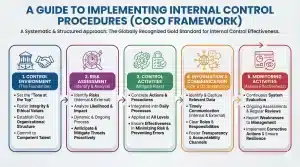
Effectively implementing internal control procedures requires a systematic and structured approach. One of the most globally recognized frameworks used as a gold standard is the COSO Framework, developed by the Committee of Sponsoring Organizations of the Treadway Commission.
This framework provides comprehensive guidance for designing, implementing, and evaluating the effectiveness of an internal control system. According to COSO, the framework consists of five interrelated components that work together to create a cohesive control structure.
1. Control Environment
This is the foundation for all other components of internal control, encompassing the “tone at the top” or the attitude and awareness of senior management regarding the importance of control.
A strong control displays integrity and ethical values, a clear organizational structure, and a commitment to attracting,developing, and retaining competent talent.
2. Risk Assessment
Every company faces a variety of risks from both internal and external sources that can hinder the achievement of its objectives. This component requires management to identify risks relevant to their business, analyze their likelihood and potential impact.
This process must be dynamic and ongoing, as risks can change with shifts in market conditions, technology, or the company’s business model. A proactive approach to risk assessment allows a company to anticipate and mitigate threats before they materialize.
3. Control Activities
These are the concrete actions or procedures implemented to mitigate the risks identified during the risk assessment phase. Control activities are what most people think of as “internal controls” themselves, including procedures.
These activities should be integrated into daily business processes and applied at all levels of the organization to ensure their effectiveness in minimizing risk and preventing errors.
4. Information and Communication
For an internal control system to function, relevant and high-quality information must be identified, captured, and communicated to the appropriate parties in a timely manner. Communication must flow effectively both internally and externally.
Employees must understand their roles and responsibilities within the control system, and there must be clear channels for reporting any issues or violations to foster an environment of transparency and accountability.
5. Monitoring Activities
An organization must continuously monitor an internal control to assess whether it is operating effectively over time. Monitoring activities can integrate ongoing evaluations such as regular managerial reviews, into business processes.
Any weaknesses or deficiencies identified during the monitoring process must be reported to management and follow up with appropriate corrective actions to ensure that the system remains resilient and responsive to new challenges.
The Role of Technology in Optimizing Internal Control Procedures
In today’s digital age, relying entirely on manual internal control procedures is no longer efficient and is highly susceptible to human error. Manual processes such as physical document checks and spreadsheet reconciliations are time-consuming.
Technology, especially integrated business management software like Enterprise Resource Planning (ERP) systems, plays a crucial role in automating, strengthening, and optimizing the effectiveness of internal control procedures.
The use of finance automation allows companies to implement controls systematically and consistently across the entire organization with a much higher degree of accuracy. One of the primary roles of technology is in the digital application of segregation of duties and access controls.
Through an ERP system, management can easily configure role-based access rights, where each user can only access modules and data relevant to their job responsibilities. For instance, a staff member responsible for creating purchase requests will not have access to approve them.
As reported by sources like Forbes, every transaction within the system is automatically recorded in an unalterable audit trail, providing full transparency about who did what and when, which greatly simplifies the audit process and investigation of any anomalies.
Common Challenges in Implementing Internal Control
Despite their clear benefits, implementing internal control procedures is often not a smooth process and faces various practical challenges. Acknowledging and anticipating these challenges is a critical step to ensure the successful adoption.
One of the biggest hurdles is employee resistance, who may view new procedures as an additional workload that hampers their speed and flexibility. Changing work habits often causes discomfort, especially if the benefits of the controls are not communicated effectively by management.
Another significant challenge is the cost and resources required for implementation, particularly for small and medium-sized enterprises (SMEs). Designing and deploying a comprehensive control system, including investing in technology like accounting software or an ERP.
Furthermore, a lack of in-house expertise to design and maintain the control system can be a major obstacle. Without a deep understanding of risk management and business processes, the controls implemented might be ineffective or even counterproductive.
Conclusion
In conclusion, internal control procedures are an indispensable component of modern business management, serving as the bedrock for financial integrity, operational efficiency, and regulatory compliance.
By implementing a layered defense system of preventive, detective, and corrective controls, organizations can proactively safeguard their assets, prevent fraud, and ensure the reliability of their financial reporting.
While challenges such as employee resistance and resource constraints are real, the strategic integration of technology, particularly through ERP systems, offers powerful solutions to automate and strengthen these controls.
Technology transforms internal control from a manual, reactive task into a dynamic, real-time process that empowers businesses to make smarter decisions. Ultimately, investing in a solid internal control system is not an expense, but rather a strategic investment in the long-term stability of the company.

Frequently Asked Questions
-
What are the 5 main components of internal control?
The five main components, based on the COSO framework, are the Control Environment, Risk Assessment, Control Activities, Information and Communication, and Monitoring Activities. These elements work together to create a comprehensive control system.
-
What is the main purpose of internal control?
The main purpose of internal control is to help an organization achieve its objectives by safeguarding assets, ensuring financial reporting accuracy, promoting operational efficiency, and ensuring compliance with laws and regulations.
-
What is an example of a weak internal control?
An example of a weak internal control is the lack of segregation of duties, where a single employee has the authority to initiate, approve, and record a financial transaction. This creates a significant opportunity for fraud and errors to go undetected.