









In today’s fast-paced business world, the speed and accuracy of delivery have become critical factors determining customer satisfaction and competitive advantage. Shipping delays not only disappoint customers but can also disrupt cash flow and damage your company’s reputation.
This is where a deep understanding of delivery lead time becomes absolutely crucial for every business leader. This metric is not just a number; it reflects the health and efficiency of your entire supply chain, from the moment an order is placed until the product arrives in the customer’s hands.
Effectively managing delivery lead time means you have greater control over your operations, inventory, and customer expectations. By implementing a supply chain management system, companies can reduce costs, increase flexibility, and build stronger customer loyalty.
This article will comprehensively cover everything you need to know about delivery lead time, from its definition and components to how to calculate it accurately and practical strategies for reducing it with modern technology.
Key Takeaways
|
What Is Delivery Lead Time?
In simple terms, delivery lead time is the total time elapsed from when a customer places an order until they receive the product or service. It is an end-to-end metric that measures the entire order fulfillment cycle from the customer’s perspective.
Consequently, delivery lead time has become one of the most critical Key Performance Indicators (KPIs) in supply chain management, logistics, and manufacturing. A shorter delivery lead time means the company can convert orders into revenue more quickly, leading to higher customer satisfaction rates.
Key Components That Make Up Delivery Lead Time
Delivery lead time isn’t a single block of time. It’s the sum of several distinct process stages, each with its own duration. Identifying and measuring each component is the first step to finding where delays are occurring.
A thorough breakdown of these elements allows businesses to pinpoint bottlenecks and implement targeted improvements. To understand it deeply, let’s dissect each of its main components.
1. Order processing time
This begins when a customer’s order is received and ends when it’s handed off to the production or warehouse team. This stage involves various administrative activities, such as verifying order details, checking stock availability, and validating payment.
Manual processes at this stage are often a significant source of initial delays, making automation is often used here to speed things up and reduce errors.
2. Pre-processing/queuing time
After an order is administratively processed, it often doesn’t move directly into the production phase. This waiting period is the time the order spends in a queue, waiting for its turn to be manufactured or picked from the warehouse.
The duration of this queue time can vary significantly depending on the volume of incoming orders, available production capacity, or the priority schedule set by the production manager. Keeping this idle time short is important for improving overall lead time.
3. Production/manufacturing time
This is the duration required actually to produce or assemble the ordered goods. The production time covers the entire process from raw material withdrawal to component assembly and the completion of the finished product.
Efficiency in this stage heavily relies on the availability of materials, machine readiness, and workforce productivity. Any disruption can push back the final delivery date.
4. Quality control & packing time
After production, the product goes through inspection to ensure it meets quality standards (QC). This step is important for reducing returns and maintaining product consistency.
Once it passing inspection, the product is packaged for shipment. . Getting both steps right ensures the product not only meets standards but also arrives without damage.
5. Transit/shipping time
This is the final component, the time it takes to transport the product from the warehouse or factory to the customer’s address it’s influenced by geographical distance, the logistics partner’s efficiency, and external factors like weather.
How to Accurately Calculate Delivery Lead Time

Calculating delivery lead time accurately is the foundation for any improvement initiative. Without precise data, you cannot measure the impact of the changes you implement or identify the most significant bottlenecks in your process.
This calculation helps in setting realistic expectations for customers and provides a baseline for internal performance tracking. Here is the basic formula and practical steps to calculate it effectively.
1. Basic lead time formula
The most fundamental formula for calculating delivery lead time is to subtract the order date from the delivery date. This formula provides a total duration of the order cycle from start to finish, giving a high-level overview of performance.
While simple, this formula is highly effective for getting a general picture and can be used as a basis for more detailed analysis across different product lines or customer segments.
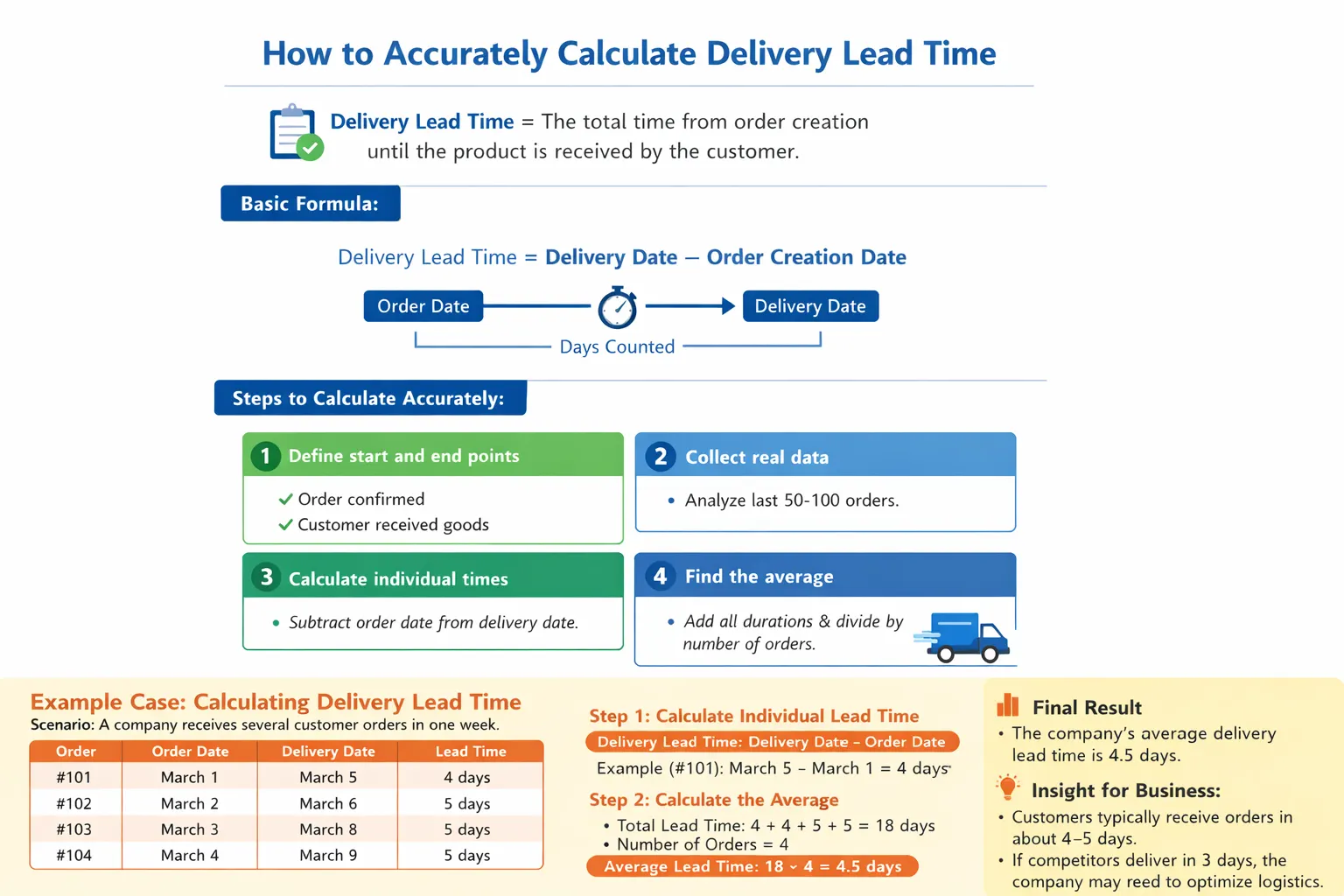
This calculation should be measured in days for consistency and ease of comparison.
2. Practical calculation steps
To obtain a more accurate and reliable result, it is best to collect data from multiple orders over a specific period and then calculate the average. First, consistently define the start point (when the order is confirmed) and the endpoint (when the customer receives the goods) for every order.
Second, gather historical data from a representative number of orders, such as the last 50-100 transactions. Finally, calculate the total duration for each order, sum them up, and then divide by the number of orders to get the average delivery lead time.
Why Does Delivery Lead Time Matter?

Reducing delivery lead time is not just about speeding up processes; it is a strategic business initiative that delivers widespread positive impacts. This effort can significantly improve a company’s financial health, strengthen its market position, and build better relationships with customers.
Here are some of the primary reasons why lead time optimization is a priority for competitive businesses in 2025.
1. Enhancing customer satisfaction and loyalty
Customers now expect fast, and transparent service. As highlighted by research from McKinsey, has noted that a growing share of consumers consider same-day delivery a baseline expectation, not a premium.
Shorter lead times help meet and sometimes exceed those expectations, which ultimately increases their satisfaction. Satisfied customers are more likely to make repeat purchases and recommend your business to others, thereby building long-term loyalty.
2. Optimizing cash flow
A shorter lead time compresses the order-to-cash cycle becomes faster. The company can issue invoices and receive payments sooner, which improves liquidity directly.
Better cash flow gives a company more room to reinvest in operations or respond to market opportunities without waiting on slow-moving receivable.
3. Increasing market flexibility and responsiveness
Faster internal processes, make a company more responsive to shift in demand or seasonal trends. New products can be launched more quickly, adjust production volumes more easily, and reduce the risk of stockouts when demand spikes unexpectedly.
This ability to adapt is a significant competitive advantage in a dynamic and often unpredictable marketplace, allowing you to capture opportunities that slower competitors might miss.
4. Reducing inventory holding costs
Long lead times typically push companies to hold more safety stock to anticipate demand or supply uncertainty. By shortening the lead time, the need for this safety stock decreases.
This, in turn, lowers inventory holding costs, insurance costs, and the risk of goods becoming damaged or obsolete in the warehouse. The capital freed up from reduced inventory can be reallocated to other value-adding activities within the business.
Fundamental Differences: Lead Time vs Cycle Time vs Takt Time
In operational management, several time-based metrics are frequently used and sometimes confused: lead time, cycle time, and takt time. Although all are related to time, they measure very different aspects of a production or service process.
Understanding their distinctions is essential for accurate process analysis and targeted improvement efforts, as each offers a unique lens on your operations.
1. Lead time
As discussed, lead time is the total time from a customer’s request to the product’s delivery. It is an external perspective, viewed from the customer’s standpoint, and it measures the entire fulfillment experience.
This metric includes all time, both value-added (active work) and non-value-added (waiting or queueing), making it a holistic measure of the end-to-end process that directly impacts customer satisfaction.
2. Cycle time
Cycle time, on the other hand, is the time it takes to complete one unit of a product from start to finish in the production process. It is an internal perspective that measures how quickly your team can produce something.
Cycle time typically counts only active work time and does not include waiting time between stages. It is a measure of production velocity and is crucial for understanding your internal capacity and efficiency.
3. Takt time
Takt time is the production rate required to meet customer demand. It is calculated by dividing the total available production time by the number of units customers demand.
Takt time is essentially the ‘heartbeat’ of production, synchronized with market demand. The goal is to align the cycle time with the takt time to produce exactly what is needed, when it is needed, without creating excess inventory or falling behind on orders.
Strategies For Reducing Delivery Lead Time
Reducing delivery lead time requires a strategic approach that spans multiple operational areas, from inventory management to supplier relationships. There is no single magic bullet; rather, it is a combination of process improvements that support one another.
Implementing these strategies can create a more efficient, responsive, and reliable supply chain. Here are some practical strategies your company can implement to achieve greater efficiency.
1. Optimize inventory management
Utilize proven inventory management methods like Just-In-Time (JIT) to reduce the amount of stock held and accelerate its flow through your system. Implement a stock classification system, such as ABC analysis, to prioritize the management of your most important items by value and demand frequency.
With effective inventory management, you can ensure that raw materials are always available when needed without tying up excess capital in unnecessary stock, thus reducing both holding costs and the risk of obsolescence.
2. Automate ordering and production processes
Manual processes are highly susceptible to errors and delays, creating significant bottlenecks in the workflow. Implement an automated system to handle repetitive tasks such as creating purchase orders, scheduling production runs, and updating order statuses.
Automation not only accelerates these processes but also improves data accuracy and provides real-time visibility into the entire workflow, allowing for more proactive management and quicker problem resolution.
3. Strengthen supplier relationship management (SRM)
Build strong, collaborative partnerships with your suppliers. Select vendors with a reliable track record of on-time delivery and consistent material quality. Collaborate transparently by sharing demand forecast data, which can help your suppliers better prepare their own stock and production schedules.
4. Implement parallel processing
Instead of executing every task sequentially, identify which stages of the process can be performed simultaneously. For example, the procurement team can begin ordering specialized raw materials as soon as a product design is approved, without waiting for the entire project plan to be finalized.
5. Analyze and refine internal workflows
Conduct value stream mapping to visualize your end-to-end process and identify activities that add no value (waste), such as unnecessary waiting, movement, or rework. Focus on eliminating these bottlenecks and streamlining the flow of materials and information.
Optimizing the entire product lifecycle, including processes for handling returns and reverse logistics, also contributes to overall operational efficiency and provides valuable insights for process improvement.
6. Leverage data for better forecasting
Use historical sales data and market trend analysis to create more accurate demand forecasts. A good forecast allows you to plan production and inventory levels more proactively rather than reactively.
This helps avoid stockouts that lead to lost sales and customer dissatisfaction, as well as overproduction that results in excess inventory and increased holding costs, both of which can negatively impact lead time.
Common Challenges in Lead Time Reduction Efforts
Although the benefits of reducing lead time are clear, the process of achieving it is often fraught with challenges. Identifying these potential obstacles early on can help companies prepare more effective mitigation strategies and set realistic goals.
A proactive approach to these common issues is essential for a successful lead time optimization project. Here are some of the most common challenges that businesses face in their efforts to streamline their supply chain.
1. Supplier dependency
Your suppliers’ performance has a direct and significant impact on your own lead time. Delays in raw material delivery, inconsistent quality that requires rework, or limited production capacity on the supplier’s end can create a domino effect throughout your production schedule.
This dependency makes your operations vulnerable to external disruptions. Strategies like supplier diversification, building strategic partnerships with key vendors, or holding buffer stock for critical components are common ways to mitigate this risk.
2. Lack of supply chain visibility
When data is scattered across different, disconnected systems such as spreadsheets, emails, and separate departmental softwar it is nearly impossible to get a holistic, real-time view of your supply chain.
This lack of visibility makes it difficult to track order status, monitor inventory levels across locations, or anticipate changes to the production schedule. As a result, decision-making becomes reactive rather than proactive, and companies often only become aware of a problem after a delay has already occurred.
3. Manual processes prone to error
A heavy reliance on manual tools like spreadsheets, emails, and physical documents to manage orders and production is not only inefficient but also highly risky. Data entry errors, lost documents, or simple miscommunications can easily occur, leading to unnecessary delays, incorrect orders, and frustrated customers.
4. Inaccurate demand forecasting
Predicting customer demand is a complex task influenced by market trends, seasonality, promotions, and external economic factors. Overly optimistic forecasts can lead to a buildup of unsold inventory, tying up capital and increasing holding costs.
Conversely, overly pessimistic forecasts can result in stockouts, lost sales, and disappointed customers. This inaccuracy creates instability in production and procurement planning, making it difficult to maintain an optimal flow of goods.
The Role of Technology in Optimizing Delivery Lead Time
In the modern era, technology plays a central role in overcoming supply chain management challenges and optimizing delivery lead time. Integrated software solutions enable companies to automate processes, enhance visibility, and make data-driven decisions.
An integrated system like an ERP becomes the backbone for effectively addressing these challenges, providing a single source of truth for all operational data and workflows.
1. Centralized ERP systems
Enterprise Resource Planning (ERP) systems integrate all business functions from sales and procurement to inventory and finance into a single, centralized platform. This eliminates data silos and provides a single source of truth for the entire organization.
With centralized, real-time data, coordination between departments becomes seamless, and decision making becomes faster and more informed, directly contributing to shorter lead times.
2. Inventory management software
Modern inventory management software is equipped with advanced features such as automated demand forecasting, reorder point calculations, and real-time stock tracking across multiple locations.
This system helps companies maintain optimal inventory levels, avoiding both stockouts and overstock situations. By ensuring that raw materials are always available just in time for production, these tools are instrumental in preventing production delays.
3. Procurement management software
This tool automates the entire procurement cycle, from creating purchase requests and approvals to generating purchase orders for vendors. Many systems also include a supplier portal to facilitate better communication and collaboration.
This automation significantly reduces the administrative processing time within the procurement cycle, which is often a significant component of the overall lead time.
4. Manufacturing software
For manufacturing companies, this software is essential for planning and managing production schedules. The system helps allocate resources like machinery and labor efficiently, track production progress in real-time, and manage the Bill of Materials (BOM).
Conclusion
Delivery lead time is a fundamental metric that reflects a business’s efficiency and competitiveness. Managing it is no longer just an option but a necessity for surviving and thriving in a market that demands speed and reliability.
Challenges like supplier dependency, manual processes, and limited visibility are real and common. But addressing them through better workflows, stronger partnerships, and the right technology makes a measurable difference both in operational performance and in how customers experience your brand.
FAQ About Delivery Lead Time
-
What is a good delivery lead time?
A ‘good’ lead time is relative to the industry and customer expectations. For e-commerce, customers often expect 2-3 days, while for custom manufactured goods, weeks or months may be acceptable. The key is to be competitive within your market and transparent with your customers.
-
How does lead time affect inventory?
Longer lead times force businesses to hold more ‘safety stock’ to buffer against uncertainty, increasing inventory carrying costs. Shorter lead times reduce the need for large stockpiles, freeing up cash and reducing the risk of obsolete inventory.
-
What is the difference between lead time and shipping time?
Shipping time is only one component of lead time. Lead time is the total duration from order placement to final delivery, which also includes order processing, production, and packing time. Shipping time only refers to the transit period from your warehouse to the customer’s door.