







Good Manufacturing Practice (GMP) is a structured framework that ensures products are consistently produced and controlled according to quality standards. It helps manufacturers maintain safety, effectiveness, and reliability across every stage of production.
Beyond regulatory compliance, GMP strengthens operational discipline, reduces errors, and builds long-term consumer trust. When supported by the right systems and processes, it can improve efficiency while minimizing waste and rework.
Still, implementing GMP requires careful planning across people, procedures, and technology. To minimize operational risks and maintain GMP standards, managers must routinely audit manufacturing activities against facility inspection readiness, ensuring all safety and regulatory requirements are met without oversight.
What are the core principles of GMP, and how can businesses apply them effectively in modern manufacturing environments? Let’s break down the essentials and practical steps to get started.
Key Takeaways
|
What Is Good Manufacturing Practice (GMP)?
- Definition of Good Manufacturing Practice
Good Manufacturing Practice (GMP) is part of quality assurance that ensures products are consistently produced and controlled according to quality standards appropriate for their intended use and marketing authorization. It covers both production processes and quality control activities to guarantee product safety and compliance. - A Brief History and Evolution of GMP
The concept of GMP emerged in the 1960s in the United States following major pharmaceutical safety incidents, notably the Thalidomide disaster, which caused severe birth defects. This tragedy underscored the need for strict government oversight and led to the establishment of stronger manufacturing regulations. - The Difference Between GMP, ISO 22000, and HACCP
GMP provides a broad framework for manufacturing processes and quality management. ISO 22000 is a comprehensive food safety management system that integrates GMP and Hazard Analysis and Critical Control Points (HACCP), while HACCP specifically focuses on identifying and controlling food safety hazards at critical points.
Why Is GMP a Crucial Investment for Manufacturing Businesses?
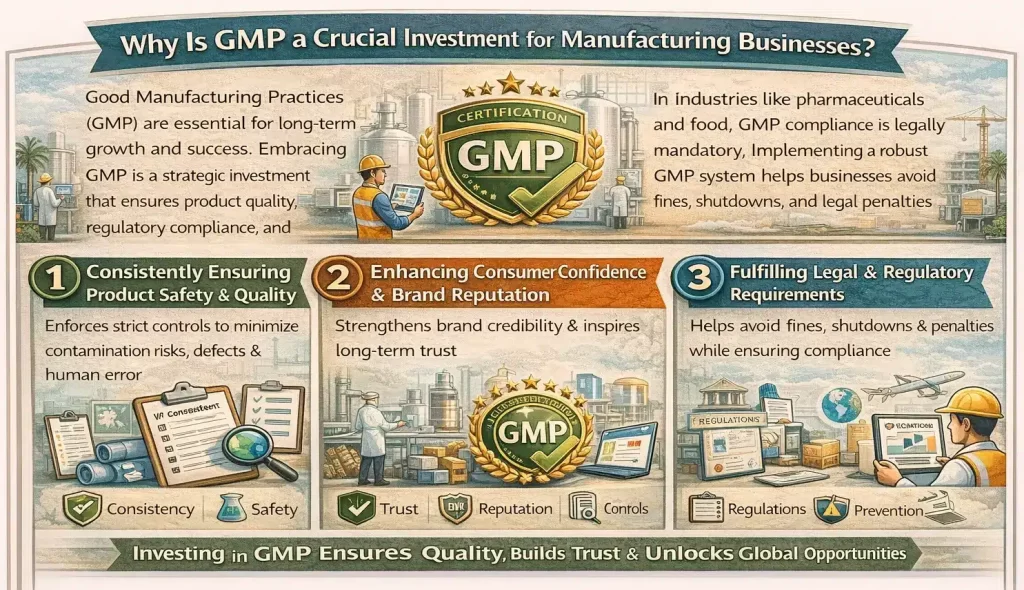
Companies that embrace GMP are not merely complying with rules but are fundamentally investing in the quality of their products, the safety of their consumers, and the long-term viability of their brand.
For any manufacturing business aiming for sustainable growth and success in 2026, a strong GMP system is not an option, but an essential foundation.
- Consistently Ensuring Product Safety and Quality
The primary benefit of GMP is ensuring every product is consistently safe and meets defined quality standards. By standardizing processes and enforcing strict controls, GMP reduces risks of contamination, defects, and human error.
- Enhancing Consumer Confidence and Brand Reputation
Strong GMP compliance strengthens brand credibility and builds long-term consumer trust. A well-documented system also enables fast, transparent investigations during quality issues, reinforcing commitment to product safety. - Fulfilling Legal and Regulatory Requirements
In industries like pharmaceuticals and food, GMP compliance is legally mandatory. Implementing a robust GMP system helps businesses avoid fines, shutdowns, and legal penalties while ensuring regulatory compliance. - Opening Access to Global Markets and Enhancing Competitiveness
GMP certification is often required for exporting products, particularly in pharmaceutical and food sectors. Adopting GMP expands international market access and improves global competitiveness. - Improving Operational Efficiency and Reducing Costs from Product Failures
Although implementation requires investment, GMP increases efficiency through standardized procedures and controlled processes. By preventing defects and recalls, it significantly lowers costs related to rework, waste, and customer complaints.
10 Core Principles That Form the Foundation of Good Manufacturing Practice
At the heart of any effective Good Manufacturing Practice system are a set of core principles that guide every action and decision within a manufacturing environment. These principles are not merely a checklist but a philosophy that must be ingrained in the company culture to be truly effective.
Understanding and applying these ten foundational principles is the first step toward building a robust GMP system that can withstand regulatory scrutiny and earn consumer trust.
Creating Clear Standard Operating Procedures (SOPs)
Establish written, step-by-step SOPs for all critical processes to ensure consistency and eliminate ambiguity. SOPs must be clear, accessible, and serve as the main reference for controlled and reproducible manufacturing.
Consistently Following Established Procedures
Procedures must be strictly followed to prevent variability and quality risks. Regular training and supervision reinforce discipline, accountability, and adherence to SOPs.
Documenting All Processes Accurately and in Real-Time
All activities must be recorded promptly and accurately to create a complete audit trail. Proper documentation ensures traceability, supports audits, and maintains data integrity.
Validating the Effectiveness of Procedures and Systems
Validation confirms that processes consistently produce products meeting predetermined quality standards. This provides objective evidence that systems are controlled and reliable.
Designing, Building, and Maintaining Appropriate Facilities and Equipment
Facilities and equipment must be designed and maintained to prevent contamination and operational errors. Proper layout, materials, lighting, and ventilation support product quality and safety.
Performing Routine Maintenance and Calibration of Equipment
Implement preventive maintenance and regular calibration to ensure equipment accuracy and reliability. This prevents production disruptions and maintains consistent product quality.
Continuously Developing Personnel Competence and Expertise
All personnel must be properly trained and qualified for their roles. Ongoing training strengthens skills, quality awareness, and GMP compliance.
Maintaining Cleanliness and Sanitation Throughout the Facility
A comprehensive sanitation program covering facilities, equipment, and personnel is essential to prevent contamination. Clear cleaning procedures, schedules, and hygiene standards must be enforced and documented.
Implementing Comprehensive Quality Control at Every Stage
Quality control should cover raw materials, in-process checks, and finished products. Effective deviation management and CAPA systems ensure continuous quality improvement.
Conducting Regular Audits for Compliance and Improvement
Regular internal audits verify GMP compliance and identify gaps. Audit findings drive corrective actions and continuous improvement across the organization.
Dissecting the 5 Key Components of GMP (5P) in Manufacturing Operations
To effectively implement Good Manufacturing Practice, it is helpful to break down the system into its core components. A widely recognized framework for this is the “5 P’s of GMP,” which provides a structured approach to addressing the critical factors that influence product quality. It serves as a practical guide for ensuring that every aspect of the manufacturing operations contributes positively to the final quality of the product.
Specific GMP Applications Across Various Industry Sectors
The level of stringency and areas of focus are tailored to the unique risks associated with each product type. For example, the controls required for manufacturing sterile injectable drugs are far more rigorous than those for producing a cosmetic lotion. Understanding these sector-specific nuances is crucial for implementing a GMP system that is both compliant and practical for a particular business.
To maintain these GMP standards consistently, floor managers should regularly verify their operations against clear [facility inspection readiness] to ensure no compliance gaps are left unchecked
This section will explore how GMP is specifically applied in key manufacturing industries, highlighting the unique challenges and requirements that define compliance in each field.
- Food and Beverage Industry
In the food and beverage sector, GMP focuses on preventing contamination and ensuring food safety. It includes controlling microbial hazards and allergens, maintaining hygiene, sanitation, pest control, and traceability systems aligned with frameworks like Hazard Analysis and Critical Control Points (HACCP). - Pharmaceutical and Medical Device Industry
The pharmaceutical sector applies stricter standards known as cGMP (Current Good Manufacturing Practice) to ensure product identity, strength, quality, and purity. This includes validated processes, sterile controls, cross-contamination prevention, and detailed documentation, with similar rigor applied to medical devices. - Cosmetics and Personal Care Industry
In cosmetics, GMP ensures products are safe, stable, and free from harmful contaminants. It emphasizes clean production environments, controlled raw materials, microbial testing, and accurate labeling to protect consumers. - Supplements and the Nutraceutical Industry
GMP for supplements ensures products contain the labeled ingredients in correct amounts and are free from contaminants. It requires raw material verification, consistent manufacturing controls, finished product testing, and compliant labeling to prevent misleading claims.
A Step-by-Step Guide to Implementing GMP in Your Company
Implementing a Good Manufacturing Practice system is a structured journey that transforms a company’s approach to quality. By following this phased approach, companies can navigate the implementation process efficiently, ensuring a smooth transition to a GMP-compliant operation.
The Role of Technology in Supporting and Automating GMP Compliance
Manual, paper-based systems are prone to human error, are difficult to manage at scale, and provide limited real-time visibility into operations. Modern technology, particularly integrated software solutions like Enterprise Resource Planning (ERP) systems, offers powerful tools to automate processes, enforce procedures, and maintain impeccable digital records, thereby strengthening every aspect of a GMP framework.
This integration of technology not only simplifies compliance but also provides valuable data and analytics that can be used to drive continuous improvement and optimize manufacturing performance.
Automating Manufacturing Processes with an Integrated ERP System
An integrated manufacturing ERP system acts as the central hub of a GMP-compliant operation by connecting production, quality control, and maintenance processes. By enforcing SOP-based workflows and capturing data automatically, ERP reduces human error and ensures consistent, controlled manufacturing.
Precise Inventory Management for Material Traceability
Advanced inventory systems within ERP use barcoding or RFID to track materials from receipt to finished batch. This enables full traceability, allowing companies to quickly identify affected products and execute targeted recalls when quality issues arise.
Digitizing Documentation and Production Batch Records
Electronic Batch Record (EBR) and Document Management Systems (DMS) digitize SOPs, specifications, and batch records to ensure only approved documents are used. Real-time data capture and electronic sign-offs create accurate, compliant, and audit-ready production records.
Predictive Maintenance for Production Assets and Facilities
Modern Asset Management systems support predictive maintenance by monitoring equipment performance in real time. This prevents unexpected breakdowns, reduces downtime, and ensures production assets remain compliant and operational.
Common Challenges in Implementation and How to Overcome Them
Many companies, especially small and medium-sized enterprises, can find the process overwhelming due to perceived costs, complexity, and the cultural shifts required. However, these challenges are not insurmountable. With strategic planning, a phased approach, and a clear understanding of the potential hurdles, any organization can successfully navigate the journey to GMP compliance.
This section will address the most frequent difficulties encountered during GMP implementation and offer practical, actionable solutions to help ensure a smooth and successful transition.
Case Study: Good Manufacturing Practice (GMP) Implementation in Malaysian Manufacturing
A food processing manufacturer in Malaysia faced recurring issues with product recalls and customer complaints due to inconsistent quality checks and poor documentation across its production lines. Without a structured quality assurance framework, the company struggled to maintain product safety standards, leading to wasted materials, regulatory scrutiny, and weakened brand trust.
To tackle these challenges, the firm began adopting Good Manufacturing Practice (GMP) principles by developing clear standard operating procedures, training employees on quality protocols, and strengthening record-keeping at every production stage. With a systematic GMP approach, the company saw a marked reduction in defects, improved traceability of batches, and greater confidence from both consumers and regulators.
Encouraged by these outcomes, the management team started evaluating pricing schemes and technology solutions that offer GMP automation and compliance tracking seeking options that would fit their growth plans and budget while supporting sustainable quality improvements.

Conclusion
FAQ About Good Manufacturing Practice
-
What is the main purpose of Good Manufacturing Practice (GMP)?
The primary purpose of GMP is to minimize risks in production processes that cannot be eliminated by testing the final product. It ensures products are consistently high in quality, from batch to batch, and safe for consumer use.
-
What is the primary purpose of Good Manufacturing Practice (GMP)?
The 5 P’s of GMP are People (personnel), Premises (facilities), Processes, Products (and raw materials), and Procedures (documentation). These five components are crucial areas that must be controlled to maintain a compliant manufacturing environment.
-
What are the 5 P’s of GMP?|Is GMP certification mandatory?
Whether GMP is mandatory depends on the industry and country. In many regions, compliance with GMP regulations is a legal requirement for marketing and selling products in sectors such as pharmaceuticals, food, and medical devices.