












Precision components play a critical role in modern manufacturing, supporting industries such as automotive, electronics, medical devices, and industrial machinery. In Malaysia, where manufacturing remains a key economic driver, consistent component quality is essential to meet both local and global market expectations.
Producing precision components is not simply about machining parts to specification. It involves tight tolerances, controlled processes, and accurate coordination between design, production, and quality inspection. Even minor deviations can affect product performance, increase material waste, and disrupt downstream operations.
This article explores what precision components are, why they matter across industries, where consistency challenges typically arise, and how manufacturers can use technology to maintain accuracy and make better operational decisions.
Key Takeaways
|
What Are Precision Components?
Precision components are parts manufactured to exceptionally strict geometric and dimensional standards, often measured in micrometers. Unlike standard parts, every detail of a precision component must be crafted with an incredibly high degree of accuracy.
Their primary characteristics include extremely tight tolerances, complex geometries, high repeatability, and superior quality materials. These pillars ensure each component fits perfectly and performs reliably within a larger assembly, from medical implants to microchips.
The creation of these components requires advanced methods like CNC machining and injection molding. These processes use specialized machinery and rigorous quality control to produce thousands of identical units with almost no deviation.
Why Are Precision Components Crucial for Manufacturing Businesses?
Precision components are a strategic element that directly impacts brand reputation, operational efficiency, and innovation. A product’s reliability is a direct reflection of the quality of its parts. A single failure can trigger costly recalls and damage customer trust, making precision a vital investment.
1. Enhancing product quality and reliability
The dimensional accuracy of precision components ensures all parts work together harmoniously, reducing friction and the potential for failure. This directly increases the product’s lifespan and performance, which in turn builds customer loyalty and strengthens the brand’s image.
2. Reducing waste and production costs
Tight tolerances drastically minimize the number of defective products, which reduces the waste of expensive raw materials. The assembly process also becomes faster and smoother, lowering the production cost per unit and increasing profit margins.
3. Driving innovation and product development
Modern technological breakthroughs, from smaller medical devices to sophisticated vehicle sensors, rely entirely on precision components. The ability to create extremely small and intricate parts allows engineers to design products that are more efficient, lighter, and more functional.
4. Ensuring safety and standards compliance
In critical industries like aerospace and medical, component failure can have fatal consequences. Precision components are manufactured to meet strict safety regulations, such as those set by the International Organization for Standardization (ISO), ensuring products are both functional and safe.
Key Manufacturing Processes for Precision Components
Creating precision components requires a sophisticated combination of advanced technology, accurate software, and skilled operators. The right manufacturing method depends on factors like material type, design complexity, and production volume.
1. CNC (Computer Numerical Control) Machining
CNC Machining is a process where computer-controlled tools cut and shape a block of raw material based on a digital design. This versatile method is ideal for producing components with complex geometries and very tight tolerances, like those in the wire mesh manufacturing process.
2. Electrical Discharge Machining (EDM)
EDM uses electrical sparks to shape conductive materials, which is ideal for creating intricate shapes in extremely hard metals. As there is no physical contact, EDM can produce fine finishes without inducing mechanical stress on the component.
3. Injection Molding
This process is widely used for the mass production of precision plastic components by injecting molten material into a precision mold. The accuracy of the final part depends entirely on the quality of the mold, which must be fabricated with extremely tight tolerances.
4. Additive Manufacturing (3D Printing)
Also known as 3D printing, this method builds objects layer by layer from a digital model. Advanced techniques like DMLS now enable the production of functional precision components from high-performance metals with unparalleled design freedom.
Common Materials Used in Precision Component Production
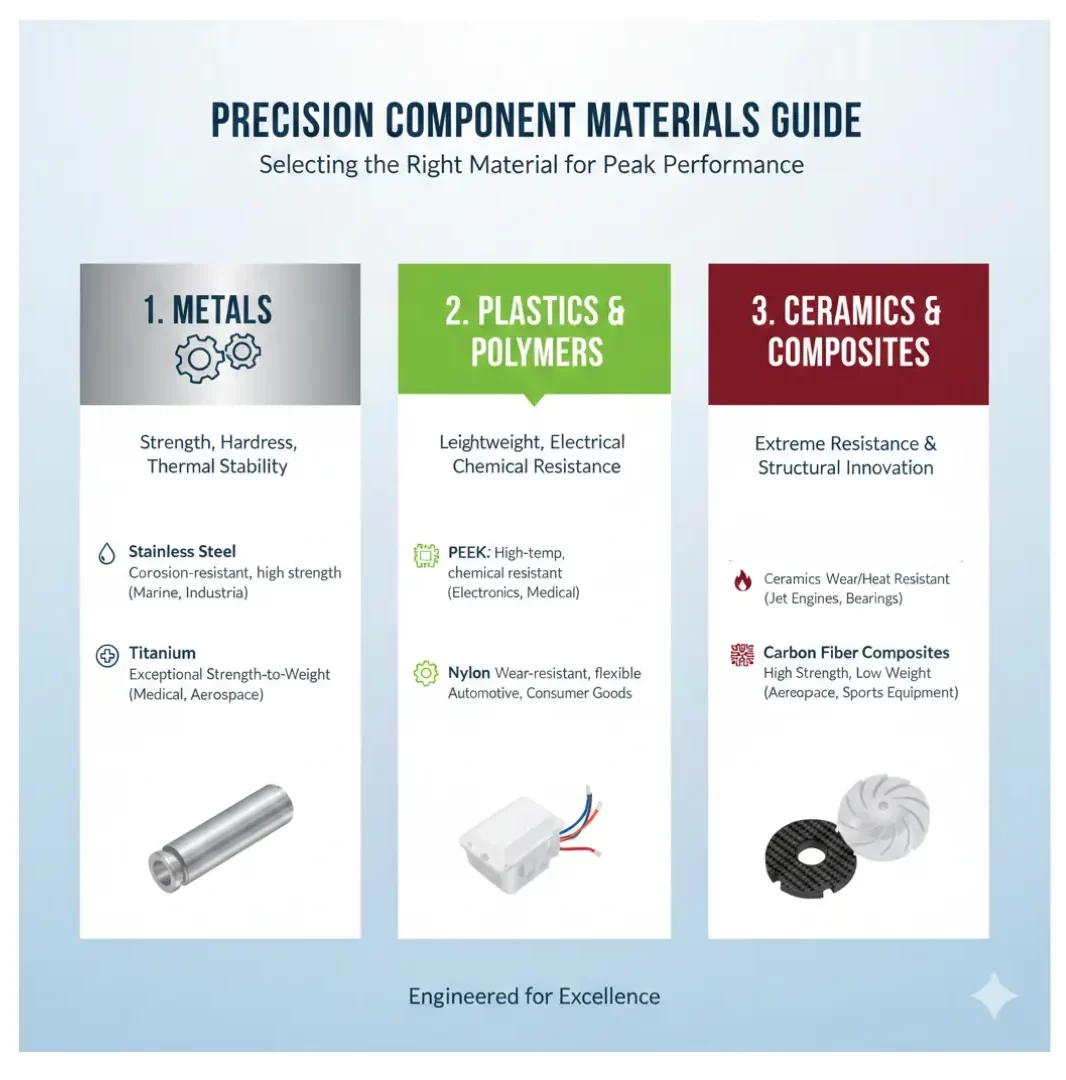
Material selection is a critical decision that directly determines a component’s performance, durability, and suitability for its application. Engineers must consider factors like mechanical strength, corrosion resistance, and weight to ensure the part functions as expected.
1. Metals
Metals like stainless steel, aluminum, and titanium are popular for their strength, hardness, and thermal stability. Stainless steel offers corrosion resistance, while aluminum is lightweight, and titanium provides an exceptional strength-to-weight ratio for aerospace and medical use.
2. Plastics and Polymers
Engineering plastics such as PEEK and Nylon offer advantages like light weight, electrical insulation, and chemical resistance. They are often used for components in electronic devices and medical equipment where non-conductive properties are essential.
3. Ceramics and Composites
Technical ceramics are chosen for applications demanding extraordinary resistance to wear and extreme temperatures, such as in jet engines. Composite materials like carbon fiber offer very high strength and extremely light weight, ideal for high-performance automotive and aerospace parts.
Application Examples of Precision Components in Various Industries
The role of precision components is fundamental in supporting the functionality of products in nearly every modern industrial sector. From life-saving medical devices to flight safety systems, their accuracy is vital to our daily lives.
1. Aerospace Industry
In aerospace, components like jet engine turbine blades and flight control actuators must withstand extreme conditions. Materials like titanium and nickel alloys are used to ensure maximum strength with minimal weight for fuel efficiency and safety.
2. Medical Sector
Precision is essential for surgical instruments and orthopedic implants to ensure they function perfectly and fit correctly. Biocompatible materials like titanium and PEEK are used to ensure the components are not rejected by the human body.
3. Automotive Industry
Modern engines and transmission systems rely on hundreds of precision components like pistons, valves, and gears working in perfect sync. This maximizes efficiency, reduces emissions, and ensures a smooth and reliable performance in every vehicle.
4. Electronics and Semiconductor Industry
Our digital world is powered by micro-sized precision components, from the parts in lithography machines to the tiny connectors in smartphones. These components ensure all electronic parts are securely fitted and can operate without overheating.
Challenges in the Production and Management of Precision Components
The production and management of precision components are fraught with complex challenges that demand significant investment and control. Consistently achieving micrometer-level accuracy requires a perfectly controlled environment and relentless focus on process management.
- Achieving Consistent Accuracy: Any minor deviation from machine vibration, temperature fluctuations, or tool wear can result in an entire production batch being rejected. This leads to significant financial losses and production delays.
- Supply Chain and Logistics: Managing the supply chain for high-quality raw materials is a major hurdle. Businesses must also track each component through production and implement strict quality control for every single unit.
- Cost Management and Visibility: Many businesses struggle with fragmented data, which makes it difficult to accurately calculate actual production costs. This lack of visibility can erode profitability and hinder sustainable growth.
The Role of ERP Software in Optimizing Precision Component Production
To overcome these challenges, companies can no longer rely on manual methods or disparate systems. A manufacturing ERP software acts as a central platform that integrates every operational aspect for real-time data visibility.
- Inventory and material procurement management: ERP software system enables real-time tracking of raw materials from receiving to consumption, automatically generating purchase requisitions to prevent shortages. This ensures full traceability, a mandatory requirement in industries like medical and aerospace.
- Production planning and scheduling (MRP): The MRP module plans material needs and production capacity based on sales orders, creating the most efficient schedule. This helps meet customer deadlines without holding costly excess inventory.
- Integrated quality control (QC): The quality assurance process is integrated directly into the ERP workflow, with inspection points set at each stage. If a component fails inspection, the system automatically flags it to prevent it from moving forward.
- Cost tracking and profitability (COGS): An ERP accurately tracks the Cost of Goods Sold (COGS) by accumulating material, labor, and machine overhead costs. This provides clear insight into product profitability and supports competitive pricing strategies.
Trends and the Future of Precision Component Technology
The precision component industry is rapidly evolving, driven by Industry 4.0 innovations that are transforming production. Automation, robotics, and smart sensors (IoT) are becoming essential for achieving higher efficiency and consistency.
Looking ahead, artificial intelligence (AI) and machine learning will further accelerate this trend by dynamically optimizing machine parameters and analyzing quality data. Sustainability will also play a crucial role, driving the development of environmentally friendly materials and energy-efficient processes.
A precision components manufacturer in Malaysia faced persistent quality challenges that hindered its ability to secure long-term contracts with OEM (Original Equipment Manufacturer) clients. The company produced parts for automotive and industrial machinery, where tolerances were extremely tight and defects could lead to costly failures downstream. Despite rigorous inspection routines, inconsistent product quality and delayed deliveries were common, resulting in order cancellations, increased rework costs, and strained customer relationships.
To address these issues, the manufacturer implemented an integrated production control system that combined real-time shop-floor monitoring with automated quality checks and traceability. By capturing accurate data on machine settings, tool wear, and measurement results at each stage of the production process, the system enabled immediate detection of out-of-spec conditions and faster corrective action. The production team could also analyze trends in defect patterns to schedule proactive maintenance and tool recalibration, reducing unplanned downtime and stabilizing output quality.
As a result, the company significantly improved product consistency, reduced defect rates, and shortened lead times, which helped win back major OEM contracts and secure new business opportunities. These tangible gains also made it easier for management to evaluate technology investments and pricing schemes aligned with long-term operational excellence and growth helping ensure the solution matched both budget and strategic goals.

Conclusion
Precision components remain fundamental to achieving quality, reliability, and innovation in modern manufacturing. Managing tight tolerances while keeping costs under control requires not only technical expertise but also strong coordination across processes.
Digital manufacturing systems help bring greater clarity to these complexities by connecting planning, production, and financial data in one integrated environment. With better visibility and structured information, businesses can make more confident operational and strategic decisions.
Strengthening this foundation supports long-term competitiveness and more consistent performance. For a closer look at how these capabilities could align with your operations, you can explore the system further through a guided concultation and discussion.

FAQ about Precision Components
-
What is the main difference between precision and standard components?
The primary difference lies in the tolerance level, or the allowed deviation from specified dimensions. Precision components have extremely tight tolerances (often in micrometers), while standard components have a looser range of variation.
-
How is the quality and precision of a component measured?
Quality is measured using advanced metrology tools like Coordinate Measuring Machines (CMM), laser micrometers, and optical scanners. These tools measure component dimensions with high accuracy and compare them to the digital design specifications (CAD).
-
Is 3D printing technology accurate enough for precision component production?
Yes, for many applications, modern additive manufacturing technologies like DMLS can produce metal and plastic components with precision and mechanical strength comparable to traditional methods, especially for highly complex geometries.
-
What factors most affect the production cost of precision components?
Key factors include the cost of high-quality raw materials, the complexity of the component design, machine cycle time, and the level of quality control required. The initial investment in precision machinery is also a significant cost factor.