








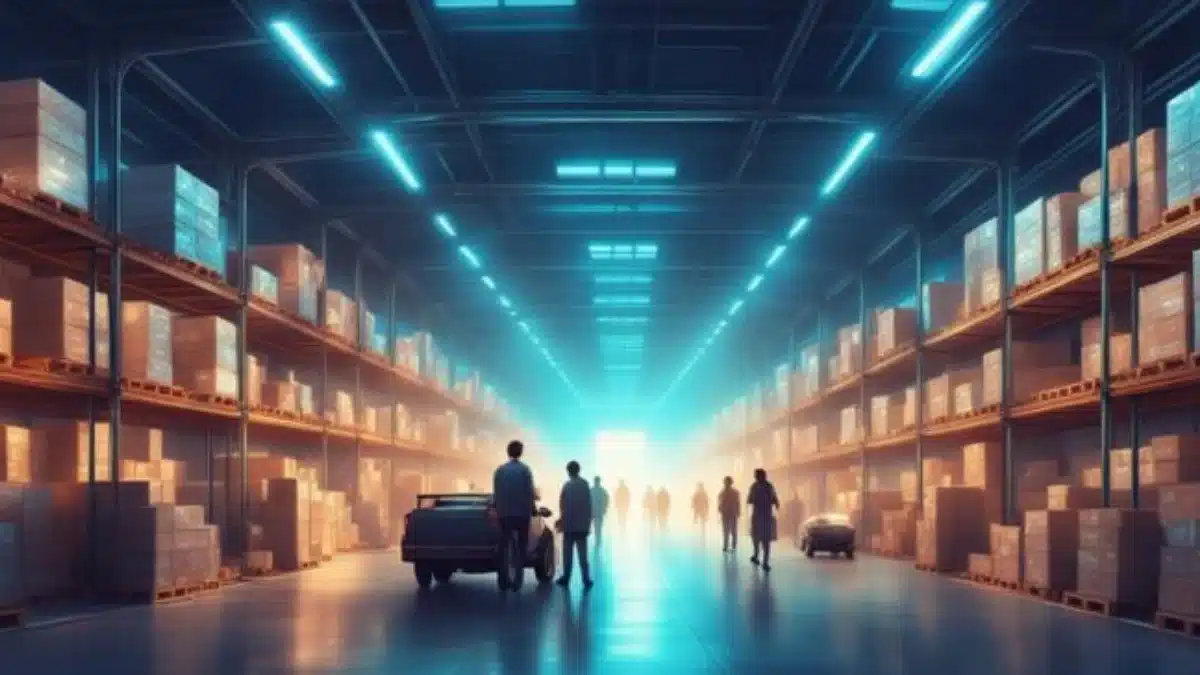
Effective yard management is the key to transforming the chaotic area outside your warehouse into a highly coordinated logistics hub. Many businesses overlook this critical space, leading to bottlenecks, unforeseen costs, and significant delays that ripple throughout the entire supply chain.
According to Supply Chain Management Review, trailers can sit idle for up to 80% of a standard shipment cycle due to poor visibility and inefficient coordination. On top of that, a McKinsey analysis found that yard inefficiencies can erode up to 20% of a facility’s throughput capacity. These are not small numbers, especially when multiplied across multiple sites.
The good news is that none of this has to stay this way. This guide covers everything you need to know about yard management, from the core concepts and common challenges to how a dedicated Yard Management System can help you turn a chaotic yard into one of the most controlled parts of your supply chain.
Key Takeaways
|
What Does Yard Management Actually Do?
Yard management is the process of coordinating all vehicle and trailer activity between your inbound and outbound gates. It covers check-in, parking assignment, trailer tracking, dock scheduling, and the movement of vehicles for loading or unloading.
The goal is to make sure every truck, trailer, and container is in the right place at the right time so inbound and outbound operations run without delays. When this process works well, drivers wait less, dock doors stay productive, and warehouse teams do not waste time locating trailers across the lot. Without a structured system, the yard becomes a bottleneck that slows down everything connected to it.
Key Challenges in Yard Management Without an Integrated System
When yard operations still rely on manual processes like phone calls, whiteboards, and spreadsheets, problems stack up fast. Poor visibility leads to lost trailers, lost trailers cause congestion, congestion triggers detention fees, and before long one small gap has turned into a chain of delays and unnecessary costs across the entire operation.
| Challenge | What Happens Without an Integrated System | Operational Impact |
|---|---|---|
| Limited visibility & inaccurate data | Trailer locations and status are tracked manually, so information becomes outdated fast. | Long search time, wrong dock planning, wasted labor hours. |
| Gate and yard congestion | Manual check-in/check-out creates queues; arrivals are not coordinated with dock capacity. | Slower flow, safety risks, parking pile-ups, disrupted internal movements. |
| Detention & demurrage costs | Delays in loading/unloading and returns lead to penalty fees from carriers. | Rising avoidable costs, damaged carrier relationships, margin erosion. |
| Inefficient team communication | Coordination relies on radio calls or face-to-face updates that are easy to miss. | Slow task assignment, wrong trailer moves, poor sync between yard and docks. |
Why Yard Management Matters for Business Efficiency
Your warehouse can run perfectly, but if the yard outside it is a mess, everything slows down. Here is why yard management deserves more attention.
1. It keeps your supply chain moving
The yard is where inbound and outbound operations meet. Congestion or disorganization here creates delays that ripple through your entire delivery schedule. According to a report by CIPS, supply chain disruptions cost businesses millions every year, and an inefficient yard is a major contributor.
2. It stops hidden costs from piling up
Detention and demurrage fees, wasted staff hours searching for trailers, and fuel burned on unnecessary vehicle movements all add up quietly. Most companies do not realize how much their yard inefficiency actually costs until they start tracking it.
3. It turns a liability into a competitive edge
A well managed yard improves asset utilization, speeds up dock turnaround, and frees up resources that were being wasted on avoidable problems. The ROI shows up in faster operations, lower costs, and fewer missed deliveries.
Key Components and Processes in Yard Management
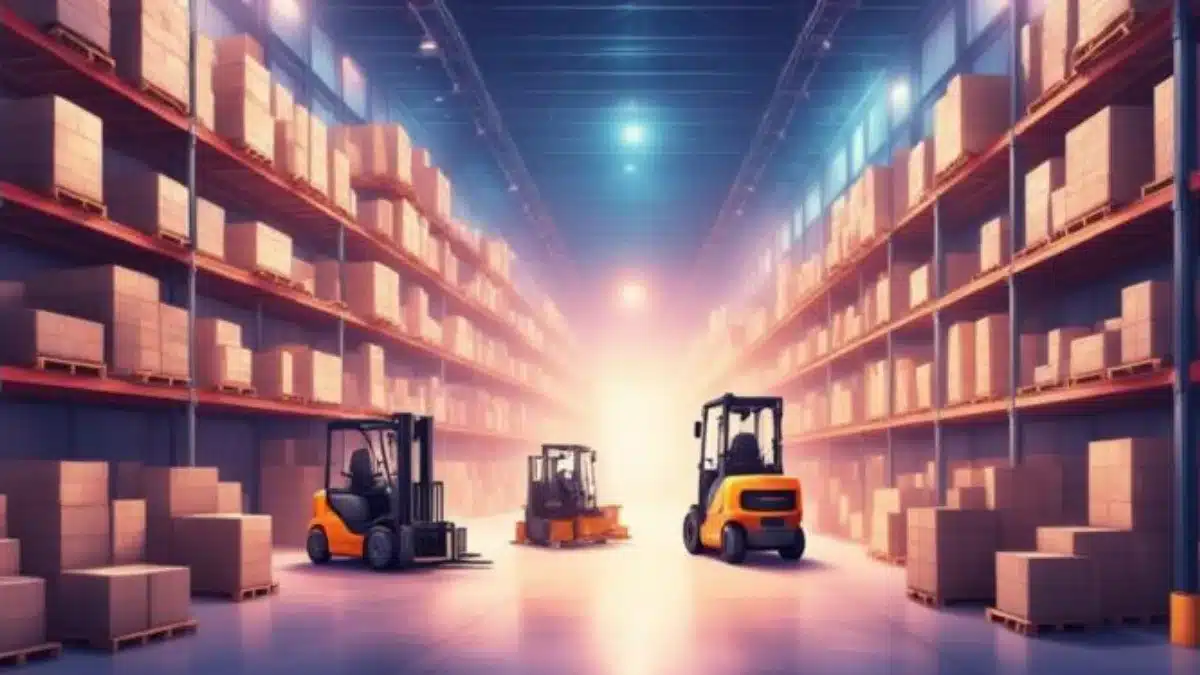
To achieve peak efficiency, yard management must be viewed as a series of structured, interconnected processes. Each component plays a vital role in ensuring the smooth and monitored movement of assets from the inbound gate to the outbound gate.
Understanding this workflow is a fundamental step before implementing any automation technology or system. The following are the core components and processes that underpin a successful yard management strategy.
By integrating these components into a single, cohesive workflow, companies can create a predictive, responsive yard environment. For example, data from gate management automatically flows into the dock scheduling system, which then triggers tasks for yard staff via the task management module.
The visibility provided by asset tracking allows all stakeholders to monitor progress in real time, while regular audits ensure that data and process integrity are maintained. This holistic approach supports the effective management of operations across a multiple warehouse management network, providing unified control.
1. Gate management
This process serves as the first and last control point for all vehicles entering and exiting the facility. Effective gate management includes recording arrival and departure times, verifying shipping documents, and conducting security checks.
Automating this stage, for instance, with an automated number plate recognition (ANPR) system or self-service kiosks for drivers, can drastically reduce wait times, minimize human error, and improve data accuracy from the very first touchpoint.
2. Dock scheduling
Dock scheduling is the process of allocating specific time slots and dock doors for each truck scheduled for loading or unloading. A robust scheduling system allows a company to plan arrivals based on warehouse capacity, labor availability, and shipment priorities.
This helps prevent vehicle congestion, maximizes dock utilization, and provides schedule visibility to all relevant parties, including transportation carriers. Advanced systems can even allow carriers to book their own appointments online.
3. Asset tracking
This is the heart of yard visibility, involving the real-time location monitoring of all trailers, containers, and other mobile assets within the yard. Technologies such as RFID, GPS, or IoT sensors are used to provide automatic location updates, completely eliminating the need for manual searches.
By knowing the precise location of every asset, managers can quickly assign the right trailer to be moved to the dock, significantly reducing downtime and improving the efficiency of all yard movements.
4. Task management
This process involves the creation, assignment, and tracking of tasks for yard staff, particularly the shunter drivers who move trailers between parking spots and dock doors. An integrated task management system can automatically dispatch work orders to staff’s mobile devices based on priority and schedule.
5. Yard check and audit
Even with advanced automation technology, periodic physical audits remain crucial for ensuring the accuracy of the system’s data. The yard check process involves a manual verification of the location and status of all trailers in the yard to reconcile them with the data in the system.
The Role of a Yard Management System (YMS) in Automation
A Yard Management System (YMS) transforms the reactive, often chaotic approach to yard operations into a proactive, data-driven strategy. By digitally integrating all key components, from the gate to the dock, a YMS provides a single source of truth for all yard activities.
Managers no longer have to guess where a trailer might be or which dock door will become available next; all this information is instantly accessible through a centralized dashboard. The automation of routine tasks, such as appointment scheduling and trailer move assignments, frees up valuable staff time to focus on higher-value activities.
Integration is the primary strength of a modern YMS, allowing it to function harmoniously with other critical business systems. When connected with a Warehouse Management System (WMS) and a Transportation Management System (TMS), a YMS creates a fully transparent and efficient logistics ecosystem.
For example, when the WMS indicates that an order is ready for shipment, the YMS can automatically schedule a truck and assign it to the appropriate dock. This seamless data flow ensures that every part of the supply chain is synchronized, from inventory levels inside the warehouse to carrier schedules on the road.
Metrics and KPIs to Measure Yard Management Success
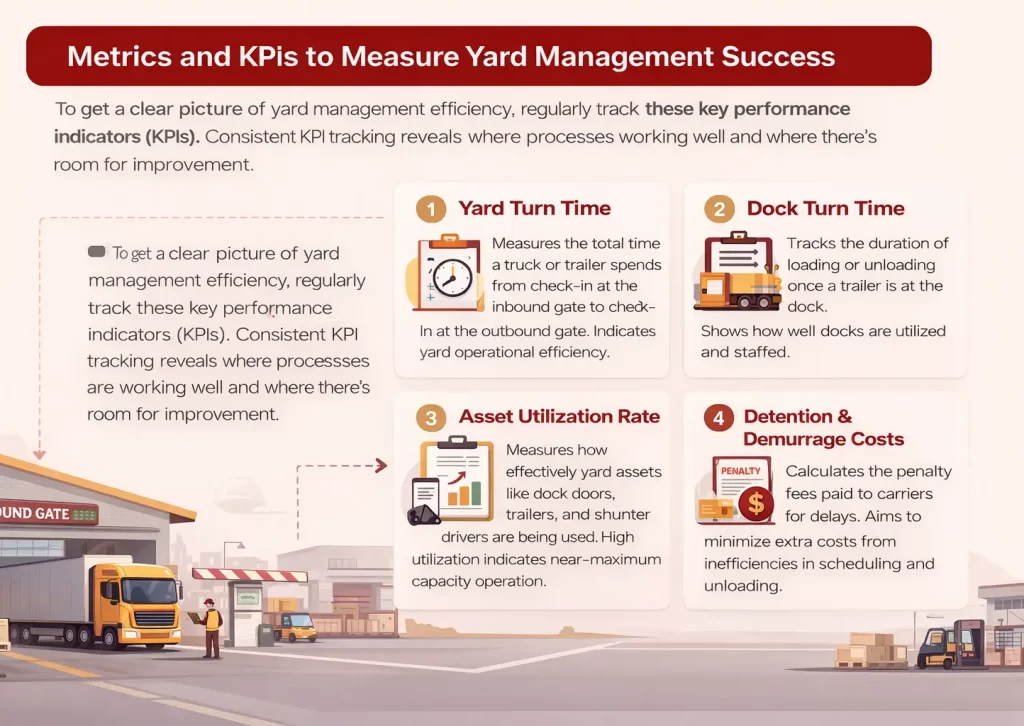 Improving yard operations means nothing if you cannot measure the results. Tracking the right KPIs, like yard turn time, dock utilization, and gate throughput, gives your team a clear picture of what is working and what needs fixing. When something slows down, the data tells you exactly where to look, whether it is congestion at the gate or a scheduling issue at the dock.
1. Yard turn time
This metric measures the total time a truck or trailer spends in the facility, from the moment it checks in at the inbound gate to the moment it checks out at the outbound gate. A shorter turn time is a strong indicator of higher efficiency across the entire process, including scheduling, movement, and loading or unloading.
Tracking this KPI helps identify systemic bottlenecks and provides a high-level overview of the yard’s overall operational health. It is often considered the ultimate measure of yard efficiency.
2. Dock turn time
This KPI measures the duration of the loading or unloading process explicitly once a trailer has arrived at a dock door. A fast dock turn time indicates an efficient warehouse team, adequate resource availability, and good coordination between the yard.
3. Asset utilization rate
This metric tracks how effectively assets such as dock doors, trailers, and shunter drivers are being used. High dock utilization indicates that the facility is operating near its maximum capacity, while good trailer utilization ensures that assets are not sitting idle in the yard for extended periods.
4. Detention and demurrage costs
This is a direct financial KPI that measures the total penalty fees paid to carriers for delays. The primary goal for any yard operation should be to reduce these costs as close to zero as possible.
Meticulous tracking of these expenses not only highlights inefficiencies in the loading and unloading processes but also provides a powerful financial justification for investing in improvements to the yard management system and its associated processes.
Future Trends and Technologies in Yard Management
Yard management is evolving fast. Here are the key technologies shaping where it is headed.
- Predictive Analytics: Instead of reacting to congestion after it happens, advanced analytics use real-time and historical data to predict bottlenecks before they form. This allows yard managers to adjust dock schedules and routing on the fly based on actual traffic conditions.
- Artificial Intelligence and Machine Learning: AI can analyze patterns from past operations to recommend the most efficient dock allocations, forecast volume changes, and suggest labor adjustments before peak periods hit. The more data it processes, the smarter it gets.
- Autonomous Yard Trucks: Self-driving yard vehicles that move trailers without human intervention are already being tested in large operations. They reduce labor dependency, improve safety, and keep trailers moving around the clock.
- IoT and Real-Time Connectivity: Sensors on trailers, gates, and dock doors feed live data into a connected system, giving yard managers full visibility over every asset in the yard at any given moment. No more manual yard checks or guesswork.
Conclusion
Yard management is one of those areas that does not get much attention until it starts causing problems. But the companies that take it seriously end up with a supply chain that runs noticeably smoother. Fixing visibility gaps, reducing congestion, and keeping track of the right numbers all contribute to faster turnaround, lower costs, and fewer missed deliveries.
You do not need to overhaul everything at once. Start with the fundamentals like gate management, dock scheduling, and asset tracking. Once those are running well, layering in smarter tools like predictive analytics and automation becomes a natural next step rather than a forced one.
The yard sits right at the center of your inbound and outbound flow. Getting it under control means everything on either side of it works better too. If you want to see how a dedicated system can help, trying a free demo is a good place to start.
Frequently Asked Questions
-
What is the main difference between yard management and warehouse management?
Yard management focuses on the movement and visibility of trucks and trailers in the area outside the warehouse. In contrast, warehouse management deals with processes inside the warehouse, such as receiving, storing, and picking goods. Both must be integrated for a seamless logistics flow.
-
How can a Yard Management System (YMS) reduce detention costs?|
A YMS reduces detention costs by providing real-time visibility into trailer locations and statuses. This enables more efficient scheduling of loading/unloading, accelerates trailer turn times, and ensures carriers’ assets are returned within the agreed free-time period, thus avoiding penalties.
-
Can a YMS be integrated with other systems, such as a WMS or a TMS?
Yes, a key strength of modern YMS is its seamless integration with other systems. Integration with a Warehouse Management System (WMS) and Transportation Management System (TMS) is crucial for creating end-to-end visibility and automating workflows across the supply chain.
-
When should a business consider implementing a YMS?
A business should consider implementing a YMS when it faces challenges such as frequent gate congestion, difficulty locating trailers, long driver wait times, and rising detention costs. If daily vehicle volume is high and manual processes are no longer efficient, it is time to invest in a YMS.