









Warehouses sit in the middle of almost everything you do in the supply chain. They hold materials before production, keep finished goods ready for delivery, and act as the “last mile” before orders go out. When the setup is right, work flows and costs stay predictable. When it’s not, small issues turn into daily firefighting.
What catches many teams off guard is how quickly the numbers can move in the wrong direction. One 2025 warehousing market report found reported inventory shrinkage more than doubled, rising from 1.24% to 2.68%. In the US, warehousing facility costs also rose, with a study showing costs per square foot increased from $7.96 (2022) to $8.31 (2024), reflecting real pressure from space and labor.
If your warehouse feels like constant firefighting, the setup is usually the cause. This guide helps you pinpoint what’s slowing work down and what to fix first, from layout and slotting to tracking and day-to-day controls
Key Takeaways
|
What Is Warehouse Setup?
Warehouse setup is the comprehensive process of designing, planning, and implementing all physical and operational elements within a warehouse. This includes determining the layout, selecting equipment, and integrating technology to manage inventory.
This process is typically managed by a team of operations managers, supply chain specialists, and logistics consultants. They work together to ensure the final setup aligns with the company’s business goals and operational needs.
Why the Right Warehouse Setup is Crucial for Your Business
A well-designed warehouse is more than just a storage space; it is the core of your operational efficiency. An optimal setup directly impacts your profitability, customer satisfaction, and ability to scale.
- Boosts Operational Efficiency: A logical workflow minimizes wasted movement and time, which significantly cuts down on labor costs.
- Improves Inventory Accuracy: Proper organization and technology integration ensure you have a clear view of your stock, reducing errors.
- Enhances Customer Satisfaction: An efficient system allows for faster order processing and shipping, leading to quicker delivery times.
- Increases Profitability: By reducing operational costs and errors, you can improve margins and reallocate resources for growth.
- Supports Business Scalability: A flexible and well-planned setup allows your operations to grow without major disruptions or redesigns.
Types of Warehouse Setups
Logistics facilities can be organised in various ways, depending on the types of products they handle and their role within the supply chain. To understand how these facilities operate, here are some of the most common warehouse configurations:
- Transit warehouses: Temporarily hold goods before they are moved to their next destination.
- Distribution centres: Positioned strategically near customer locations to ensure quick and reliable stock availability.
- Manufacturing warehouses: Store raw materials and semi-finished items that support ongoing production activities.
- Picking warehouses: Focus specifically on selecting and preparing products for order fulfilment.
- Consolidation warehouses: Combine shipments from multiple orders or different logistics points to improve delivery efficiency.
Once the type of facility is determined, the next step is organising the storage layout to support fast, accurate, and efficient operations. Depending on product movement and capacity needs, warehouse layouts typically include the following elements:
- Block stacking: Similar products are stacked directly on the floor in grouped sections.
- Racking systems: Goods are placed on structured racks to maximise vertical space and maintain order.
- Aisles: Items are arranged across defined aisles, allowing easy access and smooth movement within the warehouse.
- Zoning: Products are assigned to specific areas based on their category, characteristics, or handling requirements.
Warehouse Setup Examples
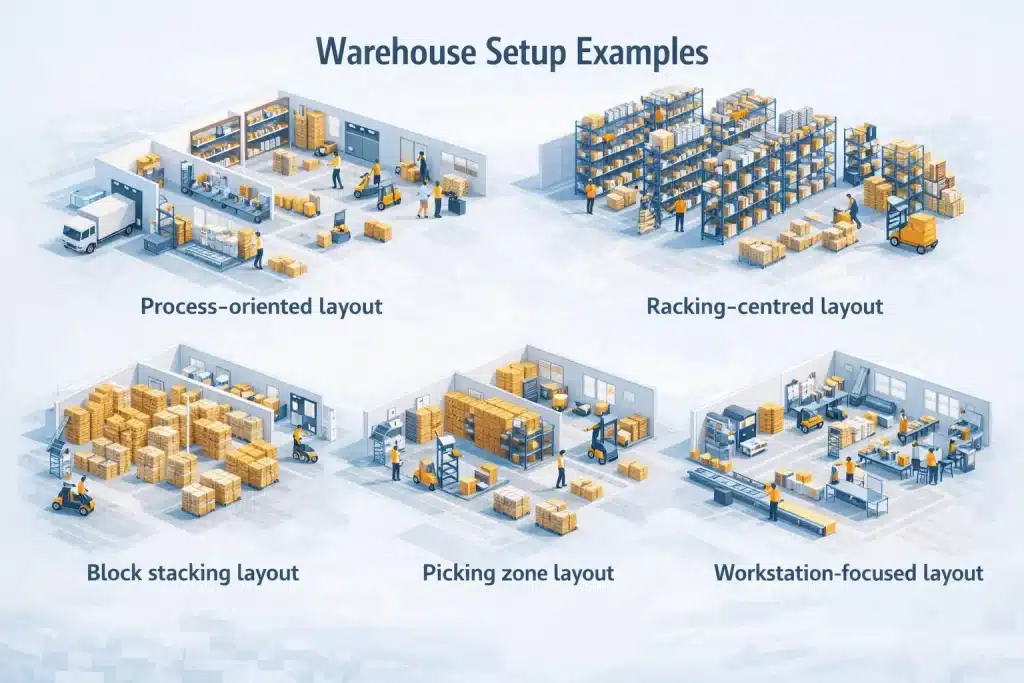 You can arrange the layout of your logistics facility in several ways, depending on factors such as the nature of your products, inventory volume, picking strategy, and the infrastructure you have in place.
Below are some widely used warehouse layout configurations:
1. Process-oriented layout
In this approach, the warehouse is divided into operational stages such as receiving, storing, picking, and dispatching. By organising the space around these functions, goods can transition smoothly from one step to the next.
2. Racking-centred layout
This setup prioritises the rack and shelving systems used to keep products organised. It is ideal for facilities that store a broad assortment of items, such as e-commerce warehouses that stock goods of varying sizes and attributes, because it provides easy access to diverse SKUs.
3. Block or block-stacking layout
Here, products are placed in large grouped sections, either within racking blocks or stacked directly on the floor. This model helps operators quickly locate identical SKUs and is particularly useful for environments that manage high volumes of uniform, fast-moving items.
4. Picking zone layout
This configuration clusters high-demand products in specific zones to speed up order preparation. By reducing travel time for pickers, it supports faster fulfilment, making it a common choice in e-commerce operations handling rapid turnover items.
5. Workstation-focused layout
The facility is arranged around dedicated stations for activities such as packing, labelling, and quality checks. Concentrating related tasks in defined areas helps improve productivity and reduces unnecessary movement.
Explore practical approaches to planning a warehouse that fits your operational needs.
Strategic Approach to Set Up Your Warehouse
A successful warehouse setup requires a structured, multi-stage approach to ensure all elements work together seamlessly. This strategic process turns your business goals into a functional and efficient operational reality.
| Stage | Key Activities |
|---|---|
| Stage 1: Planning & Budgeting |
|
| Stage 2: Layout & Workflow Design |
|
| Stage 3: Equipment & Storage |
|
| Stage 4: Technology & Systems |
|
| Stage 5: Team & People |
|
| Stage 6: Safety & Compliance |
|
| Stage 7: Performance & Optimization |
|
Optimize Your Warehouse Operations with a Warehouse System
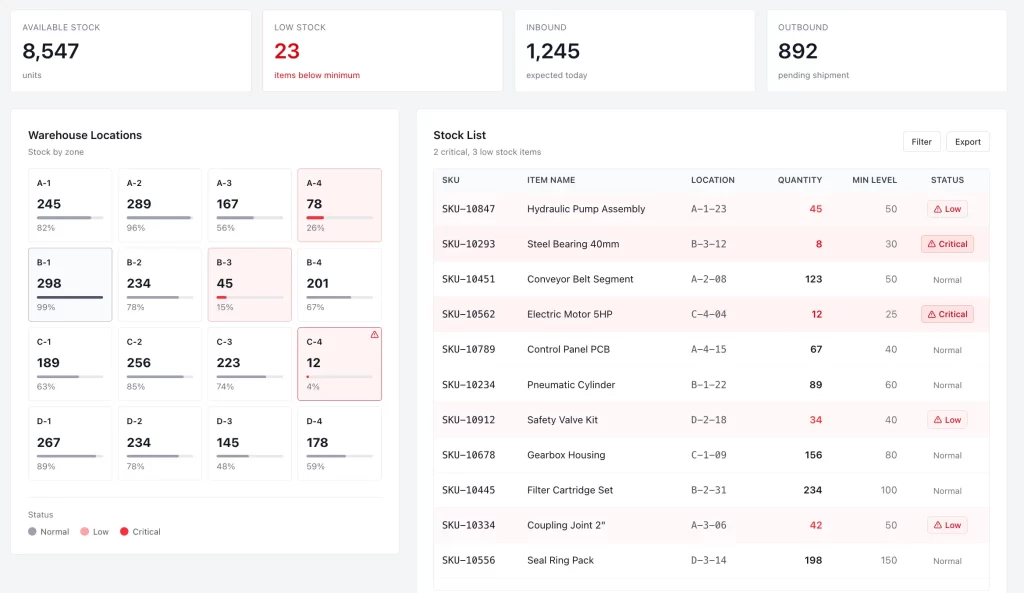
An integrated system keeps your warehouse running from the same set of information, so your team isn’t juggling spreadsheets, WhatsApp updates, and manual checks. When receiving, storage, picking, and shipping are connected, fewer things slip through the cracks and small mistakes don’t turn into big delays.
- Real-Time Inventory Tracking: The system uses barcode and RFID technology to monitor stock levels and locations across the warehouse.
- Automated Order Fulfillment: It generates system-directed tasks and optimizes picking routes for staff to follow during order processing.
- Intelligent Slotting Management: The software suggests optimal storage locations for items based on their velocity, size, and other characteristics.
- Seamless ERP Integration: It directly connects with accounting, sales, and purchasing modules to automate the flow of data across departments.
- Advanced Reporting & Analytics: The system provides comprehensive dashboards and customizable reports on key warehouse performance metrics.
Our solution can significantly enhance your operational efficiency, data transparency, and process automation. See how our system can specifically benefit your business by trying a free demo today.
Conclusion
An effective warehouse setup is not just about layout and equipment. It is a coordinated process that brings together planning, workflow design, technology, and people, so daily operations run consistently and problems are easier to control.
To make those elements work as one, many businesses rely on an integrated platform that connects receiving, storage, picking, and shipping in a single workflow. With real-time visibility and automated tracking, teams can reduce manual errors, respond faster, and improve performance over time.
If you are planning a new warehouse or improving an existing one, start by reviewing your current bottlenecks and defining the KPIs that matter most. From there, you can evaluate the right tools and processes to support your operation as it grows.
FAQ about Warehouse Setup
-
What are the 5 main components of a warehouse?
The five core components are: 1. Space (storage and operational areas), 2. Storage Equipment (racking and shelving), 3. Material Handling Equipment (forklifts, conveyors), 4. A Labor Force (staff), and 5. A Warehouse Management System (WMS) to control everything.
-
How do you plan a warehouse setup?
Planning a warehouse setup involves several key stages: defining business goals and operational scale, analyzing space needs, creating a detailed budget (CAPEX and OPEX), designing an efficient layout and workflow, and selecting the appropriate technology and equipment.
-
What is the most important factor in warehouse layout?
The most important factor is designing for an optimal workflow or material flow. The layout should minimize travel distance for staff and equipment, prevent bottlenecks, and ensure a logical sequence of operations from receiving to shipping to maximize productivity and safety.