










Accounting isn’t just about crunching numbers, it’s about ensuring the smooth flow of a company’s operations. Despite its importance, the role of special journals often goes unnoticed, leaving room for inefficiency and errors in transaction management.
Many businesses struggle with the manual handling of special journals, leading to challenges like inconsistent entries and missed deadlines. These issues can significantly impact decision-making, especially when financial statements lack precision or timeliness.
A case study in Malaysia found that companies using manual systems for financial recording took 30% longer to close their books than those using automated solutions. This demonstrates the tangible benefits of transitioning to automated tools for managing special journals.
Key Takeaways
|
What is a Special Journal?
A special journal is a separate accounting record used to log one specific type of transaction, so your bookkeeping stays organised. Instead of recording everything in one general journal, you split high-frequency activities into their own journals like sales, purchases, or cash.
This setup is useful when transactions happen in volume because similar entries follow the same pattern, making them faster to record and easier to review. For example, a sales journal is used to record credit sales in one place, which helps simplify posting later. By grouping related transactions together, special journals also make financial reports cleaner and easier to analyse, since the records are more consistent and less cluttered.
Types of Special Journal

A special journal in accounting is a record dedicated to specific types of repetitive financial transactions designed to simplify bookkeeping. Unlike a general journal, which records all kinds of transactions, special journals are tailored to particular categories such as sales, purchases, cash receipts, and cash disbursements, making accounting more efficient.
Purchase journal
A purchase journal records credit purchases of goods, services, and other assets, such as equipment. This tool simplifies the process for businesses handling high transaction volumes, ensuring accurate and efficient bookkeeping.
At the end of each reporting period, the entries in the purchase journal are summarized and posted to the general ledger. To streamline procurement further, businesses can leverage construction procurement software, which automates tasks like e-tendering and payment processing for a seamless workflow. Schedule your free demo to explore its features today!
Sales journal
The sales journal records all credit sales, documenting detailed transactions for better organization. Typical entries include invoice numbers, transaction dates, customer names, and sales amounts, providing a comprehensive view of sales activities.
By summarizing these entries at the end of the period, businesses can quickly update their general ledger while ensuring accuracy. This journal is a vital tool for managing large sales volumes, offering a clear and structured approach to accounting.
Cash receipt journal
A cash receipt journal is designed to log all incoming cash transactions, such as cash sales, debt repayments, purchase returns, and petty cash replenishments. It helps accountants organise cash inflows efficiently and accurately record every transaction.
This journal improves financial clarity and simplifies bookkeeping for businesses dealing with frequent cash transactions, ensuring no inflow is missed.
Cash payment journal
The cash payment journal records all cash outflows, including payments for expenses, purchases, and debt settlements. It serves as a detailed record of cash-based transactions, providing businesses with a clear financial trail.
The journal helps companies maintain accurate records by documenting these outflows, making financial reporting more straightforward. This tool is particularly beneficial for businesses handling a high volume of cash disbursements.
By utilizing special journals, businesses can achieve better accuracy, save time, and maintain more precise financial records, making accounting processes seamless and reliable.
Benefits of Implementing a Special Journal for Companies

Implementing a special journal provides numerous advantages for companies, particularly in streamlining repetitive financial transactions. By organizing data into categories like sales journals, purchase journals, liquidity, and cash records, businesses can enhance accuracy, save time, and improve financial accountability.
1. Minimize financial errors in the company
Special journals help minimize errors in recording financial transactions by grouping similar entries in an organized manner. This focused classification reduces the risk of duplication or incorrect entries, making record management more straightforward.
For example, a purchases journal ensures all credit-based purchases are accurately documented, reducing manual errors. Additionally, these organized records allow accountants to double-check data efficiently and prepare accurate financial statements.
2. Streamline the audit process
Regular audits are essential for maintaining transparency and accountability in a company’s financial management. Special journals provide a structured way of documenting transactions, making the audit more efficient and reliable.
For instance, the detailed entries in a sales journal simplify the tracking of credit sales, helping auditors identify discrepancies. Accurate and organized records also improve financial analysis, allowing businesses to make informed decisions confidently.
3. Enhance fraud prevention
The transparency provided by special journals helps reduce the risk of fraudulent activities and financial mismanagement. By ensuring that all transactions are systematically recorded, any attempt to alter or delete data without authorization becomes traceable.
This integrity is crucial for maintaining trust and accountability in financial reporting. With special journals, businesses can safeguard their financial records and uphold the credibility of their operations.
By implementing a special journal in accounting, companies can benefit from reduced errors, smoother audits, and enhanced fraud prevention. These tools streamline operations and build a solid foundation for long-term financial success.

When is a Special Journal Used?

A special journal is utilized when businesses need to record recurring transactions more efficiently by categorizing them into specific types. This approach eliminates the need to sort through a general journal for similar entries, making it easier to locate transactions and speeding up the posting process.
At the end of each month, totals from each special journal are summarized and transferred to the general ledger for final reporting. Companies often assign dedicated personnel to manage entries in each special journal, ensuring accuracy and consistency in financial documentation.
Most businesses rely on four primary types of special journals: the sales journal, purchases journal, cash receipts journal, and cash disbursements journal. Additional journals may be introduced based on specific business needs, such as recording credit sales or managing perpetual inventory systems for more detailed financial tracking.

General Journal vs. Special Journal: What’s the Difference?
In accounting, both general and special journals are crucial in recording financial transactions. While the special journal focuses on repetitive entries, the general journal provides a comprehensive record of unique and infrequent transactions.
Key differences between general journal and special journal:
- Purpose and scope: A special journal records similar, repetitive transactions like credit sales or cash disbursements, increasing efficiency. In contrast, the general journal is used for unique or occasional transactions, such as adjustments or error corrections, ensuring a broader accounting perspective.
- Frequency and necessity: The use of special journals is optional and depends on the volume of similar transactions a business handles, such as those in a sales journal. On the other hand, the general journal is mandatory for all businesses, serving as a central record for all types of financial activities.
- Recording method: Entries in special journals are grouped and summarized before posting to the ledger, simplifying the process for repetitive transactions. However, the general journal requires individual postings, providing detailed records for unique entries.
- Error management: Errors in a special journal are corrected using the general journal, maintaining consistency across records. However, mistakes made in the general journal cannot be addressed through special journals, emphasizing the importance of accuracy in general journal entries.
By leveraging special and general journals, businesses can streamline repetitive entries while maintaining a complete record of all financial transactions. This combination ensures efficient accounting and enhances overall financial transparency.
Examples of Special Journal

To better understand special journals, let’s use a fictional Malaysian company called AquaTech Solutions Sdn Bhd as an example. This company specializes in water filtration and distribution and handles numerous daily transactions, such as sales, supplier payments, and employee wages.
AquaTech Solutions Sdn Bhd utilizes special journals to streamline its accounting and record repetitive transactions such as cash receipts, cash disbursements, and credit sales.
1. Cash Receipts Journal (for recording cash received from customers)
Transaction:
On 5 January 2024, AquaTech Solutions Sdn Bhd received a cash payment of RM2,500 from a customer for a water filtration system sold on credit. The transaction reduces the Accounts Receivable balance and increases the Cash balance.
Journal Entry:
| Date | Account Title | Debit (RM) | Credit (RM) |
| 05/01/24 | Cash | 2,500 | |
| Accounts Receivable | 2,500 |
2. Cash Disbursements Journal (for recording cash payments to suppliers or creditors)
Transaction:
On 7 January 2024, AquaTech Solutions Sdn Bhd paid RM1,500 to its supplier, Aquaflow Supplies, for water filtration materials purchased on credit. The payment reduces both the Accounts Payable and Cash balances.
Journal Entry:
| Date | Account Title | Debit (RM) | Credit (RM) |
| 07/01/24 | Accounts Payable | 1,500 | |
| Cash | 1,500 |
3. Sales Journal (for recording sales on credit)
Transaction:
On 10 January 2024, AquaTech Solutions Sdn Bhd sold a water filtration system worth RM3,000 on credit to GreenSprings Sdn Bhd. The sale increases Accounts Receivable and credits Sales to recognize revenue.
Journal Entry:
| Date | Account Title | Debit (RM) | Credit (RM) |
| 10/01/24 | Accounts Receivable | 3,000 | |
| Sales | 3,000 |
4. Purchase Journal (for recording purchases on credit)
Transaction:
On 12 January 2024, AquaTech Solutions Sdn Bhd purchased office supplies worth RM800 from OfficePro Sdn Bhd, with payment due in 30 days. The purchase increases the Office Supplies expense and Accounts Payable balance.
Journal Entry:
| Date | Account Title | Debit (RM) | Credit (RM) |
| 12/01/24 | Office Supplies | 800 | |
| Accounts Payable | 800 |
5. General Journal (for transactions not covered by special journals)
Transaction:
On 15 January 2024, AquaTech Solutions Sdn Bhd recorded depreciation for its water filtration equipment amounting to RM500. Depreciation Expense is debited, and Accumulated Depreciation is credited to reflect the reduction in asset value.
Journal Entry:
| Date | Account Title | Debit (RM) | Credit (RM) |
| 15/01/24 | Depreciation Expense | 500 | |
| Accumulated Depreciation | 500 |
6. Payroll Journal (for recording employee wages and salaries)
Transaction:
On 20 January 2024, AquaTech Solutions Sdn Bhd paid RM2,000 in salaries to its employees for the month of January. Salaries Expense is debited to reflect labor costs, while Cash is credited for the payment.
Journal Entry:
| Date | Account Title | Debit (RM) | Credit (RM) |
| 20/01/24 | Salaries Expense | 2,000 | |
| Cash | 2,000 |
Using these special journal examples, AquaTech Solutions Sdn Bhd effectively manages its recurring transactions, saving time and ensuring accuracy in its accounting processes.
Challenges of Special Journal

While special journals offer significant benefits for managing recurring transactions, they also present specific challenges that businesses must address.
These challenges, from organizational complexities to integration issues, highlight the need for proper oversight and skilled management to ensure accurate accounting processes.
Key challenges of special journals:
- Challenges in managing processes: Managing multiple special journals can be overwhelming, particularly for large businesses with diverse operations. Each journal requires careful monitoring, and errors in any of them can lead to discrepancies in the general ledger, affecting overall financial accuracy.
- Possibility of duplicate entries: Recording similar transactions frequently in special journals increases the risk of duplication, especially when multiple employees handle the entries. Such duplication can result in inaccurate financial statements and errors during posting, complicating reconciliation efforts.
- Need for experienced staff: Accurate handling of special journals requires trained personnel who understand their intricacies and integration with the general ledger. A lack of experienced staff or improper management of journal entries can lead to errors, undermining the reliability of financial records.
- System integration challenges: Integrating special journals with other accounting systems, such as inventory management or payroll, can be challenging. This is particularly true for businesses using perpetual inventory systems, where sales and inventory data must be recorded in real-time to maintain accuracy.
- Restricted adaptability for unique transactions: Special journals are designed for recurring transactions, leaving little room for unusual or one-time transactions. These outliers may require separate recording or adjustments, adding complexity to the accounting process and increasing the potential for oversight.
- Lengthy reconciliation procedures: At the end of each accounting period, reconciling the totals from special journals with the general ledger can be time-consuming. Errors in entries or the reconciliation process may demand significant effort to correct, potentially delaying financial reporting.
By understanding these challenges of special journals, businesses can take proactive steps to address them, such as implementing better training programs, using advanced ERP software, and establishing robust oversight systems.
Make Special Journal Preparation More Efficient with an Accounting System
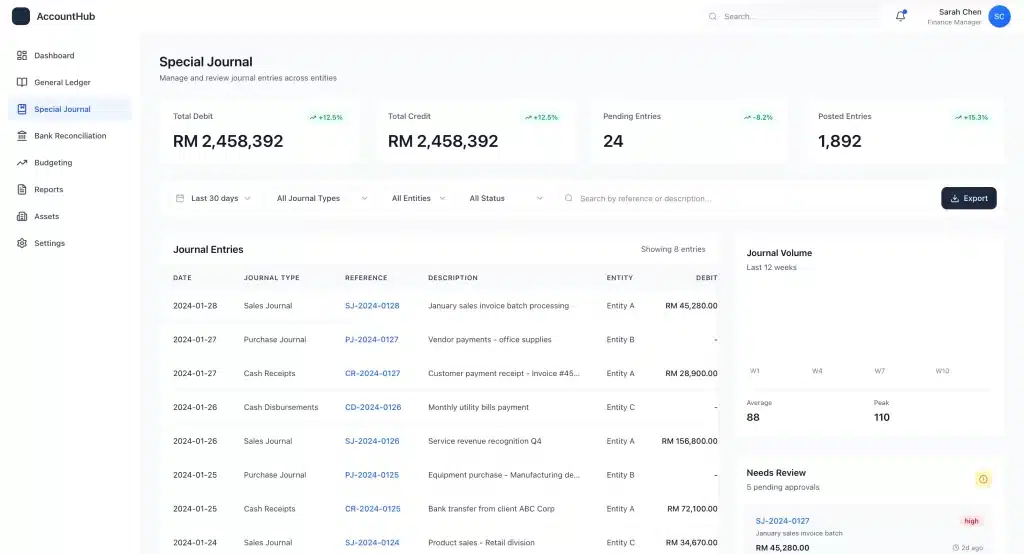 Special journals are essential for organising high-volume transactions, but manual preparation often creates the same headaches; repetitive entry, inconsistent formats, and higher risk of posting errors. An accounting system helps by standardising workflows, reducing rework, and making reviews easier during month-end.
If you’re evaluating solutions, focus on how well the system fits your actual workflow, not just the feature list. The right choice should shorten closing time, improve traceability, and give you cleaner reporting without adding extra admin steps.
Instead of chasing “the most advanced” option, start with clear outcomes: fewer correction entries, faster approvals, and better visibility into cash flow and performance. A short product walkthrough or consultation can help you validate fit before you commit to implementation.
Features that can support special journal management
- Bank Integration and Automation: Automates repetitive work like reconciliation and payment processing to reduce manual errors.
- Budgeting and Forecasting: Supports budget vs actual tracking and forecasting views so variances are caught earlier.
- Financial Reports and Analysis: Provides complete financial statements with period comparisons and ratio analysis to monitor trends.
- Cash Flow Management: Improves liquidity visibility through cash flow reporting and forecasting tools.
- Multi-Entity and Consolidation: Helps manage multiple companies, including intercompany transactions and consolidated reporting.
- Invoice Customisation and Automation: Enables consistent billing formats and automated follow-ups to reduce delays in collection.
- Operational Controls: Includes three-way matching (invoice, delivery order, sales order) to prevent procurement discrepancies, plus landed cost tracking for imported goods.
- Asset and Equity Management: Supports asset tracking, depreciation control, and equity movement reporting across periods.
Conclusion
Special journals are grouped accounting records that organise transactions by type, such as purchases, sales, cash receipts, and cash payments. When they’re maintained consistently, they make it easier to trace entries, review supporting documents, and keep reporting clean during month-end.
In practice, the challenge is rarely the definition, it’s the daily workload. Manual posting and cross-checking can slow teams down, especially when transaction volume grows or approvals involve more than one person, and that’s where an accounting system can help by standardising entries, improving audit trails, and reducing avoidable corrections.
If you’re considering HashMicro, it’s best to evaluate it the same way you would any other system: does it match your workflow, reporting needs, and internal controls. A short product walkthrough or consultation can help you validate the fit early, so you can decide confidently without overcommitting time and resources.
FAQ About Special Journal
-
What is the difference between general journal and special journal?
In a general journal, transactions are typically recorded using two or more line entries, with the debit entry appearing on the first line and the credit entry on the second. In contrast, special journals streamline the process by recording sales and purchases as single-line entries, including references to debtors, creditors, and other relevant details, making bookkeeping more efficient.
-
What are the 6 special journals?
1.Sales Journal: Designed to record credit sales transactions, this journal ensures accurate tracking of receivables. Common accounts debited include Accounts Receivable and Cost of Goods Sold.
2. Purchases Journal: Used to document purchases made on credit, simplifying inventory management. The primary account debited is Inventory.
3. Cash Disbursements Journal: This journal captures all cash outflows, such as payments to suppliers or settling expenses. Debited accounts may include Accounts Payable or other relevant accounts.
4. Cash Receipts Journal: Focused on recording incoming cash transactions, such as customer payments or returns. The account debited is typically Cash.By organizing financial activities into these specialized journals, businesses can enhance accuracy, efficiency, and transparency in their accounting processes.
-
Why are special journals more efficient?
Special journals simplify accounting processes by organizing specific types of transactions. By focusing on areas such as sales and purchases, these journals enhance efficiency, minimize errors, and save valuable time when recording and tracking financial activities.