









Seasonal demand is rarely a surprise, but the operational impact is. When Ramadan and Lebaran hit, Harbolnas drives online traffic, or schools reopen, the same question comes back. Do we have enough stock in the right places, at the right time?
While Malaysia’s Ramadan sales offer massive potential, sudden demand surges often lead to costly stockouts inventory that can erode margins. To overcome these hurdles, optimized inventory levels are essential to protect profitability and maintain stable service levels. Handled well, this strategic planning ensures procurement, warehouse, and sales teams move in sync on one calendar, preventing cash from being trapped in leftover goods.
The tricky part is that “seasonal” is not always a clean repeat of last year. Weather, promotional intensity, supplier lead times, and shifting consumer preferences can all shift the peak forward or backward, and even a small shift can cause stockouts or excess.
Key Takeaways
|
What is Seasonal Inventory Dynamics?
Seasonal inventory refers to products that experience strong demand during certain windows and weaker demand outside those windows. Seasonality is not limited to major holidays, it can also be driven by climate cycles, religious observances, school calendars, and even fiscal-year activities in certain industries.
What makes seasonal items different is the lifecycle. Staple goods tend to have stable demand, while seasonal goods follow a sharp curve (ramp-up, peak, then decline). This shape affects how procurement and promotions should be timed: arriving too early increases holding costs, while arriving too late sacrifices the peak margin window.
Seasonal stock also has a clear financial footprint. Inventory carrying costs, storage, insurance, handling, and the opportunity cost of tied-up capital, can erode profits when turnover slows after the peak. To keep seasonal stock “healthy,” businesses often manage it through the lens of cash conversion, aiming to sell quickly while demand is still active.
How Seasonal Demand Behaves in Real Life
Seasonality comes in different “types,” and mixing them up leads to avoidable planning errors:
- Climatic seasonality: Rain gear, umbrellas, cold-chain items, or weather-driven SKUs.
- Cultural seasonality: Festive hampers, gifting items, event-driven bundles (e.g., Hari Raya, Chinese New Year).
- Institutional seasonality: School terms, year-end budgeting, and fiscal close cycles.
Unlike staple goods, seasonal items behave like a bell curve: ramp-up, peak, then a rapid decline. That short lifecycle changes how teams should time procurement, storage, and promotion, because being late by a few weeks can force immediate discounting.
Optimizing Inventory Levels and Safety Stock
Once the forecast is set, the next step is defining optimal stock levels and safety stock. Safety stock acts as a buffer against demand variability and supply delays. During peak periods, a stockout doesn’t just mean a lost sale, it can also mean losing a repeat customer to a competitor.
However, carrying too much stock increases the risk of obsolescence and margin erosion. A practical approach is a tiered strategy:
- A-items (high velocity): higher safety buffers, tighter replenishment cadence, closer monitoring.
- B-items: moderate buffers with weekly sell-through checks.
- C-items (slow moving): smaller initial buys, tighter triggers, or supplier-direct fulfillment where feasible.
Optimizing inventory levels and safety stock is best managed through a disciplined Open-to-Buy (OTB) plan, a financial budget designed to align procurement with sales projections. It calculates how much inventory to purchase to meet sales projections while maintaining the planned ending inventory level. This prevents emotional overbuying and preserves liquidity to respond to mid-season shifts.
Forecasting Demand Beyond Last Year’s Numbers
A seasonal forecast is only as strong as the data quality and the assumptions that teams continually update. Instead of “last year plus growth,” combine three inputs:
- Corrected historical demand: If an item stocked out last season, sales data understates true demand. Treat stockouts weeks as missing data, then rebuild the baseline using comparable weeks or similar SKUs.
- Early-season leading indicators: Track weekly sell-through by SKU and location once ramp-up starts. If sell-through is slow in weeks 1–2, act early rather than waiting for peak week.
- Scenario planning: Build “base/upside/downside” scenarios with clear triggers.
Example triggers:
- Upside trigger: sell-through runs 15% above plan for 2 consecutive weeks.
- Downside trigger: sell-through falls 10% below plan and promo response is weak.

Supply Chain Coordination and Lead Times
Seasonal inventory management isn’t just a warehouse issue. It depends on tight supply chain coordination. Lead time volatility is the biggest risk, if seasonal stock arrives after the demand window, the inventory value drops fast.
To reduce this risk, align early with suppliers and lock production schedules ahead of peak periods. Pre-building inventory can secure supply (sometimes at a lower unit cost), though it increases holding costs.
For items with unpredictable demand, a chase strategy can work better: commit part of the order upfront, then replenish in-season based on actual sell-through. This requires suppliers that can ramp production quickly and deliver reliably.
Lastly, supplier diversification acts as risk control. Relying on a single supplier for a key seasonal SKU makes the season vulnerable to disruptions such as material shortages, port delays, or capacity constraints. Backup suppliers, even at a slightly higher cost, often function like insurance.
Warehouse Operations and Logistics
Seasonal inventory can overwhelm warehouse operations. A site that runs smoothly off-peak can become congested during peak season, so planning space, flow, and workforce capacity is essential to maintain stable throughput.
Slotting optimization is a high-impact tactic: place high-demand seasonal items in the most accessible pick locations (near dispatch zones, along main aisles, or at waist level). This reduces picker travel time and improves fulfilment speed.
Peak periods also require temporary staff, which makes fast onboarding and clear SOPs critical. Labor management systems (LMS) help track productivity and bottlenecks in real time. Cross-docking can also help with high-volume, pre-allocated goods by moving items from inbound to outbound with minimal storage, freeing space and improving cash flow.
The Role of Technology in Management
Managing these complexities manually is untenable. Enterprise Resource Planning (ERP) systems serve as the central nervous system for your business. These platforms integrate sales, procurement, and logistics into a single source of truth.
Modern software uses AI to correlate weather forecasts with sales data or automate replenishment orders based on dynamic lead times. This technology facilitates better communication through Electronic Data Interchange (EDI), reducing errors and speeding up the procurement cycle.
Managing Excess and Financial Metrics
Despite perfect planning, some excess is inevitable. The goal is to recover capital quickly.
- Avoid “Pack and Hold”: Holding stock for next year ties up capital and risks damage.
- Liquidate Strategically: Use bundling or sell to off-price retailers.
Key Performance Indicators (KPIs)
- GMROI (Gross Margin Return on Investment): Gross Margin / Average Inventory Cost. A value > 1.0 means you are making a profit over your acquisition cost.
- Sell-Through Rate: (Units Sold / Units Received) x 100.
- DSI (Days Sales of Inventory): This should drop significantly during peak periods.
Future Trends: 2025 and Beyond
We are moving toward Predictive Autonomy. Future inventory systems won’t just report data, they will prescribe actions, rerouting shipments or changing prices dynamically based on real-time data. Furthermore, Sustainability is becoming central. Circular economy models will lead to more conservative production runs and higher-quality goods designed to last multiple seasons.
Expert Insight
Research from McKinsey & Company highlights that inventory levels can drop by 10–20% while still meeting required service levels when companies adopt more advanced, data-driven supply chain planning. For Malaysian businesses scaling across states and channels, a data-led operating model is no longer a “nice-to-have”, it’s the baseline for staying competitive.
Reference:
McKinsey & Company – Autonomous supply chain planning for consumer goods companies
If you would like to see how these strategies can be tailored to your business model, you can arrange a free consultation with our expert team to review your current inventory workflow.
Industry-Specific Considerations for Seasonal Execution in Malaysia
Seasonal execution in Malaysia is shaped by predictable demand spikes around festive periods, multi-state distribution realities, and cross-border supply dependencies. Because lead times, buying behavior, and logistics capacity vary by region and channel, seasonal targets work best when they are set by location and supported by clear replenishment rules.
By industry
- Fashion and apparel: Seasonality is driven by trends and weather, and the risk of obsolescence is high because styles change fast. The priority is speed-to-market, supported by shorter buying cycles, quicker replenishment, and tighter allocation by store cluster (for example, Klang Valley vs East Malaysia).
- Food and beverage: Seasonality is intensified by perishability and cold-chain constraints, especially for peak items with fixed expiry windows. Strong FIFO/FEFO discipline, accurate forecasting, and capacity planning for chilled storage and transport help reduce spoilage and compliance risks.
- Consumer electronics: Peaks are commonly tied to launches and gifting seasons, while value drops quickly when newer models arrive. Tight control of channel inventory, faster sell-through monitoring, and clear price and promotion rules help reduce markdown exposure after the peak.
By the operating model
- Manufacturing: Production smoothing helps avoid overtime spikes and quality drift during peak periods. Raw material staging matters when inputs are seasonal or imported, which is common in food processing where shelf life narrows the margin for delays.
- Retail (multi-location): Allocation is the main challenge across different states and city tiers. The same seasonal SKU can perform very differently by location, so planning should follow store clusters, demographics, and footfall patterns.
- Distribution and wholesale: Seasonal peaks amplify the bullwhip effect, where small demand changes trigger exaggerated upstream ordering. Sharing sell-through data and enforcing replenishment rules (min/max, order cadence, lead-time buffers) helps prevent panic ordering, stockouts, and sudden overstock after the peak.
- E-commerce: Returns often increase after peak periods, so reverse logistics capacity should be planned in advance. Clear inspection and grading rules (back-to-stock vs. clearance) reduce delays and protect margins when warehouse and delivery capacity is stretched post-peak.
Implementation Roadmap and Key Performance Indicators
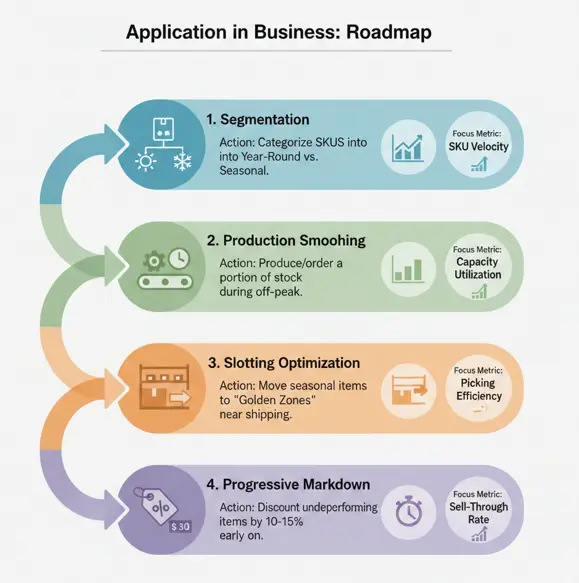
Transitioning from a reactive to a proactive seasonal strategy requires a structured implementation roadmap. This process moves beyond simple spreadsheets, integrating ERP data with operational workflows. The following steps outline a path to maturity in seasonal inventory control.
Step 1: Data Segmentation and Cleaning
Before forecasting, inventory must be segmented. Not all products have the same seasonal profile. Businesses should categorize SKUs into “Year-Round,” “Seasonal,” and “Trend-Based.” Historical data must be scrubbed of anomalies, for example, if a stockout occurred last year during the peak, the sales data will be artificially low. Forecasting based on uncorrected data will lead to under-ordering for the upcoming season.
Step 2: Collaborative Planning, Forecasting, and Replenishment (CPFR)
Silos between sales, marketing, and operations are disastrous during seasonal peaks. Implementation involves regular CPFR meetings in which marketing shares upcoming promotional calendars and operations assesses feasibility. If marketing plans a “Black Friday” blitz on a specific item, operations must ensure the supply chain can support a 300% lift in sales volume.
Step 3: Establishing Metrics and KPIs
To measure success, businesses must track specific KPIs relevant to seasonal performance. General inventory metrics often fail to capture the nuance of short-term peaks.
- Sell-Through Rate: This measures the percentage of inventory sold against the amount received within a specific period.
Formula: (Units Sold / Units Received) x 100.
A low sell-through rate early in the season indicates a need for immediate marketing intervention or pricing adjustments. - Gross Margin Return on Investment (GMROI): This metric evaluates the profitability of inventory. It is particularly vital for seasonal goods where markdowns are common.
Formula: Gross Margin / Average Inventory Cost.
A GMROI greater than 1.0 means the firm is selling the merchandise for more than it costs to acquire and hold it. - Season-End Days Sales of Inventory (DSI): While standard DSI tracks speed of sales, Season-End DSI focuses on the liability remaining as demand drops. The goal is to have this number approach zero as the season concludes.
Navigating Common Pitfalls and Mitigation Strategies
Even with robust planning, businesses often fall into psychological and operational traps. Recognizing these pitfalls is the first step toward avoiding them.
1. The “Just-in-Case” Trap
Fear of stockouts often drives buyers to over-order “just in case” demand surges. This emotional decision-making leads to bloated warehouses and stagnant cash flow.
Mitigation: Use statistical safety stock formulas that account for lead-time variability and service-level targets, rather than relying on gut feelings. Set a hard cap on inventory investment per category.
2. Ignoring the Long Tail of Liquidation
Many companies focus entirely on the peak and have no plan for the decline. They hold onto full-priced inventory too long, hoping for a late surge that never comes, eventually resulting in deep losses.
Mitigation: Establish a pre-planned “markdown cadence.” For example, if 30% of the stock remains by a certain date, an automatic 15% discount is applied. This removes emotion from the decision and clears space for the next season.
3. Cannibalization of Staple Products
Aggressively promoting seasonal items can sometimes draw sales away from higher-margin staple goods. For instance, a coffee shop promoting a complex, low-margin holiday drink might see a drop in sales of its high-margin standard coffee.
Mitigation: Analyze “market basket” data to ensure that seasonal items drive incremental growth rather than displace existing revenue. Strategies should focus on upselling seasonal items as add-ons rather than replacements.
Advanced Best Practices for Optimization
For organizations that have mastered the basics, advanced techniques can unlock further value and competitive advantage.
1. Scenario Planning and Stress Testing
Advanced planners do not rely on a single forecast number. Instead, they model multiple scenarios: Best Case, Worst Case, and Most Likely. They stress-test their supply chain against these scenarios.
“If demand is 20% higher than forecast, do we have the supplier capacity to replenish? If demand is 20% lower, do we have the cash reserves to absorb the holding costs?” This prepares the operations team to pivot quickly based on early-season signals.
2. Post-Mortem Analysis
The most critical phase of seasonal management occurs after the season ends. A formal “post-mortem” or “autopsy” meeting should be held to review what went right and what went wrong.
This involves analyzing forecast accuracy, supplier performance (on-time delivery), and the effectiveness of marketing campaigns. The insights gathered here should be documented and directly fed into the planning parameters for the following year, creating a cycle of continuous improvement.
Conclusion
Seasonal inventory control is not just about buying more stock before a big event. It is a coordination problem between demand signals, lead times, warehouse capacity, and cash discipline.
When the forecast is corrected, safety stock is tiered, and suppliers and warehouses operate on the same calendar, seasonal volatility becomes manageable. The final advantage comes from a clean exit plan, because protecting cash after the peak is what funds the next season’s growth.
If the team wants to pressure-test the forecast, stock buffers, and exit triggers against real lead times, a free consultation can help map the workflow and identify the fastest fixes before the peak hits.
FAQ About Seasonal Inventory Management
-
What is the difference between seasonal inventory and cycle stock?
Cycle stock is the inventory kept to meet regular, predictable demand and is replenished on a normal cadence. Seasonal inventory is extra stock built specifically to support a short-term demand spike that exceeds typical cycle demand, such as festive periods or weather-driven peaks.
-
How can businesses calculate the optimal safety stock for seasonal items?
Safety stock for seasonal items is estimated by analysing demand and lead-time variability during the peak window, then applying a higher service-level target because the selling period is limited. In practice, many businesses increase buffers (often aiming for 98–99% service levels) and update the calculation more frequently as sales velocity changes.
-
What are the risks of carrying too much seasonal inventory?
The biggest risks are higher carrying costs (space, handling, insurance), cash flow pressure from capital tied up in stock, and obsolescence once the season ends. When demand misses the forecast, businesses often need heavy markdowns or write-offs, which can quickly erode margins.
-
How does ERP software improve seasonal inventory management?
ERP helps by integrating sales, purchasing, and logistics into a single system, so teams can see stock levels and movement in real time. It can automate replenishment rules, support forecasting and exception alerts, and reduce manual errors—making it easier to react quickly when demand rises or drops unexpectedly.
-
What strategies help manage excess inventory after the season ends?
Common approaches include progressive markdowns, bundling slow movers with fast movers, moving stock to off-price channels or liquidators, and defining clear return and resale rules (back-to-stock vs. clearance). The aim is to recover cash, protect margin where possible, and free warehouse space for the next cycle.