









Sales inventory management connects stock levels with real customer demand, ensuring products are available without overloading storage. When managed well, it supports smoother cash flow, faster fulfillment, and a better buying experience.
In Malaysia’s competitive retail environment, many businesses are aligning sales data with warehouse inventory through automated systems. This synchronization helps reduce discrepancies, improve purchasing accuracy, and keep operations running more efficiently.
But how can companies maintain this balance as transactions grow and channels multiply? Understanding how structured, real-time inventory control works is a practical starting point for building a more responsive and profitable operation.
Key Takeaways
|
What Is Sales Inventory and Why Is It Crucial for Your Business?
Sales inventory refers to finished goods held by a company specifically to generate revenue, acting as a primary current asset on the balance sheet. It distinguishes itself from raw materials by being the final product ready for immediate purchase by your customers.
Strategically, it serves as the central nervous system of your operations, dictating your ability to fulfill orders and manage cash flow effectively. A well-managed inventory ensures that procurement and sales are perfectly synchronized to meet market demand without delay.
Conversely, ineffective management leads to costly overstocking or damaging stockouts that erode customer trust and brand reputation. To prevent these pitfalls, offers integrated solutions that keep your inventory lean, accurate, and profitable.
Key Components in the Sales Inventory Management Cycle
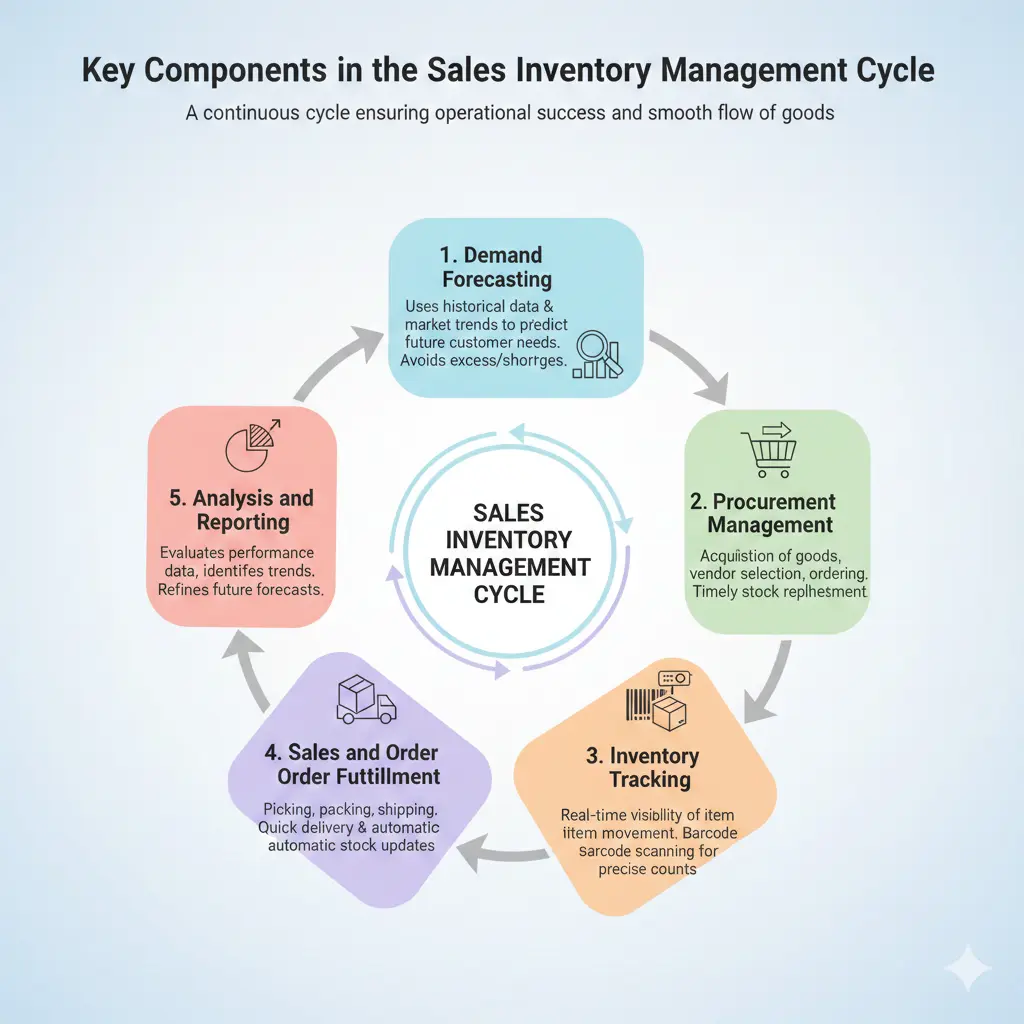
Managing sales inventory involves a continuous cycle of interconnected stages that must work in harmony to ensure operational success. Each phase, from prediction to analysis, relies on the accuracy of the previous step to maintain a smooth flow of goods.
- Demand forecasting: This foundational step uses historical data and market trends to predict future customer needs accurately. It helps businesses order the right amount of stock to avoid both excess and shortages.
- Procurement management: Once demand is known, this process handles the acquisition of goods through strategic vendor selection and ordering. It ensures products arrive just in time to replenish stock without inflating storage costs.
- Inventory tracking: Real-time visibility is achieved by monitoring item movement from the warehouse entry point to the final sale. Advanced tools like barcode inventory software are essential here to eliminate human error and maintain precise counts.
- Sales and order fulfillment: This stage connects inventory to the customer, triggering picking, packing, and shipping the moment an order is placed. A streamlined fulfillment process ensures quick delivery and automatically updates stock records to reflect the sale.
- Analysis and reporting: The cycle concludes with evaluating performance data to identify trends and areas for operational improvement. These insights are crucial for refining future forecasts and making data-driven decisions for the next cycle.
Key Metrics to Measure Sales Inventory Performance
I always tell my clients that you cannot improve what you do not measure, especially when it comes to valuable assets like inventory. Tracking the right metrics moves you from guessing to knowing, providing a clear numerical snapshot of your business health.
These indicators serve as a diagnostic tool, revealing hidden inefficiencies in how you convert stock into revenue. By monitoring these figures regularly, you can make strategic adjustments that directly boost your bottom line.
1. Days Sales in Inventory (DSI)
Days Sales in Inventory (DSI) is a crucial financial metric that measures the average number of days it takes for a company to convert its inventory into sales. It essentially tells you how long your cash is tied up in your stock, impacting your overall liquidity.
A lower DSI is typically better, as it indicates that the company is selling its inventory quickly and efficiently. Monitoring DSI helps businesses identify slow-moving products and improve overall inventory management strategies.
2. Inventory turnover ratio
The inventory turnover ratio is a powerful indicator that measures how many times a company’s inventory is sold and replaced over a specific period. It is calculated by dividing the Cost of Goods Sold (COGS) by the average inventory held during that timeframe.
A higher ratio generally suggests strong sales and efficient purchasing, meaning goods are moving fast. However, a ratio that is too high might signal a risk of stockouts, highlighting the need for a balanced approach.
3. Sell-through rate
The sell-through rate is a key metric that compares the amount of inventory sold to the amount of inventory received from a supplier. It provides a clear percentage of how well a specific product is performing within a certain month or quarter.
A high sell-through rate is a strong indicator of high demand and effective marketing efforts. This metric is invaluable for evaluating the success of new product launches and making timely decisions about reordering.
4. Gross Margin Return on Investment (GMROI)
Gross Margin Return on Investment (GMROI) reveals how much gross profit is earned for every dollar invested in inventory. A GMROI greater than 1.0 indicates that the business is selling its merchandise for more than what it costs to acquire and hold it.
This metric is particularly useful for identifying which products are the true profit drivers in your catalog. It helps businesses make smarter decisions about pricing, promotions, and shelf space allocation.
Sales of Inventory Formula and Calculation
The “Sales of Inventory” calculation generally focuses on the Cost of Goods Sold (COGS), which is essential for determining gross profit. The basic formula is:
For example, if a Malaysian electronics retailer starts with RM 50,000 in stock, purchases RM 20,000 more, and ends with RM 10,000, their COGS is RM 60,000. This figure is then subtracted from total revenue to reveal the actual gross profit generated from sales inventory.
Understanding this calculation is vital for pricing strategies and identifying how much capital is being consumed to generate sales. Regular analysis of these figures helps businesses adjust their purchasing habits to maximize profitability and liquidity.
Effective Strategies to Optimize Sales Inventory
Optimizing your stock requires a blend of proven methodologies and modern tools to build a resilient system. By implementing a multi-faceted approach, you can create a highly efficient operation that minimizes waste and maximizes profitability.
- Implementing the Just-In-Time (JIT) method: This strategy involves receiving goods only as they are needed for production or sale, drastically reducing storage costs. It requires reliable suppliers and accurate forecasting to minimize waste and free up cash flow.
- Using ABC analysis: This technique categorizes inventory into three groups based on value and importance, allowing businesses to prioritize their management efforts. It ensures that high-value items receive tighter control while low-value items consume fewer resources.
- Establishing safety stock and reorder points: Safety stock system acts as a buffer against unexpected demand spikes, while reorder points trigger replenishment at the optimal time. Calculating these levels prevents costly stockouts and ensures continuous product availability for customers.
- Leveraging technology for automation: Modern solutions like Inventory Management System automate complex calculations and tracking. This technology removes human error and provides real-time data for smarter, faster decision-making.
Common Challenges in Sales Inventory Management and Their Solutions
Many businesses face complex hurdles that disrupt operations, often stemming from outdated manual processes and lack of oversight. Recognizing these root causes is the first step toward building a more resilient and efficient inventory system.
From data inaccuracies to communication breakdowns, these issues are common but entirely solvable with the right approach. Let’s examine the most frequent pain points and the practical solutions to address them.
- Inaccurate stock data: Discrepancies between physical stock and system records often arise from human error or theft. The solution is implementing barcode scanning and regular cycle counting to ensure data integrity.
- Overstocking and understocking: Poor forecasting leads to either excess capital tied up in stock or lost sales due to shortages. Utilizing predictive analytics tools helps balance inventory levels with actual market demand.
- Lack of inter-departmental visibility: Operational silos prevent sales and procurement teams from coordinating effectively. Implementing a centralized ERP system ensures everyone works from a single source of truth.
- Time-consuming manual processes: Relying on spreadsheets is slow and prone to errors, hindering business scalability. Automating workflows with specialized software frees up staff for strategic tasks and improves accuracy.
The Role of Technology in Transforming Sales Inventory Management
In today’s digital economy, technology is the engine that drives a truly optimized and proactive inventory management strategy. Modern systems integrate disparate parts of your business, eliminating information silos and reducing reliance on manual tasks.
- Data centralization with an ERP system: An ERP platform acts as a unified database, connecting sales, purchasing, and inventory in real-time. This ensures that every department has instant access to accurate information for better decision-making.
- Automated tracking with barcodes and RFID: Integrating scanning technology automates the tracking of goods from receipt to dispatch. This drastically reduces manual errors and accelerates warehouse operations.
- Predictive analytics for better forecasting: Advanced systems use AI to analyze historical data and identify trends, enabling highly accurate demand predictions. This allows businesses to optimize stock levels and minimize the risk of overstocking.
- Integration with sales platforms (e-commerce & POS): Seamlessly connecting inventory with sales channels ensures that stock levels are updated instantly across all platforms. This prevents overselling and guarantees a consistent customer experience online and offline.
Case Study: Improving Sales Inventory Accuracy in a Healthcare Distribution Environment
A regional healthcare distributor operating under the Abbott product portfolio faced ongoing challenges in aligning sales transactions with physical inventory levels. With multiple sales channels and strict product handling requirements, stock discrepancies frequently occurred between warehouse records and actual availability. This led to delayed deliveries, excess safety stock, and increased pressure on working capital.
To address this, the company adopted a centralized inventory management system that synchronized sales orders, warehouse movements, and stock updates in real time. Batch-level tracking and automated stock adjustments reduced manual data entry, while integrated reporting provided clearer demand visibility. As a result, the distributor improved stock accuracy, shortened order processing time, and reduced overstock on slow-moving items.
With improved visibility across sales and inventory data, teams could make more accurate replenishment decisions while maintaining consistent service levels for critical healthcare products. Transitioning from manual reconciliation to system-driven inventory control created a more stable, responsive, and operationally efficient supply chain environment.
Conclusion
Mastering sales inventory management helps businesses turn stock into a strategic asset rather than a financial burden. With a more proactive approach, companies can maintain healthier cash flow, improve product availability, and strengthen customer satisfaction in an increasingly competitive market.
A structured system supported by integrated technology enables real-time visibility, smarter replenishment, and better coordination across departments. This foundation helps reduce inefficiencies while supporting more informed operational and financial decisions.
For organizations aiming to build stronger control over their inventory and long-term performance, discussing the right system approach with experienced consultants can be a practical step toward more efficient and sustainable operations.
FAQ About Sales Inventory
-
What is the first step to improve sales inventory management?
The first step is to achieve accurate, real-time visibility of your current stock levels. Without knowing exactly what you have and where it is, no other strategy can be effectively implemented.
-
How often should I calculate metrics like DSI and inventory turnover?
You should calculate DSI and inventory turnover at least monthly, or more frequently if your business has fast-moving inventory.
-
Is a spreadsheet still sufficient for a small business’s sales inventory?
While a spreadsheet can work at the very beginning, it quickly becomes inefficient and error-prone as a business grows. It lacks real-time updates, automation, and integration, which are crucial for scalability.
-
What is the main difference between sales inventory and other inventory assets?
Sales inventory consists of finished goods ready for sale, directly impacting revenue and cash flow. Other assets like raw materials or work-in-progress are components used in production and are not yet available to customers.
-
How does an ERP system specifically help reduce storage costs?
An ERP system helps reduce storage costs by providing accurate demand forecasting, which prevents overstocking. It also enables strategies like Just-In-Time (JIT), ensuring goods arrive only when needed, thus minimizing the need for large warehouse space.