






Recurring payments a reliable engine for revenue and long-term financial stability. Malaysia-based streaming service adopted recurring payments to replace manual bank transfers and inconsistent monthly collections. This automated system provides a simple and convenient customer experience while reducing administrative workload and creating a scalable foundation for sustainable business growth.
This article explains the meaning of recurring payment, how it works across industries, its key advantages and disadvantages, the available types, and how automated recurring payment processing operates. Whether you are a business owner exploring payment models or a finance professional looking to improve billing efficiency, this guide provides the essential insights to make informed decisions.
Key Takeaways
Understand the core definition and meaning of recurring payments in a modern business context.
Explore how recurring billing models are applied across different sectors and industries.
A quick analysis of the key benefits and potential drawbacks of recurring payment systems.
Learn the difference between fixed and variable recurring payments and when each applies.
What is Recurring Payments?
Recurring payments refer to a billing arrangement in which a customer authorizes a business to automatically charge a set or variable amount from their payment method, such as a credit card, debit card, or bank account to predetermined intervals. These intervals can be weekly, monthly, quarterly, or annually, depending on the agreement between the merchant and the customer.
In the simplest terms, recurring payment is automatic and repeated collection of funds from a customer’s account for an ongoing product or service without requiring the customer to manually initiate each transaction. Once the customer provides their payment credentials and agrees to the billing terms, the merchant’s payment processor handles every subsequent charge automatically.
Rather than completing a transaction and concluding the relationship, recurring payments establish an ongoing financial relationship between buyer and seller. This is the backbone of subscription-based business models across virtually every sector, from software-as-a-service (SaaS) and e-commerce to healthcare, education, and utilities.
According to industry research, the global subscription economy has seen exponential growth over the past decade, with more businesses recognizing the stability and scalability that recurring revenue provides. Understanding the fundamentals of billing terms is often the first step for businesses looking to structure their recurring billing agreements effectively.
From a technical standpoint, recurring payments rely on three key components: the customer’s stored payment information, a merchant account, and a payment gateway or processor. These elements create a seamless transaction loop that operates without manual intervention from either the business or the customer.
How Recurring Payment Work in Industry Field

Recurring payments are not limited to any one type of business or industry they’re the standard billing model across a wide range of sectors. Understanding how this system functions in different contexts helps illustrate just how versatile and impactful it has become.
1. Software and Technology (SaaS)
The SaaS industry arguably pioneered the modern recurring payment model. Companies like Adobe and Microsoft transitioned from one-time software licenses to monthly or annual subscriptions. In this sector, recurring payments allows businesses to tier their services and adjust pricing as customers upgrade or downgrade their subscriptions.
2. Retail and E-Commerce
Subscription boxes and replenishment services have brought recurring payments into the consumer retail world. Brands like Amazon’s “Subscribe and Save” or monthly beauty box subscriptions charge customers automatically and ship curated products at regular intervals. This model reduces cart abandonment, improves inventory planning, and builds brand loyalty over time.
3. Healthcare and Wellness
Medical clinics, dental practices, and wellness centers increasingly use recurring payments for membership programmers that give patients access to preventive care services at a flat monthly rate. Gym memberships are another classic example, where customers are billed monthly without needing to renew manually each time.
4. Media and Entertainment
Streaming platforms such as Netflix, Spotify, and Apple TV+ operate entirely on recurring subscription fees. Customers pay a fixed monthly or annual rate in exchange for continuous access to content libraries. The ease of automatic billing removes friction from the customer experience and reduces churn rates.
5. Professional Services and Consulting
Law firms, marketing agencies, and accounting firms sometimes charging a fixed monthly fee for a defined scope of services. This creates financial predictability for both parties and eliminates the need for repeated invoicing cycles. For businesses managing these payments structures tools that simplify the invoicing process can significantly reduce administrative overhead.
6. Utilities and Telecommunications
Electricity providers, water companies, and telecom operators have long used recurring payments. Customers are charged monthly based on their consumption, and automatic billing ensures that payments are collected reliably. Some utilities also offer budget billing plans where customers pay a fixed monthly amount regardless of actual usage, which represents a hybrid approach.
7. Education and Online Learning
Online learning platforms like Coursera, Duolingo, and Udemy Premium charge learners on a subscription basis. Educational institutions are also beginning to offer tuition instalment plans managed through recurring billing systems, reducing the financial burden on students while providing schools with consistent cash flow.
In each of these industries, the recurring payment model serves the same fundamental purpose. It creates a reliable and automated revenue stream that reduces the administrative burden on businesses and simplifies the payment process for customers.
Quick Analysis: Advantages and Disadvantages of Recurring Payment
Like any billing model, recurring payments come with both significant benefits and notable challenges. Businesses considering this approach should weigh both sides carefully before committing to implementation.
| Advantages of Recurring Payments | Disadvantages of Recurring Payments |
|---|---|
| Predictable Revenue Enables accurate forecasting and better budgeting decisions. |
Payment Failures Expired or cancelled cards can cause involuntary churn. |
| Automated Billing Reduces manual invoicing and administrative workload. |
Chargebacks Forgotten subscriptions may lead to disputes and refunds. |
| Steady Cash Flow Scheduled payments ensure consistent incoming revenue. |
Compliance Requirements Businesses must meet PCI DSS and data protection standards. |
| Higher Retention Subscription models naturally extend customer relationships. |
Revenue Recognition Complexity Subscription income may require deferred accounting treatment. |
| Lower Transaction Costs Repeated charges often incur fewer processing fees. |
Customer Resistance Some users hesitate to commit to automatic billing. |
| Better Customer Experience Automatic payments create a seamless and convenient process. |
Understanding these trade-offs is critical when designing a recurring billing strategy. The advantages generally outweigh the disadvantages for most business models, but only when the implementation is done thoughtfully and with the right tools in place.
Two Type of Recurring Payments
Recurring payments are not a one-size-fits-all solution. There are two primary categories of recurring payments, each with distinct characteristics and ideal use cases.
1. Fixed Recurring Payments
Fixed recurring payments, sometimes called flat-rate or regular recurring payments, involve charging the customer the exact same amount at every billing interval. The amount does not change from cycle to cycle unless the customer upgrades, downgrades, or otherwise modifies their plan.
This is the most straightforward type of recurring billing and the most common in subscription-based business models. Examples include:
- Monthly streaming service subscriptions (e.g., a flat RM 15/month for video content).
- Annual software licenses with a fixed per-seat fee.
- Fixed-rate gym membership fees.
- Monthly retainer fees for professional services.
- Fixed-rate insurance premiums paid monthly or annually.
Why businesses prefer fixed recurring payments:
From an operational standpoint, fixed billing is the easiest to manage. Revenue forecasting is straightforward because the amount billed is constant. Customers also appreciate the simplicity, they know exactly what will be charged each cycle and can budget accordingly. The transparency of fixed billing reduces the likelihood of payment disputes or customer complaints about unexpected charges.
Ideal use cases:
Fixed recurring payments work best for businesses offering a standardized product or service where the value delivered does not fluctuate significantly from period to period. SaaS platforms with tiered pricing, media subscription services, and membership programmers are all well-suited to this model.
2. Variable Recurring Payments
Variable recurring payments, also referred to as irregular or usage-based recurring payments, involve charging the customer a different amount each billing cycle based on actual consumption, usage, or another variable factor. While the billing occurs on a regular schedule, the amount billed changes each time.
Examples of variable recurring payments include:
- Utility bills (electricity, gas, or water charged based on monthly consumption)
- Mobile data plans where overages result in additional charges
- Pay-as-you-go cloud computing services billed monthly based on resource usage
- Variable-rate credit card bills
- Commission-based service agreements where the monthly fee depends on sales volume
Challenges with variable recurring payments:
While this model allows businesses to align their billing with actual value delivered, it introduces complexity on both sides of the transaction. Customers may find it harder to predict their monthly costs, which can lead to dissatisfaction if a bill is unexpectedly high. For businesses, tracking and accurately calculating variable charges requires more sophisticated billing infrastructure.
Managing variable billing effectively:
To mitigate customer concerns about variable billing, many businesses provide usage dashboards, real-time spending alerts, and monthly summaries so customers can monitor their consumption throughout the billing period. Transparent communication and detailed billing statements such as invoices management are essential tools for maintaining trust with customers on variable billing plans.
Hybrid models:
Many businesses combine both approaches, offering a fixed base subscription fee plus variable charges for usage above a defined threshold. Cloud service providers, for example, may charge a fixed monthly minimum and then add variable fees for additional compute hours or storage. This hybrid model balances predictability with flexibility.
How do Automatic Recurring Payments Work?
Automatic recurring payments might seem seamless from the customer’s perspective, but there is a well-orchestrated sequence of steps that makes this possible. Understanding this process helps businesses appreciate the infrastructure required and identify where things can go wrong.
Step 1: Customer Authorization
The process begins when a customer agrees to be billed on a recurring basis. This authorization is typically captured through a checkout page, a sign-up form, or a direct agreement. The customer provides their payment credentials and explicitly consents to automatic charges at agreed-upon intervals.
This authorization is legally significant. It is the customer’s permission for the merchant to initiate future charges without requiring further approval for each transaction. Most payment regulations require this consent to be clearly documented and stored by the merchant.
Step 2: Tokenization and Secure Storage
Once the customer submits their payment information, the data is typically tokenized. Tokenization replaces sensitive payment details with a unique identifier (a “token”) that the merchant stores securely. The actual card or bank account details are held by the payment processor or gateway in a PCI DSS-compliant environment, removing the merchant from direct contact with raw payment data.
This is a critical security step. By using tokens rather than raw card data, the risk associated with a data breach is dramatically reduced, the token itself is useless to a would-be attacker without access to the payment processor’s secure vault.
Step 3: Billing Schedule Configuration
The merchant or their billing software configures the recurring payments schedule, specifying the amount, frequency, start date, and any end conditions. For fixed billing, this is straightforward. For variable billing, the system must be connected to a usage tracking mechanism that calculates the billable amount before each charge date.
Modern billing platforms allow extensive customization of these parameters, including the ability to set trial periods, apply discounts for the first billing cycle, or apply different rates for annual versus monthly commitments.
Step 4: Transaction Initiation
When the billing date arrives, the merchant’s system automatically initiates a charge request using the stored token. This request is sent to the payment gateway, which acts as the intermediary between the merchant’s system and the customer’s bank.
The gateway forwards the request to the relevant card network (Visa, Mastercard, etc.) or bank, which then processes the authorization request. If the customer’s account has sufficient funds and the card is valid, the transaction is approved.
Step 5: Authorization and Capture
The authorization process confirms that the funds are available and reserves them. In most recurring payments scenarios, the authorization and capture happen simultaneously or within a very short window. Once the transaction is captured, the funds begin moving from the customer’s account through the card network to the merchant’s account.
Step 6: Settlement
Settlement is the final step, during which the funds are actually transferred to the merchant’s bank account. Depending on the payment processor, settlement can take anywhere from one to three business days. Some processors offer faster settlement options for an additional fee.
Step 7: Receipt and Record-Keeping
Once the transaction is complete, both the merchant and customer receive confirmation through their billing dashboard merchant and the customer through an automated email receipt. The transaction is recorded in the merchant’s accounting system, and any relevant documents (such as an invoice or billing statement) are generated and stored.
Handling Failed Transactions
Not every recurring payment succeeds on the first attempt. Common reasons for failure include expired cards, insufficient funds, bank blocks on recurring charges, or invalid account details. When a payment fails, the billing system typically:
- Flags the transaction as failed and records the reason.
- Sends an automated notification to the customer requesting updated payment information.
- Attempts to retry the payment after a set period (often 24–72 hours).
- Escalates to a dunning process if multiple retry attempts fail.
Dunning management is a critical component of a robust recurring payments strategy. Without recurring payments, businesses risk losing revenue to involuntary churn from customers who would have continued paying if their payment issue had been resolved.
Subscription Management and Customer Updates
Customers inevitably need to update their payment information, change their subscription plan, or cancel their subscription. A well-designed recurring payment system includes self-service tools that allow customers to make these changes easily. This not only improves the customer experience but also reduces the volume of support requests related to billing.
Integration with Financial Systems
For businesses with more complex financial operations, recurring billing must integrate cleanly with accounting software, enterprise resource planning (ERP) systems, and customer relationship management (CRM) tools. This ensures that billing data flows seamlessly into financial reports, customer records, and operational dashboards without the need for manual data entry.
Compliance Considerations
Recurring payment processing must comply with a range of regulatory requirements that vary by country and payment type. Key compliance areas include:
- PCI DSS: The Payment Card Industry Data Security Standard mandates strict requirements for how cardholder data is stored, processed, and transmitted.
- GDPR and local data protection laws: Customer payment data is personal data, subject to privacy regulations that govern how it is collected, stored, and used.
- Mandate management for direct debits: In regions using direct debit schemes (such as SEPA in Europe or FPX in Malaysia), specific mandate agreements must be collected and maintained before recurring charges can be initiated from a bank account.
- Clear disclosure of billing terms: Many jurisdictions require that businesses clearly disclose recurring billing terms — including the amount, frequency, and cancellation process — before collecting payment information.
Businesses that fail to comply with these requirements risk financial penalties, reputational damage, and elevated chargeback rates. Partnering with a reputable payment processor and investing in compliant billing infrastructure is essential.
Step-by-Step to Implement Recurring Payments
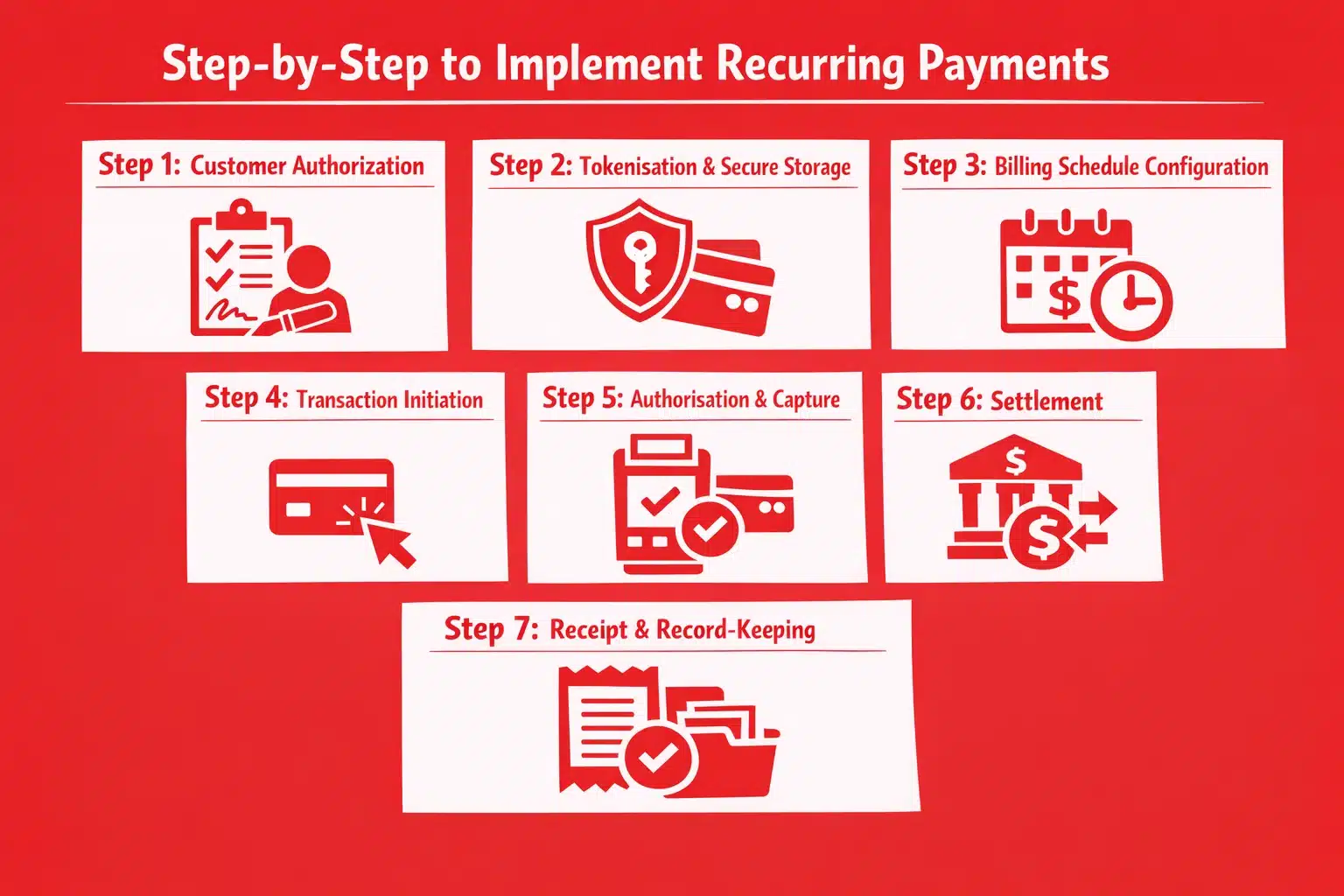 Implementing a recurring payment system requires careful planning across technical, legal, and operational dimensions. Rushing the process can result in failed transactions, compliance violations, and poor customer experiences. The following steps provide a structured approach to getting your recurring billing infrastructure right from the start.
Step 1: Define Your Billing Model
Before selecting any payment provider, you must clearly define how your recurring payments will work. Decide whether you will use fixed recurring payments or variable recurring payments. Determine your billing intervals from weekly, monthly, quarterly, or annually, and whether you will offer multiple pricing tiers. Aligning your billing model with your product or service structure is critical before any technical implementation begins.
Step 2: Choose a Payment Gateway and Processor
Choose a payment gateway that supports recurring payments and secure automated billing. Prioritize providers with tokenization to protect stored card data. Ensure the system supports multiple payment methods and sends webhook alerts for payment updates.
Step 3: Obtain Explicit Customer Authorization
Recurring payments require clear, documented consent from the customer before any automatic charge can be initiated. The customer must be informed of the billing amount, frequency, and the terms under which the subscription can be cancelled. Storing a digital record of this authorization is a legal requirement in most jurisdictions and an essential protection in the event of a dispute or chargeback.
Step 4: Set Up Dunning Management
Dunning management refers to the process of handling failed payment attempts. Even in well-structured systems, payments fail due to expired cards, insufficient funds, or bank-side issues. Your system should automatically retry failed charges according to a defined schedule before suspending the customer’s account. Automated email notifications should accompany each retry attempt, prompting customers to update their payment details.
Step 5: Integrate with Your Accounting and CRM Systems
Integrate your payment system with your accounting software to ensure that invoices, revenue recognition, and tax calculations are updated automatically with each billing cycle. Connecting payment data with customer relationship management (CRM) platform also allows sales and support teams to access up-to-date subscription status, payment history, and renewal dates, enabling more informed customer interactions.
Step 6: Monitor, Test, and Optimize
After launching recurring payment system, continuous the monitoring is crucial. Track key metrics like churn rate, payment failures, average revenue per user, and customer lifetime value, and regularly test your billing logic to prevent errors. Use these insights to optimize your dunning strategy, pricing structure, and renewal communications over time.
Common Pitfalls in Recurring Payment Systems
Despite the clear advantages of recurring billing, businesses that implement it without adequate preparation frequently encounter significant challenges. Being aware of these pitfalls in advance allows you to design systems and processes that mitigate their impact.
1. Ignoring Compliance and Regulatory Requirements
Recurring payments are subject to a range of legal and regulatory frameworks that vary by country and payment method. In many regions, including the European Union and the United Kingdom, businesses must comply with strong customer authentication requirements under PSD2 regulations. Failing to adhere to these requirements can result in fines, forced refunds, and reputational damage.
2. Poor Communication Around Billing Changes
One of the most common triggers for customer complaints and chargebacks is a lack of clear communication about billing changes. If you intend to raise prices, change billing cycles, or alter the scope of a subscription, you must notify customers in advance with sufficient time for them to respond. Surprising customers with unexpected charges erodes trust and increases the likelihood of cancellations and disputes.
3. Neglecting Failed Payment Recovery
Many businesses implement recurring payments, but without an automated dunning system, failed charges often go unnoticed until a customer’s account is deactivated. Business that fail to actively manage payment failures often face higher involuntary churn, leading to lost revenue even when customer satisfaction and product quality remain unchanged.
4. Storing Payment Data Insecurely
To facilitate recurring charges, businesses must store customer payment credentials in some form. Doing so without meeting Payment Card Industry Data Security Standard (PCI DSS) requirements exposes both the business and its customers to significant security risks. The safest approach is use a payment gateway with tokenization to replace sensitive card data with secure tokens, allowing future charges without exposing actual card details.
5. Overlooking Cancellation Experience Design
A difficult cancellation process may seem like a short-term tactic to retain subscribers, but it almost always backfires. Customers who struggle to cancel are more likely to initiate chargebacks, leave negative reviews, and warn others away from the service. Offering a clear, frictionless cancellation path is a far more effective long-term strategy. Customers who cancel on good terms are also far more likely to resubscribe in the future.
Conclusion
Recurring payments have evolved from a convenient billing alternative to a foundational component of modern business strategy. Understanding the recurring payment meaning equips businesses to implement these systems thoughtfully and effectively.
Whether you are running a SaaS platform, a subscription e-commerce brand, or a professional services firm, the shift to recurring payments is a fundamental restructuring of how businesses and customers exchange value over time. By investing in the right infrastructure, processes, and tools, businesses can build recurring revenue streams that are both resilient and scalable.
For businesses ready to move forward, adopting integrated billing and invoicing platforms is a strategic step. These solutions automate the recurring payment lifecycle and improve overall financial operations.
FAQ about Recurring Payments
-
What is the difference between a one-time payment and a recurring payment?
A one-time payment is a single transaction that completes a purchase and ends the financial exchange. A recurring payment, by contrast, establishes an ongoing billing relationship where the customer is automatically charged at regular intervals for continued access to a product or service. Recurring payments require prior authorization from the customer and are managed through automated billing systems.
-
How do businesses handle failed recurring payments?
When a recurring payment fails, due to an expired card, insufficient funds, or other reasons, most billing systems automatically retry the transaction after a short period. If retries are unsuccessful, the system initiates a dunning process: sending automated notifications to the customer requesting updated payment information. Effective dunning management is critical for reducing involuntary customer churn and protecting revenue.
-
Is it safe to set up recurring payments?
Yes, when implemented correctly, recurring payments are very safe. Reputable payment processors use tokenization to replace sensitive card data with a secure identifier, and all stored payment information must comply with PCI DSS standards. Customers should ensure they are setting up recurring payments only with trusted merchants who clearly communicate billing terms and offer easy cancellation options.