





A project can look “on track” on paper, yet still bleed money through small leaks, scope changes without cost approval, rushed procurement, rework, and delayed sign-offs. When these issues stack up, cost overruns stop being a budget line item and become a profitability problem that leadership has to solve under pressure.
For project owners, finance leaders, and operations managers, the challenge is rarely the formula, it is maintaining control when timelines shift, vendors change, and multiple teams report different numbers. That is why cost overrun prevention needs clear governance: a realistic baseline, strict change control, frequent variance checks, and accountability for decisions that create cost.
This guide explains what a cost overrun is, why it happens, the early warning signs to watch for, and practical steps to prevent and recover from overruns. It also explains how modern project systems provide stronger cost visibility and faster decision-making, ensuring projects remain predictable and financially defensible.
Key Takeaways
|
What Exactly is a Cost Overrun?
A cost overrun happens when the actual cost of completing a project exceeds the budget that was initially planned. In practice, it is a project performance gap that signals breakdowns in estimation, scope control, execution, or external assumptions, not just a general “budget shortfall.”
A common way to quantify it is:
Cost Overrun % = ((Actual Cost − Budgeted Cost) / Budgeted Cost) × 100%
For example, if a project budget is 1,000,000 and actual cost becomes 1,150,000, the overrun is 15%, which makes it easier to track performance across projects and identify recurring drivers.
Key Factors Causing Cost Overruns in Projects
Budget blowouts are rarely triggered by a single event; they are the result of compounding structural issues. To prevent overspending, you must diagnose the root causes rather than merely treating the symptoms. Based on market analysis and common pitfalls in the Malaysian construction project management landscape, here are the primary culprits:
1. Flaws in the planning stage
A project’s financial failure is often sealed before the first brick is laid. Mistakes here set a flawed foundation that no amount of execution efficiency can fully correct.
- Optimism bias in estimation: Managers often underestimate costs and timelines due to a lack of reliable historical data. Research by McKinsey finds that 98% of megaprojects suffer cost overruns of more than 30% due to this initial bias.
- Undefined scope & design errors: Incomplete drawings or vague requirements inevitably lead to Scope Creep, the uncontrolled expansion of work without budget adjustments.
- Regulatory and admin oversights: Failing to budget for specific Malaysian compliance costs (e.g., CIDB requirements, local council permits) or land acquisition legal fees often leaves a gap in the initial budget.
2. Issues During Project Execution
The gap between the “Plan” and “Site Reality” is where the budget leaks most profusely.
- Low labor productivity: In Malaysia, challenges with unskilled labor or high turnover rates can extend timelines, directly inflating man-hour costs.
- Inefficient resource management: Poor scheduling leads to operational downtime—such as heavy machinery sitting idle or workers waiting for materials. This “silent burn” eats into profit margins daily.
- Fragmented communication: When site teams, procurement, and finance operate in silos, it leads to duplicate orders, rework, and costly delays.
3. Unforeseen External Factors
While these factors are beyond your control, they must be accounted for in your risk assessment. A contingency fund (typically 10-20%) is essential to absorb these shocks.
- Material price volatility: Fluctuations in global commodity prices (steel, cement, oil), often exacerbated by the Ringgit’s (MYR) performance, can render a fixed-price contract unprofitable overnight.
- Environmental constraints: The monsoon season is a predictable “unforeseen” factor. Projects that fail to account for weather-related work stoppages will incur unavoidable penalties and overtime costs to catch up.
- Economic & policy shifts: Sudden changes in tax structures (like SST rate adjustments) or minimum wage mandates can instantly increase project overheads.
The Negative Business Impacts of Cost Overrun
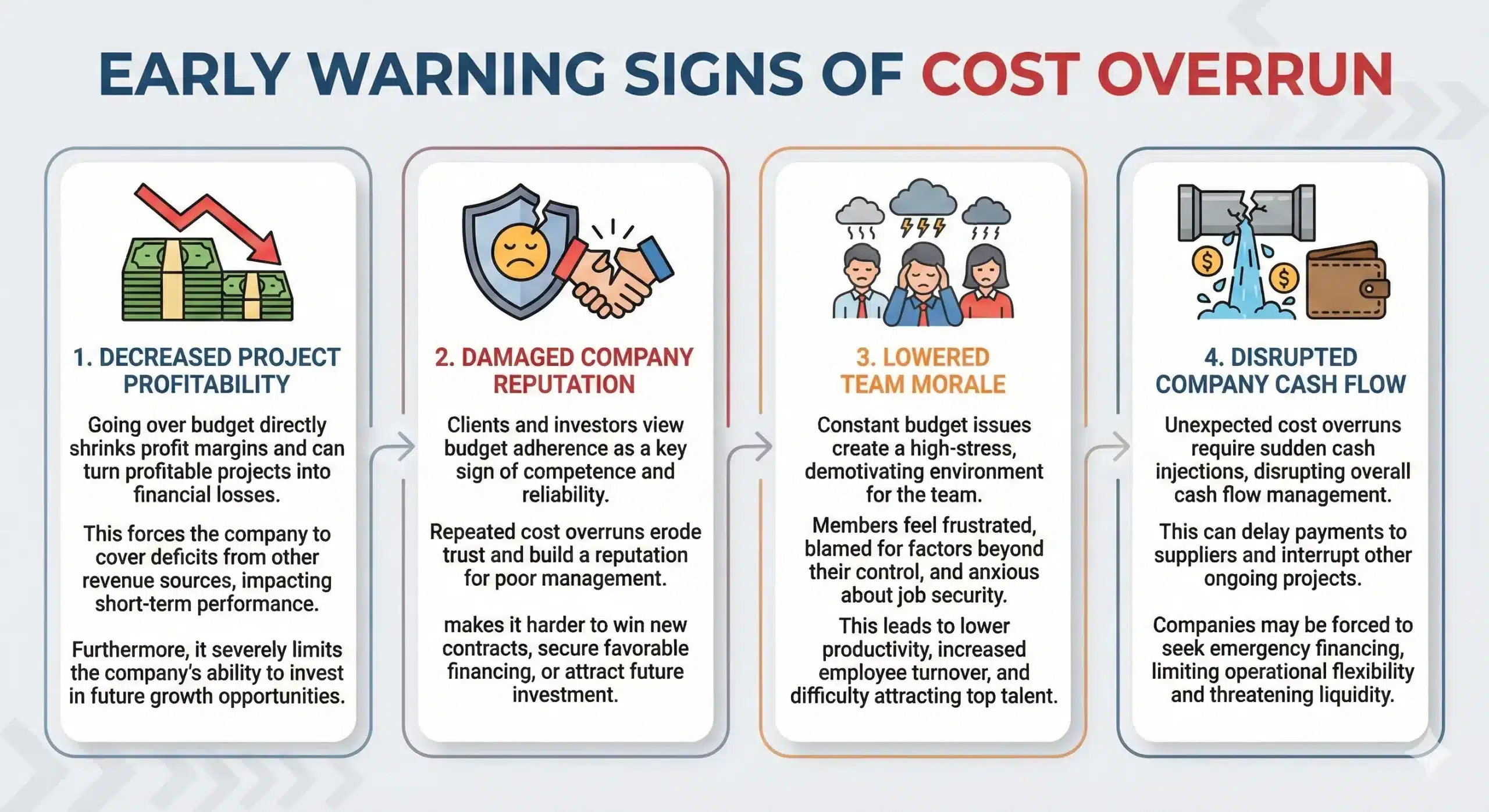
A cost overrun is more than a budget variance on a project spreadsheet, it can weaken profitability, decision-making, and operational stability across the business. When costs drift beyond plan, leadership often has to trade off speed, quality, and scope under pressure, which increases the likelihood of further inefficiencies.
Over time, repeated overruns reduce stakeholder confidence and make future budgeting less credible because teams start padding estimates to “protect” themselves. The result is a cycle where projects become harder to govern, less predictable to finance, and more stressful to execute.
1. Decreased project profitability
Cost overruns directly reduce margin because every unplanned dollar spent comes out of the project’s expected profit. If the contract price is fixed, the overrun is usually absorbed by the company, turning a profitable job into a breakeven or loss-making one.
Even in cost-plus arrangements, higher costs can trigger disputes, approvals delays, or client pushback that slows billing and impacts cash collection. Over time, weaker project profitability limits reinvestment into hiring, equipment, and capability-building that supports growth.
2. Damaged company reputation
Consistent delivery within budget is often perceived by clients, partners, and investors as proof of operational discipline and reliability. Repeated overruns signal weak cost control, unclear governance, or poor risk management, which can reduce trust even if the final deliverables meet technical requirements.
This reputation risk can affect bid competitiveness because clients may demand stricter terms, higher performance guarantees, or more frequent reporting. It can also complicate financing or partnerships if stakeholders view the company as higher-risk due to unpredictable project outcomes.
3. Lowered team morale
A project that repeatedly exceeds budget usually creates pressure cycles, urgent cost-cutting, blame, and constant reprioritisation, rather than calm execution. Teams may feel exposed when they are asked to “fix” structural issues such as unclear scope, late decisions, or unrealistic baseline assumptions.
This environment can reduce productivity because people spend more time firefighting, reworking, and explaining variances than delivering progress. Over time, sustained stress increases turnover risk and makes it harder to attract strong talent for future projects.
4. Disrupted company cash flow
Cost overruns often require unplanned funding to keep procurement, labour, and subcontractors moving, especially when payments are tied to milestones. If costs rise faster than billing, the company may face a short-term cash squeeze even when the project is technically “on track.”
This can delay supplier payments, interrupt purchasing, or force leadership to divert cash from other projects and operations. In severe situations, the business may need emergency financing, which increases borrowing costs and reduces financial flexibility.
7 Strategies to Prevent Cost Overrun
Cost overrun prevention is strongest when it is built into governance, not treated as a last-minute finance exercise. The most effective teams combine disciplined planning with weekly cost control habits, so variance is caught early and corrected before it becomes structural.
1. Build a bottom-up cost estimate
A credible budget starts with a Work Breakdown Structure (WBS) and task-level estimating, because this exposes hidden work and cost drivers early. Use historical cost data from similar projects to benchmark labour productivity, material usage, equipment time, and subcontractor rates.
Validate high-value items with vendors or specialist teams so assumptions are grounded in real lead times, pricing, and constraints. Include indirect costs (overheads, admin, site facilities) and define a contingency buffer tied to risk exposure rather than “guesswork padding.”
2. Lock scope early and run strict change control
Scope creep is a major driver of overrun because small additions accumulate without corresponding budget and timeline adjustments. Define scope in a measurable way (deliverables, acceptance criteria, exclusions) and baseline it with formal stakeholder sign-off before execution begins.
Implement a change request process that requires each request to state the cost, schedule, and resource impacts before it can be approved. Track approved variations in a single log so the project always reflects the true committed scope, not an outdated baseline.
3. Maintain a risk register with owners and contingency logic
A risk register turns uncertainty into action by assigning ownership and making mitigation measurable. Identify risks across technical, operational, financial, vendor, and external factors, then rate them by probability and impact.
For priority risks, define triggers (early signs) and mitigation steps so teams respond before costs spike. Tie contingency allocation to the register and revisit it regularly, so the buffer is used deliberately—not consumed quietly through unmanaged surprises.
4. Track cost and progress frequently
Monthly reporting is often too slow because overruns typically grow through weekly drift, small delays, small rework, small procurement issues. Track actual costs and progress against the baseline at least weekly, then focus on trends, not excuses for one isolated variance.
Use simple variance tracking or Earned Value concepts to quantify whether spend is aligned with progress delivered. When variance crosses thresholds, trigger corrective actions immediately (scope review, productivity reset, procurement re-plan) before the gap widens.
5. Control resource burn (labour, materials, equipment)
Resource burn is where budgets quietly leak, through idle labour, rework, underutilised equipment, and material wastage. Set productivity assumptions upfront (output per day, crew size, equipment hours) and compare actual usage against those targets regularly.
Tighten material handling to prevent loss, theft, and rush purchasing caused by poor inventory visibility or late ordering. Treat delays as cost drivers, because every day of slippage can increase labour hours, equipment rentals, and overhead costs.
6. Strengthen procurement discipline and vendor governance
Procurement surprises often cause overruns through price volatility, lead-time slippage, unclear contract terms, and uncontrolled variations. Standardise procurement workflows so quotes, PO approvals, and vendor commitments are documented and visible before costs hit the project.
Confirm pricing validity, delivery milestones, and variation rules early, then enforce them consistently to avoid “urgent” decisions that inflate costs. Monitor vendor performance during execution (delivery, quality, change requests) so issues are addressed early rather than becoming expensive rework or delays.
7. Keep communication decision-focused with one source of truth
Cost control fails when teams operate with different numbers, delayed updates, and informal approvals that bypass governance. Establish a fixed cadence for budget and risk reviews where each meeting ends with decisions, owners, and deadlines, not just status updates.
Use one source of truth for cost status (baseline, commitments, actuals, forecast) so leaders and site teams act on the same information. Keep communication short and structured, because faster clarity prevents slow decisions that often lead to overtime, expediting costs, and rework.
The Role of Technology in Mitigating Cost Overruns
Fast-moving projects often outgrow spreadsheets and scattered updates, creating errors and blind spots that delay cost variance detection. Purpose-built software centralises finance, procurement, progress, and approvals to automate workflows, improve visibility, and help teams act on commitments and actuals early before small issues escalate into budget blowouts.
Here’s a closer look at the critical role technology plays in mitigating the risk of budget blowouts.
1. Construction software for accurate planning
Modern construction software revolutionizes the planning phase by enabling the creation of highly accurate Cost Budgets (RAB) and Bills of Quantities (BOQ). With features like digital material takeoffs, you can calculate material requirements directly from architectural drawings, drastically reducing the risk of manual calculation errors.
These platforms are often integrated with up-to-date material price databases, facilitating more realistic cost estimations and supporting a more competitive and accurate construction bidding process.
2. ERP systems for centralized data visibility
An integrated Enterprise Resource Planning (ERP) system serves as the central nervous system for efficient operations. By unifying data from disparate departments, such as finance, procurement, and project management, into a single database, an ERP system demolishes data silos.
This provides unparalleled real-time visibility into every financial aspect of a project, from material requisitions to subcontractor payments. With this single source of truth, managers can effortlessly track actual expenditures against the budget and generate accurate reports without the tedious and error-prone process of manually consolidating data from multiple spreadsheets.
3. Project management apps for team collaboration
Modern project management applications facilitate seamless communication and collaboration among all team members, whether they are in the office or on the project site. Features such as task scheduling with a clear critical path, daily progress reporting, and centralized document sharing ensure everyone is working from the most current information.
The ability to monitor construction progress remotely via mobile apps allows managers to identify and address issues almost instantly, minimizing downtime and preventing potential cost escalations.
4. Accounting software for real-time financial tracking
The integration of project management with accounting software is absolutely critical for effective cost control. Every expense incurred, from material purchases to labor wages, can be automatically recorded and allocated to the correct project and cost code.
This enables real-time tracking of project profitability and simplifies the progressive billing process. With financial data always up to date, companies can maintain healthy cash flow and make more informed, timely financial decisions.
Optimizing Project Control with Integrated Construction Solutions
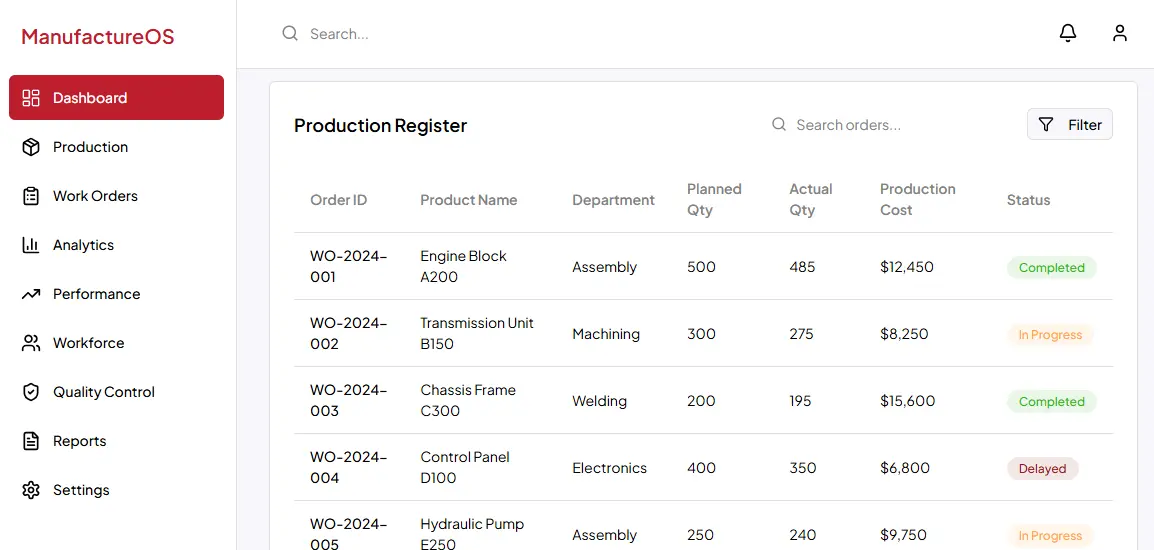
To prevent cost overruns, spreadsheets and disconnected tools are rarely enough—modern projects need finance, site progress, and procurement to stay aligned in one system. An integrated ERP setup helps turn fragmented updates into clear cost visibility, so risks are flagged early before they erode margins.
Integrated construction platforms connect construction management, accounting, and supply chain workflows so teams can control budgets consistently from planning through execution. In practice, the capabilities that matter most include:
- Real-time budget S-curve: Compares budget vs actuals continuously, so deviations are caught early and corrected faster.
- Detailed job estimates (RAB): Builds a stronger baseline by breaking costs into materials, labour, and overhead, reducing scope-driven leakage.
- Procurement control: Links PR–PO–invoice to budget approvals to prevent unplanned spend and reduce downtime from late materials.
- Centralised project monitoring: Gives a single dashboard for progress and resource usage across sites to reduce reporting gaps.
- Automated progressive claims: Speeds up billing based on verified progress, supporting healthier cash flow and fewer disputes.
With the right system, teams spend less time firefighting and more time controlling costs, schedules, and accountability throughout the project lifecycle.
Conclusion
Cost overrun is not an unavoidable outcome, but a measurable business risk that can be controlled with the right discipline and governance. The shift that matters most is moving from reactive firefighting to proactive prevention through stronger planning, execution, and accountability.
When teams apply detailed estimation, strict scope control, frequent cost monitoring, and clear decision cadence, budgets become more predictable and easier to defend. Early warning signals also become actionable, so small deviations are corrected before they turn into structural overruns.
Modern project technology strengthens this control by centralising cost, progress, procurement, and approvals into consistent reporting and faster decisions. If your team is evaluating improvements to cost governance, schedule a free consultation to review your current process gaps and identify the most practical upgrades for your project environment.
FAQ About Cost Overrun
-
What is the difference between cost overrun and budget overrun?
Cost overrun refers to the final actual cost exceeding the total budgeted cost for a project. Budget overrun is sometimes used more broadly to describe spending beyond a planned budget during a specific period, even before the project is completed.
-
What percentage of cost overrun is considered acceptable?
There is no universal threshold because it depends on project size, contract type, and complexity. In many industries, overruns below 5–10% may be manageable, while 15–20% typically signals significant estimation, scope, or execution issues that need governance fixes.
-
How does scope creep directly cause cost overrun?
Scope creep adds work beyond the approved scope without formal change control that adjusts budget and timeline. Each additional task consumes unbudgeted labour, materials, and time, which increases actual costs and often triggers knock-on expenses such as rework, overtime, and delays.