










Your buyer agrees to purchase 500 units at RM 45 each, shipping included. Before you manufacture anything or book the shipment, you need that agreement in writing. Not a final invoice, just a document that confirms what both sides expect.
That document is a proforma invoice. It locks in the details, including price, quantity, shipping terms, and delivery timeline, before money changes hands or goods leave your warehouse.
Below is a breakdown of what proforma invoices include, how they differ from commercial invoices and purchase orders, and when Malaysian businesses typically use them.
Key Takeaways
|

What is Proforma Invoice?
A proforma invoice is a preliminary document that outlines what you intend to sell, at what price, and under what terms. It goes to the buyer before you deliver anything.
Unlike a standard invoice, a proforma does not demand payment. It serves as a written confirmation of the deal so both parties can review details before committing. If the buyer wants to change quantities or negotiate shipping terms, the proforma gets revised. Once everything is agreed, you issue the actual commercial invoice.
International traders use proforma invoices frequently because buyers often need documentation to arrange letters of credit, apply for import licenses, or estimate customs duties before the shipment arrives.
Generating proforma invoices can be risky, that’s why the use of invoicing software is important. You can explore the most recommended invoicing software in Malaysia, or download the price scheme below for more detailed information.

Proforma Invoice vs. Other Invoices
Different documents serve different stages of a transaction. A proforma invoice comes before the sale is final. A commercial invoice comes after. A purchase order comes from the buyer, not the seller. Here is how they compare:
| Comparison Aspect | Proforma Invoice | Invoice | Commercial Invoice | Purchase Order |
|---|---|---|---|---|
| Definition | A preliminary bill of sale issued before delivery. It outlines the seller’s intent to provide goods or services. | A formal request for payment issued after delivery, reflecting the actual amount owed. | A document used in international trade that states the value of shipped goods for customs and tax purposes. | A document issued by the buyer to authorise a purchase and state the transaction requirements. |
| Legal Binding | Not legally binding and does not require payment upon receipt. | Legally binding and requires the buyer to make payment. | Legally binding and used for customs clearance, including duties and taxes. | Becomes binding once accepted by the seller, stating what is ordered, at what price, and in what quantity. |
| Purpose in Transaction | Used to formalise a future transaction. Common in cross-border deals for customs reference but has no fiscal value. | Used to finalise the transaction and trigger the payment process after goods or services are delivered. | Used mainly for cross-border shipping to complete the sale and declare goods to customs. | Used by the buyer to specify and approve a purchase before any invoice is issued by the seller. |
| Typical Usage | Used to confirm sale terms and get buyer approval before issuing the official invoice. | Used to request payment and confirm completion of a sale. | Used for importing and exporting goods across borders, detailing shipment contents. | Used to control purchasing and track goods or services as part of inventory and procurement control. |
Proforma Invoice Example
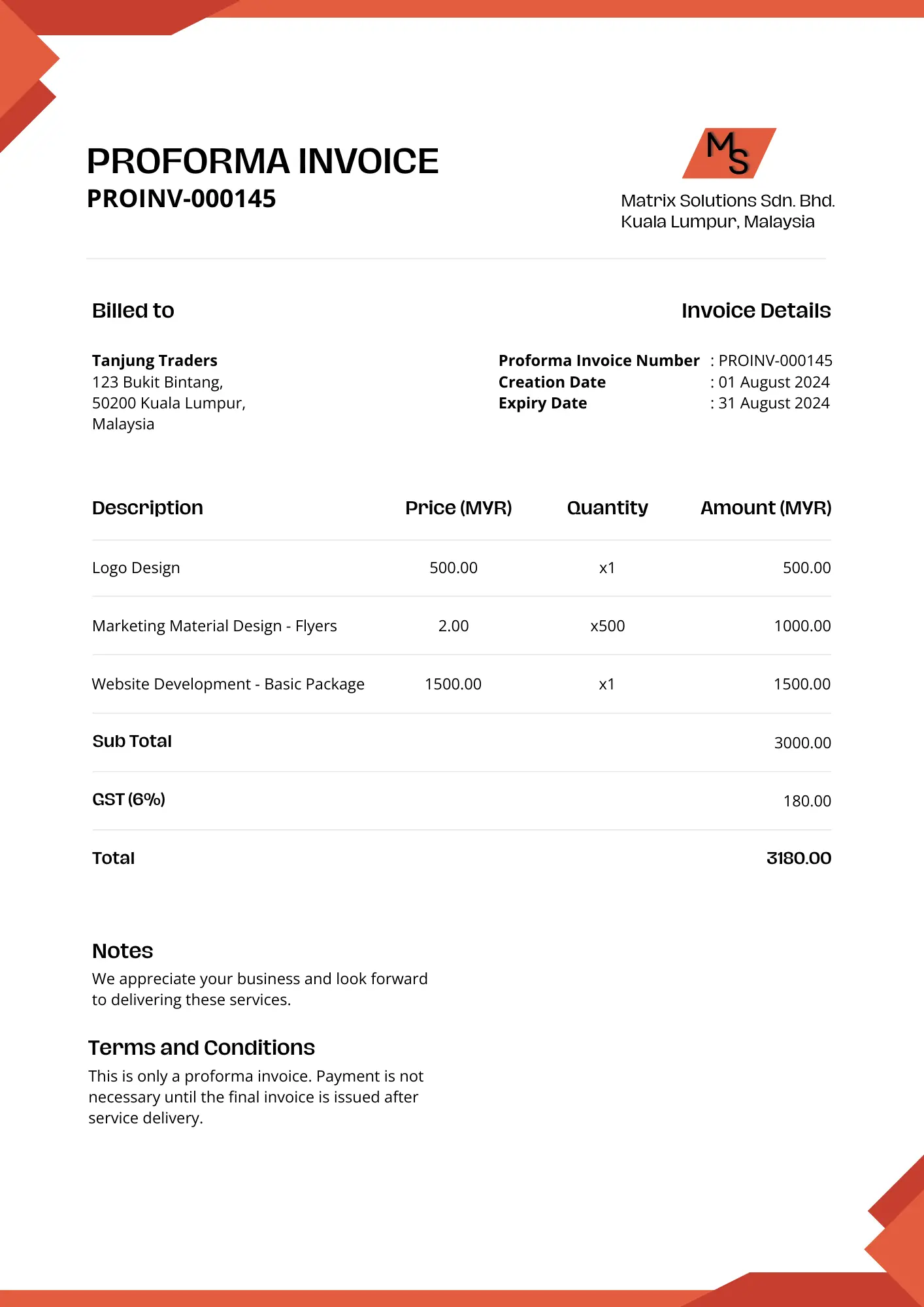
To give you more understanding about how a proforma invoice in Malay looks like, we have provided a proforma invoice example below.
Proforma Invoice Overview
A proforma invoice isn't typically required for international shipments but is often used to provide an estimate of costs for transactions that are not yet finalized. It helps customs determine necessary duties with included details such as estimated price, product description, quantity, payment method, and expected delivery time. When used, it must be followed by a commercial invoice within 120 days.
Proforma invoices in non-international contexts should detail all transaction elements to avoid surprises for the buyer. They should clearly indicate that they are not final invoices with terms such as Pro Forma Invoice and Not an Invoice. Key details often include transaction date, product descriptions, quantity, selling price, and applicable fees like handling and shipping.
Proforma Invoice Use Case: How MISC Berhad Implements Proforma Invoices

MISC Berhad, a leading Malaysian shipping company, integrates proforma invoices into their business operations, significantly streamlining their billing and export processes. The use of proforma invoices by MISC Berhad exemplifies their utility in international trade, providing a clear, preliminary document that outlines the terms of trade agreements before the official transaction occurs.
When MISC Berhad receives an order for international shipment, they issue a proforma invoice. This document serves as an initial agreement, detailing the shipment’s contents, the total cost, and other terms like shipping fees and insurance costs. The proforma invoice facilitates discussions and adjustments between MISC Berhad and their international clients regarding any terms that may require modification before the final deal.
The benefits for MISC Berhad include enhanced clarity and agreement on trade terms before the shipment and official invoicing. This preliminary agreement mitigates risks of disputes over terms after the delivery, ensures compliance with international trading standards, and assists in the smooth clearance of goods through customs by providing detailed information upfront. Additionally, it allows for better financial planning and coordination with clients, enhancing overall business efficiency and customer satisfaction.
Using Invoicing Software for Proforma Invoice Management
Invoicing software simplifies how businesses create, track, and convert proforma invoices into final invoices. Instead of managing documents manually or duplicating data across spreadsheets, the system keeps everything in one place.
For example, a furniture exporter in Johor sends proforma invoices to buyers in Singapore and Australia. Each country has different currency and shipping terms. With invoicing software, the finance team selects the customer, and the system pulls the correct currency, applies current exchange rates, and formats the invoice accordingly. When the buyer confirms the order, the proforma converts to a commercial invoice with one click, no retyping required.
Features that matter for proforma invoices:
- Template Customisation: Adjust layout for different customers or transaction types without starting from scratch.
- Multi-Currency Support: Automatic rate updates so you do not manually check exchange rates for every foreign invoice.
- Document Conversion: Convert proforma to commercial invoice directly, keeping all details intact.
- Payment Tracking: See which proforma invoices have been confirmed, invoiced, and paid.
- Tax Compliance: Apply SST or other tax rules automatically based on transaction type.
Businesses that regularly issue proforma invoices, especially those with international customers or multiple currencies, benefit most from having invoicing in a dedicated system rather than scattered across files and emails.
Conclusion
A proforma invoice sets expectations before a transaction is final. It protects both parties by documenting agreed terms, whether for pricing, quantities, shipping, or delivery timelines. For businesses involved in international trade, it also supports customs clearance and buyer financing.
The document itself is simple, but managing multiple proforma invoices across different clients and currencies manually introduces errors. Invoicing software automates this process, tracks revisions, and converts proforma invoices to commercial invoices once deals close.
The right invoicing software handles proforma invoices, commercial invoices, and tax compliance in one system. No more switching between spreadsheets or manually converting documents. Try the free demo to see how it works with your actual workflow.
Frequently Asked Questions About ERP Comparison Charts
-
What is an ERP comparison chart and how should you use it?
An ERP comparison chart helps you review multiple systems in one structured view. Instead of relying on brochures or sales presentations, you compare features, deployment options, scalability, and integration capability side by side. Use it as a screening tool to eliminate systems that clearly do not match your operational needs before moving into deeper evaluations.
-
What should you look at first when reviewing an ERP comparison chart?
Start with how well the system supports your daily operations. If you manage manufacturing, focus on production planning and inventory control. If you operate multiple branches, review consolidation and reporting capabilities. Let your workflow guide the decision, not just feature lists.
-
Can an ERP comparison chart help you avoid implementation mistakes?
It can, but only if you go beyond the surface. A comparison chart shows whether features exist, but it does not explain how well they work together. After shortlisting options, validate your choice through demonstrations, real use scenarios, and discussions about integration and scalability.
-
Is cost comparison enough when evaluating ERP systems?
Cost should never be the only factor. Initial pricing does not reflect long term implementation effort, customization needs, training time, or future expansion. A lower subscription fee may look attractive, but it becomes expensive if the system cannot support your growth.