






Every month, Malaysian HR teams must meet payroll deadlines. Under the Employment Act 1955, wages must be paid within seven days after the wage period ends, not on a fixed date. Teams also handle EPF, SOCSO, EIS, PCB, and HRD Corp submissions on their respective schedules, where manual errors can quickly affect multiple records.
submissions on their respective schedules, where manual errors can quickly affect multiple records.
This inefficiency is particularly dangerous because payroll is one of the few processes where a single mistake becomes visible to everyone immediately. With Malaysia’s median monthly salaries rising to RM2,793 according to DOSM 2024 reports, the financial stakes for accurate and error free processing are higher than ever.
As a result, a reliable payroll software system helps standardize calculations, centralize payroll data, and enhance audit and internal check traceability. Furthermore, with the right system, companies can improve payout accuracy while supporting statutory requirements such as EPF and SOCSO with fewer manual steps and fewer last-minute fixes.
Key Takeaways
Many Malaysian businesses struggle with outdated manual payroll processes prone to errors and inefficiencies.
When choosing payroll software, consider factors like ease of use, integration capabilities, and scalability.
Implementing efficient payroll software automates tasks, ensuring accuracy and compliance with local laws.
A customizable payroll solution helps automate calculations, reduce errors, and ensure employees are paid accurately and on time.
What a Payroll System in Malaysia Must Handle?
A payroll system in Malaysia automates salary calculations and statutory obligations such as EPF (Employees Provident Fund), SOCSO (Social Security Organisation), EIS (Employment Insurance System), PCB or MTD (Monthly Tax Deduction), and the HRD Corp levy for employee training.
It also processes employee data, salary categories, allowances, overtime, claims, and deductions accurately. This helps reduce payroll errors, payment delays, and manual work caused by scattered records.
A complete payroll system can generate payslips and statutory forms such as EA (annual employee income statement) and CP8D (employee remuneration statement for tax reporting), while storing payroll records for audits and reporting. Integration with HR and accounting systems also connects attendance, leave, claims, and overtime data with salary costs, statutory liabilities, and deductions.
Shortlisted Best Payroll Software System
After reviewing various payroll tools, this shortlist highlights payroll software options in 2026 based on accuracy, compliance, and ease of use. These platforms automate salary processing, handle statutory deductions like EPF, SOCSO, and PCB, and generate payslips to ensure compliance and efficiency.


Best Because
Automate recruitment, HR, payroll, and benefits.


After shortlisting the top 5 payroll software, it’s helpful to compare other available options to see how they differ in features, compliance, and pricing. The quick comparison below gives a clear overview of each system, helping you find the best fit for your business needs in Malaysia.
Quick Comparison: Top Payroll Software in Malaysia
| Software | Strength | Compliance Coverage | Integration | Implementation Difficulty | Pricing Model | Best For |
|---|---|---|---|---|---|---|
| HashMicro | End-to-end payroll and HRMS with deep customization and automation | EPF, SOCSO, EIS, PCB, payslip, and statutory reporting support | HRMS, attendance, claims, accounting, and approval workflows | Medium to high, depending on customization scope | Custom pricing | Mid-sized to enterprise businesses with complex payroll needs |
| PayrollPanda | Simple LHDN-approved payroll with fast processing for SMEs | EPF, SOCSO, EIS, PCB, and payroll forms | Payroll, leave, claims, and selected accounting integrations | Low | Free up to 5 employees; starts from RM29/month | Small businesses and SMEs |
| Swingvy | Modern all-in-one HRMS with payroll, claims, and leave integration | EPF, SOCSO, EIS, HRDF, and PCB | Payroll, leave, claims, employee records, and HR workflows | Low to medium | Starts from RM99/month + RM7/employee | SMEs and growing companies |
| Talenox | Lightweight cloud HRIS with payroll, leave, and employee management | EPF, SOCSO, EIS, PCB, and tax forms | Payroll, leave, employee records, and accounting exports | Low | Starts from RM10/employee/month | Small businesses and lean HR teams |
| Kakitangan | Secure payroll system with one-click processing and bank integration | EPF, SOCSO, EIS, PCB, and statutory updates | Payroll, leave, attendance, claims, and bank payment files | Low | Starts from RM30/month + RM3/employee | Small to mid-sized Malaysian businesses |
| Employment Hero | All-in-one HR, payroll, and employee lifecycle platform | EPF, SOCSO, EIS, PCB, and statutory contributions | HR, payroll, leave, employee records, and onboarding workflows | Low to medium | Starts from RM8/employee/month | SMEs that want HR and payroll in one platform |
| HR2eazy | Comprehensive HRMS with 30+ modules and payroll automation | EPF, SOCSO, EIS, PCB, and payroll compliance workflows | Payroll, attendance, leave, claims, HR, and reporting modules | Medium | Starts from RM4.50/employee/month | Mid-sized businesses needing broad HR coverage |
| Sage Payroll | Structured payroll system with strong compliance and HR templates | EPF, SOCSO, EIS, PCB, and payroll reporting | Payroll, HR records, accounting, and reporting tools | Medium | Est. RM79.39 - RM271.29/month, depending on plan | SMEs and established finance teams |
| Zoho Payroll | Integrated payroll within Zoho ecosystem | Malaysia payroll compliance via supported Zoho and partner tools | Zoho People, HR records, leave, attendance, and Zoho ecosystem apps | Low to medium | Est. RM29/month + Zoho People licence via PayrollPanda | Businesses already using Zoho apps |
| BrioHR | Cloud HR suite with payroll, performance, and analytics | EPF, SOCSO, EIS, PCB, and Malaysian statutory regulations | Payroll, HR, performance, recruitment, and employee records | Medium | Est. RM5/employee/month; minimum RM200/month | Growing SMEs and regional HR teams |
| Info-Tech | All-in-one payroll with attendance, leave, and claims integration | EPF, SOCSO, EIS, PCB, LHDN, and bank payment support | Payroll, attendance, leave, claims, biometrics, and accounting exports | Medium | Starts from RM150/month | SMEs to mid-sized companies with local HR operations |
| Ramco Paycework | Global payroll system with AI and multi-country support | EPF, SOCSO, EIS, PCB, and multi-country payroll compliance | Payroll, HR, finance, global workforce, and enterprise workflows | High | Est. RM20-62/employee/month | Large enterprises and multi-country employers |
| HR2000 | Proven local payroll system with strong banking and compliance support | EPF, SOCSO, EIS, PCB, and Malaysian statutory forms | Payroll, banks, HR records, and statutory submissions | Low to medium | Starts from RM100/month | Small and mid-sized Malaysian businesses |
| SQL Payroll | Accurate payroll with strong reporting and accounting integration | EPF, SOCSO, EIS, PCB, and payroll submissions | Payroll, accounting, bank files, reporting, and HR data | Medium | Starts from RM120/month | SMEs using SQL accounting or local finance tools |
| JustPayroll | Affordable payroll system with essential HR features | EPF, SOCSO, EIS, PCB, and statutory submissions | Payroll, leave, employee records, and basic HR tools | Low | Starts from RM50/month | Small businesses with basic payroll needs |
| Omni | Global HRIS and payroll system with multi-currency support | Malaysia payroll support with international compliance coverage | HRIS, payroll add-on, employee records, and global HR workflows | Medium | Est. RM8-16/employee/month for payroll add-on | Regional companies and distributed teams |
| Papaya Global | Enterprise-grade global payroll with AI compliance support | Malaysia payroll support with local tax and statutory coverage | Global payroll, HR, finance, compliance, and workforce payments | High | Est. RM119/employee/month | Enterprises with international payroll needs |
| Oyster Payroll | Simple cloud payroll for remote and global teams | Basic Malaysia payroll compliance support through global payroll setup | Global payroll, EOR, contractor management, and HR records | Medium to high | Est. RM1,186/entity/month + RM119/employee/month | Remote-first and global hiring teams |
| Gusto | User-friendly payroll system for small teams | Limited Malaysia-specific payroll compliance support | Payroll, HR, benefits, and accounting integrations for supported markets | Low for supported markets, higher for Malaysia use cases | Est. RM200/month + RM25/person/month | Small teams with simple payroll needs outside Malaysia-first compliance |
| QuickHR | Integrated payroll within QuickHR ecosystem | EPF, SOCSO, EIS, PCB, and Malaysian HR compliance | Payroll, leave, attendance, claims, HR, and employee self-service | Low to medium | Est. RM7-21/employee/month | SMEs and growing businesses in Malaysia |
What is Payroll Software?
Payroll software is a digital tool that automates salary processing, tax deductions, and ensures compliance with labor laws. It simplifies payroll tasks, reduces manual errors, and integrates with attendance and accounting systems for better efficiency.
In Malaysia, payroll software automates statutory deductions like EPF, SOCSO, and PCB, generates payslips, updates records, and simplifies workflows. It reduces admin tasks, ensures compliance, and maintains accurate payroll cycles.
Choosing the right payroll software ensures compliance and smooth payroll.
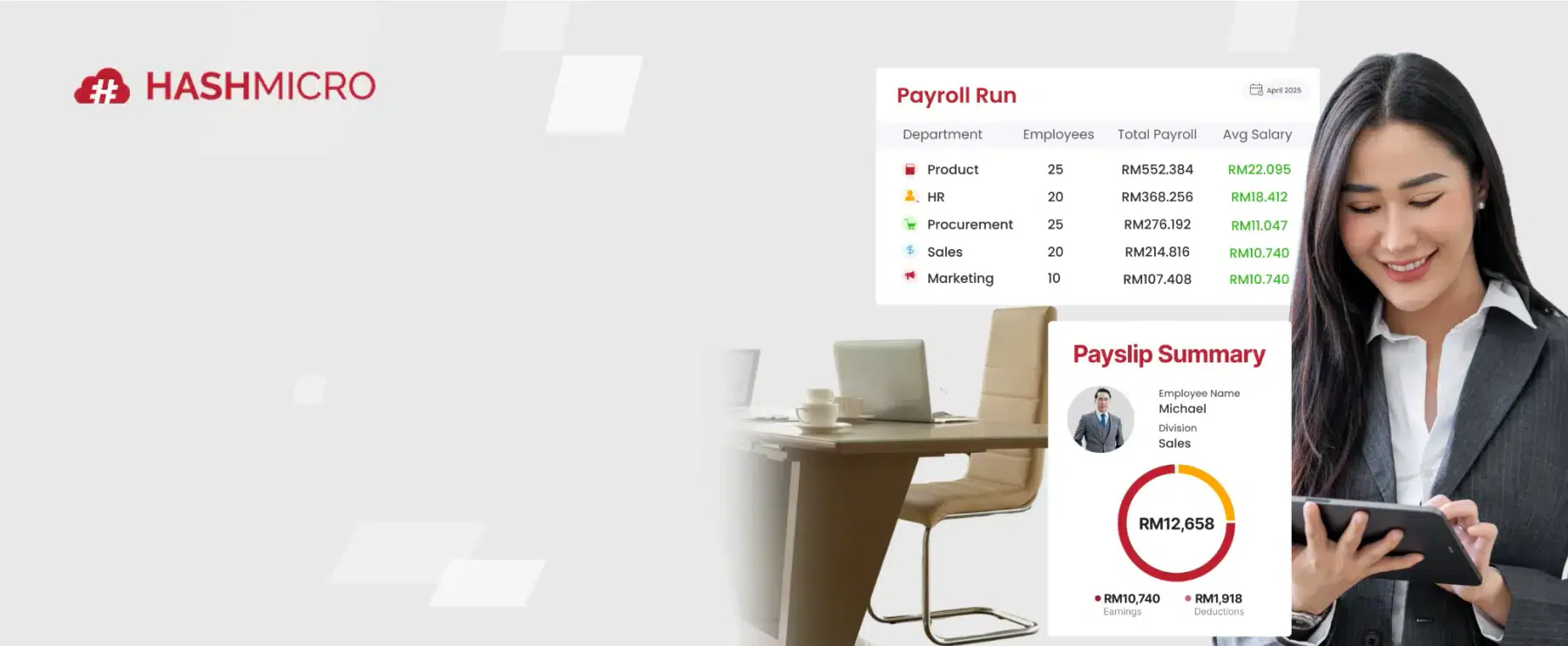
Why Do Malaysian Companies Need Payroll Software?
Managing payroll manually is not just time-consuming and it’s also one of the most common sources of avoidable errors in HR operations. From inaccurate salary calculations to missed statutory deadlines, these mistakes can affect employee satisfaction and put financial stability at risk.
Fortunately, modern payroll software addresses these challenges directly. By automating calculations and ensuring compliance with Malaysian tax rules, it significantly reduces the administrative burden on HR teams. Furthermore, when integrated with an attendance management system, payroll software eliminates the need for manual data cross-checking altogether.
As the business landscape continues to evolve, adopting the right payroll tools is no longer optional, it’s a competitive necessity for Malaysian companies.
What are the Benefits of Using Payroll Software?
Implementing ERP payroll software brings multiple benefits that help businesses manage payroll more efficiently and accurately.
1. Reduce costs: First, payroll software helps companies cut costs by optimizing workflows and minimizing human errors. These operational efficiencies translate directly into better financial health and stronger overall performance.
2. Receive automated reminders: In addition to cost savings, automated alerts ensure that nothing slips through the cracks whether it’s submission deadlines, tax filings, or scheduled payment runs. As a result, your team stays compliant without having to manually track every due date.
3. Improve accuracy and security: Beyond reminders, automation significantly enhances calculation precision by removing manual inputs from the equation. Moreover, built-in security features such as encryption and role-based access controls protect sensitive payroll data from unauthorized access or breaches.
4. Access comprehensive reports and analytics: Finally, a well-integrated payroll system generates detailed reports covering payroll expenses, tax obligations, and labor costs. These insights not only support better decision-making but also make audit preparation far less stressful.
To see how automated claim handling can further strengthen your HR workflows, you can also explore our article about expense management software.
How We Chose the Best Payroll Software in Malaysia
The evaluation focused on the features most important for accurate, compliant, and scalable payroll operations in Malaysia, including statutory calculations, payment processing, system integrations, security, pricing, and local support.
1. Statutory Compliance with Malaysian Labor & Tax Regulations
Prioritize automates software monthly deductions for the Employees Provident Fund (EPF/KWSP), Social Security Organisation (SOCSO/PERKESO), Employment Insurance System (EIS/SIP), and Monthly Tax Deductions (PCB/MTD). The system must generate compliant itemized payslips and support mandatory annual tax filings, including Form EA for employees and Form CP8D for LHDN reporting, alongside HRD Corp levy processing.
2. Automated Bank File Generation & Payment Processing
Platforms were assessed on their ability to generate batch salary payment files compatible with major Malaysian banking platforms. Automated payment processing can reduce manual transfers, administrative work, and errors during salary disbursement.
3. Native Integration with Leave and Attendance Systems
Payroll accuracy depends on reliable attendance, overtime, shift, and leave data. Systems with integrated attendance and leave management can feed verified employee data directly into payroll calculations, reducing reliance on manual spreadsheet imports.
4. Audit Trail, Data Security, and Regulatory Control
Payroll systems handle sensitive employee and salary information, making access controls and activity tracking important. Evaluation included role-based permissions and audit logs that record changes to salaries, bonuses, payroll rates, and approvals to support data security and PDPA-related controls.
5. Business Size Suitability and System Scalability
Different businesses have different payroll requirements, from straightforward SME payroll to complex multi-branch and multi-entity structures. Scalability was considered based on support for growing employee numbers, multiple entities, commissions, and customized approval workflows.
6. Transparent Pricing and Total Cost of Ownership (TCO)
Cost evaluation considered more than the advertised subscription price. Factors included per-user fees, implementation costs, additional modules, annual tax form charges, and potential costs as employee numbers or payroll requirements increase.
7. Dedicated Malaysia-Based Technical Support
Local support can be particularly important when payroll regulations or statutory requirements change. Platforms were assessed based on the availability of responsive support and assistance with Malaysia-specific payroll requirements and regulatory updates.
20 Payroll Software Recommendations for Businesses in Malaysia
These 20 systems are not ranked by quality, each fits a different business size and payroll approach. HashMicro suits companies needing payroll connected to HR and finance. PayrollPanda and Kakitangan fit smaller teams managing EPF, SOCSO, and PCB automatically. Use the comparison below to find your fit.
1. HashMicro
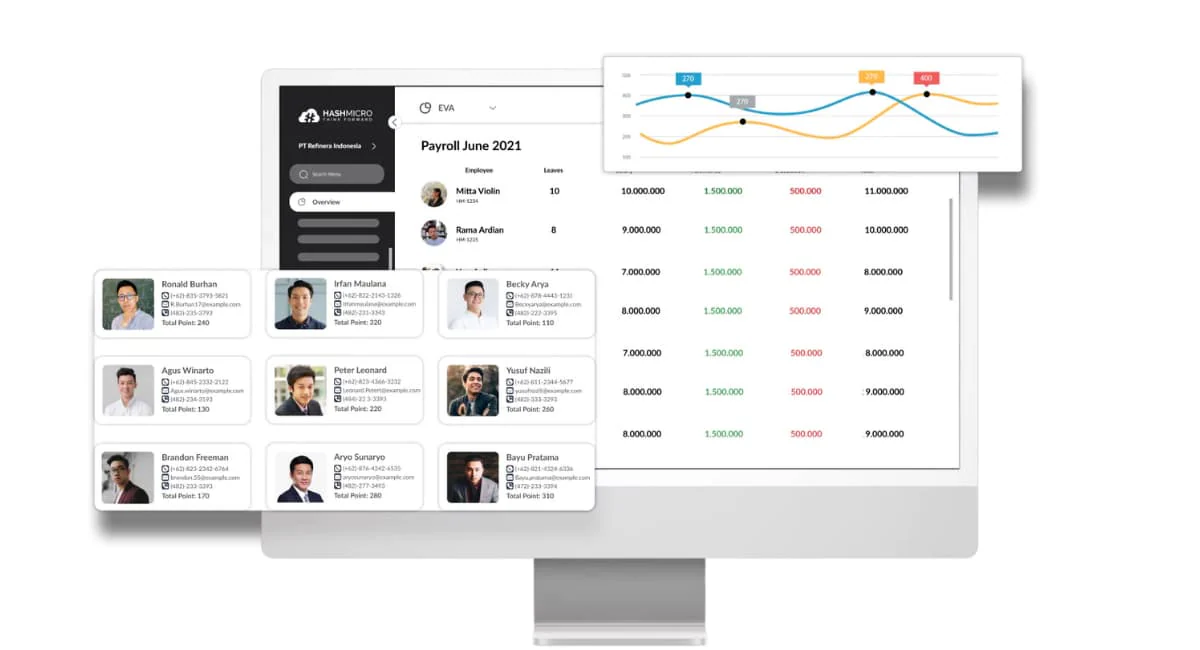
More than 3,000 companies in Southeast Asia, including clients in Malaysia across the retail, F&B, manufacturing, and agriculture sectors run their payroll on HashMicro. Few local vendors can claim such widespread adoption while offering full customisation for each industry.
From a technical perspective, HashMicro is more than a payroll software; it forms part of a 40+ module ERP ecosystem. This means that attendance, claims and payroll data are automatically synced without the need for manual data exports between systems.
Best features:
- Payroll management: Automates salary calculations based on work hours, overtime, and attendance, ensuring accurate and timely payroll processing ideal for complex sectors like manufacturing work.
- Employee database: Centralizes personal and financial employee data as a single source of truth.
- Expense management: Automates expense tracking and reimbursement, therefore reducing administrative burden.
- Attendance management: Accurately tracks employee attendance and integrates with payroll for precise salary computations.
- Leaves management: Simplifies leave application and approval, ensuring compliance with labour laws.
- Employee on/off-boarding: Manages the full employee lifecycle, consequently ensuring smooth transitions at every stage.
Pricing : HashMicro uses a custom pricing model because the total cost depends on the modules, features, and implementation requirements selected by each business. Companies can request a free demo and personalized quotation to estimate the cost of their preferred configuration.
Why this suits Malaysian businesses: HashMicro Payroll is built for Southeast Asian operations, making it highly aligned with Malaysian regulations like EPF, SOCSO, and PCB. Its customizable modules and unlimited user access support businesses across industries, from SMEs to mid-sized enterprises. Local implementation support also helps ensure smoother adoption and long-term scalability.
| Strengths | Weaknesses |
|
|
These points highlight HashMicro’s capability to provide reliable and secure payroll management system while noting areas where users may need additional support or time to fully utilize the system’s capabilities.
"In markets with evolving regulations, accuracy is everything. HashMicro’s payroll engine ensures every calculation aligns with Malaysia’s statutory requirements, helping businesses stay compliant without the stress."
2. PayrollPanda
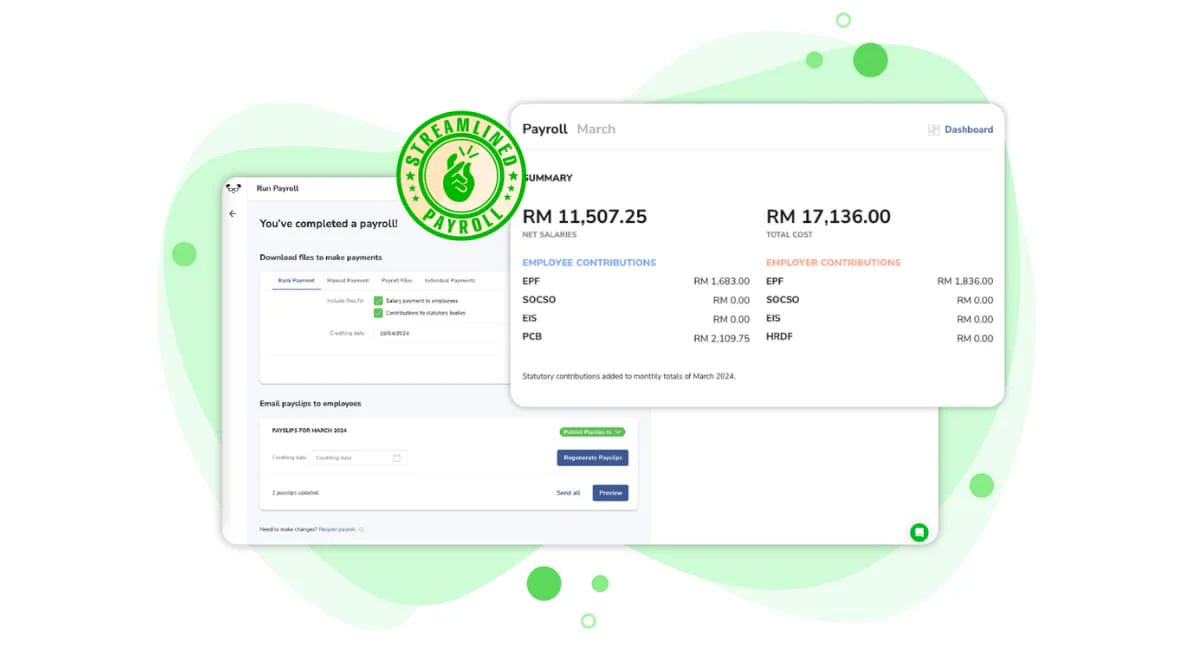
PayrollPanda suits Malaysian SMEs and growing companies with small HR teams that handle payroll without a dedicated payroll specialist. It is a practical option for businesses that want EPF, SOCSO, EIS, and PCB submissions processed automatically each month without building formal internal payroll processes from scratch.
PayrollPanda simplifies payroll process for Malaysian companies with an LHDN-approved, user-friendly system. Designed for easy use without training, it lets HR teams run payroll in just a few clicks, saving time and effort.
Best features:
- Streamlined payroll: Complete payroll in minutes without manual calculations.
- Compliance: Keeps up-to-date with the latest Malaysian laws and requirements.
- Automated processes: Automates payslips, statutory contributions, and tax calculations.
- User-friendly interface: It is Designed for ease of use without needing in-depth training.
- Cloud-based: Accessible anywhere, ensuring data is backed up and always current.
- Detailed reporting: Provides insights into labor costs and resource allocation.
Pricing: Free for up to five employees, with paid plans starting from RM29 per month. Total costs depend on employee count, payroll frequency, and selected HR integrations.
Why this suits Malaysian businesses: PayrollPanda is tailored for Malaysian SMEs needing a simple and compliant payroll solution. With LHDN approval and automated statutory calculations, it ensures accuracy without complexity. Its user-friendly design allows teams to run payroll quickly with minimal training.
| Strengths | Weaknesses |
|
|
3. Swingvy
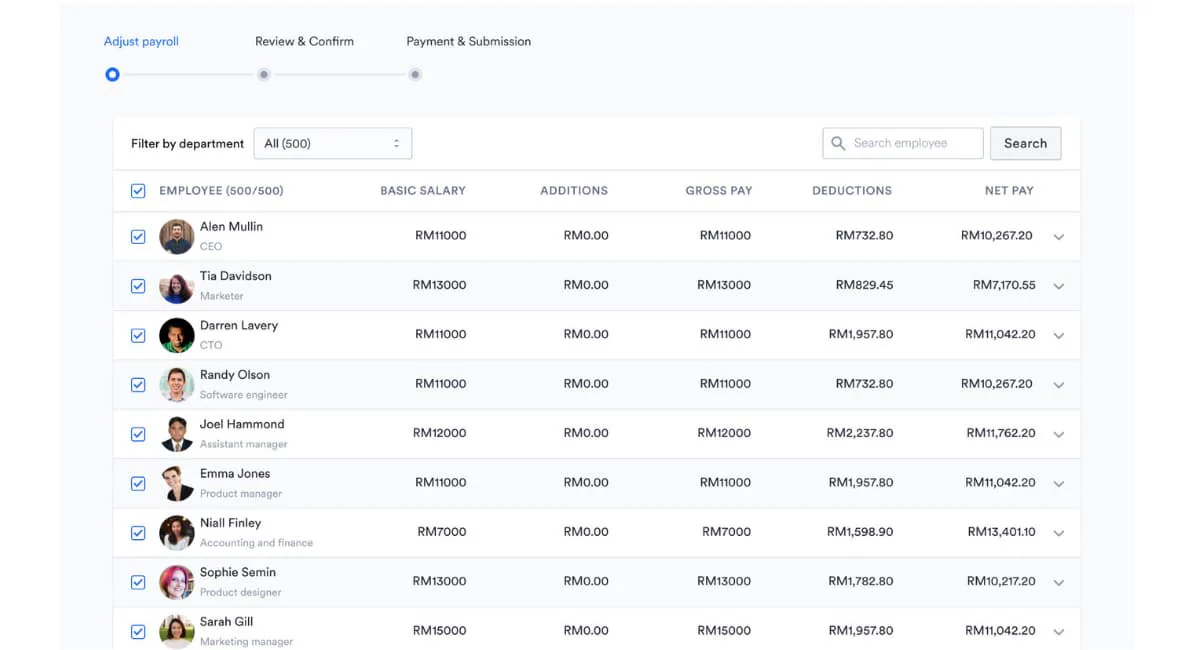
Not only does it offer a module for recording and managing employees’ health insurance benefits directly within the platform without the need for a separate system, but Swingvy also provides a free mobile app for all users, covering everything from leave and claims to payslip notifications.
Swingvy offers modern HRMS software for Malaysian businesses, combining payroll, leave, claims, and attendance in one platform. It’s ideal for CEOs and HR managers seeking to automate and simplify HR workflows.
Best features:
- Comprehensive HRMS: Integrates payroll, leave, time, claims, and reimbursements.
- Mobile accessibility: It provides a mobile app for on-the-go HR management.
- Statutory compliance: Ensures compliance with Malaysian statutory requirements like EPF, SOCSO, EIS, HRDF, and PCB.
- Bank integration: Supports local bank GIRO for easy salary payments.
- Automated tax filings: Certified by LHDN for automated tax calculations and filings.
Pricing: Estimated starting from RM99 per month plus RM7 per employee. Additional costs may apply for attendance, claims, performance management, and other HR modules.
Why this suits Malaysian businesses: Swingvy offers an all-in-one HRMS platform that aligns with Malaysian statutory requirements. It integrates payroll, leave, and claims into a single system, making it ideal for growing teams. Its mobile access and local bank integration add convenience for modern workplaces.
| Strengths | Weaknesses |
|
|
4. Talenox
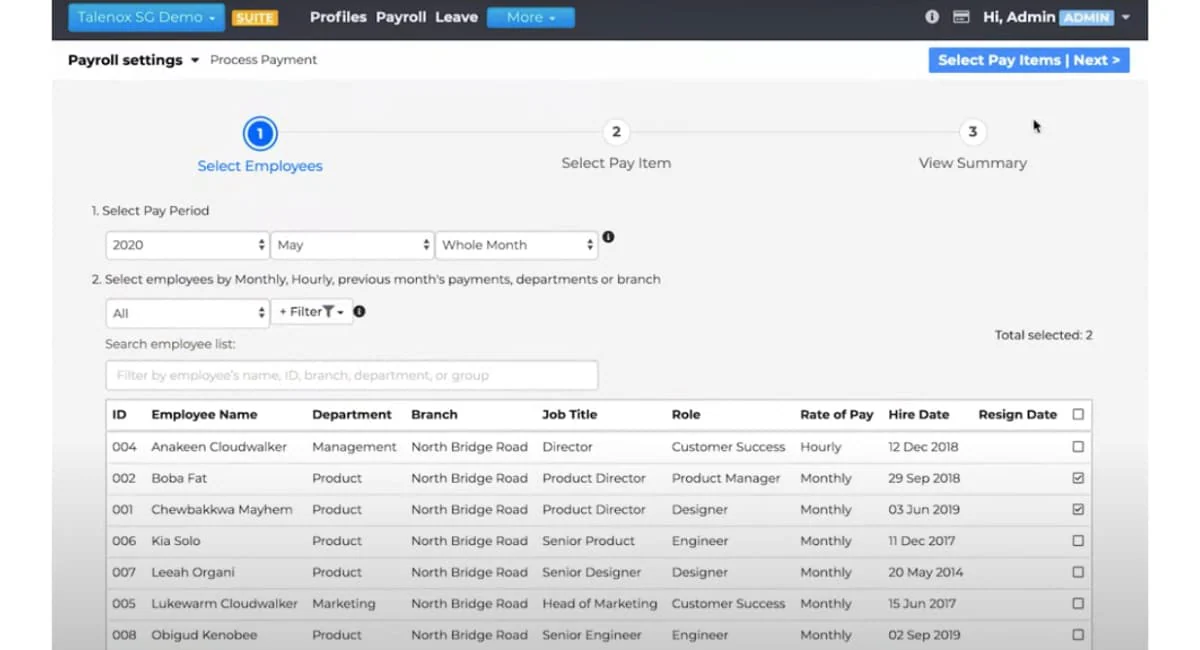
Talenox is a cloud-based HRIS system in Malaysia designed to manage payroll, leave, and store employee information efficiently. It’s tailored for ease of use, allowing companies to handle HR tasks with minimal effort and maximum accuracy.
What sets Talenox apart is how its three core modules, employee profiles, payroll, and leave, are connected in real time. A leave approval automatically reflects in the next payroll run, reducing the need to reconcile attendance and deductions separately each month.
Best features:
- Cloud-based system: Accessible from anywhere, ensuring flexibility and continuity.
- Flexible payroll options: Supports various payment schedules and caters to different types of workers.
- Automatic calculations: Localized for Malaysia, it automates tax and statutory contributions calculations.
- Integrated modules: Profiles, Payroll, and Leave modules are interconnected for real-time data updates.
- Compliance: Updated with the latest labor regulations for hassle-free HR management.
- Payroll reports: Provide strategic insights with just a few clicks.
Pricing: Estimated starting from RM10 per employee per month. Final subscription costs depend on employee headcount, activated HR features, and payroll-processing requirements.
Why this suits Malaysian businesses: Talenox provides a lightweight, cloud-based HRIS tailored for Malaysian SMEs. It automates payroll and statutory calculations while keeping HR processes simple and accessible. Its flexibility makes it suitable for companies looking for efficient, no-fuss HR management.
| Strengths | Weaknesses |
|
|
5. Kakitangan HR
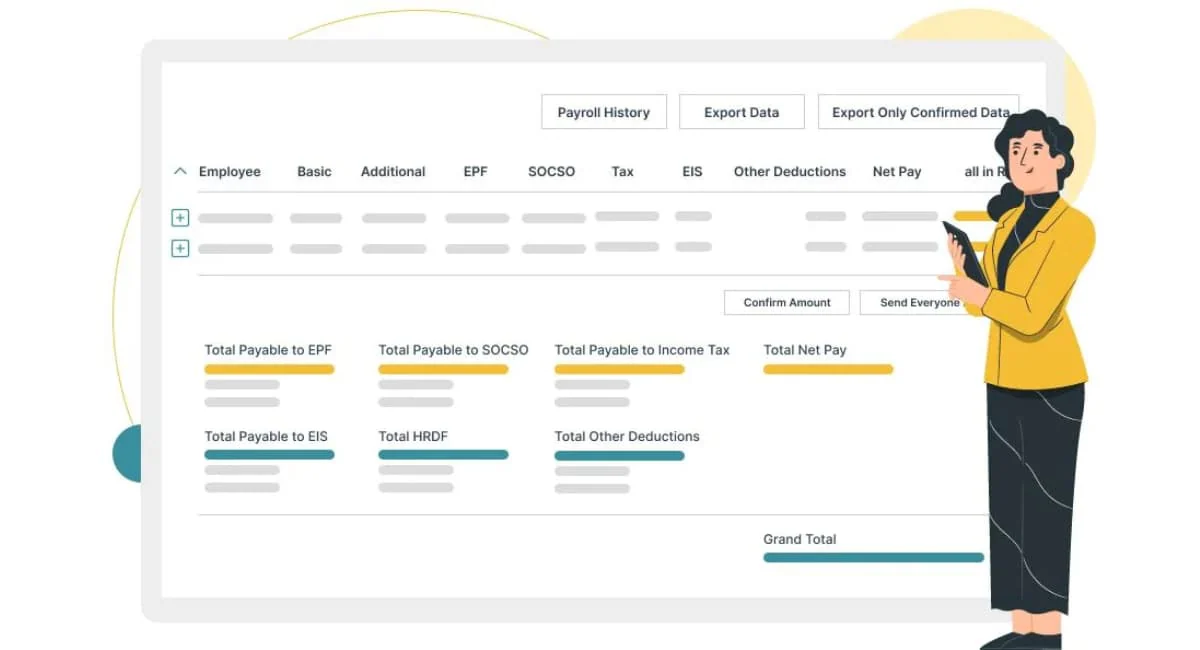
Rather than competing on complex enterprise-level HR features, Kakitangan’s core value lies in its role as a practical bridge for SMEs, combining essential employee self-service tools with direct payroll integration into core accounting software to eliminate manual administrative tasks.
Kakitangan’s key strength lies in its highly specific focus on the Malaysian market, particularly in terms of seamless, automated compliance with local regulatory bodies such as KWSP, SOCSO and LHDN.
Best features:
- Simple integration: Supports all banks in Malaysia and multiple accounting software integrations.
- Compliance assured: Regular updates for statutory and bank compliances, PDPA audited by BDO.
- Configurable & integrated modules: Consolidates HR operations with a single platform.
Pricing: Estimated starting from RM30 per month plus RM3 per employee. Costs may increase when adding leave, attendance, claims, or other HR functions.
Why this suits Malaysian businesses: Kakitangan focuses on fast and secure payroll processing with strong local compliance. It supports Malaysian banks and statutory updates, ensuring reliable salary distribution. Its simplicity makes it ideal for teams prioritizing efficiency and data security.
| Strengths | Weaknesses |
|
|
6. Employment Hero
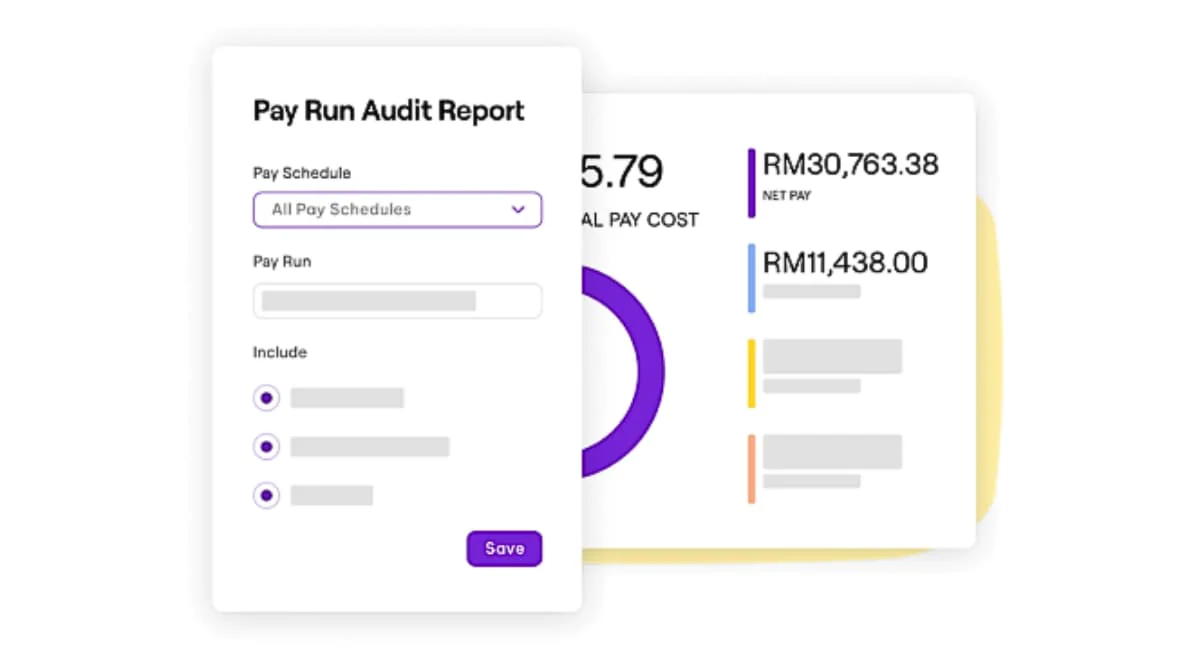
Employment Hero is designed to automate recruitment, HR, payroll, and benefits, providing a comprehensive business solution. It’s recognized for helping companies manage employees efficiently, focusing on simplifying and automating payments.
What sets Employment Hero apart is its direct integration with accounting platforms such as Xero, Zohobooks, and Netsuite, where payroll figures sync automatically after each run without manual reconciliation.
Best features:
- Automated payroll: Simplifies payroll management with LHDN-approved software.
- HR integration: Offers an all-in-one HR software that simplifies leave management.
- Mobile app: Manage payroll online using a mobile app for convenience.
- Statutory compliance: Automated MTD/PCB and statutory contribution calculations.
- Employee self-service: Empowers employees to manage their profiles and submit requests.
- Smart integrations: Compatible with popular accounting software like Xero, Zohobooks, and Netsuite.
Pricing: Estimated starting from RM8 per employee per month. Final pricing depends on employee volume, payroll capabilities, HR modules, and implementation support.
Why this suits Malaysian businesses: Employment Hero delivers a complete employee lifecycle solution, covering payroll, HR, and benefits. It supports Malaysian compliance while helping businesses automate routine HR processes. This makes it suitable for companies seeking an all-in-one workforce management platform.
| Strengths | Weaknesses |
|
|
7. HR2eazy
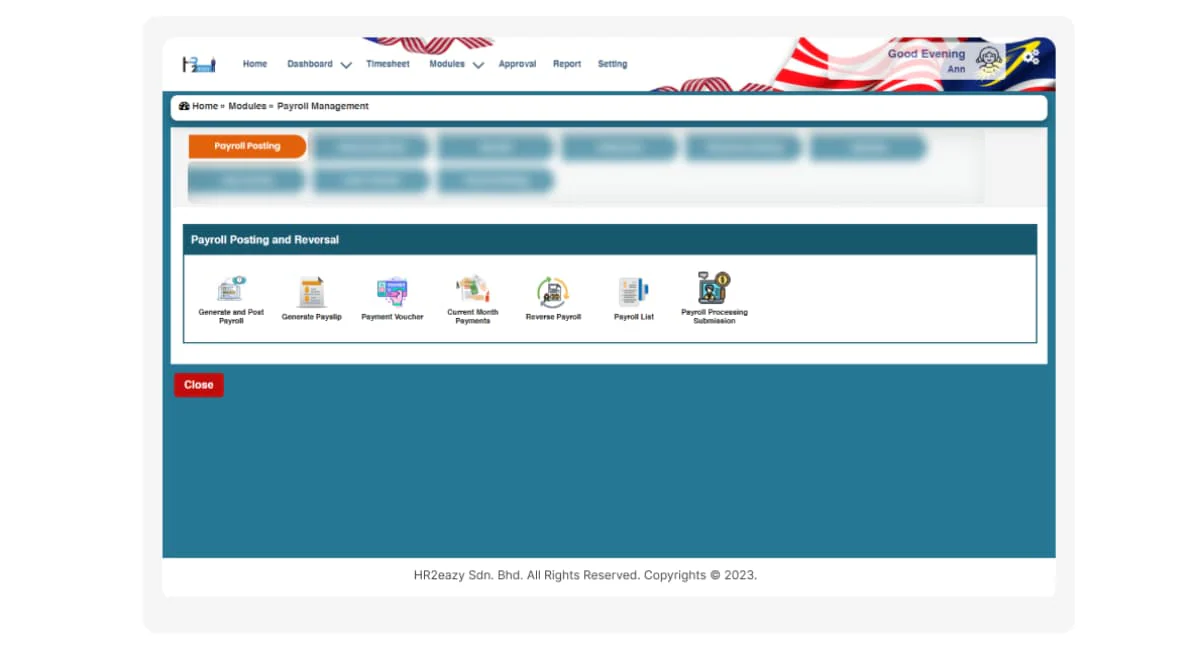
HR2eazy is a payroll software integrated with an HR system Malaysia, designed to unifies HR processes for businesses of all sizes. It offers 30+ modules, including HRMS, financial management, and performance management.
What sets HR2eazy apart is its mobile app that functions offline, which is particularly relevant for teams using it as a construction payroll software, where managers on-site process attendance and HR data without stable internet access.
Best features:
- Comprehensive HRMS: A wide array of modules for complete HR management.
- Offline access: Mobile app functionality even without internet access.
- Customization: Extensive customizations to match unique business workflows.
- Automated workflows: Integrated workflows for general HR and payroll, manpower planning, succession planning, and asset management.
Pricing: Estimated starting from RM4.50 per employee per month. Buyers should confirm minimum monthly charges and costs for additional HR modules or implementation services.
Why this suits Malaysian businesses: HR2eazy offers extensive HR and payroll modules designed for businesses with more complex needs. Its customizable workflows and broad functionality support various industries in Malaysia. This makes it a strong fit for organizations looking for flexibility and scalability.
| Strengths | Weaknesses |
|
|
8. Sage
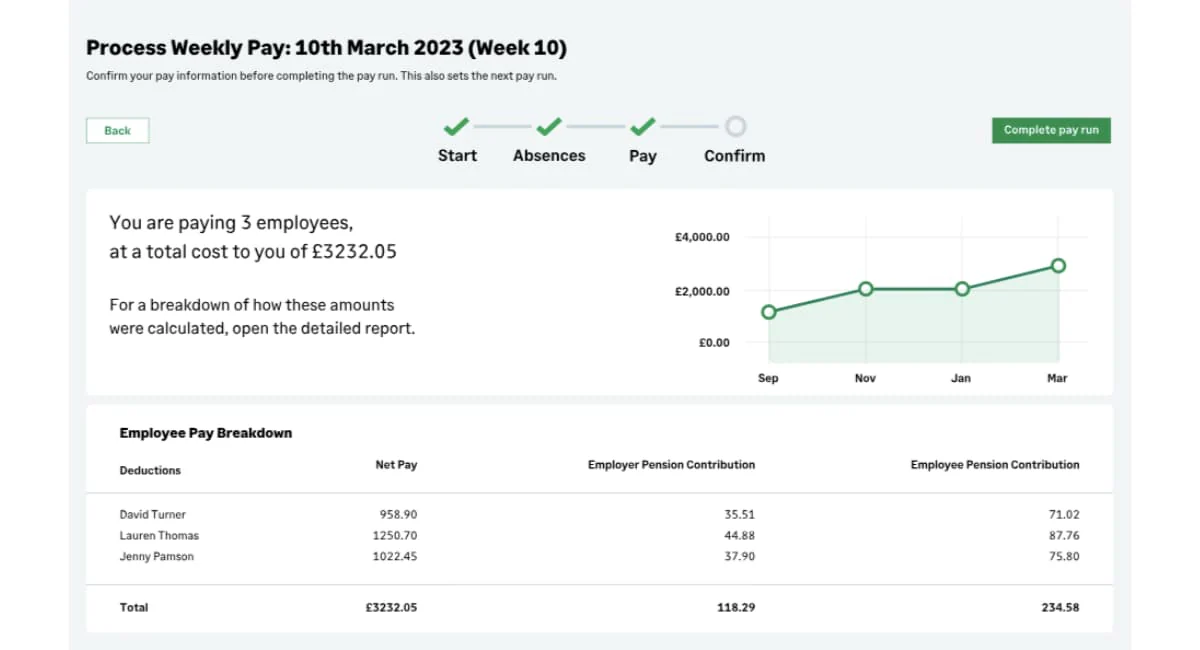
Sage Payroll is known for streamlining payroll with standard HR templates, boosting efficiency by managing payroll and resource issues. It complies with local laws, keeping businesses aligned with current regulations.
For companies already running Sage Accounting, payroll entries from Sage Payroll post directly into the ledger after each run, removing the need for a separate integration or manual journal entry each month.
Best features:
- Legislation compliance: Keeps up with local laws and regulations.
- HR templates: Provides standard documentation for HR processes.
- Efficiency: Automates payroll processes for better productivity.
- Visibility: Offers complete control over payroll management.
Pricing: Regional published plans are estimated at approximately RM80–RM271 per month after currency conversion. Malaysian pricing may differ depending on employee capacity, partner services, and deployment requirements.
Why this suits Malaysian businesses: Sage Payroll is ideal for companies that prefer structured HR processes and standardized documentation. It ensures compliance with Malaysian regulations while improving payroll efficiency. Its established system suits businesses with more traditional workflows.
| Strengths | Weaknesses |
|
|
9. Zoho Payroll
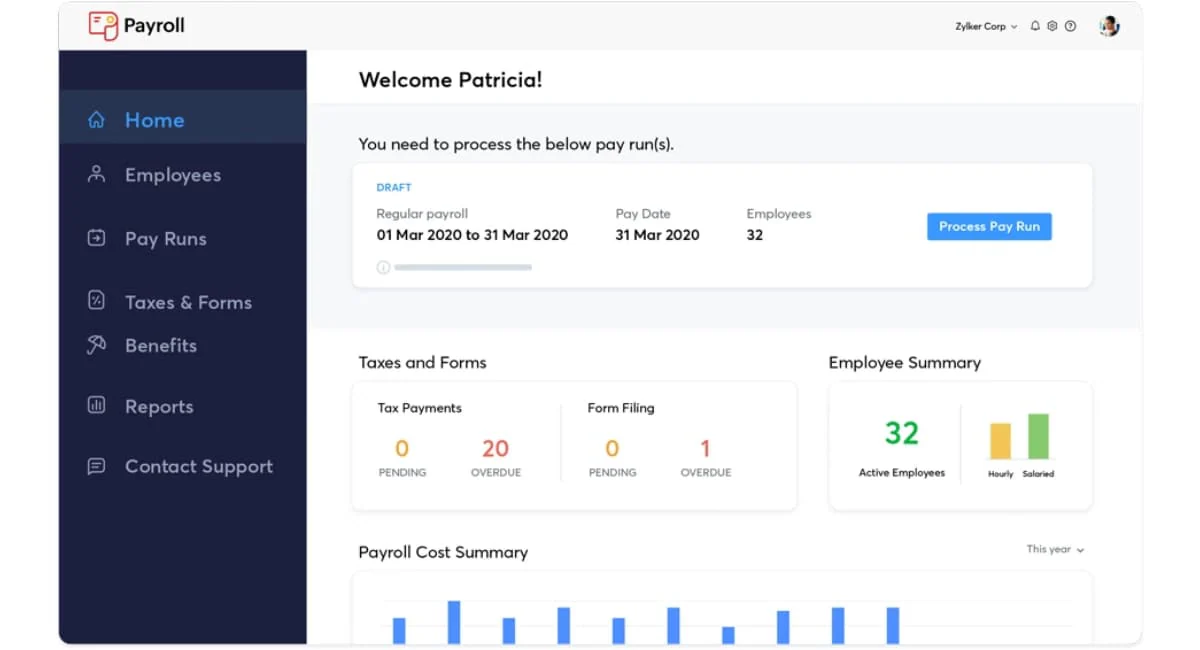
Zoho Payroll, part of the Zoho business suite, is known for its affordable and straightforward payroll management. It integrates natively with Zoho Books and Zoho People, providing a cohesive payroll system Malaysia experience.
Zoho Payroll works best for businesses already running other Zoho products such as Zoho Books or Zoho CRM, where payroll data connects to the same workspace without setting up a separate integration or switching between platforms.
Best features:
- Ecosystem connectivity: Payroll data syncs directly with Zoho Books and Zoho People without additional integration setup.
- Statutory tracking: EPF, SOCSO, and PCB deductions are calculated and tracked automatically each pay cycle.
- Employee portal: Staff access payslips and submit leave requests through a built-in self-service dashboard.
- Cloud payroll dashboard: Salary runs, tax deductions, and employee records are managed from a single cloud interface.
Pricing: Estimated from RM29 per month when using its PayrollPanda integration, excluding the separate Zoho People licence. Final costs depend on employee count, selected Zoho applications, and integration requirements.
Why this suits Malaysian businesses: Zoho Payroll integrates natively with the Zoho ecosystem, making it a cost-effective choice for existing users. It supports Malaysian compliance and simplifies payroll through automation. This makes it ideal for businesses looking for an affordable, connected system.
| Strengths | Weaknesses |
|
|
10. BrioHR
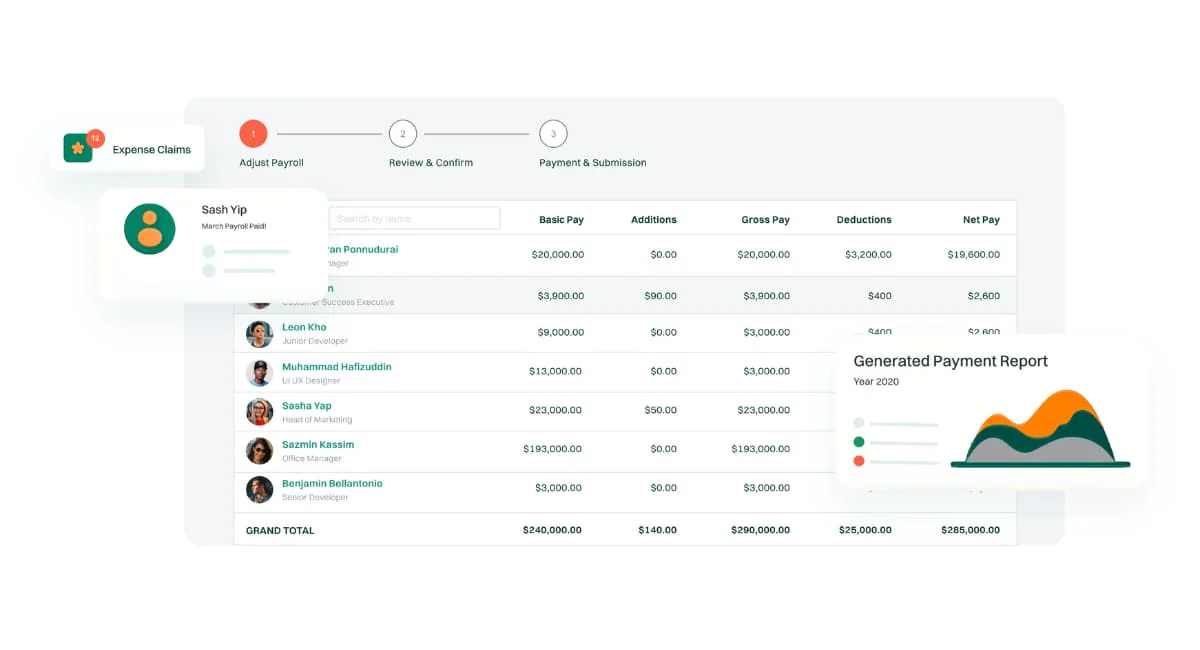
BrioHR Payroll simplifies HR processes with a secure, scalable platform covering recruitment, onboarding, payroll, claims, performance, and analytics. Backed by experts, it helps HR teams focus on what matters most – their people.
Beyond the software itself, BrioHR includes access to HR advisory support, where teams can consult practitioners on policy and compliance questions rather than relying solely on the platform’s automated rules.
Best features:
- A cloud-based platform: Ensures secure, scalable, and accessible HR management.
- Comprehensive HR management: Offers over 30 modules for various HR functions.
- Employee self-service: Empowers employees with a portal for HR-related tasks.
- Statutory compliance: Keeps up-to-date with Malaysian statutory regulations and requirements.
Pricing: Estimated at RM5 per employee per month, subject to a minimum charge of approximately RM200 per month. Additional modules and implementation services may affect the final subscription.
Why this suits Malaysian businesses: BrioHR provides a comprehensive HR suite with payroll, recruitment, and performance tools. It supports Malaysian statutory compliance while offering a scalable cloud platform. This makes it suitable for companies wanting a complete HR solution in one place.
| Strengths | Weaknesses |
|
|
11. Info-Tech
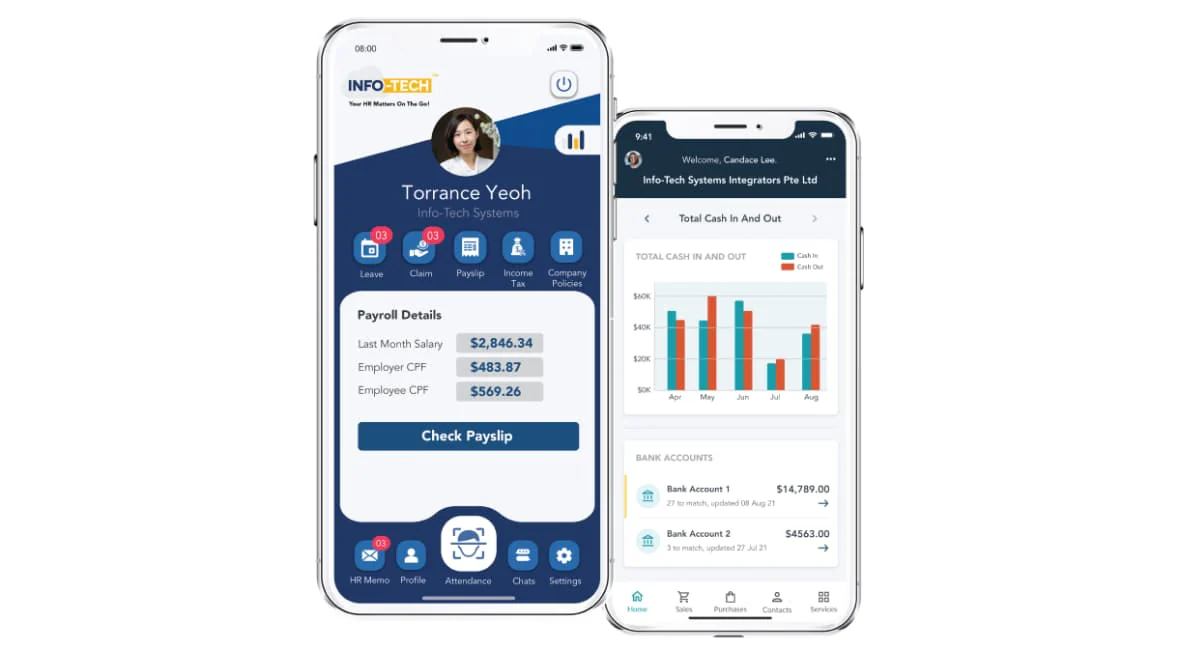
Info-Tech Payroll offers an all-in-one payroll software Malaysia that integrates payroll with attendance, leave, and claim software. It is designed to automate payroll calculations and reduce the risks of incorrect payments, making it a reliable tool for businesses of all sizes.
Bank-approved for Interbank GIRO and over 50 Malaysian bank formats, Info-Tech covers salary disbursement directly to virtually any Malaysian bank without routing payments through a third-party service.
Best features:
- Cloud-based: Ensures data is always accessible and secure.
- Comprehensive integration: Combines payroll with attendance, leave, and claim management.
- Statutory compliance: Approved by major Malaysian government bodies for automatic statutory contributions.
- Automated back-up: Provides automatic back-up at scheduled timings.
- Customizable reports: Allows for tailored payroll reports to suit business needs.
Pricing: Starting from RM150 per month. Final costs depend on employee volume and the inclusion of attendance, leave, claims, mobile applications, and HR management modules.
Why this suits Malaysian businesses: Info-Tech is widely recognized in Malaysia for its strong compliance with local authorities and banks. It integrates payroll with attendance and claims for better efficiency. Its reliability makes it a solid choice for businesses of all sizes.
| Strengths | Weaknesses |
|
|
12. Ramco Paycework
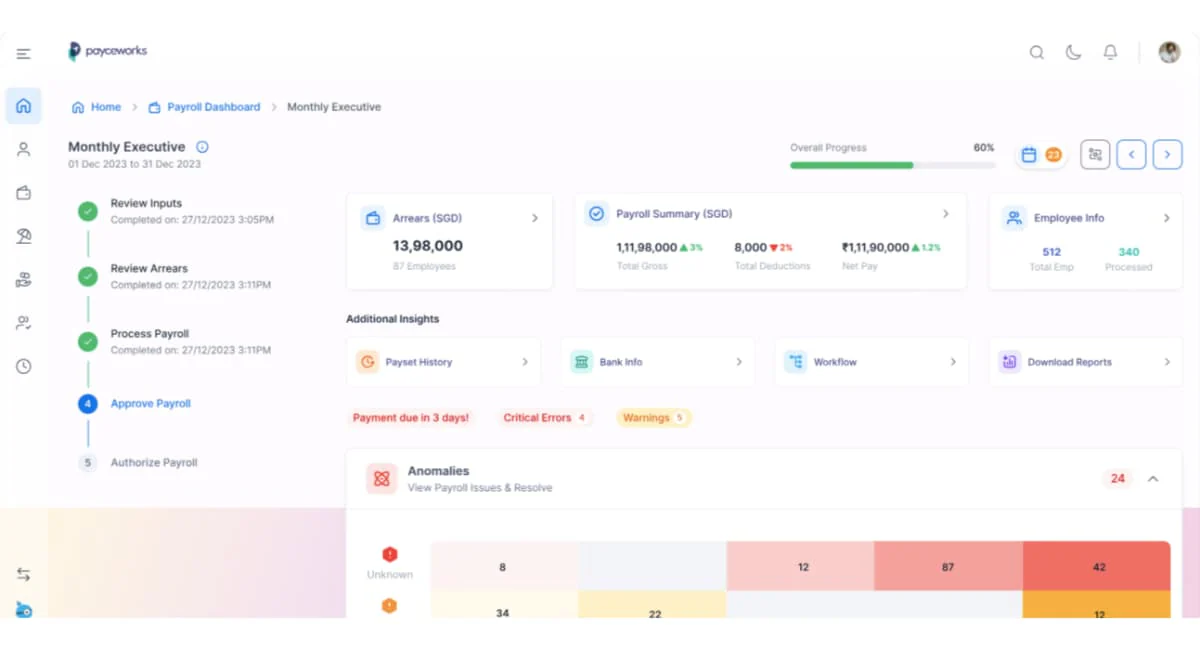
Ramco Paycework offers a unified solution for payroll, core HR, and attendance, built for global enterprises with multi-country operations. It features innovations like chatbots, facial recognition, and voice interfaces via Google Assistant and Alexa to enhance the employee experience.
Ramco supports facial recognition for employee check-in, linking attendance data directly to payroll calculations and removing the manual step of reconciling shift records against salary runs for companies with large or rotating workforces.
Best features:
- Global coverage: Supports payroll for over 50 countries, including Malaysia.
- Local compliance: Incorporates all taxation laws for Malaysia, managing EPF, SOCSO, and Employee Income Tax.
- Innovative technology: Features like facial recognition and voice-based UI.
- Mobile accessibility: Complete visibility of payroll & workforce information on mobile, tabs, and desktops.
Pricing: Editorial estimates range from RM20–RM62 per employee per month. Enterprise quotations vary according to workforce size, number of countries, payroll complexity, integrations, and managed services.
Why this suits Malaysian businesses: Ramco Paycework is designed for enterprises managing multi-country payroll, including Malaysia. It combines global capabilities with local compliance requirements. This makes it ideal for large organizations with complex workforce structures.
| Strengths | Weaknesses |
|
|
13. HR2000 i-Payroll
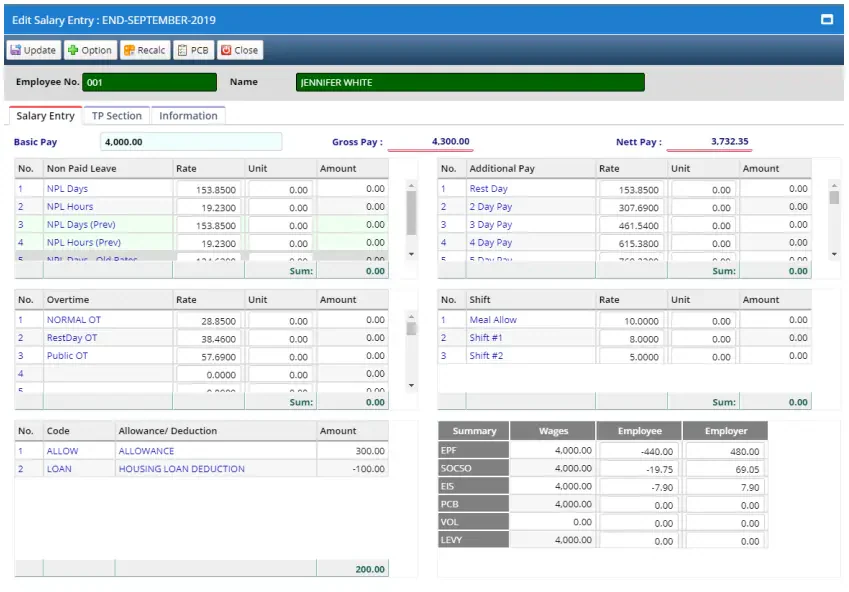
HR2000 payroll software Malaysia has supported Malaysian companies since 1999 with a reliable system built for both small and large enterprises. It offers i-Payroll (web-based) and QuickPay (desktop-based) systems, providing flexibility and strong local compliance for different business needs.
HR2000 offers both a web-based version (i-Payroll) and a desktop version (QuickPay) under the same product, letting businesses choose between cloud and local processing without switching to a different payroll provider.
Best features:
- Dual deployment: Available as web-based (i-Payroll) or desktop (QuickPay) under the same product.
- Bank format coverage: Supports over 50 Malaysian bank formats for salary disbursement.
- Statutory reporting: Automates EPF, SOCSO, EIS, and PCB reports each payroll period.
Multi-company access: Manage multiple company accounts from a single login.
Pricing: Starting from RM100 per month. Final pricing depends on employee count, banking integrations, statutory submission features, and additional HR modules.
Why this suits Malaysian businesses: HR2000 offers a long-standing, reliable HR payroll system built specifically for the Malaysian market. It supports multiple bank formats and statutory compliance. Its proven track record makes it suitable for companies prioritizing stability and experience.
| Strengths | Weaknesses |
|
|
14. SQL Payroll
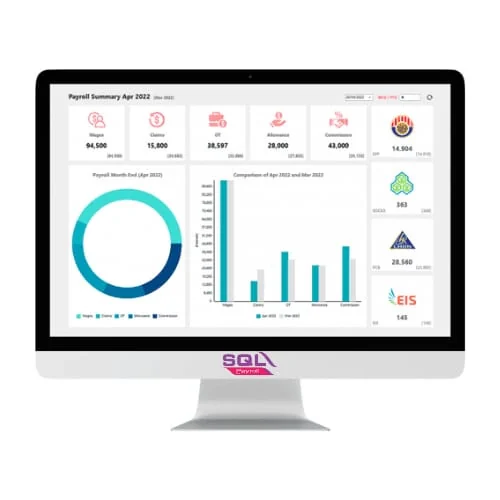
This vendor is Available in both desktop and hybrid cloud versions, with full compliance for EPF, SOCSO, PCB and EIS makes SQL Payroll management Malaysia is one of the most popular payroll solutions. For businesses already using SQL Account, payroll integration is seamless and requires no manual exports.
Accounting firms managing payroll for multiple clients can run all accounts from a single SQL Payroll login, removing the overhead of maintaining separate subscriptions or logins for each company they handle.
Best features:
- Deployment flexibility: Runs as desktop or hybrid cloud, including offline processing.
- e-Submission: Direct submission to EPF, SOCSO, EIS, PCB, and Malaysian banks.
- Multi-client account: Accounting firms manage multiple company payrolls from one login.
- Payslip delivery: Password-protected payslips sent in batch to employee emails.
Pricing: Starting from RM120 per month. Total costs depend on employee capacity, accounting integration, statutory reporting, and implementation support.
Why this suits Malaysian businesses: SQL Payroll is popular for its accurate calculations and integration with accounting systems. It supports statutory submissions and detailed reporting for Malaysian businesses. This makes it a strong fit for mid-sized companies needing precision and scalability.
| Strengths | Weaknesses |
|
|
15. JustPayroll
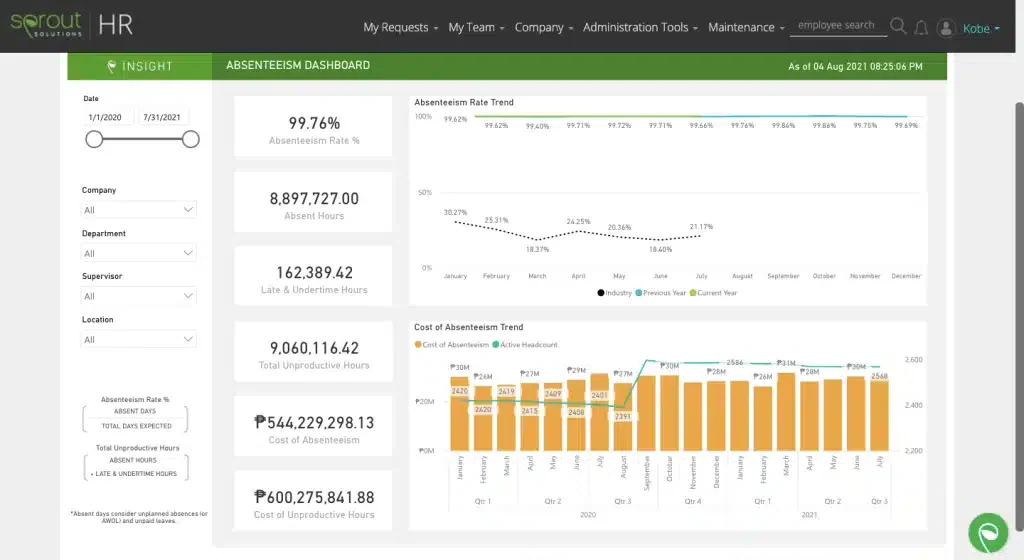
JustPayroll provides a simplified and cost-efficient approach to payroll software in Malaysia for small and medium-sized businesses. Its cloud-based platform offers flexible automation, easy onboarding, and direct integration with local compliance systems.
JustPayroll includes a guided onboarding flow with a demo setup, where new users can configure settings and run a test cycle before processing live salaries, reducing the chance of first-month calculation errors.
Best features:
- Demo setup: Run a test payroll cycle before processing live salaries.
- Direct statutory submission: Submits to EPF, SOCSO, and PCB from within the platform.
- Automated payroll cycle: Leave, claims, and payslips processed automatically each period.
- Cloud backup: Records stored with automatic backup, accessible from any browser.
Pricing: Estimated starting from RM50 per month. Subscription costs vary according to employee count, payroll features, statutory submissions, and optional HR functions.
Why this suits Malaysian businesses: JustPayroll delivers a simple and affordable payroll solution for SMEs. It automates compliance and payroll processes while remaining easy to use. This makes it ideal for growing businesses with limited resources.
| Strengths | Weaknesses |
|
|
16. Omni
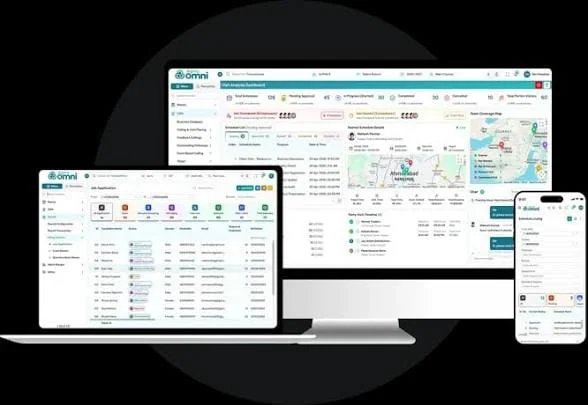
Omni is a comprehensive HR payroll system in Malaysia that supports both local and international payroll needs. It centralizes payments across multiple currencies and jurisdictions while ensuring full compliance with regional regulations.
Automated time tracking feeds directly into payroll calculations as attendance data comes in, removing the need for HR to manually reconcile timesheets against the payroll run each period.
Best features:
- Multi-currency payroll: Processes salaries across currencies and jurisdictions from one dashboard.
- Attendance-to-payroll sync: Time tracking updates payroll calculations automatically.
- Audit trail: All record and payroll changes logged with timestamps.
- Connected HR modules: Recruitment, performance, and benefits linked to payroll in one platform.
Pricing: Estimated at RM8–RM16 per employee per month after converting its published USD payroll add-on. Managed payroll services, regional coverage, and additional HR modules may cost more.
Why this suits Malaysian businesses: Omni supports both local and international payroll, making it suitable for expanding companies. It ensures compliance across regions, including Malaysia. Its flexibility benefits businesses managing multi-country operations.
| Strengths | Weaknesses |
|
|
17. Papaya Global
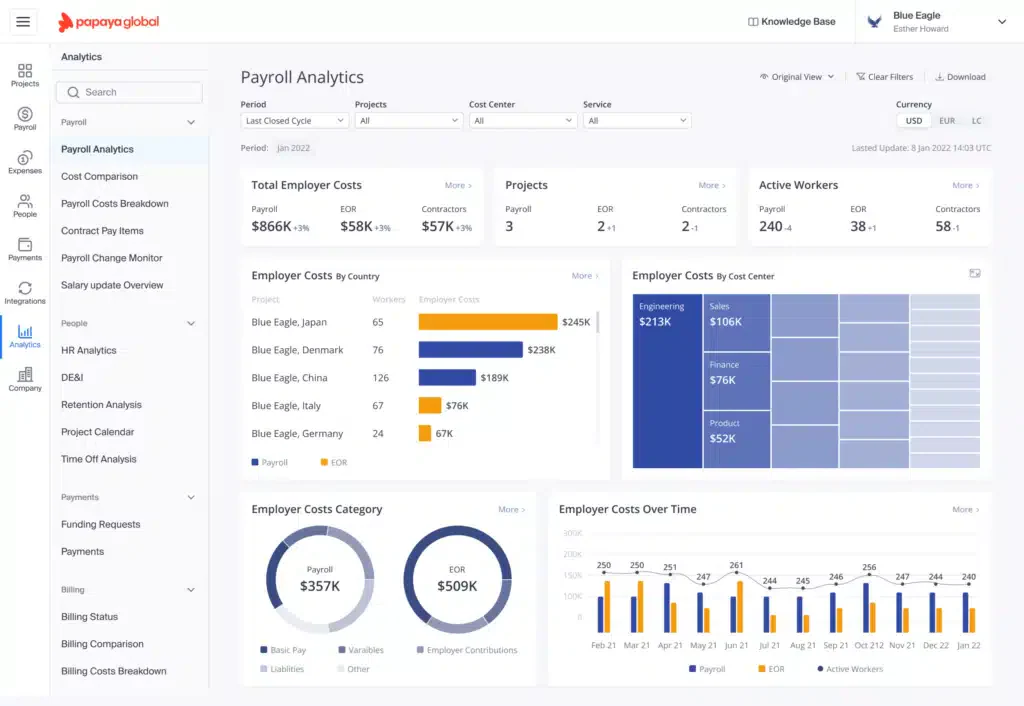
Papaya Global is a cloud-based payroll software in Malaysia designed for enterprises managing an international workforce. It ensures compliance with multi-country payroll laws, including local LHDN standards, making it a powerful tool for regional operations.
Its compliance engine updates automatically as tax and labor laws change across jurisdictions, so businesses operating in multiple countries do not need to manually adjust tax tables or monitor regulatory changes in each market.
Best features:
- Auto-updating compliance: Tax and labor law changes applied automatically across jurisdictions.
- Global payroll: Manages multi-country payroll, including Malaysia, from one platform.
- System integration: Connects to accounting, HR, and ERP platforms via API.
- Cloud reporting: Real-time payroll and compliance reports stored securely in the cloud.
Pricing: Payroll Plus is estimated starting from RM119 per employee per month after USD conversion. Final costs depend on country coverage, payment services, onboarding, and workforce complexity.
Why this suits Malaysian businesses: Papaya Global is built for global enterprises needing centralized payroll management. It combines AI-driven compliance with support for Malaysian regulations. This makes it ideal for companies handling complex international payroll.
| Strengths | Weaknesses |
|
|
18. Oyster Payroll
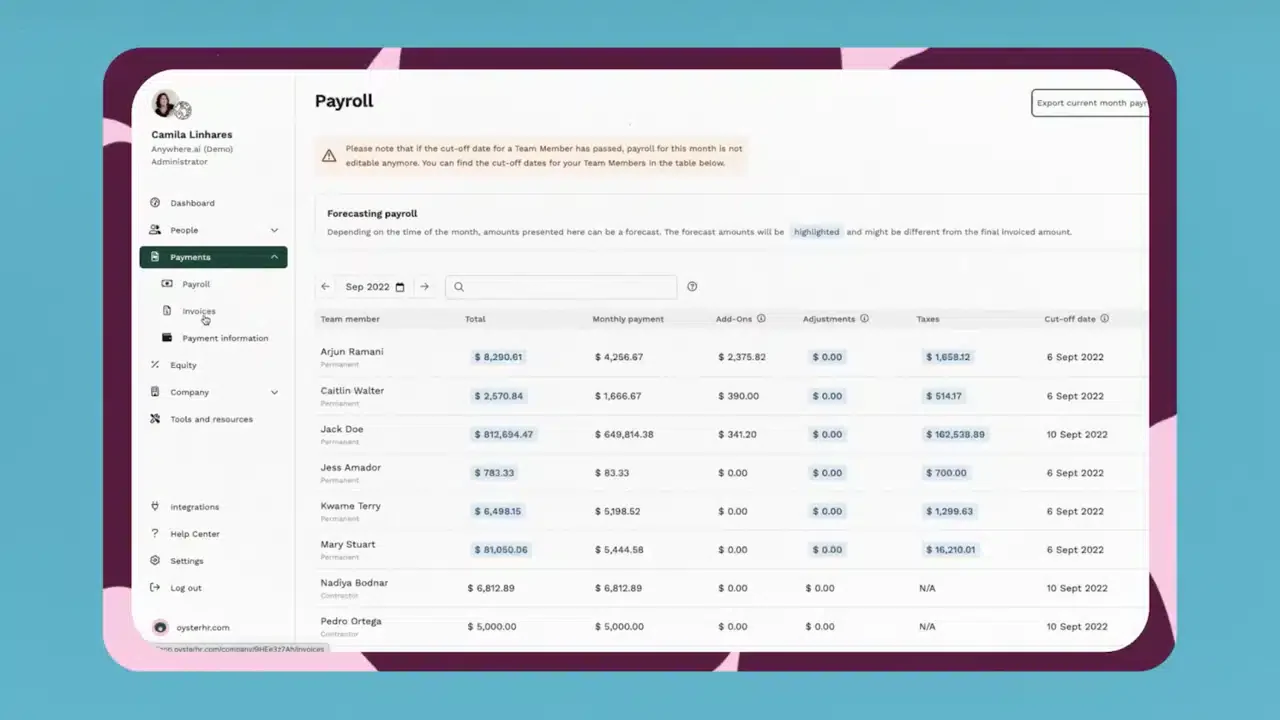
Oyster Payroll focuses on simplicity and flexibility, delivering payroll software that’s cloud-based and easy to scale. It provides essential payroll and compliance tools suitable for small to mid-sized businesses.
Border payment feature allows the same platform to pay employees and contractors in different countries, removing the need for a separate international remittance service when the workforce spans Malaysia and other markets.
Best features:
- Cross-border payments: Pays local employees and international contractors from one platform.
- Real-time dashboard: Payroll status and tax summaries update as data changes.
- Employee self-service: Staff access payslips and payment records through a secure portal.
- Automated deductions: Tax and benefits adjust based on each employee’s location and contract.
Pricing: Estimated at RM1,186 per entity per month plus RM119 per employee per month. Setup may cost around RM2,045 per entity, while optional payment processing is approximately RM8 per employee monthly.
Why this suits Malaysian businesses: Oyster Payroll offers a simple, cloud-based system with global payroll capabilities. It supports basic compliance and cross-border payments. This makes it suitable for SMEs with remote or distributed teams.
| Strengths | Weaknesses |
|
|
19. Gusto
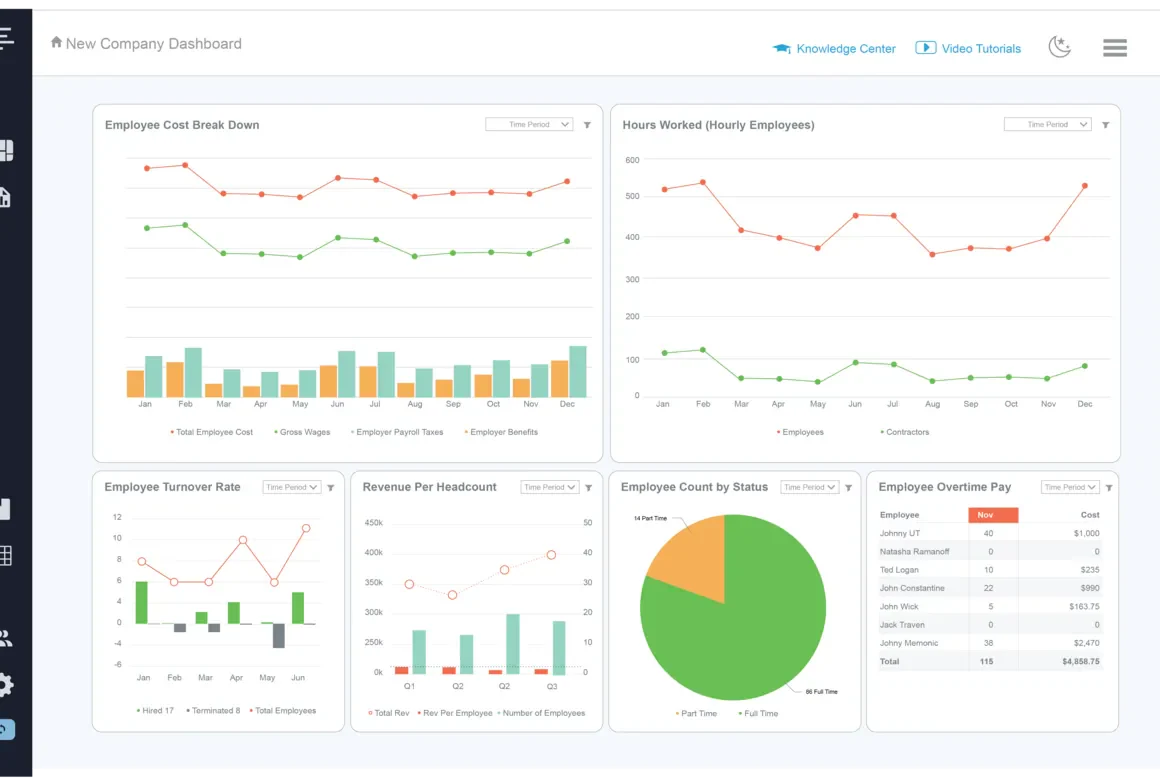
Gusto payroll system Malaysia offers a clean, intuitive platform that simplifies HR and payroll for small businesses. While it’s primarily used in global markets, it supports essential functions through cloud accessibility and automation.
Includes built-in reminders for compliance deadlines and contract renewals, which reduces the risk of missing submission dates for small teams that do not have a dedicated person monitoring payroll timelines each month.
Best features:
- Compliance reminders: Alerts for payroll deadlines, tax filing dates, and contract renewals.
- Contractor and employee payroll: Both staff types processed from the same dashboard.
- Benefits management: Allowances and insurance handled alongside the regular payroll run.
- Accounting sync: Payroll entries transfer automatically to connected accounting software.
Pricing: Estimated starting from RM200 per month plus RM25 per employee after USD conversion. Because Gusto is primarily US-focused, Malaysian statutory payroll support may require a separate local solution or service provider.
Why this suits Malaysian businesses: Gusto provides an easy-to-use payroll platform for small teams. While globally focused, it supports essential payroll functions through automation. This makes it a practical choice for startups seeking simplicity.
| Strengths | Weaknesses |
|
|
20. QuickHR
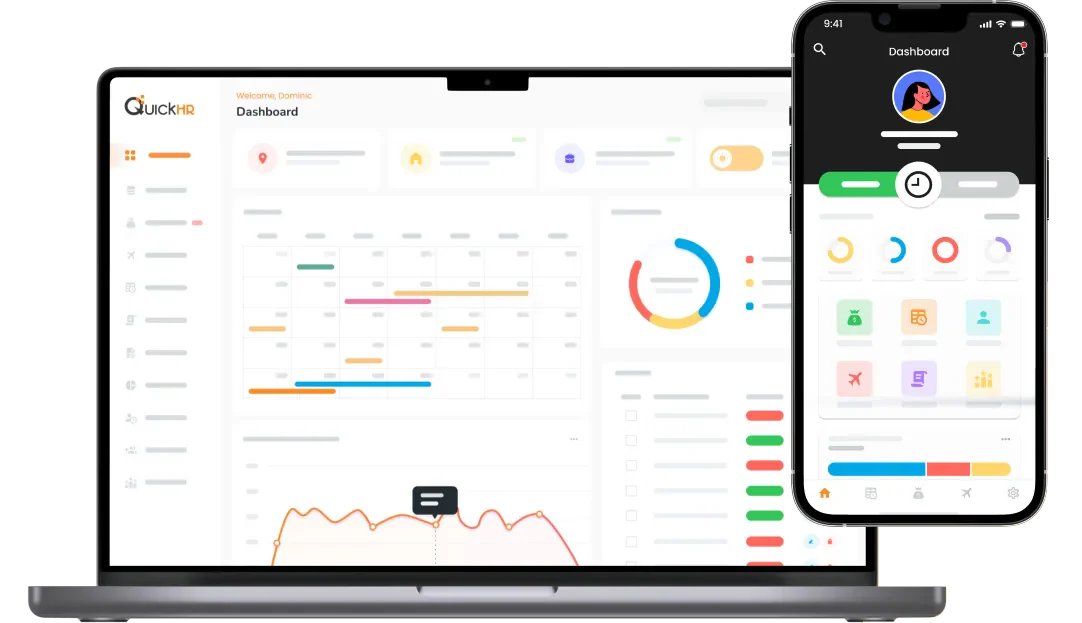
QuickHR is a multi-award-winning, cloud-based HRMS designed to simplify complex human resource processes. With a strong presence in Southeast Asia, it offers a highly secure and scalable platform that ensures full compliance with Malaysian statutory bodies, helping companies make a smooth transition from manual tracking to an efficient automated system.
Integrates directly with biometric hardware for attendance tracking, feeding clock-in data straight into payroll calculations rather than requiring HR to manually enter or reconcile attendance records before running payroll.
Key Features:
- Automated Payroll Processing: Standardizes salary calculations with built-in compliance for LHDN, KWSP, SOCSO, and EIS.
- Time and Attendance: Integrates directly with biometric hardware and mobile clock-ins for accurate tracking.
- Mobile ESS App: Dedicated Employee Self-Service application for quick access to payslips, leave applications, and expense claims.
- Itemized Reporting: Generates highly detailed payroll reports and bank GIRO files compatible with major Malaysian banks.
- Secure Cloud Infrastructure: ISO-certified data security ensures that sensitive employee financial records remain protected.
Pricing: Estimated at RM7–RM21 per employee per month across its published Malaysian plans. Final costs depend on the chosen tier, employee headcount, payroll functions, and additional HR modules.
Why this suits Malaysian businesses: QuickHR is a secure, cloud-based HRMS with strong compliance for Malaysian regulations. It combines payroll with attendance and employee self-service tools. This makes it ideal for SMEs and mid-sized businesses looking for a modern HR ecosystem.
| Strengths | Weaknesses |
|
|
Overall Comparison of Payroll Software in Malaysia
| Provider | Ease of Use | Payroll Automation | Compliance Accuracy | Pricing Value |
|---|---|---|---|---|
| HashMicro | ||||
| HR2eazy | ||||
| Employment Hero | ||||
| Zoho | ||||
| BrioHR |
How to Choose The Right Payroll Software for Your Business
Choosing the right payroll software comes down to a few key factors. Use this checklist to evaluate which platform fits your business best before making a decision.
| No | Factor | What to Look For | Why It Matters |
|---|---|---|---|
| 1 | Payroll Needs | Does it support your workforce size, shift patterns, and payroll frequency? | A mismatch between your needs and the software’s capability leads to workarounds and errors every pay cycle. |
| 2 | Malaysian Compliance | Auto-calculates EPF, SOCSO, EIS, and PCB and updates when regulations change. | Manual compliance tracking is error-prone. Missed submissions can result in penalties from LHDN or KWSP. |
| 3 | Integration | Connects with your existing HR, attendance, and accounting tools without manual imports. | Disconnected systems create duplicate data entry, which slows down your team and increases the risk of discrepancies. |
| 4 | Pricing Transparency | Clear per-employee or flat-fee pricing with no hidden charges. | Hidden fees for extra users, compliance updates, or support can significantly inflate your actual monthly cost. |
| 5 | Ease of Use | Simple enough for new HR staff to pick up quickly, with solid onboarding support. | A platform your team avoids using defeats the purpose. Ease of adoption directly impacts how well the system gets used day-to-day. |
| 6 | Data Security | Encryption, role-based access, PDPA compliance, and clear data breach protocols. | Payroll data includes salaries, IC numbers, and bank details. A breach doesn’t just cost money it damages employee trust permanently. |
| 7 | Scalability | Supports growth multiple locations, entities, or currencies as your business expands. | Switching platforms mid-growth is expensive and disruptive. Choosing a scalable system from the start saves significant time and cost later. |
| 8 | Free Trial / Demo | Offers hands-on testing before you commit to a paid plan. | Running a mock payroll cycle during a trial reveals friction points that no product video or sales call will show you in advance. |
Which Payroll Software System Suits The Most for Your Business?
With so many payroll solutions available, the right choice ultimately depends on your company’s size, complexity, and compliance needs. After comparing the options, the next step is to identify which product best aligns with your operational priorities and long-term goals.
| Business Scenario | Recommended Software | Why It Fits |
|---|---|---|
Small business or startup with limited HR resources | PayrollPanda or JustPayroll | Both provide simple, cost-effective payroll solutions with fast setup and strong compliance support, making them suitable for small teams with limited HR capacity. |
SMEs looking for affordable all-in-one payroll and HR tools | Talenox or Kakitangan | These platforms combine payroll, leave, and employee management in one system, offering a practical balance between functionality and affordability for growing SMEs. |
Growing companies needing HRMS + payroll in one system | Swingvy or Employment Hero or HashMicro | All three offer integrated HR and payroll capabilities. Swingvy and Employment Hero focus on ease of use and automation, while HashMicro provides broader modular scalability for expanding operations. |
Businesses needing customizable and scalable payroll solutions | HashMicro or HR2eazy | Both solutions support customization and workflow flexibility, making them suitable for companies with more complex operational requirements. |
Companies prioritizing strong compliance and local expertise | Info-Tech or HR2000 or PayrollPanda | These platforms are widely recognized for their alignment with Malaysian statutory requirements, offering reliable compliance features and local payroll expertise. |
Mid-sized companies needing accounting + payroll integration | SQL Payroll or Zoho Payroll or HashMicro | Each solution supports payroll-accounting integration. SQL Payroll and Zoho Payroll emphasize financial connectivity, while HashMicro offers integration within a broader ERP ecosystem. |
Enterprises managing multi-country payroll | Ramco Paycework or Papaya Global | Both platforms are designed for global payroll operations, supporting multi-country compliance and centralized workforce management. |
Companies expanding globally with distributed teams | Omni or Oyster Payroll | These tools support multi-currency payroll and remote workforce management, making them suitable for businesses with international or distributed teams. |
Businesses wanting a full HR suite beyond payroll | BrioHR or Sage Payroll or HashMicro | All three provide broader HR functionalities beyond payroll. BrioHR and Sage focus on structured HR processes, while HashMicro delivers a more extensive ERP-based approach. |
Small teams prioritizing simplicity and ease of use | Gusto | Gusto offers a clean, user-friendly interface with essential payroll features, making it ideal for small teams seeking a straightforward solution. |
Conclusion
Transitioning to modern payroll software is your best defense against Malaysian regulatory non-compliance. Relying on spreadsheets for volatile monthly tax deductions (PCB) and statutory contributions creates major organizational vulnerabilities. The right platform safeguards your business while completely removing administrative bottlenecks from your HR department.
The market offers clear paths based on your organizational maturity. Micro-businesses should look to PayrollPanda for straightforward tracking, whereas scaling companies needing stringent data compliance and leave tracking should opt for Kakitangan or Swingvy. Meanwhile, large-scale enterprises with intricate operational workflows require the deep customizability and cost-effective unlimited-user value of HashMicro, or the end-to-end HR integration of Employment Hero.
Because every company features unique overtime rules and banking configurations, a live evaluation is crucial. If you are still weighing your options, book a free demo today to see the system manage your actual workflows before committing financially.

FAQ About Payroll Software
Malaysia ensures compliance with local statutory requirements such as EPF, SOCSO, and LHDN deductions. Specifically, these systems are designed to automatically calculate and deduct the necessary contributions and generate the required forms, for example Form E and EA. As a result, this automation helps businesses avoid errors and penalties associated with manual processing. processing.
Payroll software often integrates with other HR and accounting systems to streamline business operations. For instance, many solutions are compatible with accounting software, enabling seamless data transfer and synchronization. Consequently, this integration helps maintain accurate financial records and simplifies processes such as leave management, time tracking, and expense claims.
Employee self-service (ESS) portals in payroll software allow employees to manage their own information, such as viewing payslips, applying for leave, and updating personal details. Therefore, this feature enhances efficiency by reducing the administrative workload on HR departments. Moreover, some advanced ESS portals also support mobile access and real-time updates.
Payroll software in Malaysia incorporates several security measures to protect sensitive employee and company data. Specifically, these include SSL encryption, secure cloud hosting, and compliance with data protection laws such as the Personal Data Protection Act (PDPA). Additionally, many systems provide secure login features and regular updates to safeguard against security threats.