









The Southeast Asia nutraceuticals market was valued at USD 35.27 billion in 2024 and is projected to reach USD 77.04 billion by 2033, growing at a CAGR of 9.1%. Malaysia, Singapore, and Thailand lead the region with clearer regulatory frameworks that attract both local manufacturers and global players looking to set up production in the region.
Managing these processes manually is not only inefficient but also introduces risks that can damage a business’s reputation. A specialised manufacturing software is no longer an option but a strategic necessity to overcome these hurdles.
I’ll break down what this software actually fixes on the production floor, and the few criteria that truly matter when you’re choosing a solution that won’t slow your team down.
Key Takeaways
|
What is Nutraceutical Manufacturing Software?
Nutraceutical manufacturing software is a specialised tool designed to manage the unique production processes of health supplements. It automates operations from formula management and inventory control to final quality assurance.
This software is essential for companies producing vitamins, dietary supplements, and functional foods. It supports businesses of all sizes in meeting strict industry standards and efficiently scaling their operations.
Why Nutraceutical Manufacturing Software is Crucial for Business?
In today’s competitive market, companies can no longer rely on manual methods for precision and traceability. Specialised software provides the centralised control and real-time data needed to maintain the highest standards.
1. Ensures strict regulatory compliance
It helps businesses adhere to complex regulations like Good Manufacturing Practices (GMP). The system digitally documents every production step, which simplifies audits and reduces human error.
2. Improves quality control and product consistency
The software enforces Standard Operating Procedures (SOPs) for every batch, ensuring product uniformity. Integrated quality management features allow teams to test and approve products at each critical stage.
3. Optimises inventory and supply chain management
It effectively manages raw materials with short shelf lives using the FEFO (First-Expired, First-Out) method. This visibility prevents stockouts of critical ingredients and minimises waste.
4. Simplifies complex formula and recipe management
It provides a secure, centralised platform to manage valuable and complex product formulas. The system ensures that any recipe changes are instantly and accurately updated across the production line.
5. Provides accurate production cost visibility
This software automatically tracks all production costs, including materials, labour, and overheads. This gives management an accurate view of COGS to make more strategic and profitable pricing decisions.
Key Features of Nutraceutical Manufacturing Software

Choosing the right solution begins with understanding the essential features designed for the nutraceutical industry. These tools work together to create a transparent, efficient, and compliant production ecosystem.
1. Formula & recipe management
This feature acts as a central database for all product recipes, detailing ingredients and instructions. It securely manages version control and access rights to protect valuable intellectual property.
2. Lot & expiry date tracking
It provides end-to-end traceability by tracking every ingredient from the supplier to the finished product. The system also automatically manages expiry dates to alert staff and prevent material waste.
3. Integrated quality control
This embeds quality checks throughout the production workflow, from raw material inspection to final product verification. It allows you to set quality parameters and digitally record test results for compliance.
4. Regulatory compliance
The software includes built-in tools like audit trails and electronic signatures to meet standards like cGMP. It simplifies the generation of compliance reports, making regulatory audits much smoother.
5. Production planning & scheduling
This tool helps managers create efficient production schedules based on sales forecasts and material availability. It optimises workflows to reduce equipment downtime and ensure on-time product delivery.
6. Intelligent inventory management
It offers real-time visibility into stock levels across all warehouse locations and production sites. The system automates reorder point suggestions to prevent costly shortages of raw materials.
7. In-depth reporting & analytics
This feature transforms operational data into actionable insights through customisable, visual dashboards. It generates reports on OEE in manufacturing, production costs, and quality outcomes to support better decision-making.
The Importance of Integrating Manufacturing Software with Other Business Systems
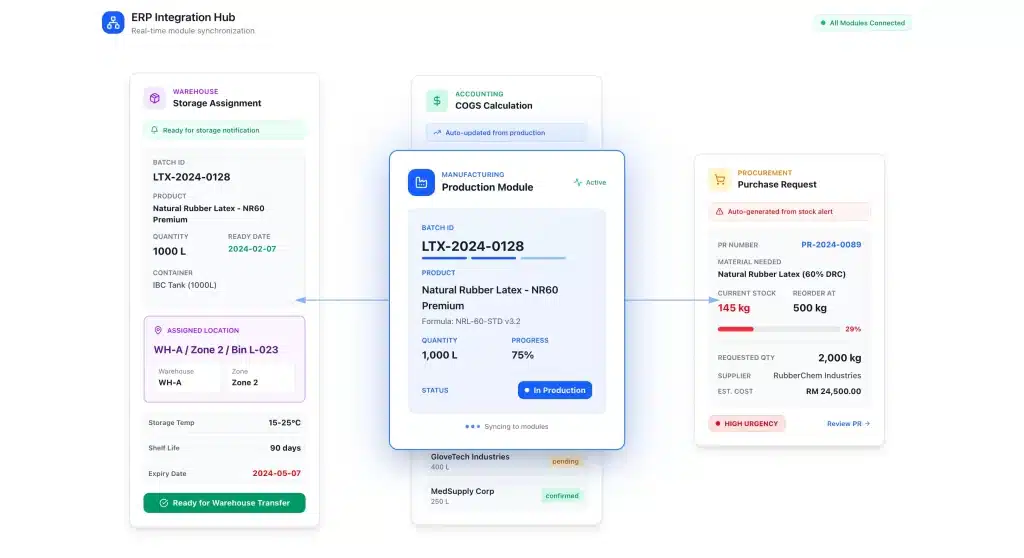 A manufacturing system’s true power is unlocked when it connects seamlessly with other business software. This integration creates a single source of truth, eliminating data silos and error-prone manual entry.
1. Integration with accounting systems
This automates financial workflows by sending production cost data directly to the accounting system for accurate COGS calculation. It can also trigger automatic invoicing upon shipment to improve cash flow.
2. Synchronisation with procurement management
It links production needs with purchasing by automatically creating purchase requests when stock levels are low. This ensures timely material availability and supports better supplier negotiations.
3. Connectivity with CRM and sales
Connecting with a CRM gives the sales team real-time visibility into product availability for accurate delivery promises. Sales data, in turn, can be used to generate more precise production forecasts.
4. Link with warehouse management (WMS)
This integration streamlines logistics by notifying the WMS when products are ready for storage. It also helps manage efficient order picking, packing, and shipping processes for sales orders.
Choosing a System That Fits Your Production
Selecting the right manufacturing software is a long-term investment that requires a careful, systematic evaluation. This approach ensures you find a technology partner that understands your unique business needs and goals.
1. Evaluate your specific business needs
Begin by conducting an internal analysis to identify your primary challenges and operational objectives. Involve key departments to create a clear and prioritised list of functional requirements.
2. Check for scalability and flexibility
Ensure the software can grow with your business, whether you are adding new product lines or expanding facilities. Ask vendors about customisation options to confirm the system can adapt to your unique workflows.
3. Prioritise user-friendliness and technical support
Choose a system with an intuitive interface to reduce the learning curve and encourage user adoption. Evaluate the vendor’s technical support services to ensure they offer comprehensive local training and assistance.
4. Consider the total cost of ownership (TCO)
Look beyond the initial licence fee to understand the full cost, including implementation, customisation, and support. Request transparent pricing from the outset to avoid unexpected expenses down the line.
5. Request a live demo and relevant case studies
Never make a decision without seeing a live demonstration tailored to your specific use cases. Ask for case studies from other nutraceutical companies to verify the software’s real-world effectiveness.
Conclusion
manufacturing involves more variables than typical production. Formulas change, ingredients expire, and regulators expect complete documentation for every batch. Managing all of this manually works at small scale, but breaks down as production grows.
Manufacturing software does not eliminate the need for skilled operators or quality teams. What it does is connect the pieces so everyone works from the same data. Formulas stay current. Expiry dates get flagged before materials reach the production line. Batch records are complete when auditors arrive.
If your current system relies on spreadsheets and paper logs, it may be worth testing a manufacturing ERP to see where the gaps are. Most providers offer free demos or trial periods so you can evaluate fit before committing.
FAQ about Nutraceutical Manufacturing Software
-
What’s the main difference between general manufacturing software and one built for nutraceuticals?
The difference is in compliance and quality control features. Nutraceutical-specific software includes built-in tools for lot tracking, complex formula management, and cGMP-compliant documentation. General manufacturing software typically lacks these.
-
How does this software help during regulatory audits?
It provides a complete digital audit trail. During inspections, you can quickly generate Electronic Batch Production Records (EBRs), lot traceability history, and quality testing logs. This cuts down audit prep time significantly.
-
Can the software handle multiple production sites or warehouses?
Yes. Modern ERP platforms are built for multi-location operations. You can monitor inventory, production schedules, and performance metrics across all facilities from a single dashboard.
-
How long does implementation take?
It depends on your operation’s complexity, typically ranging from a few weeks to several months. A good vendor will work with you on a realistic rollout plan, including data migration and user training.