










Key Takeaways
|
What Is Lot Tracking and Why Is It Crucial?
Lot tracking is an inventory management method used to trace product batches across the supply chain. Each group of items produced or received together is assigned a unique lot number. This enables businesses to monitor product history, shelf life, and movement from raw materials to customers. Today, lot tracking is essential for maintaining quality, safety, and operational efficiency.
Understanding lot tracking helps businesses improve recall readiness and daily inventory control. The system ensures older stock is used first and supports compliance with industry regulations. By knowing how lot tracking differs from other tracking methods and what components support it, companies can make more accurate, data-driven operational decisions.
1. The fundamental definition of lot tracking
Lot tracking groups products with similar production details under one lot number. This number records the batch’s journey across sourcing, production, and distribution. It allows full traceability, which is critical for quality control, stock accuracy, and regulatory compliance.
2. Key differences: Lot tracking vs. serial number tracking
Lot tracking monitors products by batch, while serial number tracking follows individual units. Lot tracking suits high-volume goods like food and pharmaceuticals. Serial tracking is better for high-value products needing individual service or warranty records.
3. Key components in a lot tracking system
A lot tracking system relies on three elements: a unique lot number, detailed batch data (production date, supplier, expiry), and tracking technology like barcodes or RFID. These are supported by centralized inventory software that turns data into actionable insights.
Why Is Lot Tracking Important for Your Business?
In today’s competitive and highly regulated market, lot tracking is no longer just an inventory practice but a strategic business necessity. It protects brand reputation, ensures regulatory compliance, and reduces operational risks. Without proper batch traceability, companies face inefficiencies, waste, and costly legal exposure.
Lot tracking delivers operational and financial benefits across the organization. With full batch visibility, businesses can improve product safety, optimize inventory, and make proactive decisions. Here are the key reasons lot tracking is a critical investment.
1. Ensuring regulatory compliance and industry standards
Lot tracking helps meet strict traceability regulations in industries like food, pharma, and medical devices. It simplifies audits, reduces legal risks, and demonstrates commitment to consumer safety.
2. Improving quality management and product safety
Batch traceability allows companies to quickly isolate defects, identify root causes, and prevent faulty products from reaching customers, protecting brand trust.
3. Facilitating fast and accurate product recalls
Instead of recalling all products, companies can isolate specific batches, reducing financial loss and preserving customer confidence.
4. Optimizing stock rotation (FIFO/FEFO)
Lot tracking supports efficient inventory rotation, minimizing expired stock, reducing waste, and improving profitability.
5. Increasing supply chain visibility
Businesses gain real-time insight into product movement, improving demand planning, logistics efficiency, and overall operational control.
How Does a Lot Tracking System Work?
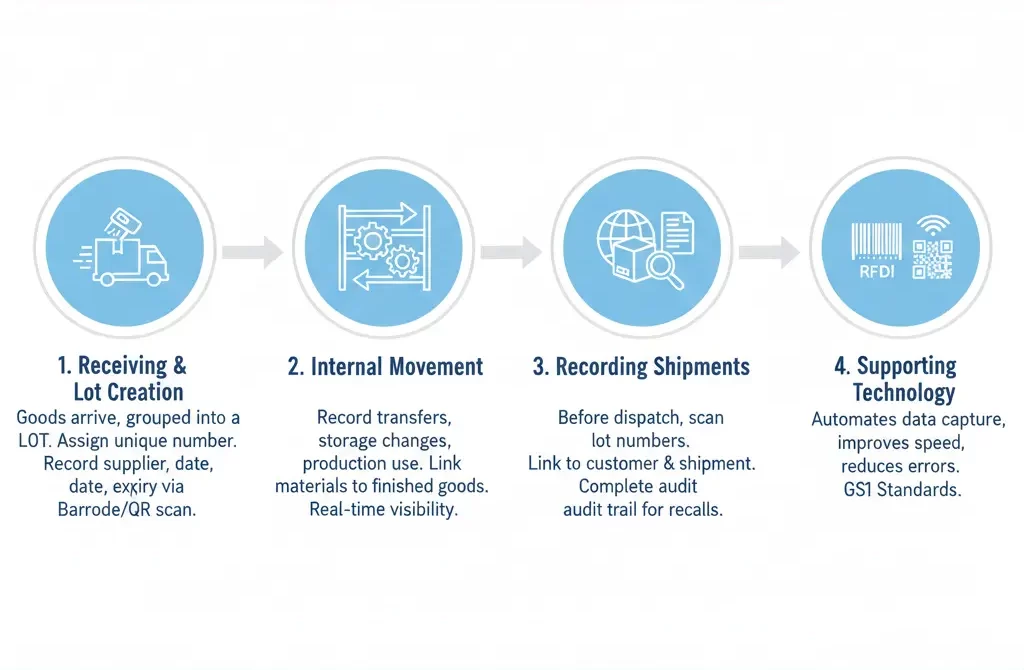
Understanding how a lot tracking system works is key to implementing it effectively. The system creates a continuous digital trail for every product batch, recording critical data from receiving to final shipment. Each step relies on standardized procedures and technology to maintain data accuracy and traceability.
Consistency and automation are what make lot tracking reliable. From structured lot numbers to barcode or RFID scanning, each element reduces human error and supports smooth daily operations. Here are the core stages of the lot tracking workflow.
1. Stage 1: Receiving goods and creating a lot number
Tracking starts when goods arrive. Items received together are grouped into one lot, assigned a unique lot number, and recorded with supplier, date, and expiry data using barcode or QR scanning.
2. Stage 2: Tracking internal movement (production and transfers)
Every transfer, storage change, or production use is recorded. This links raw material lots to finished goods and ensures real-time visibility of each batch’s location and status.
3. Stage 3: Recording shipments to customers
Before dispatch, lot numbers are scanned and linked to customer and shipment details. This completes the audit trail and enables fast, targeted recalls if issues arise.
4. Supporting technology: Barcodes, QR codes, and RFID
Barcodes, QR codes, and RFID automate data capture, improve speed, and reduce errors. Standards like GS1 ensure compatibility across supply chains.
Common Challenges in Lot Tracking Implementation and Their Solutions
Implementing lot tracking sounds powerful in theory, but in practice it often comes with real operational and technical hurdles. Companies moving from manual systems frequently underestimate the discipline, integration, and cultural change required. Without preparation, projects can stall, data becomes unreliable, and the system adds complexity instead of control.
The good news? These challenges are manageable with the right strategy. Early planning, strong change management, proper training, and smart technology choices make the transition smoother. Here are the most common obstacles—and how to overcome them.
1. High initial costs and resource allocation
Software, scanners, RFID, and training require upfront investment. Build a strong business case showing savings from reduced waste, fewer recall losses, and higher efficiency. Consider phased rollout and cloud-based systems to lower initial spending.
2. Employee resistance and lack of training
New workflows often face pushback. Communicate clear benefits, provide role-based training, and involve key staff early. When employees understand the “why” and “how,” adoption becomes much easier.
3. Integration with existing systems
Lot tracking delivers real value only when connected to ERP, accounting, and WMS systems. Choose solutions with strong APIs or built-in integrations, and involve IT teams early to ensure smooth data flow.
A Guide to Implementing Lot Tracking in Your Company
Implementing a lot tracking system is not just about software—it requires workflow redesign, clear standards, and team readiness. A structured rollout minimizes disruption and ensures the system truly improves traceability, efficiency, and data accuracy.
This step-by-step guide helps companies of any size adopt lot tracking effectively, from evaluating processes to full system integration.
1. Step 1: Evaluate your current inventory processes
Map how goods are received, stored, moved, and shipped. Identify inefficiencies, risks, and data gaps across departments to build a system that solves real operational issues.
2. Step 2: Define your lot numbering standards
Create a consistent lot number structure (e.g., date, location, product code). Clear standards ensure easier tracking, reporting, and cross-team alignment.
3. Step 3: Choose the right lot tracking software
Select user-friendly, scalable software with strong lot tracking features and integration with inventory, sales, accounting, and production systems.
4. Step 4: Train your team and conduct a pilot test
Provide role-based training, then test the system in one area or product line. Use feedback to refine workflows before full deployment.
5. Step 5: Integrate with other systems (ERP, Accounting)
System integration ensures inventory, financial, and operational data stay synchronized, eliminating silos and improving decision-making accuracy.
The Future of Lot Tracking: Innovations and Technological Trends
Lot tracking is evolving from basic barcode recording into a smart, connected traceability system. Businesses now expect real-time visibility, automation, and deeper supply chain insights. Companies that keep up with these innovations gain stronger control, faster decisions, and greater operational resilience.
Emerging technologies are reshaping how products are tracked, verified, and monitored. Beyond internal efficiency, these tools also improve collaboration with suppliers and strengthen customer trust through greater transparency.
1. Blockchain for enhanced transparency and security
Blockchain creates a tamper-proof record of every product movement. This boosts authenticity verification, regulatory trust, and consumer confidence—especially for food, pharma, and high-value goods.
2. Artificial intelligence (AI) and machine learning (ML) for predictive insights
AI analyzes lot history, demand patterns, and external data to improve forecasting, optimize inventory, detect quality risks early, and reduce waste across operations.
3. Internet of Things (IoT) for real-time monitoring
Conclusion
Effective lot tracking is no longer just an operational tool, but a key foundation for maintaining product quality, regulatory readiness, and supply chain transparency. When batch data is accurate and accessible, businesses can respond faster, reduce risk, and operate with greater control.
A structured approach supported by integrated systems helps transform traceability from a reactive task into a proactive management practice. With better visibility across inventory movements, teams can strengthen compliance, improve efficiency, and make more confident decisions.
For organizations looking to enhance batch-level control and build a more resilient supply chain, discussing the right approach with system specialists can be a practical next step toward long-term operational improvement.
FAQ About Lot Tracking
-
What is the main difference between FIFO and FEFO in lot tracking?
FIFO (First-In, First-Out) ensures that the first products received are the first to be sold. FEFO (First-Expired, First-Out) is more specific, prioritizing products with the earliest expiration date, which is crucial for perishable goods.
-
Do small and medium enterprises (SMEs) also need a lot tracking system?
Absolutely. SMEs can benefit greatly from lot tracking to reduce waste, improve quality control, and build customer trust. Cloud-based systems now make it affordable and scalable for businesses of all sizes.
-
What information should ideally be in a lot number?
Ideally, a lot number should contain key information such as the production date, location or facility code, and a unique batch sequence number. This makes tracing the product’s origin and history much easier.
-
Are there industries where lot tracking is legally mandatory?
Yes, lot tracking is legally mandatory in many industries, most notably pharmaceuticals, medical devices, and the food and beverage sector. Regulatory bodies like the FDA require strict traceability to ensure consumer safety and enable rapid recalls.
-
How does lot tracking specifically help reduce expired product waste?
By tracking the expiration date of each lot, the system can automatically alert staff to prioritize selling or using products that are nearing their expiry. This systematic approach ensures older stock is moved first, drastically minimizing spoilage.