





Good Manufacturing Practice (GMP) becomes an indispensable framework for any manufacturing business. It provides a systematic approach to production and quality control, ensuring that every product leaving the facility is safe, effective, and consistent. Adhering to GMP is not just about following rules; it is a fundamental commitment to excellence that builds consumer trust and strengthens brand reputation.
For many businesses, implementing GMP may seem like a daunting task involving significant investment in processes, people, and technology. However, viewing it as a cost is a shortsighted perspective. Instead, GMP software should be seen as a strategic investment that yields substantial returns through enhanced efficiency, reduced waste, and access to new markets.
This comprehensive guide will demystify GMP, breaking down its core principles, key components, and a step-by-step implementation plan to help your organization achieve operational excellence and thrive in the demanding market of 2026.
Key Takeaways
|
What Is Good Manufacturing Practice (GMP)?
Good Manufacturing Practice (GMP) is a system of principles and procedures designed to ensure that products are consistently produced and controlled in accordance with strict quality standards. It covers all aspects of production, from the initial sourcing of materials to the final distribution of the finished goods.
This framework is not a one-size-fits-all solution but rather a set of guidelines that can be adapted across industries, including pharmaceuticals, food and beverages, cosmetics, and medical devices.
A. Definition of Good Manufacturing Practice
Formally, Good Manufacturing Practice is defined as the part of quality assurance which ensures that products are consistently produced and controlled to the quality standards appropriate to their intended use and as required by the marketing authorization. It is concerned with both production and quality control aspects of manufacturing. .
B. A brief history and evolution of GMP
The concept of GMP emerged in the 1960s in the United States in response to several tragic incidents involving contaminated or improperly formulated pharmaceutical products. The most notable was the thalidomide disaster, which caused severe birth defects in thousands of children. This event highlighted the urgent need for stringent government oversight of drug manufacturing processes.
C. The difference between GMP, ISO 22000, and HACCP
While GMP, ISO 22000, and HACCP all aim to ensure product safety, they have different scopes and focuses. GMP provides a broad framework for the overall manufacturing process and quality management. Hazard Analysis and Critical Control Points (HACCP), on the other hand, is a specific system focused on identifying and controlling food safety hazards at critical points in the production process. ISO 22000 is a more comprehensive food safety management system standard that incorporates the principles of both GMP and HACCP. Essentially, GMP and HACCP can be considered components of the larger ISO 22000-certified system, with GMP establishing foundational conditions and HACCP providing risk-based control measures.
Why Is GMP a Crucial Investment for Manufacturing Businesses?
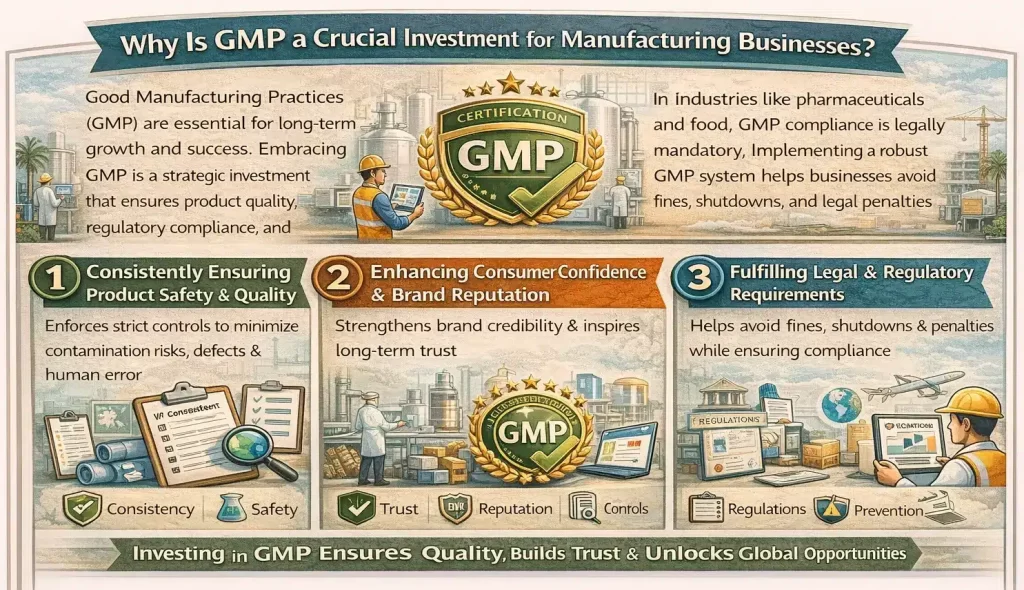
For any manufacturing business aiming for sustainable growth and success in 2026, a strong GMP system is not an option, but an essential foundation.
A. Consistently ensuring product safety and quality
The foremost benefit of GMP is its role in ensuring that every manufactured product is safe and meets its intended quality specifications. By standardizing processes, controlling variables, and implementing rigorous checks at every stage, GMP minimizes the risk of errors, contamination, and defects.
B. Enhancing consumer confidence and brand reputation
A strong commitment to GMP directly translates into a stronger brand. When consumers know that a company adheres to stringent quality standards, their confidence in the products grows. This trust is a powerful asset, leading to repeat business, positive word-of-mouth, and a loyal customer base. In the event of a quality issue, a well-documented GMP system allows for swift and transparent investigation, reinforcing the company’s commitment to consumer safety.
C. Fulfilling legal and regulatory requirements
For many manufacturing sectors, particularly pharmaceuticals and food, GMP compliance is mandated by law. Failure to adhere to these regulations can result in severe penalties, including fines, facility shutdowns, and criminal charges. By implementing a robust GMP system, businesses ensure they are operating within the legal framework, avoiding costly legal battles and operational disruptions.
D. Opening access to global markets and enhancing competitiveness
In a global marketplace, GMP certification is often a prerequisite for international trade. Many countries and trading blocs will not allow the import of products, especially pharmaceuticals and food, unless they are manufactured in a GMP-certified facility. Therefore, adopting GMP is a strategic move that significantly expands a company’s market reach.
E. Improving operational efficiency and reducing costs from product failures
While an initial investment is required to implement GMP, the long-term financial benefits are substantial. Standardized procedures and well-defined processes lead to greater operational efficiency, reducing waste of materials, time, and labor. By preventing defects and product failures, GMP significantly reduces costs associated with recalls, rework, and customer complaints.
10 Core Principles That Form the Foundation of Good Manufacturing Practice
At the heart of any effective Good Manufacturing Practice system are a set of core principles that guide every action and decision within a manufacturing environment. These principles are not merely a checklist but a philosophy that must be ingrained in the company culture to be truly effective.
Understanding and applying these ten foundational principles is the first step toward building a robust GMP system that can withstand regulatory scrutiny and earn consumer trust.
A. Creating clear standard operating procedures (SOPs)
The first principle is to establish and write down clear, step-by-step procedures and work instructions for every critical process. These Standard Operating Procedures (SOPs) eliminate ambiguity and ensure that tasks are performed consistently by all personnel, regardless of who is performing them. SOPs should be detailed, easy to understand, and readily accessible to the relevant staff. They serve as the primary reference for how work should be done, forming the backbone of a reproducible and controlled manufacturing process.
B. Consistently following established procedures
Creating procedures is only half the battle; the second principle is to ensure they are followed meticulously and consistently by everyone. Deviations from established SOPs can introduce variability and risk into the process, potentially compromising product quality. A strong GMP culture emphasizes discipline and accountability, where following procedures is a non-negotiable aspect of daily work. Regular training and supervision are essential to reinforce this principle and ensure that best practices become ingrained habits.
C. Documenting all processes accurately and in real-time
The third principle, often summarized as “if it was not documented, it did not happen,” underscores the importance of meticulous record-keeping. All activities, from receiving raw materials to shipping finished products, must be documented promptly and accurately. This documentation provides a complete history of each batch, creating an invaluable traceable audit trail for quality control, deviation investigations, and regulatory audits. Real-time documentation prevents errors from memory and ensures data integrity.
D. Validating the effectiveness of procedures and systems
The fourth principle involves proving that the established procedures, processes, and systems consistently produce the expected results. This process, known as validation, is a cornerstone of GMP. It involves collecting and analyzing data to demonstrate that a process will reliably and repeatedly produce a product of a predetermined quality. Validation provides objective evidence that the system is under control and can consistently maintain quality standards over time.
E. Designing, building, and maintaining appropriate facilities and equipment
The physical environment and the tools used in manufacturing are critical to product quality. The fifth principle requires that facilities and equipment are designed, located, and maintained to suit their intended operations. This includes logical workflow design to prevent mix-ups, smooth surfaces for easy cleaning, adequate lighting and ventilation, and equipment constructed from materials that will not contaminate the product. The goal is to create an environment that actively supports quality and prevents contamination.
F. Performing routine maintenance and calibration of equipment
To function correctly, manufacturing equipment must be maintained in optimal condition. The sixth principle mandates a robust program for routine maintenance, cleaning, and calibration of all critical equipment. A preventive maintenance schedule helps to avoid breakdowns that can disrupt production and compromise product quality. Regular calibration ensures that measuring instruments, such as scales and thermometers, provide accurate readings, which is crucial for process control and product consistency.
G. Continuously developing personnel competence and expertise
The people behind the process are the most critical component of any GMP system. The seventh principle emphasizes the need for all personnel to be properly qualified and trained for their assigned roles. This includes initial training on their specific tasks and GMP principles, as well as ongoing training to maintain and update their skills. Competent employees are more likely to perform their jobs correctly, understand the importance of quality, and actively contribute to the success of the GMP system.
H. Maintaining cleanliness and sanitation throughout the facility
Cleanliness is a fundamental prerequisite for preventing product contamination. The eighth principle requires a comprehensive sanitation program that covers personnel, facilities, and equipment. This includes establishing written cleaning procedures, defining cleaning schedules, and maintaining records of all sanitation activities. Personal hygiene practices for employees, such as wearing appropriate protective clothing and washing hands, are also critical to maintaining a clean and controlled manufacturing environment.
I. Implementing comprehensive quality control at every stage
Quality control must be integral to the entire manufacturing process, not just a final inspection. The ninth principle involves implementing controls throughout the production lifecycle, including the testing of raw materials, in-process materials, and finished products. This ensures that materials and products meet their specifications at every critical step. It also includes systems for managing deviations, investigating non-conformities, and implementing corrective and preventive actions (CAPA) to address root causes.
J. Conducting regular audits for compliance and improvement
The final principle is to verify that the GMP system is functioning as intended periodically and to identify opportunities for improvement. This is achieved through a program of regular self-inspections and quality audits. These audits should assess all aspects of the operation for compliance with GMP principles and internal procedures. The findings from these audits provide valuable feedback to refine processes, correct deficiencies, and drive a cycle of continuous improvement across the organization.
Dissecting the 5 Key Components of GMP (5P) in Manufacturing Operations
To effectively implement Good Manufacturing Practice, it is helpful to break down the system into its core components. A widely recognized framework for this is the “5 P’s of GMP,” which provides a structured approach to addressing the critical factors that influence product quality. It serves as a practical guide for ensuring that every aspect of the manufacturing operations contributes positively to the final quality of the product.
A. People (Personnel)
People are the most critical asset in any manufacturing operation. This component of GMP emphasizes that all personnel must be qualified, trained, and competent to perform their assigned tasks. Their responsibilities should be clearly defined in job descriptions, and they must receive initial and ongoing training in GMP principles, specific SOPs, and personal hygiene. A culture of quality must be fostered, where every employee understands their role in protecting product integrity and feels empowered to report any issues or deviations they observe.
B. Premises (Buildings and Facilities)
The physical environment where manufacturing occurs plays a vital role in preventing contamination and ensuring product quality. The ‘Premises’ component requires that buildings and facilities be designed, constructed, and maintained to facilitate proper operations, cleaning, and maintenance. This includes a logical layout to prevent cross-contamination, adequate space for operations, controlled environmental conditions (like temperature and humidity), and proper lighting and ventilation. Surfaces should be smooth, durable, and easy to clean, and there must be effective systems for waste disposal and pest control.
C. Processes (Production Processes)
All processes involved in manufacturing must be clearly defined, validated, and controlled to ensure consistency and reproducibility. This component covers every step, from the receipt of raw materials through processing and packaging to the distribution of the final product. Critical process parameters must be identified and monitored to ensure the process remains in a state of control. Any changes to a process must be managed through a formal change control procedure to evaluate their potential impact on product quality.
D. Products (Products and Raw Materials)
This component focuses on the materials themselves, including raw materials, packaging components, in-process materials, and finished products. All materials must have clear specifications for quality, and they must be tested to ensure they meet these specifications before use. Materials should be handled and stored under appropriate conditions to prevent degradation or contamination. A robust system for traceability is also required, allowing every component in a finished product to be traced back to its source, which is critical for investigations and recalls.
E. Procedures (Procedures and Documentation System)
Procedures and documentation are the glue that holds the GMP system together. This component, also referred to as ‘Paperwork’, requires a robust system of documentation and record-keeping for all activities. This includes having written Standard Operating Procedures (SOPs) for every critical task, as well as maintaining detailed records for each batch produced (Batch Manufacturing Records). This documentation provides the evidence that processes were followed correctly and allows for a complete and traceable history of every product manufactured.
Specific GMP Applications Across Various Industry Sectors
The level of stringency and areas of focus are tailored to the unique risks associated with each product type. For example, the controls required for manufacturing sterile injectable drugs are far more rigorous than those for producing a cosmetic lotion. Understanding these sector-specific nuances is crucial for implementing a GMP system that is both compliant and practical for a particular business.
This section will explore how GMP is specifically applied in key manufacturing industries, highlighting the unique challenges and requirements that define compliance in each field.
A. Food and beverage industry
In the food and beverage industry, GMP focuses on preventing contamination and ensuring food safety. Key areas of concern include controlling microbial hazards, managing allergens, and ensuring the cleanliness of equipment and facilities. GMP in this sector involves strict personal hygiene protocols for employees, robust pest control programs, and procedures for cleaning and sanitizing food contact surfaces. It also requires careful control of raw materials and a traceability system to quickly manage any food safety incidents, as detailed in frameworks such as HACCP.
B. Pharmaceutical and medical device industry
The pharmaceutical industry has the most stringent GMP requirements, often referred to as Current Good Manufacturing Practice (cGMP), which emphasizes that systems must be up-to-date with the latest technology and standards. The focus is on ensuring product identity, strength, quality, and purity. This involves rigorous validation of processes, sterile manufacturing controls for injectable products, prevention of cross-contamination between different active ingredients, and a highly detailed system of documentation and batch records. Similar strict controls apply to medical devices to ensure they are safe and perform as intended.
C. Cosmetics and personal care industry
For cosmetics, GMP guidelines focus on ensuring products are free of harmful microorganisms and contaminants and remain stable throughout their shelf life. While generally less stringent than pharmaceutical GMP, cosmetics GMP still requires careful control of raw materials, clean production environments, and proper documentation. Key considerations include microbial testing of products, ensuring formulation stability, and accurate ingredient labeling to protect consumers with sensitivities or allergies.
D. Supplements and the nutraceutical industry
The GMP requirements for dietary supplements and nutraceuticals fall somewhere between those for food and pharmaceuticals. The goal is to ensure that supplements contain the ingredients stated on the label, in the specified amounts, and are free from contaminants. This involves verifying the identity and purity of raw materials, controlling the manufacturing process to ensure consistent potency, and conducting finished product testing. Proper labeling and claims are also a critical aspect of GMP in this sector to avoid misleading consumers.
A Step-by-Step Guide to Implementing GMP in Your Company
Implementing a Good Manufacturing Practice system is a structured journey that transforms a company’s approach to quality. By following this phased approach, companies can navigate the implementation process efficiently, ensuring a smooth transition to a GMP-compliant operation.
A. Stage 1: Forming a GMP team and securing full management commitment
The first and most critical step is to secure unwavering commitment from senior management. Without this support, any GMP initiative is likely to fail. Once commitment is established, a cross-functional GMP implementation team should be formed. This team should include representatives from key departments such as quality assurance, production, engineering, and warehousing. Their role will be to lead the project, develop the implementation plan, and drive the necessary changes throughout the organization.
B. Stage 2: Conducting a gap analysis
Before making any changes, it is essential to understand where your current operations stand in relation to GMP requirements. A thorough gap analysis involves auditing your existing facilities, processes, documentation, and training against the applicable GMP guidelines for your industry. This assessment will identify all areas of non-compliance and provide a clear list of deficiencies to address. The results of the gap analysis will form the basis of your implementation action plan.
C. Stage 3: Developing and drafting documentation (SOPs & records)
Based on the gap analysis, the next stage is to develop the necessary documentation. This is often the most time-consuming part of the implementation. It involves writing Standard Operating Procedures (SOPs) for all critical processes, creating forms and records for documenting activities, and developing specifications for all materials and products. The documentation should be clear, concise, and practical, providing a solid framework for consistent and controlled operations.
D. Stage 4: Providing intensive training for all relevant employees
With the new procedures in place, it is crucial to train all employees on their roles and responsibilities within the GMP system. Training should cover general GMP principles, specific SOPs relevant to their jobs, and personal hygiene requirements. The goal is to ensure that every employee understands not just what they need to do, but also why it is important. Training effectiveness should be assessed, and records of all training must be maintained.
E. Stage 5: Implementation, monitoring, and initial evaluation
This is the stage where the new procedures are put into practice. The GMP team should closely monitor the implementation process to ensure that procedures are being followed correctly and to provide support to employees. During this initial phase, it is important to collect data and evaluate the effectiveness of the new system. This allows for any necessary adjustments to be made before the system is fully rolled out across the entire operation.
F. Stage 6: Conducting internal audits and preparing for external certification
Once the GMP system has been implemented and is running smoothly, the final stage is to verify its compliance and effectiveness. This is done through a program of regular internal audits conducted by trained personnel who are independent of the area being audited. These audits identify any remaining gaps and prepare the company for an official audit by a regulatory body or a third-party certification organization. The goal is to achieve a state of continuous audit-readiness and a culture of ongoing improvement.
The Role of Technology in Supporting and Automating GMP Compliance
Manual, paper-based systems are prone to human error, are difficult to manage at scale, and provide limited real-time visibility into operations. Modern technology, particularly integrated software solutions like Enterprise Resource Planning (ERP) systems, offers powerful tools to automate processes, enforce procedures, and maintain impeccable digital records, thereby strengthening every aspect of a GMP framework.
This integration of technology not only simplifies compliance but also provides valuable data and analytics that can be used to drive continuous improvement and optimize manufacturing performance.
A. Automating manufacturing processes with an integrated ERP system
An integrated manufacturing ERP system serves as the central nervous system for a GMP-compliant operation. It automates and connects various processes, from production scheduling and execution to quality control and maintenance. By enforcing workflows based on pre-defined SOPs, an ERP system ensures that processes are executed in the correct sequence and that all required data is captured automatically. This reduces the risk of human error and provides a consistent, controlled production environment.
B. Precise inventory management for material traceability
Traceability is a core requirement of GMP, and technology provides the most effective tools to achieve it. An advanced inventory management system, often part of an ERP, uses tools like barcoding or RFID to track every material from receipt to its use in a specific batch. This creates a detailed digital record of material movement and usage, enabling full traceability in both directions. In the event of a quality issue with a raw material, companies can quickly identify all affected batches of finished product, facilitating a swift and targeted recall.
C. Digitizing documentation and production batch records
The burden of paperwork is one of the biggest challenges in GMP. Electronic Batch Record (EBR) and Document Management Systems (DMS) digitize this entire process. These systems manage the creation, review, approval, and distribution of all GMP documents, such as SOPs and specifications, ensuring that only the current, approved versions are in use. EBRs guide operators through the manufacturing process electronically, capturing data in real-time and ensuring all steps are completed and signed off, creating a perfect, error-free batch record every time.
D. Predictive maintenance for production assets and facilities
Maintaining equipment in a validated state is crucial for GMP. Modern Asset Management software goes beyond simple scheduled maintenance by using sensors and data analytics for predictive maintenance (PdM). By monitoring equipment condition and performance in real time, these systems can predict potential failures before they happen. This allows maintenance to be scheduled proactively, preventing unexpected downtime, avoiding costly emergency repairs, and ensuring that equipment remains in a constant state of readiness and compliance.
Common Challenges in Implementation and How to Overcome Them
Many companies, especially small and medium-sized enterprises, can find the process overwhelming due to perceived costs, complexity, and the cultural shifts required. However, these challenges are not insurmountable. With strategic planning, a phased approach, and a clear understanding of the potential hurdles, any organization can successfully navigate the journey to GMP compliance.
This section will address the most frequent difficulties encountered during GMP implementation and offer practical, actionable solutions to help ensure a smooth and successful transition.
A. Initial investment costs for facilities and technology
One of the most significant barriers is the upfront cost of upgrading facilities, purchasing new equipment, and implementing new technologies such as an ERP system. To overcome this, it is crucial to develop a detailed business case that outlines not just the costs, but also the long-term return on investment (ROI). This includes quantifiable benefits like reduced waste, lower recall risk, increased efficiency, and access to new markets. A phased implementation approach can also help spread the costs over time, making the investment more manageable.
B. Resistance to cultural change from employees
Employees who are accustomed to established ways of working may resist the new, more rigid procedures required by GMP. Overcoming this resistance requires strong leadership, clear communication, and comprehensive training. It is essential to explain the ‘why’ behind the changes, emphasizing the benefits for product quality, consumer safety, and job security. Involving employees in the process of developing new SOPs can also foster a sense of ownership and reduce resistance, turning them into advocates for the new system.
C. Complexity in drafting and managing documentation
The sheer volume of documentation required for GMP can be daunting. The key to managing this complexity is to start small and be systematic. Focus on developing SOPs for the most critical processes first. Utilize standardized templates to ensure consistency and consider implementing a digital Document Management System (DMS) early on. A DMS simplifies the entire document lifecycle, from creation and review to distribution and archiving, significantly reducing the administrative burden and ensuring compliance.
D. Understanding and navigating the GMP certification process
The process of achieving official GMP certification from a regulatory body like the FDA or a third-party auditor can seem opaque and complex. To navigate this, it is highly beneficial to seek expert guidance. This could involve hiring a consultant with experience in your specific industry or thoroughly studying the guidelines and resources provided by the relevant regulatory authorities. Conducting rigorous internal audits that mimic the external audit process is also an excellent way to prepare the team and identify any final gaps before the official inspection.
Optimize Your Manufacturing Business with Manufacturing Solutions from HashMicro

HashMicro’s system is designed with full integration between modules, allowing data to flow seamlessly between departments such as accounting, inventory, purchasing, and sales. This provides unparalleled visibility into the entire business operation and ensures that every decision is based on accurate, up-to-the-minute information. This level of integration is critical for maintaining the traceability and documentation standards required by GMP.
Features of HashMicro Manufacturing Software:
- Manufacturing Production Scheduling: Helps create detailed production schedules based on demand data and factory capacity, ensuring a more organized and efficient production flow.
- Secret Recipe/BoM (Bill of Materials): Manages recipes or material compositions secretly and structurally, ensuring product quality standards are maintained in every production batch.
- Manufacturing Quality Control: Provides a comprehensive quality control system at every stage, ensuring products consistently meet safety and quality standards.
- Machine Maintenance Management: Automatically schedules machine maintenance to prevent downtime and maintain high productivity, a key component of GMP compliance.
- Real-Time Production Dashboard: Provides a visual, real-time data display to help managers make faster, more accurate decisions about the production floor.
With HashMicro, your company can enhance operational efficiency, data transparency, and business process automation. To see how our solutions can concretely help your business, do not hesitate to try our free demo now.
Conclusion
Good Manufacturing Practice is an essential framework that underpins quality, safety, and consistency in the manufacturing industry. Its principles and components provide a comprehensive roadmap for building a robust quality management system that not only meets regulatory requirements but also drives business excellence. By embracing GMP, companies can significantly reduce risks, enhance consumer trust, improve operational efficiency, and unlock new market opportunities. The implementation journey, while challenging, is a strategic investment in the long-term health and success of the business.
In 2026, the integration of technology, particularly comprehensive HashMicro manufacturing systems, has made achieving and maintaining GMP compliance more accessible than ever. Try our free demo to see how automating processes, digitizing records, and providing real-time visibility transform GMP from a burdensome obligation into a powerful tool for continuous improvement. Ultimately, a strong GMP culture is a testament to a company’s unwavering commitment to its customers and to producing products of the highest quality.
FAQ About Good Manufacturing Practice
-
What is the main purpose of Good Manufacturing Practice (GMP)?
The primary purpose of GMP is to minimize risks in production processes that cannot be eliminated by testing the final product. It ensures products are consistently high in quality, from batch to batch, and safe for consumer use.
-
What is the primary purpose of Good Manufacturing Practice (GMP)?
The 5 P’s of GMP are People (personnel), Premises (facilities), Processes, Products (and raw materials), and Procedures (documentation). These five components are crucial areas that must be controlled to maintain a compliant manufacturing environment.
-
What are the 5 P’s of GMP?|Is GMP certification mandatory?
Whether GMP is mandatory depends on the industry and country. In many regions, compliance with GMP regulations is a legal requirement for marketing and selling products in sectors such as pharmaceuticals, food, and medical devices.