










Optimizing your fulfillment warehouse is essential for maintaining a competitive edge in today’s fast-paced business environment. By improving distribution efficiency and reducing shipping costs, businesses can enhance customer satisfaction and scale operations effectively.
One of the most effective ways to achieve this is by leveraging a fulfillment warehouse. This specialized facility helps businesses manage inventory, process orders, and ensure timely deliveries with minimal operational hassle.
This article examines how a fulfillment warehouse optimizes logistics, enhances efficiency, and facilitates business scalability. Try our free demo and head on to discover how investing in a warehouse management system (WMS) can improve your fulfillment strategy.
Key Takeaways
|
What is Fulfillment Warehouse?
A fulfillment warehouse is a specialized facility that manages the storage, processing, and delivery of products on behalf of businesses, particularly e-commerce and retail companies. Its primary function is to handle every stage of order fulfillment from receiving inventory and storing it safely to picking, packing, and shipping customer orders efficiently.
Fulfillment warehouses in Malaysia often use automation and inventory management software to ensure real-time stock tracking and accurate order processing. Many also integrate with online marketplaces like Shopee, Lazada, and Shopify, enabling seamless order updates and faster delivery to customers nationwide.
How does Fulfillment Warehouse Work?
A fulfillment warehouse in Malaysia works by managing the entire order fulfillment process for businesses, from storing inventory to delivering products to customers. Here’s how it typically operates step by step:
1. Receiving Inventory: Businesses send their products to the fulfillment warehouse. Upon arrival, the warehouse team verifies the accuracy and quality of the items, then logs them into the warehouse management system (WMS). How fast this dock to stock cycle runs determines how quickly new inventory is ready to ship.
2. Storage and Organization: The products are stored in designated areas — often organized by SKU, product type, or demand frequency. Modern warehouses in Malaysia utilize barcode scanning and automated inventory systems to track stock levels in real-time.
3. Order Processing: When a customer places an order (for example, through Shopee, Lazada, or an online store), the order details are automatically sent to the fulfillment center. The system identifies the product location and generates a pick list for the warehouse staff.
4. Picking and Packing: The warehouse team picks the ordered items, verifies them for accuracy, and packs them securely according to brand or courier requirements. Some warehouses even offer customized packaging and labeling services.
5. Shipping and Delivery: Once packed, the orders are handed over to logistics partners such as Pos Laju, J&T Express, or DHL. Tracking information is automatically updated in the system and shared with customers for transparency.
6. Returns Management: Many fulfillment warehouses also handle product returns. Returned goods are inspected, restocked if possible, or recorded for replacement or refund.
In short, a fulfillment warehouse in Malaysia provides an end-to-end logistics solution, enabling businesses to reduce manual work, expedite delivery times, and enhance customer satisfaction through efficient automation and real-time tracking.
Key functions of a Fulfillment Warehouse
A fulfillment warehouse in Malaysia serves as a comprehensive logistics hub, ensuring that products are stored, handled, and delivered efficiently, allowing businesses to focus on sales growth and customer service. Here are the key functions of a fulfillment warehouse:
1. Inventory Storage and Management
Fulfillment warehouses provide secure and organized storage for products. They use warehouse management systems (WMS) to monitor stock levels, track item locations, and prevent overstocking or stockouts.
2. Order Processing
When a customer places an order online, the warehouse system automatically receives and processes it. This includes picking the right products, verifying order accuracy, and preparing them for packing.
3. Picking and Packing
Warehouse staff collect items from storage (picking) and pack them securely for shipping. Many Malaysian fulfillment centers offer branded or customized packaging to enhance the customer experience.
4. Shipping and Delivery Coordination
Fulfillment warehouses partner with major courier services such as J&T Express, Pos Laju, Ninja Van, and DHL. They handle the entire shipping process and update order tracking in real time for both businesses and customers.
5. Returns and Reverse Logistics
They manage returned products by inspecting, restocking, or processing refunds or replacements. This function helps maintain smooth after-sales operations and customer satisfaction.
6. System Integration and Automation
Many Malaysian fulfillment centers integrate directly with e-commerce platforms like Shopee, Lazada, and Shopify. Automation ensures real-time updates, faster order handling, and reduced manual errors.
7. Reporting and Analytics
Advanced systems offer detailed insights into sales performance, stock movement, and delivery times, enabling businesses to make data-driven decisions that optimize their operations.
The Critical Role of a Fulfillment Warehouse in E-commerce Success
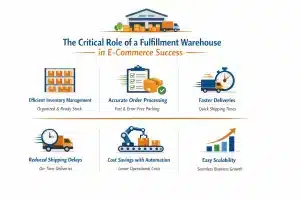
A fulfillment warehouse plays a key role in keeping ecommerce operations smooth and reliable. By connecting inventory, order processing, and delivery, it helps businesses scale while meeting customer expectations.
- Efficient Inventory Management: A fulfillment warehouse enables ecommerce brands to keep stock organized and ready for customer demand.
- Accurate Order Processing: By streamlining workflows, from monitoring inventory to packing and shipping, fulfillment warehouses ensure orders are packed correctly and shipped without errors.
- Faster Deliveries: Ecommerce businesses benefit from quicker shipping times, improving customer satisfaction and loyalty.
- Reduced Shipping Delays: With structured logistics, fulfillment warehouses minimize late deliveries and strengthen brand reputation.
- Cost Savings with Automation: Automation within fulfillment warehouses lowers costs while maintaining accuracy in operations.
- Easy Scalability: Partnering with third-party logistics service allows ecommerce companies to expand smoothly as they grow.
When to Upgrade to a Professional Fulfillment Warehouse

Upgrading to a professional fulfillment warehouse is often the next step for growing ecommerce businesses. Knowing the right time to make the switch can save costs, improve efficiency, and keep customers happy.
- Rising Order Volumes: What worked for small operations no longer keeps up with growing demand.
- Frequent Errors and Delays: Shipping mistakes, stock discrepancies, and slow fulfillment show your system is falling short.
- Expanding Into New Markets: A strategically located warehouse helps lower shipping costs and deliver faster to more regions.
- Struggles With Scaling: A professional partner provides efficiency and flexibility, letting you focus on business growth.
Optimizing Fulfillment Warehouse Layout
A well-structured fulfillment warehouse layout plays a crucial role in maximizing operational efficiency, minimizing errors, and expediting order fulfillment. By strategically organizing their warehouses, businesses can streamline workflows, improve inventory accessibility, and minimize handling time.
1. Smart Inventory Organization
Proper inventory categorization and labeling ensure that products are easy to locate and pick. Using a logical storage system, such as ABC classification (grouping items by sales frequency), minimizes search time and increases order fulfillment speed.
2. Optimized Flow Pathways
An efficient warehouse layout should reduce unnecessary movement. Organizing picking stations, packing areas, and shipping zones in a seamless flow helps workers navigate the space efficiently, leading to faster order processing.
3. Leveraging Technology and Automation
Implementing barcode scanning, conveyor belts, and robotic picking systems significantly enhances accuracy and reduces manual errors. Automation in warehouse layout boosts productivity while cutting down operational costs.
Understanding the Impact of On-Demand Fulfillment Warehousing
On-demand warehousing is transforming logistics by offering flexible, scalable storage solutions. Unlike traditional warehousing, which requires long-term leases, on-demand warehousing allows businesses to adjust storage capacity based on demand, improving efficiency and cost management.
1. Cost-Effective Storage Solutions
Instead of committing to fixed warehouse space, businesses can use on-demand warehousing services to pay only for what they use, reducing unnecessary expenses and increasing financial flexibility.
2. Seamless Seasonal & Market Expansion
During peak seasons or business expansions, companies can scale storage up or down without long-term contracts, ensuring they always have the right amount of space when needed.
3. Faster Order Fulfillment & Delivery
With access to multiple fulfillment warehouse locations, businesses can store products closer to customers, reducing shipping time and costs while enhancing customer satisfaction.
4. Optimized Inventory & Risk Management
By leveraging real-time inventory tracking, businesses can avoid overstocking or stock shortages, ensuring they always maintain optimal stock levels for smooth operations.
Integrating Eco-Friendly Practices into Fulfillment Warehouse Operations
Sustainability is becoming a priority for businesses looking to reduce costs and minimize their environmental impact. Simple changes, like switching to LED lighting and optimizing heating and cooling systems, can significantly cut energy consumption. Using electric delivery vehicles and route optimization also helps lower fuel costs and reduce carbon emissions.
Reducing waste is another key step. Businesses can replace single-use plastics with biodegradable or recyclable packaging to create a more sustainable shipping process. Setting up recycling stations for materials like cardboard and plastic ensures warehouses contribute to waste reduction efforts while keeping operations efficient.
Adopting green logistics strategies not only benefits the environment but also boosts brand reputation. Customers are increasingly drawn to businesses that prioritize eco-friendly practices, making sustainability a smart move for both the planet and long-term business growth.
Choosing a Warehouse Management System (WMS) for Your Fulfillment Warehouse

A Warehouse Management System (WMS) is essential for keeping a fulfillment warehouse running smoothly. It helps businesses track inventory in real-time, reduce errors, and speed up order processing. Choosing the right WMS requires careful consideration to ensure it aligns with your business operations, growth plans, and budget.
1. Key Features for Efficiency
A good WMS should offer real-time inventory tracking so you always know what’s in stock. Features like barcode scanning and order processing automation help speed up fulfillment while minimizing errors. Some systems also provide demand forecasting to help businesses plan inventory based on sales trends, preventing stock shortages or excess inventory.
Additionally, a WMS with automated alerts can notify warehouse managers of low stock levels, delayed shipments, or unexpected demand spikes. This ensures quick decision-making and reduces the risk of disruptions in the supply chain.
Choosing a system that supports batch picking or wave picking can also increase efficiency by allowing multiple orders to be processed at once, reducing labor costs and improving order fulfillment speed.
2. Scalability & System Compatibility
As your business grows, so should your WMS. A scalable system can handle higher order volumes, multiple warehouse locations, and increased product variety. It’s also crucial that the WMS integrates smoothly with your ecommerce platforms, ERP systems, and shipping providers, ensuring a seamless flow of data across different departments.
An adaptable WMS should also support multi-channel fulfillment, enabling businesses to process orders from different sales channels—such as websites, marketplaces, and retail stores—without delays or errors.
The ability to customize workflows and automate repetitive tasks helps businesses stay efficient even during peak seasons or rapid growth. A flexible e-commerce fulfillment software ensures warehouses can scale their operations without sacrificing speed or accuracy.
3. Ease of Use & Accessibility
A WMS should be intuitive and easy to use so warehouse staff can operate it without extensive training. Cloud-based systems provide remote access, allowing business owners and managers to monitor warehouse operations in real-time from anywhere, making management more flexible.
A well-designed interface with drag-and-drop features, visual dashboards, and mobile compatibility can improve productivity by making it easier to manage warehouse tasks.
Mobile access allows employees to scan items, update inventory, and receive shipment notifications directly from handheld devices. This ensures real-time updates and fewer processing delays, making operations smoother and more efficient.
Leveraging Technology to Enhance Fulfillment Warehouse Productivity
The adoption of technology in warehouse operations has significantly improved efficiency, accuracy, and cost management.
Automation has become a game-changer, allowing warehouses to streamline order fulfillment with automated storage and retrieval systems (AS/RS), conveyor belts, and robotic picking solutions. By minimizing manual tasks and reducing human errors, these systems ensure faster order processing, improved accuracy, and quicker shipping times, ultimately enhancing customer satisfaction.
In addition to automation, Artificial Intelligence (AI) is transforming inventory management system by providing data-driven insights into sales trends, stock levels, and demand forecasting.
AI-powered systems help businesses optimize stock replenishment, preventing both overstocking and stock shortages. Automated reordering ensures inventory is maintained efficiently, reducing the risk of stockouts and minimizing unnecessary holding costs.
Another crucial innovation is real-time tracking and IoT (Internet of Things) integration, which provides warehouses with greater visibility and control over inventory movement. Technologies such as RFID (Radio Frequency Identification) and smart sensors allow for real-time stock monitoring and improving order accuracy.

Conclusion
A fulfillment warehouse is essential for businesses looking to streamline logistics, optimize order fulfillment, and enhance customer satisfaction. By integrating efficient warehouse layouts, automation, and scalable solutions, businesses can ensure that inventory management and shipping processes run smoothly while keeping operational costs under control.
If you’re looking to optimize your fulfillment warehouse operations and enhance inventory management, HashMicro’s Warehouse Management Software can help. With features like automated inventory tracking, real-time stock visibility, and seamless order fulfillment, our solution ensures that your warehouse operates with maximum efficiency while reducing errors and costs.
Want to see how a smart warehouse management system can transform your logistics? Request a free demo today and experience the power of automation in streamlining your fulfillment operations.

FAQ about Fulfillment Warehouse
-
What is a fulfillment warehouse, and how does it work ?
A fulfillment warehouse is a facility that stores, processes, and ships orders on behalf of businesses. It manages inventory storage, order picking, packing, and shipping, ensuring that products reach customers efficiently. Many fulfillment warehouses also use automation and warehouse management systems (WMS) to streamline operations and improve accuracy.
-
How can a fulfillment warehouse improve order accuracy and delivery speed ?
A fulfillment warehouse enhances order accuracy by using barcode scanning, automated sorting, and inventory tracking systems to ensure the right products are packed and shipped. Additionally, strategically located warehouses help reduce shipping times by storing inventory closer to customers, leading to faster deliveries and improved customer satisfaction.
-
When should a business upgrade to a professional fulfillment warehouse ?
Businesses should consider upgrading when they experience increasing order volumes, frequent shipping delays, stock discrepancies, or difficulty managing inventory. A professional fulfillment warehouse offers real-time tracking, optimized storage, and automated order processing, allowing businesses to scale efficiently while maintaining accuracy.
-
How does a Warehouse Management System (WMS) enhance fulfillment operations ?
Businesses should consider upgrading when they experience increasing order volumes, frequent shipping delays, stock discrepancies, or difficulty managing inventory. A professional fulfillment warehouse offers real-time tracking, optimized storage, and automated order processing, allowing businesses to scale efficiently while maintaining accuracy.