










 Limited to 100 registrants
Effectively managing the flow of data and products is essential to maintaining productivity and competitiveness in business operations and logistics. Technological advancements allow businesses to access various software solutions to streamline operations and improve productivity.
Warehouse Management Systems (WMS) and Enterprise Resource Planning (ERP) systems are two of the most popular choices. But first, what are WMS and ERP, and how are they different? Which ERP and WMS options are best for your unique requirements?
Making the best choice for your business requires understanding the key differences between ERP and WMS software, despite their apparent similarities. This article will review the benefits of each system and help you decide which would be the best fit for your company, given its specific requirements.
Key Takeaways
Comprehensive software programs known as enterprise resource planning (ERP) solutions are made to assist companies in better handling and organizing their day-to-day operations.
A warehouse management system (WMS) software program is created to assist companies in effectively managing and overseeing their warehouse operations.
Several key different depending on your particular requirements and priorities, considering several criteria is critical when deciding between an ERP and a WMS.

What is Enterprise Resource Planning (ERP)?
Comprehensive software programs, known as enterprise resource planning (ERP) solutions, are designed to help companies manage and organize their day-to-day operations more effectively. ERP software collects and arranges data from multiple departments, including finance, human resources, procurement, and inventory management, acting as a central hub.
ERP software provides businesses with a comprehensive view of their operations by combining these features into a single, integrated platform. It facilitates better decision-making and increases operational efficiency. ERP systems are crucial for enhancing corporate productivity, fostering long-term growth, and optimizing efficiency.
Because ERP solutions are adaptable and configurable, companies can tailor the system to meet their operational requirements and goals. ERP simplifies complicated tasks, making it a crucial tool for companies looking to streamline their operations and remain competitive.
What is Warehouse Management System (WMS)?
A warehouse management system (WMS) software program is designed to help companies efficiently manage and oversee their warehouse operations. It provides features and capabilities to help handle incoming and departing shipments, track inventory, and optimize other warehouse operations.
WMS system ensures that products are ideally located and shipped at the correct time by automating these processes and offering real-time insights into inventory movements. Ultimately, a WMS helps companies efficiently manage their stock, reduce errors, and enhance efficiency in the warehouse setting.
What’s The Differences Between ERP and WMS System?

After reviewing each ERP and WMS definition, you might wonder what the main difference is between ERP and WMS systems. Therefore, we shall outline the key distinctions between ERP and WMS in the list below:
1. Main focus
ERP systems are designed to manage various corporate functions, such as purchasing, production, inventory control, finance, and human resources. Their primary objective is to integrate all corporate operations into a single platform, enabling better organizational decision-making and offering detailed insight.
WMS software, unlike ERP, is designed to manage warehouse operations, and a cloud WMS platform for real-time operations helps teams access workflows and data across devices and locations. It ensures the effective use of warehouse space and optimizes the movement of goods, including storage, shipping, receiving, and inventory.
2. Scope of functions
The second difference between ERP and WMS is their functionality. ERP systems encompass a wide range of departments, including accounting, human resources, marketing, production, and inventory, and provide a comprehensive solution for managing the entire business process.
On the other hand, the WMS system’s primary focus is on warehouse management. WMS software manages logistics activities like receiving, storing, picking, packing, and shipping. Although it can be integrated with ERP, its primary functions remain inventory management and warehouse operations.
3. Scalability
ERP is scalable and can be modified to meet changing corporate requirements. ERP may adjust with the business, whether that change is in regulations, commercial expansion, or the addition of new locations.
WMS software’s scalability, on the other hand, is more concentrated on storage capacity and inventory quantities. By ensuring that warehouse space is utilized as efficiently as possible and that inventory is always accurate, WMS systems help companies streamline their logistics.
4. Key benefits
ERP’s primary advantages include reduced data duplication, enhanced operational visibility, and faster, more informed decision-making. ERP enables management to access information from multiple departments in real-time, facilitating more efficient strategies.
WMS systems offer advantages in improved warehouse operational efficiency, fewer shipping errors, and more accurate inventory management. They also help maximize storage space and guarantee that products are always ready for shipping when needed.
5. Impact on business processes
ERP as a system impacts every aspect of business operations, including sales and production. ERP enables businesses to coordinate and manage their operations effectively, ultimately improving overall performance.
However, WMS software has a direct impact on the effectiveness of warehouse and logistics operations. By guaranteeing on-time delivery, the system lowers storage expenses, ensures the efficient flow of items in the warehouse, and increases customer satisfaction.
Finally, ERP vs WMS impacts business processes differently. ERP influences the entire organization, from sales to production, while WMS enhances logistics by ensuring on-time deliveries and improved inventory control, ultimately improving customer satisfaction. To make the differences more straightforward, here’s a simplified comparison.
| ERP | WMS |
|---|---|
| Integrates all business functions into a single system for improved decision-making. | Specializes in warehouse operations, including inventory management and logistics. |
| Covers finance, HR, procurement, production, and more. | Limited to receiving, storage, picking, packing, and shipping. |
| Expands in line with business growth, regulatory requirements, and new locations. | Scales mainly with inventory volume and storage capacity. |
| Reduces data duplication, enhances visibility, and facilitates better decision-making. | Boosts warehouse accuracy, reduces errors, and optimizes space utilization. |
| Influences company-wide processes, including sales and production. | Directly improves warehouse efficiency and customer satisfaction. |
Key Features in ERP Software System
It is a ERP industry with a wide range of functions to provide, regardless of your needs, be they ERP or WMS. Business automation company that offers a range of Cloud ERP solutions to help businesses increase productivity, operational efficiency, and overall business management. Here are some of the key features of ERP system:
1. Built-in Business Intelligence (BI)
Pivot, KPI Scorecard, and Data Visualization are comprehensive BI tools that give companies real-time data for better decision-making. These tools enable users to quickly visualize key indicators, supporting data-driven strategies and enhancing productivity.
2. Sheet management
A well-organized sheet management system would enable companies to track and manage data more efficiently. It would also improve teamwork and guarantee instant access to reliable data for all departments.
3. Fast stock recording
Automated inventory checks ensure more accurate results by reducing errors and speeding up updates and stock-taking. By offering real-time stock visibility, businesses can maintain optimal inventory levels and avoid issues such as stockouts and overstocking.
4. Smart transaction bookkeeping
Automated bookkeeping lowers errors and maintains updated financial records by reducing the need for manual data entry. This enhances financial data control and streamlines decision-making, compliance, and budgeting procedures.
5. Real-time reporting
With instant access to updated company reports, companies can monitor performance in real-time. Accurate analytics can help businesses stay competitive and make quick adjustments.
ERP system offers a scalable and adaptable solution utilizing the latest technology, enabling businesses across various sectors to customize the system to their specific requirements.
Key Features in WMS Software
Warehouse Management Systems (WMS) help businesses manage warehouse operations more efficiently by automating processes such as inventory tracking, order handling, and shipments. Here are some of WMS software key features:
1. Inventory Tracking
A WMS provides real-time visibility into inventory levels across the warehouse. Businesses can track the location, quantity, and movement of products accurately. This helps prevent stock discrepancies, overstocking, or stock shortages.
2. Barcode and RFID Scanning
Many WMS platforms support barcode scanning and RFID technology to track items automatically. These tools speed up warehouse processes such as receiving, picking, and shipping. They also reduce manual errors in inventory recording.
3.Order Picking and Packing Optimization
WMS software helps optimize picking routes and packing processes within the warehouse. This ensures that orders are processed faster and more efficiently. As a result, businesses can improve order fulfillment speed and reduce operational delays.
4. Warehouse Space Optimization
WMS systems help businesses organize storage locations based on product demand and inventory turnover. By optimizing warehouse layout and storage strategies, companies can maximize the use of available space. This improves operational efficiency and reduces storage costs.
5. Shipment and Delivery Management
A WMS supports the coordination of outbound shipments and delivery schedules. The system ensures that the correct products are picked, packed, and shipped on time. This improves delivery accuracy and enhances customer satisfaction.
Implementing a WMS can significantly improve warehouse efficiency by providing better inventory visibility and more accurate operational control. With automated processes and real-time data, businesses can reduce errors, speed up order fulfillment, and manage warehouse activities more effectively. As a result, companies can maintain smoother logistics operations and support overall business growth.
Operational Advantages of ERP and WMS Systems
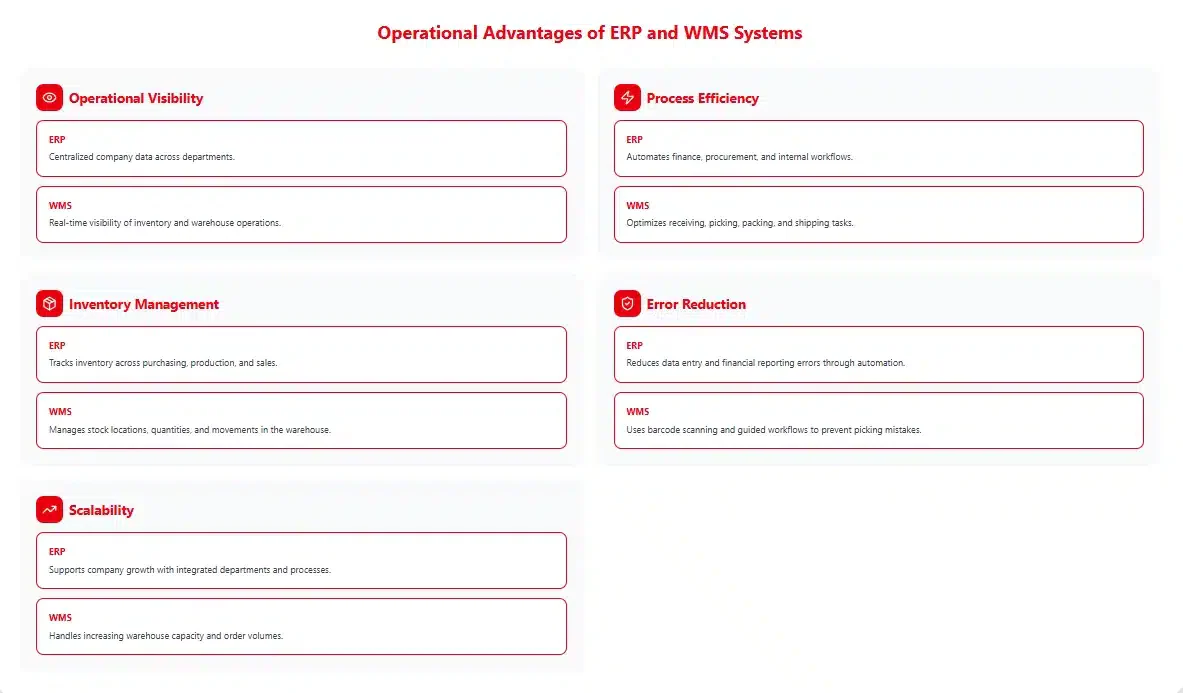
Both ERP and WMS systems offer significant advantages for businesses aiming to improve operational efficiency and data management. While ERP focuses on integrating company-wide processes, WMS specializes in optimizing warehouse activities. Understanding the specific benefits of each system helps businesses determine how these technologies can support their operational goals.
1. Improved Operational Visibility
ERP systems provide a centralized platform that connects data from multiple departments such as finance, procurement, and production. This integration allows managers to access comprehensive business insights from a single system. With better visibility into company performance, leaders can make faster and more informed strategic decisions.
WMS platforms focus on providing detailed visibility into warehouse operations and inventory movement. Businesses can monitor stock locations, quantities, and order status in real time. This level of transparency helps warehouse teams maintain accurate inventory records and improve operational control.
2. Higher Efficiency in Business Processes
ERP automates many administrative and operational tasks, including financial reporting, procurement workflows, and data management. This reduces the need for repetitive manual work across departments. As a result, organizations can improve workflow efficiency and allocate resources more effectively.
WMS improves the efficiency of warehouse processes by optimizing tasks such as receiving, picking, packing, and shipping. The system organizes workflows and guides employees through each step of the order fulfillment process. This helps reduce processing time and increases overall warehouse productivity.
3. Better Inventory Management
ERP systems help businesses track inventory across purchasing, production, and sales operations. This integrated view ensures that stock levels remain balanced throughout the supply chain. Companies can avoid issues such as overstocking or stock shortages while maintaining better operational planning.
WMS focuses on managing inventory within the warehouse environment. It provides real-time tracking of product locations, stock quantities, and inventory movements. This accuracy helps businesses maintain organized storage and ensures products are available when needed.
4. Reduced Operational Errors
ERP systems reduce errors by automating financial transactions, data entry, and reporting processes. Automated workflows ensure that information is recorded consistently across the system. This helps organizations maintain accurate financial records and improve operational reliability.
WMS minimizes warehouse errors through technologies such as barcode scanning, automated tracking, and guided workflows. These features help ensure that the correct products are picked, packed, and shipped. As a result, businesses can reduce costly mistakes in inventory handling and order fulfillment.
5. Scalable Business Growth
ERP systems are designed to support business expansion by integrating additional departments, processes, and locations into the same platform. As companies grow, the system can handle higher transaction volumes and more complex operations. This scalability allows businesses to maintain consistent management across the organization.
WMS solutions scale alongside warehouse operations as inventory volumes and order demands increase. The system helps businesses manage larger storage capacities and more complex logistics workflows. This ensures that warehouse efficiency remains stable even as the business continues to grow.
Overall, both ERP and WMS systems contribute to improving business performance, although they focus on different operational areas. ERP supports broader organizational management, while WMS strengthens warehouse efficiency and inventory control. By understanding these benefits, businesses can choose the system that best aligns with their operational priorities and long-term growth plans
Things to Consider Before Choosing ERP vs WMS
Depending on your specific requirements and priorities, considering several key criteria is crucial when deciding between an ERP and a WMS. The following list is essential factors to help you determine whether ERP vs WMS is better for your company:
1. Business needs ERP vs WMS
Every business has unique needs that depend on its size, structure, and level of operational complexity. ERP is a comprehensive solution for managing a company’s finances, personnel, inventory, manufacturing, and other key areas. ERP systems offer comprehensive visibility and automate departmental processes, making them ideal for businesses consolidating all corporate operations onto a single platform.
WMS, on the other hand, is only concerned with managing warehouse operations. A WMS might be more relevant if a business requires increased stock management, shipping, and storage efficiency.
2. Budget ERP vs WMS
Because ERPs have many enterprise-wide functionalities, they are usually more expensive, though opting for an affordable ecount erp software can help minimize upfront capital. The costs associated with ERP setup, training, and maintenance can be substantial, and additional resources are often necessary to ensure optimal usage.
Conversely, a WMS is a more specific and often more economical solution because it focuses solely on warehouse management. Selecting a WMS over an ERP can be more cost-effective for a business with modest inventory and warehouse management requirements.
3. Adaptability ERP vs WMS
ERP is built with a firm framework to guarantee consistency and stability throughout the company. However, this framework limits ERP’s ability to adapt to unforeseen circumstances or abrupt changes. ERP customization usually requires a significant amount of time and money.
On the other hand, because WMS is designed to manage real-time changes in workflow and inventory, it has greater flexibility when adjusting warehouse operations. WMS may be more adaptable than ERP for businesses that want a system that can swiftly adapt to changes in day-to-day operations.
Adopting structured ERP deployment practices ensures a smooth system transition regardless of the software architecture your company chooses. Check our price scheme below for more information on ERP systems.
Conclusion
In conclusion, improving business operations and logistics requires the integration of warehouse management systems (WMS) and enterprise resource planning (ERP) systems. ERP systems provide a comprehensive picture of operations by integrating and managing key business processes across multiple departments.
With specific capabilities for inventory management and warehouse efficiency, WMS concentrates on streamlining warehouse operations. When deciding between an ERP and a WMS, it’s crucial to consider your company’s specific needs and priorities.
If you’re unsure which is best for you, use our free demo to explore the dashboard and gather more information.

FAQ about ERP vs WMS
An ERP helps you to streamline your entire business. Fit for a specific purpose. A WMS’s sole purpose is to increase productivity and profitability in your warehouse.
No, WMS (Warehouse Management System) is not a CRM (Customer Relationship Management) system.
There are four main types of warehouse management systems: standalone WMS, Supply Chain Execution Modules, Integrated ERP Systems, and Cloud-Based Systems. Each type offers unique benefits for different warehouse needs.