








In today’s competitive business landscape, many companies prioritize acquiring new customers while overlooking the greater value of retaining existing ones. While marketing campaigns often focus on growth, long-term success is largely driven by customer loyalty. Strong customer retention strategies help increase profitability, strengthen brand value, and secure a competitive edge.
The cost difference is significant, acquiring new customers can be five to twenty-five times more expensive than retaining current ones. Even a five percent increase in retention can boost profits by twenty-five to ninety-five percent, as loyal customers tend to buy more often, spend more, and recommend the brand to others.
To unlock this potential, businesses need to shift toward a relationship-driven approach. By focusing on customer experience and using data-driven strategies, companies can build lasting connections that support sustainable growth. The following article explores key customer retention strategies your business can implement.
Key Takeaways
|
Explore the following solutions to find tools that fit your business needs. Click the banner below to learn more about each product in detail.

What is Customer Retention?

Before diving into specific tactics, it is crucial to establish a foundational understanding of what customer retention truly entails. It is a multi-faceted metric, a business philosophy, and a reflection of a company’s overall health. Retention is not simply the absence of churn; it is the presence of ongoing engagement, satisfaction, and loyalty.
The Psychology of Customer Loyalty
Customer retention is strongly influenced by human psychology. Buying decisions are shaped by trust, emotional connection, and perceived value. When customers stay loyal, they believe the brand understands their needs, respects their time, and consistently delivers on its promises.
This trust is built through consistent, positive interactions at every touchpoint from onboarding to support and communication. When experiences feel relevant and customer-focused, brand affinity grows. However, poor service or generic interactions can quickly weaken trust and drive customers away.
The Economic Imperative of Retention
Customer retention offers clear financial advantages. Existing customers are more profitable because acquisition costs have already been covered. They are also less price-sensitive, as they are familiar with the product’s value and reliability.
In addition, loyal customers are more open to upselling and often promote the brand through word-of-mouth. Their recommendations and reviews play a major role in influencing new buyers, making them valuable assets for organic growth.
Shifting from Reactive to Proactive Posture
Many businesses used to approach retention reactively, only taking action when customers showed signs of leaving. This often comes too late, as trust has already declined.
A proactive approach is far more effective. By anticipating needs, identifying issues early, and using data to guide decisions, businesses can improve the customer experience. This shifts retention from a defensive tactic into a strategy for long-term growth.
The Role of CRM in Customer Retention
Executing proactive customer retention strategies at scale is virtually impossible without the right technological infrastructure. Customer Relationship Management (CRM) systems centralized hubs that power the entire customer lifecycle. A properly utilized CRM is the central nervous system of any retention initiative.
1. Centralizing the Customer Truth
A major challenge in customer retention is fragmented data across departments. When marketing, sales, and support teams work separately, the customer experience becomes inconsistent. This often leads to frustration, such as receiving irrelevant offers or repeating the same issue to multiple agents.
A CRM system solves this by unifying all customer data into a single platform. With access to complete interaction history and behavior insights, teams can respond more effectively and personally. This helps improve customer experience, strengthen relationships, and reduce churn.
2. Predictive Analytics and Churn Prevention
Modern CRM platforms use AI and data analysis to identify early signs of customer churn. By tracking behavior such as reduced activity or repeated issues, businesses can detect when a customer is likely to disengage.
Once risks are identified, companies can take action through targeted strategies like personalized outreach or re-engagement campaigns. Addressing issues early allows businesses to retain customers who might otherwise leave.
3. Automating Personalized Engagement
Managing personalized communication at scale can be difficult without automation. CRM systems make this possible by delivering timely and relevant messages across different channels without manual effort.
This includes onboarding emails, milestone messages, and product recommendations based on customer behavior. Automation helps maintain consistent engagement, making customers feel valued while allowing teams to focus on more strategic tasks.
Proven Customer Retention Strategies
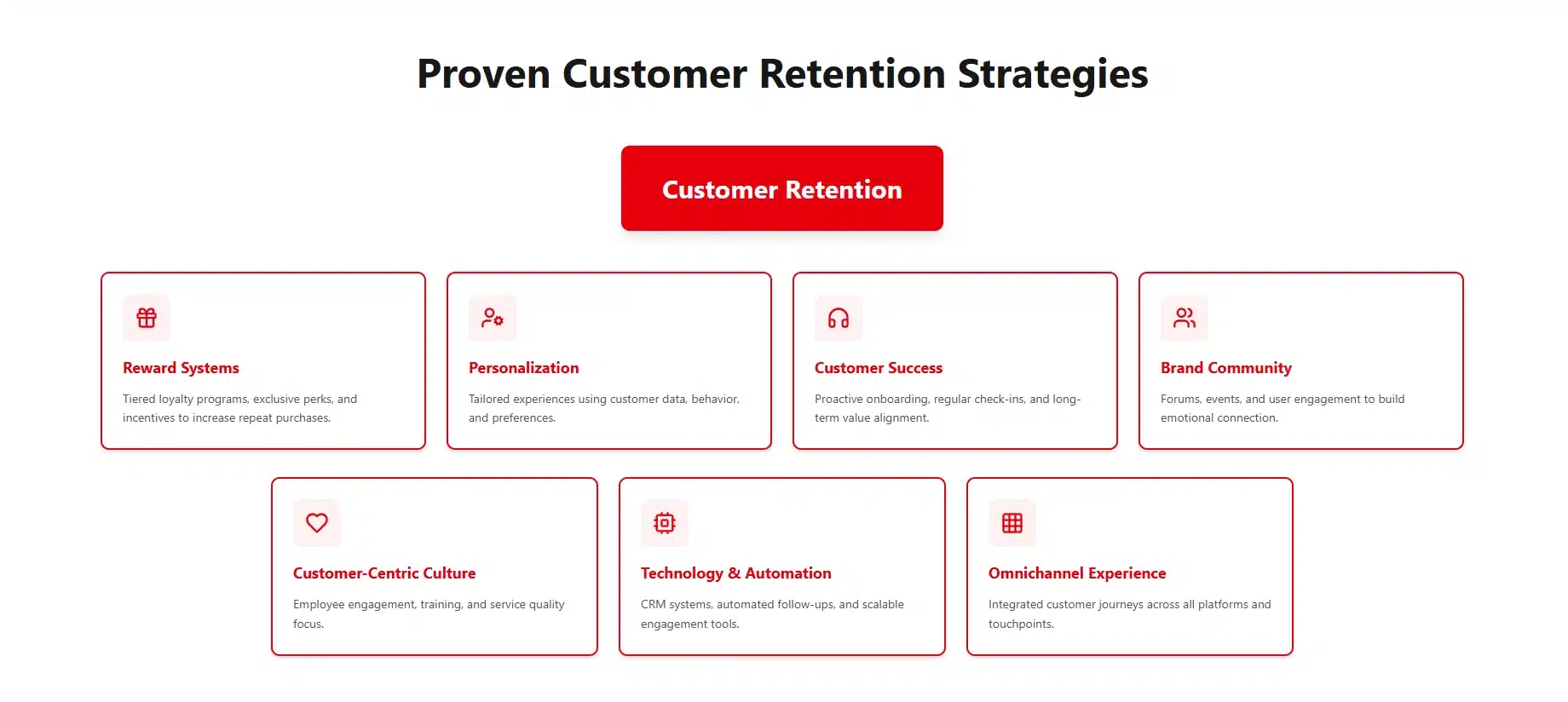
With a solid understanding of the psychology and technology underpinning retention, organizations can begin implementing specific, actionable strategies. The most effective approaches are holistic, combining product excellence, exceptional service, and targeted marketing efforts.
1. Designing Structured Reward Systems
Incentives play a key role in encouraging repeat purchases. A well-designed reward system can increase customer lifetime value, but it needs to offer real value beyond basic promotions. Modern programs should align with customer preferences to remain attractive and relevant.
Tiered loyalty programs are especially effective, as they motivate customers to spend more to unlock better benefits. Exclusive perks like early access, free shipping, or VIP support create a sense of status and encourage ongoing engagement. When structured properly, these programs drive loyalty without sacrificing profitability.
2. Hyper-Personalization of the Customer Journey
Today’s customers expect personalized experiences, and generic messaging often leads to disengagement. Hyper-personalization uses customer data to tailor interactions based on behavior, preferences, and past activity.
This can include customized product recommendations, dynamic website content, and communication through preferred channels. By delivering relevant experiences, businesses can strengthen connections and make it less appealing for customers to switch to competitors.
3. Implementing Proactive Customer Success Management
Customer Success (CS) focuses on helping customers achieve their goals, not just solving issues. This proactive approach is especially important in B2B and SaaS industries where long-term value matters.
It starts with strong onboarding to ensure customers quickly understand the product’s benefits. Ongoing check-ins and performance reviews help maintain alignment with customer needs, increasing satisfaction and reducing churn.
4. Fostering a Brand Community
Customers are more likely to stay loyal when they feel part of a community. Creating spaces where users can connect adds emotional value beyond the product itself. When a customer feels connected not just to the company, but to other users, their loyalty becomes deeply entrenched.
This can be done through online forums, events, or user-generated content. A strong community encourages engagement, builds advocacy, and makes it harder for customers to leave the brand.
5. Cultivating a Customer-Centric Internal Culture
Customer experience is closely tied to employee experience. Engaged and well-supported employees are more likely to deliver better service, which directly impacts retention.
Companies should invest in training, empower teams to make customer-focused decisions, and recognize strong performance. A customer-first culture ensures consistent and high-quality interactions. With focusing on boosting overall employee engagement ensures that the team interacting with your buyers is motivated, enthusiastic, and genuinely invested in the customer’s success
6. Leveraging Advanced Technology and Automation
As businesses grow, maintaining personalized engagement manually becomes difficult. Technology helps scale retention efforts while keeping interactions relevant and timely.
By integrating CRM systems and investing in the best loyalty program software, companies can manage tasks like follow-ups, surveys, and re-engagement campaigns efficiently. This ensures consistency and improves overall customer experience.
7. Creating Seamless Omnichannel Experiences
Customers interact with brands across multiple channels, from social media to apps and support platforms. If these channels are disconnected, it can lead to frustration.
An omnichannel approach ensures a consistent experience by connecting all touchpoints. This allows customer data and context to flow across channels, reducing friction and improving satisfaction.
Measuring Retention Metrics
You cannot improve what you do not measure. To determine the efficacy of customer retention strategies, organizations must meticulously track a specific set of Key Performance Indicators (KPIs). These metrics provide objective insights into customer health and highlight areas requiring immediate intervention.
1. Customer Retention Rate (CRR)
The Customer Retention Rate is the most fundamental metric. It calculates the percentage of customers a company has retained over a specific period. The formula is:
CRR = ((E – N) / S) x 100)
Where:
- E = Number of customers at the end of a period
- N = Number of new customers acquired during that period
- S = Number of customers at the start of that period
Monitoring CRR on a monthly, quarterly, and annual basis allows businesses to identify seasonal trends and assess the macro-level impact of newly implemented retention initiatives.
2. Customer Lifetime Value (CLV)
Customer Lifetime Value projects the total revenue a business can reasonably expect from a single customer account throughout the entirety of their relationship. CLV is a critical metric because it dictates how much money a company can afford to spend on acquiring and retaining a customer.
Calculating CLV involves multiplying the average purchase value by the average purchase frequency rate, and then multiplying that result by the average customer lifespan. A successful retention strategy will manifest as a steady increase in CLV, indicating that customers are staying longer and spending more.
3. Churn Rate
Churn rate is the inverse of retention rate; it measures the percentage of customers who cease their relationship with a company over a given period. While some level of churn is inevitable, a high or rapidly increasing churn rate is a glaring red flag indicating systemic issues with the product, pricing, or customer service.
It is crucial to segment churn data to glean actionable insights. Are customers churning immediately after onboarding? This suggests a problem with user education. Are long-term customers suddenly leaving? This might indicate aggressive competitor activity or a decline in product quality. Understanding the “when” and “why” of churn is the first step in stopping it.
4. Net Promoter Score (NPS)
While CRR and Churn measure actual behavior, the Net Promoter Score measures customer sentiment and loyalty. NPS is derived from a single survey question: “On a scale of 0 to 10, how likely are you to recommend our product/service to a friend or colleague?”
Respondents are categorized as Promoters (9-10), Passives (7-8), or Detractors (0-6). The NPS is calculated by subtracting the percentage of Detractors from the percentage of Promoters. A high NPS correlates strongly with high retention rates and organic growth. Furthermore, the qualitative feedback often collected alongside the NPS score provides invaluable insights into what customers love and what needs improvement.
Common Retention Mistakes to Avoid
Even with the best intentions, companies frequently stumble in their retention efforts. Recognizing and avoiding these common pitfalls is just as important as implementing proactive strategies.
1. Treating All Customers Equally
Not all customers deliver the same value, as some contribute higher long-term revenue while others require more effort with lower returns. Applying the same retention strategy to every customer can lead to inefficient resource use. Businesses should segment customers based on profitability, engagement, and overall value, then adjust their retention efforts to match each group.
2. Ignoring the Voice of the Customer (VoC)
Customers continuously share their needs, both directly through feedback channels and indirectly through their behavior. Ignoring these insights can harm a business. Companies should have clear processes to collect, analyze, and act on customer feedback. When concerns or suggestions are not addressed, customers may feel overlooked and undervalued.
3. Over-Promising and Under-Delivering
The fastest way to destroy trust is to break a promise. In the eagerness to close a sale or appease a frustrated customer, sales and support teams sometimes overstate capabilities or guarantee unrealistic timelines. When the reality falls short of the expectation, the resulting disappointment inevitably leads to churn. Honesty, transparency, and setting realistic expectations from day one are foundational to long-term retention.
Conclusion
Customer retention is not a one-time initiative but an ongoing process that requires constant improvement. As market conditions shift, competitors evolve, and customer expectations change, strategies that once worked may lose their effectiveness. Businesses need to continuously test, analyze performance metrics, and refine their approaches to stay relevant in a dynamic environment.
Maintaining strong customer relationships requires a clear understanding of customer needs and aligning internal processes to meet those expectations. Companies must also leverage the right technologies, such as CRM systems, to manage and execute retention strategies efficiently at scale.
Ultimately, prioritizing retention alongside acquisition helps businesses build more stable and profitable models. Focusing on long-term relationships, companies can strengthen customer loyalty and remain competitive despite market changes. Request a free demo today to see how the right solution can support your strategy.

FAQ about Customer Retention Strategies
-
What is the difference between customer retention and customer acquisition?
Customer acquisition focuses on bringing new buyers to your business through marketing and sales efforts. Customer retention focuses on keeping those existing buyers engaged, satisfied, and continuing to purchase from you over time. Retention is generally more cost-effective than acquisition.
-
What is a good Customer Retention Rate (CRR)?
A ‘good’ CRR varies heavily by industry. For SaaS companies, a retention rate of 90% or higher is often targeted. For e-commerce, it may be lower. However, the universal goal is to consistently improve your specific baseline CRR year over year.
-
How does a CRM system improve customer retention?
A CRM improves retention by centralizing customer data, providing a 360-degree view of interactions, automating personalized communications, and using predictive analytics to identify customers who may be at risk of churning before they actually leave.
-
Why is customer onboarding important for retention?
Onboarding is critical because it sets the tone for the entire relationship. If a customer does not understand how to use your product or fails to see its value quickly during the initial onboarding phase, they are highly likely to churn. Effective onboarding ensures they achieve their desired outcomes early on.