









Most construction delays don’t start on site. They start weeks earlier, when assumptions quietly replace verified data.
A project may look “on track” on paper, yet procurement is waiting on late drawings, subcontractors are pricing outdated scopes, and the site team is forced to improvise. By the time issues surface, recovery already costs time and margin.
The construction project life cycle isn’t a textbook sequence. In practice, it’s a control framework. When each phase is managed with the right checkpoints, handovers, and ownership, teams spot risks early instead of reacting to them after damage is done.
Key Takeaways
|
What Is the Construction Project Life Cycle?
The construction project life cycle refers to the structured phases a project moves through, from early feasibility to final handover and close-out.
In real operations, this life cycle acts as a decision filter. Each phase answers a different question; “Is the project viable? Is the scope buildable? Are we executing as planned? Are we closing without leakage?”
Teams that treat these phases as living checkpoints, not static milestones, maintain tighter control over cost, schedule, and accountability.
Why the Project Life Cycle Matters in Construction
Construction is uniquely exposed to cascading errors. A small miss in early planning often multiplies downstream.
Without a clear life-cycle structure:
- Scope changes appear late, when contracts are already locked
- Procurement reacts instead of planning, inflating material costs
- Site teams rely on verbal coordination, increasing rework risk
A well-managed life cycle creates early warning signals. Budget variance, design gaps, and resource conflicts surface while options still exist, not after they disappear.
The Project Life Cycle, as It Actually Works on Site
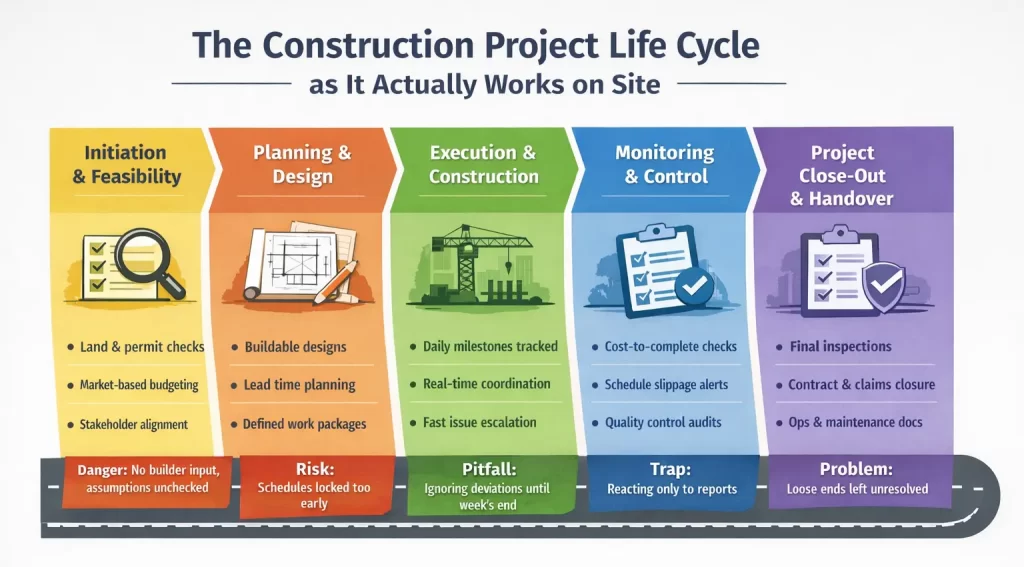 In practice, the construction project life cycle is not a neat sequence of phases. Teams move back and forth, revisit assumptions, and adapt to constraints they did not anticipate.
What the life cycle really provides is decision timing. It clarifies when certain questions must be answered, and what happens if they are postponed. If a project feels reactive, it is usually because key decisions were delayed into phases where flexibility was already gone.
Phase 1: Initiation & Feasibility
This phase decides whether the project deserves to exist. Beyond high-level budgeting, effective teams validate:
- Land readiness, permitting risks, and zoning constraints
- Financial assumptions tied to real market conditions
- Stakeholder alignment on scope boundaries
Projects that skip rigorous feasibility often compensate later through change orders and rushed approvals.
Hidden failure mode: feasibility signed off without construction input, leaving site realities untested.
Phase 2: Planning & Design
According to the Project Management Institute, this phase is crucial because decisions made here directly impact the cost, schedule, and quality of construction, requiring intensive collaboration and iterative reviews to ensure all requirements are met before moving forward. Planning is where most cost certainty is won or lost. Strong planning focuses on:
- Buildable design, not just approved drawings
- Procurement lead times mapped against site sequences
- Clear work packages tied to accountability
This phase should reduce unknowns, not simply produce documents.
Where teams cheat the process: locking schedules before suppliers confirm availability.
Phase 3: Execution & Construction
Execution turns plans into physical progress, but control depends on visibility. Successful execution requires:
- Daily progress tracked against committed milestones
- Real-time coordination between site, procurement, and finance
- Immediate escalation of deviations, not weekly summaries
The goal isn’t speed. It’s predictability.
Phase 4: Monitoring & Control
Monitoring is not a separate phase. It runs parallel to execution. Effective control focuses on:
- Cost-to-complete, not just budget spent
- Schedule slippage trends, not isolated delays
- Quality deviations caught before handover
Teams that rely solely on end-of-month reports often react too late to correct course.
Phase 5: Project Close-Out & Handover
Close-out determines whether value is actually realized. This phase includes:
- Final inspections and defect resolution
- Contract reconciliation and claims closure
- Documentation handover for operations and maintenance
Weak close-out creates lingering disputes and operational headaches long after construction ends.
Common Challenges in Managing the Construction Project Life Cycle
Every stage of a construction project carries risk. The difference between teams that deliver on time and those that don’t often comes down to how early they spot problems and how quickly they respond.
- Fragmented communication and lack of collaboration
Keeping architects, engineers, contractors, and subcontractors aligned is difficult when information lives in scattered emails, spreadsheets, and printed documents. Without a centralized platform, decisions get made on outdated data, approvals slow down, and rework becomes inevitable. - Inaccurate budgeting and cost overruns
Cost overruns plague most projects, usually starting with weak estimates and poor tracking during execution. When there’s no real-time visibility into spending, problems surface too late, forcing companies to absorb losses or renegotiate with clients. - Project delays and ineffective scheduling
Construction schedules have hundreds of linked tasks. One delay triggers another. Without tools to monitor project progress and flag bottlenecks early, teams end up reacting to problems instead of preventing them. - Poor inventory and resource management
Running out of materials stops work. Overstocking ties up cash and invites theft. A proper site inventory system tracks what’s on-site, what’s in transit, and what’s running low, so nothing catches you off guard.
The Role of Construction Software in Optimizing Each Stage
When a project gets busy, the first thing that breaks is usually coordination. Teams end up working from different versions of drawings, updates move slowly, and decisions rely on partial data. Construction software helps by putting schedules, costs, documents, and site updates in one place, so everyone works off the same reality.
Used well, it reduces admin work, speeds up approvals, and makes progress easier to see early. That shift matters because it helps teams prevent issues instead of only reacting after delays and cost overruns show up.
-
Accurate foundations in planning and design
In the early stage, the goal is simple. Build estimates and plans you can actually deliver. A system can help teams produce tighter BOQ and schedules using past project data, while keeping drawings and specs controlled so contractors are not quoting or building from outdated files. -
Controlled execution during construction
On site, control comes from fast, clean updates. Teams can track actual cost, material usage, and work progress from the field, then compare it against the plan in a dashboard. Procurement and subcontractor workflows also get easier to manage, so materials arrive on time and payment processes do not slow the job down. -
Clear learning at closeout and post construction
After handover, the real value is in what you learn. Project reports can show profitability, resource usage, and where time leaked during delivery. To benchmark and improve, some teams also compare performance against industry tools like Autodesk Construction Cloud, so future bids and planning assumptions get sharper.
Choosing the Right Construction Management Software
 The challenges above, scattered communication, budget overruns, schedule delays, inventory gaps, all point to the same root problem: disconnected systems. When project data lives in separate tools, teams spend more time chasing information than acting on it.
Construction management software solves this by connecting the pieces. Budget tracking, procurement, subcontractor management, and inventory all feed into one system. Fewer surprises, faster decisions.
Features of HashMicro Construction Software:
- Budget S-Curve Management: Provides a comprehensive view of budget planning and actual spending, helping to identify financial trends and patterns for better cost control.
- In-Depth Job Estimates (RAB): Facilitates the creation of accurate and detailed project cost estimates, ensuring a solid financial foundation before the project begins.
- Subcontractor Management: Centralizes all subcontractor information, contracts, and performance tracking to simplify collaboration and ensure accountability.
- Real-Time Project Dashboard: Offers an intuitive dashboard with real-time data on project progress, costs, and timelines, enabling quick and informed decision-making.
- Procurement Management: Automates the entire procurement process, from purchase requests to vendor selection and order tracking, ensuring materials are on-site when needed.
Before committing to any provider, test it with your actual project data. The right software should fit how your team works, not force you to rebuild your process from scratch.

Conclusion
Mastering the seven stages of the construction project life cycle helps you turn challenges into structured opportunities for better control and improved efficiency. When each phase is managed with clarity, projects are more likely to finish on time, stay within budget, and strengthen your company’s reputation.
To support consistent execution, HashMicro Construction Suite provides an integrated platform that unifies teams, processes, and data. Its end-to-end visibility makes it easier to manage complex workflows and reduce risks across your entire project portfolio.
If you want to manage construction projects with greater precision, now is the time to explore how this system works in real scenarios. Try the free demo to experience how HashMicro can elevate your operational performance.
FAQ About Construction Project Life Cycle
-
What is the most crucial stage in the construction project life cycle?
While all stages are important, many experts consider the Design & Feasibility (Stage 2) and Pre-Construction (Stage 3) phases to be the most crucial. Errors or oversights during these early stages have a much larger cost impact to fix later on, making thorough planning the best investment for smooth execution.
-
How does this life cycle apply to small-scale projects?
This framework is highly scalable and can be adapted for projects of all sizes. For smaller projects, some stages might be simplified or combined, but the fundamental principle of progressing through each phase logically still applies to ensure control and quality.
-
What is the role of Building Information Modeling (BIM) in this life cycle?
BIM is a highly influential technology throughout the project life cycle. It is used in the design stage for detailed 3D modeling, during pre-construction for clash detection and scheduling (4D), and in the post-construction phase for facility management using the as-built model.