







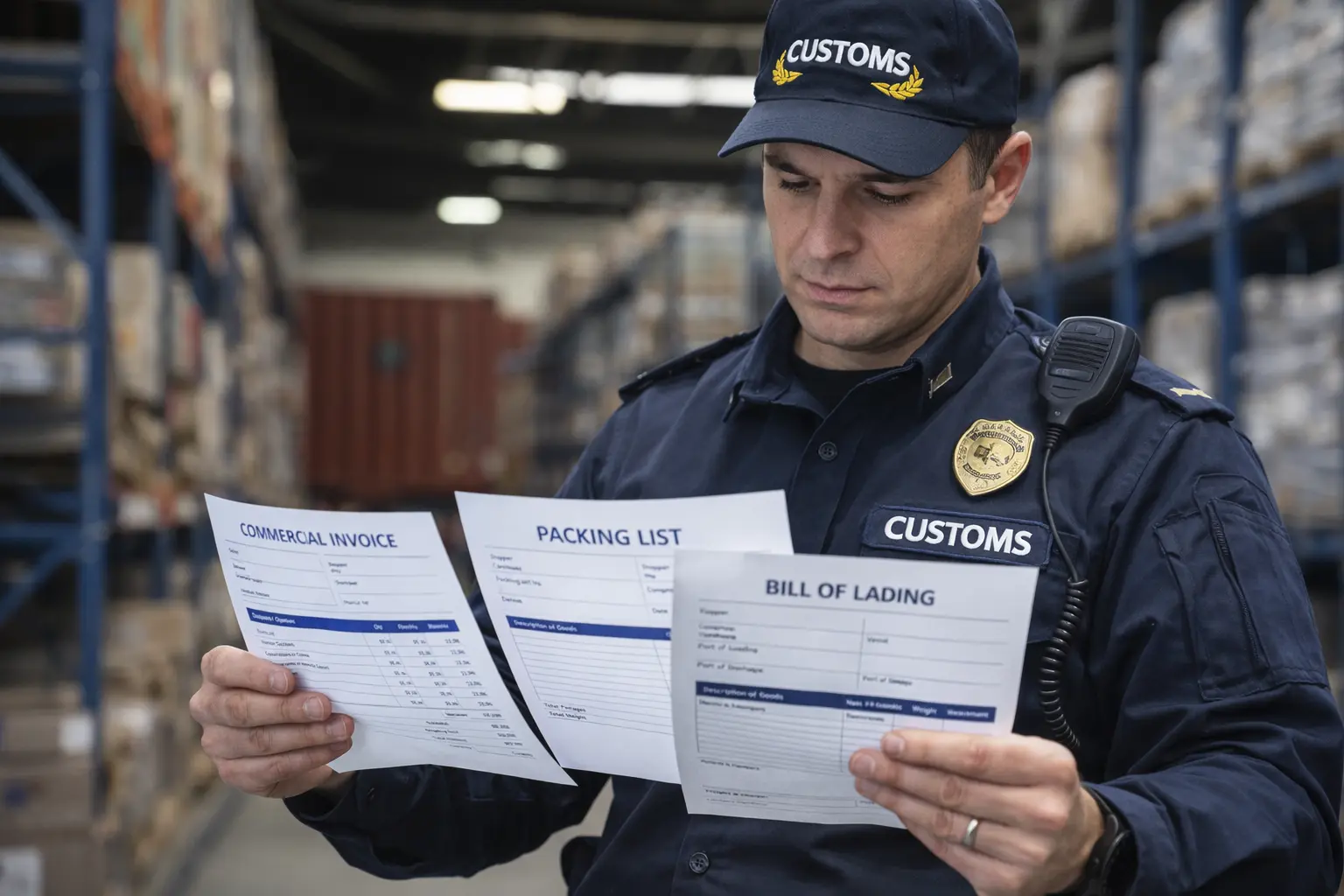
In international trade, paperwork is everything. The difference between a shipment that clears customs in hours and one that sits in a warehouse for weeks often comes down to a single document: the commercial invoice.
The commercial invoice was a legally binding document that serves as the foundational record of a transaction between a buyer and a seller. Utilizing a properly structured commercial invoice template is not just a matter of administrative preference, it is an absolute necessity for ensuring that international shipments clear customs without unnecessary delays, disputes, or unexpected financial penalties.
Whether you are a small business owner shipping your first batch of artisanal products overseas or a large-scale manufacturer managing a complex global supply chain, understanding how to construct, utilize, and manage your export documentation is critical to your operational success.
In this comprehensive guide, we will explore every facet of commercial invoicing, from its core components and legal implications to best practices for modernizing your financial workflows.

Key Takeaways
Table of Content
|
What is a Commercial Invoice?
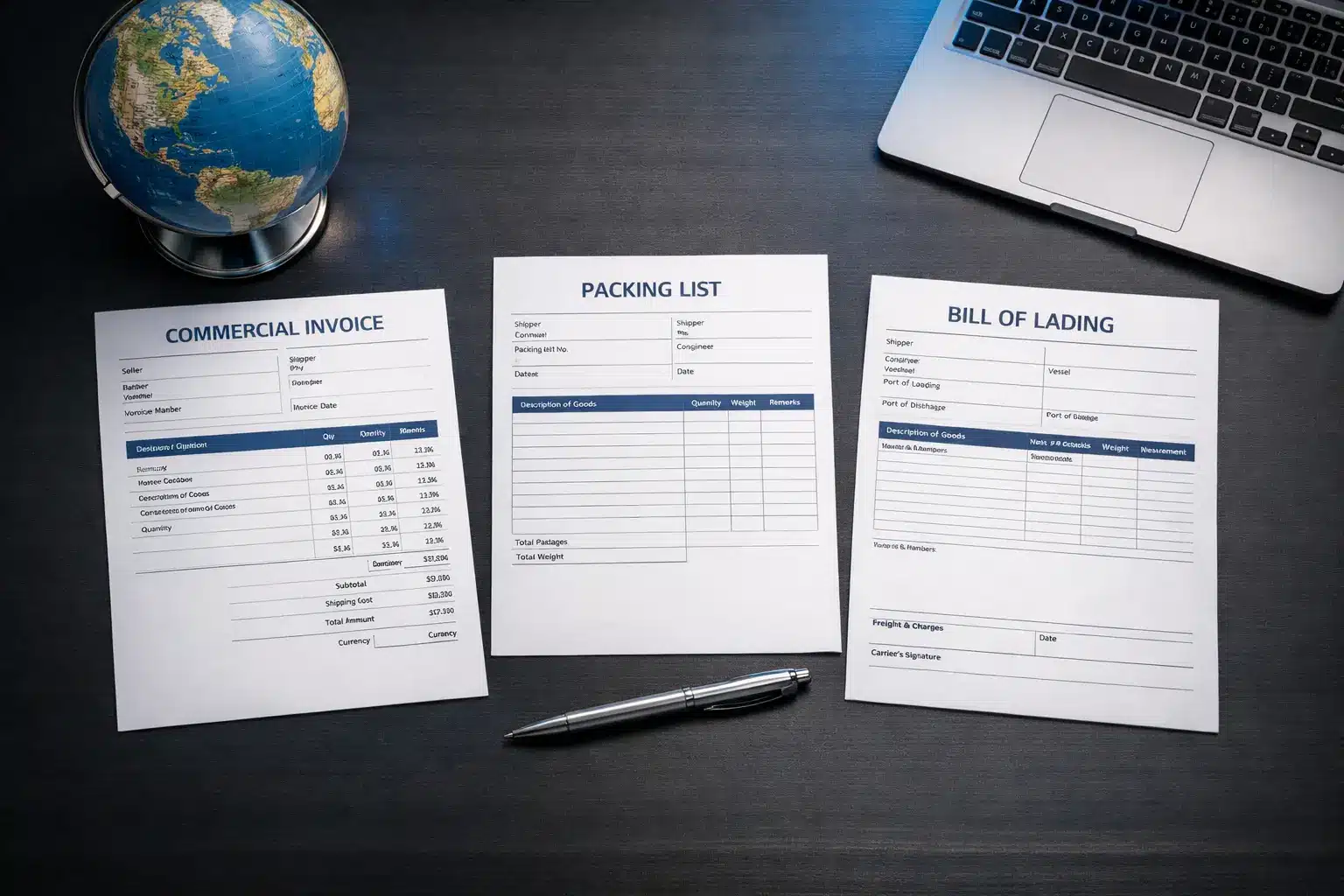
A commercial invoice is a specialized export document that acts as the primary proof of a transaction between an exporter (seller) and an importer (buyer).
Unlike a standard domestic invoice, which primarily functions as a request for payment, a commercial invoice plays a dual role: as both a financial record and an official customs declaration. When your goods arrive at an international border, customs officers rely almost entirely on this document to assess the shipment’s value, calculate the applicable import duties and taxes, and verify compliance with local import regulations.
The importance of this document cannot be overstated. Without a complete and accurate commercial invoice, Customs officials cannot legally process the shipment. This may result in:
(1) Goods being held at the port and incurring demurrage/storage fees
(2) The shipment being flagged for physical inspection
(3) In serious cases, seizure or destruction of goods. Additionally, banks and financial institutions require a valid commercial invoice to process Letters of Credit and documentary collections.
Furthermore, the commercial invoice is often required by financial institutions to facilitate international payment mechanisms, such as Letters of Credit or documentary collections, making it an indispensable tool for securing your revenue.
Key Components of a Standard Commercial Invoice Template
To ensure seamless international trade, a commercial invoice template must be comprehensive, leaving no room for ambiguity. Customs officials process thousands of shipments daily, and any missing or unclear information will immediately flag a shipment for manual inspection. Any missing field or unclear information is enough to flag your shipment for manual review. Here’s what every commercial invoice template must contain:
1. Document Header & Invoice Number
The document must clearly state “Commercial Invoice” at the very top. This immediately identifies the nature of the document to customs officials and logistics providers. Below that, include a unique invoice number and the date of issue. The invoice number is critical for cross-referencing with your Bill of Lading and Packing List.
2. Parties to the Transaction
A complete commercial invoice template must explicitly identify all parties involved in the transaction. This includes:
- Shipper/Exporter: The full legal name, registered business address, contact information (phone and email), and tax identification number of the company selling the goods.
- Consignee/Importer: The full legal name, delivery address, contact information, and tax identification number of the company or individual receiving and taking ownership of the goods.
- Notify Party: If a freight forwarder or customs broker will handle arrival, their details go here so they can be contacted when the cargo arrives.
3. Detailed Description of Goods
This is the most critical field and the one most often done incorrectly. Writing ‘Electronics’ or ‘Clothing’ is not enough. A customs officer has never seen your product, they need enough detail to classify it correctly. for example:
| Good Description | Bad Description |
|
|
4. Harmonized System (HS) Codes
HS codes are a globally standardized classification system for traded goods. Every line item on your invoice must have the correct 6-to-10 digit code. Customs authorities use these codes to determine tariff rates instantly. An incorrect HS code can result in overpayment of duties or accusations of deliberate misclassification.
5. Country of Origin
The country of origin is where manufacturers produced or substantially transformed the goods. It is not necessarily the country from which you ship them. This distinction matters enormously because trade agreements, anti-dumping duties, and import embargoes are all linked to origin, not shipping location.
Example: If you source raw materials from Vietnam, manufacture in Thailand, and ship to Germany, the country of origin is Thailand.
6. Quantity, Unit Price, and Total Value
Every line item must include: the exact quantity, the unit of measure (pieces, kilograms, liters, etc.), the price per unit, and the extended total. A grand total at the bottom is mandatory. Undervaluing goods to reduce the buyer’s import taxes is illegal, always declare the actual transaction value.
7. Currency of Transaction
Because international trade involves multiple countries, the currency used for the transaction must be explicitly stated (e.g., USD, EUR, GBP, MYR). A value of “10,000” means very little to a customs officer if they do not know whether it represents US Dollars or Japanese Yen. The currency listed on the commercial invoice will be used by customs authorities to convert the value into their local currency for the purpose of calculating duties.
8. Incoterms (Terms of Sale)
Incoterms (International Commercial Terms) are a set of standardized rules published by the International Chamber of Commerce (ICC) that define who is responsible for freight, insurance, and duties at each stage of the shipment. Your invoice must state both the Incoterm and the named place (e.g., FOB Tanjung Priok, CIF Rotterdam, DAP Berlin). This directly affects how customs calculates the dutiable value of your shipment.
9. Signature and Declaration
Finally, a commercial invoice must include a declaration certifying that the information provided is true and correct, accompanied by the signature of an authorized representative of the exporting company. Include their printed name and job title. Some countries also require a company stamp or official seal.
Why You Need a Reliable Commercial Invoice Template
Building a new invoice from scratch for every shipment is one of the most efficient ways to introduce errors into your supply chain. Here’s why a fixed, well-designed template is worth investing in:
- Consistency & compliance: A template pre-built with all mandatory fields means nothing gets left out even when a junior employee is filling it in.
- Faster customs clearance: Complete and accurate paperwork clears customs faster. Period. This directly protects your delivery timelines and your client relationships.
- Professional credibility: International buyers, freight forwarders, and banks judge your business by the quality of your documentation. A polished invoice signals that you know what you’re doing.
- Operational efficiency: Standardized templates dramatically reduce the time spent on each shipment especially important as your export volume scales.
a standardized template ensures absolute consistency and compliance. International trade regulations are strict, and customs authorities are unforgiving when it comes to missing data. A reliable template also enhances your brand’s professional image.
When dealing with international buyers, freight forwarders, and overseas financial institutions, the quality of your documentation reflects the quality of your business. A clean, well-organized, and professionally formatted commercial invoice instills confidence in your partners. It shows that you understand the intricacies of global trade and are a reliable vendor capable of managing complex logistical requirements.
Commercial Invoice Template
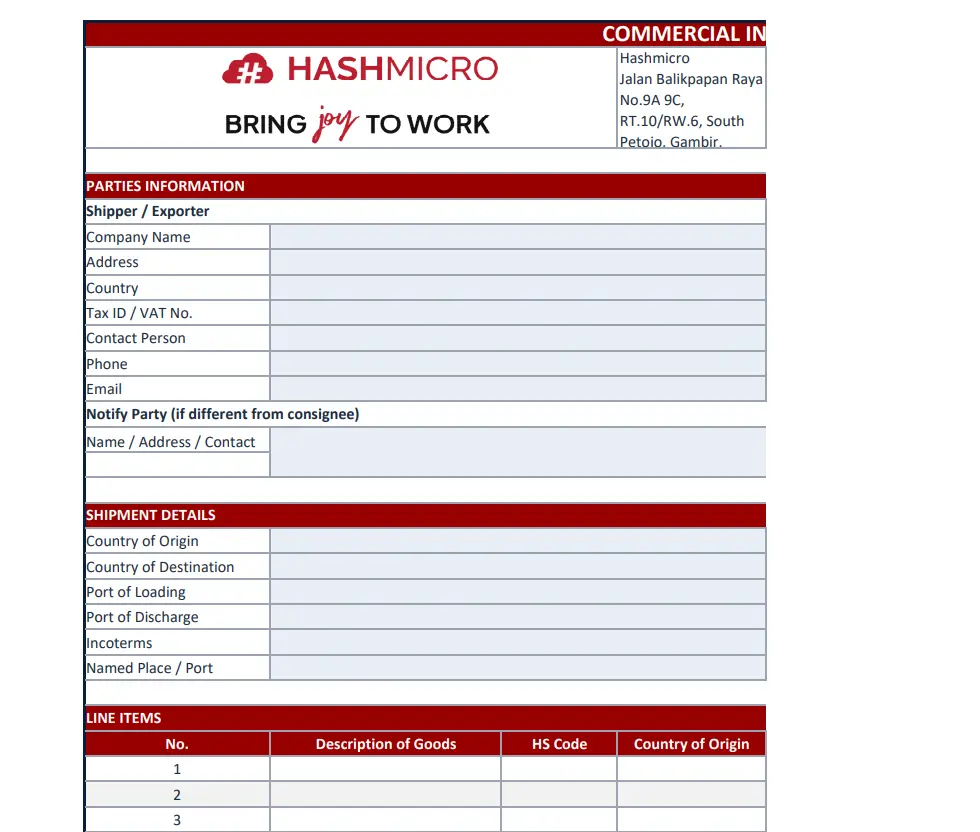
Commercial Invoice Template
If you need to modify formulas, formatting, or other protected areas in the template, you can easily remove the sheet protection by following these steps:
- Open the Commercial Invoice Template in Microsoft Excel.
- Click the Review tab in the top menu.
- Select Unprotect Sheet.
- Enter the following password: invoice123
- Click OK.
The Differences Between a Commercial Invoice and a Standard Bill
In everyday conversation, ‘invoice’ and ‘bill’ are often used interchangeably. But in accounting and international trade, they serve different purposes and are viewed from different perspectives.
A standard invoice is issued by a seller to request payment. When the buyer receives that same document, they record it in their accounts payable as a ‘bill.’ It’s the same document just seen from opposite sides of the transaction.
A commercial invoice was a regulated government document designed to cross international borders. A domestic bill lists a service and a price. A commercial invoice lists HS codes, Incoterms, country of origin, declared customs value all formatted specifically for government agencies to process.
To put it simply, an invoice is a document sent by a provider of a product or service to the purchaser. A bill, conversely, is what the purchaser receives and records in their accounts payable. When you send a commercial invoice to your overseas client, you view it as an invoice representing revenue to be collected. When your client receives that exact same document, they view it as a bill representing an expense that needs to be paid. For a deeper dive into how these documents interact within your accounting ecosystem, you can explore the nuances of understanding the fundamental difference between an invoice and a bill.
Purchase Order vs Invoice in International Trade
To fully appreciate the role of the commercial invoice template, you must understand where it fits within the broader chronological timeline of an international trade transaction. The documentation process is a continuous dialogue between the buyer and the seller, and it almost always begins with a Purchase Order (PO).
- The buyer creates a Purchase Order and sends it to the seller. This legally binding document specifies exactly what the buyer wants: products, quantities, agreed price, and delivery timeline. It is an official offer to buy.
- Once the seller accepts the PO, they issue a Proforma Invoice. This confirms the expected terms and gives the buyer a reference document for financing or import permits.
- The seller manufactures, packages, and prepares the goods for international transit. This is also when they gather all required shipment data for the final invoice.
- At this point, the seller issues the Commercial Invoice the final, legally binding record of what was sold, at what price, and under what terms. This document must match the original Purchase Order precisely.
- When goods arrive, the buyer’s accounts payable team performs a three-way match. They compare the Commercial Invoice against the original PO and the Receiving Report.
If the quantities, prices, or terms differ from the PO, payment stops until the discrepancy is resolved. As a result, accuracy in your commercial invoice directly determines how quickly you get paid.
The relationship between these two documents is the cornerstone of corporate procurement and financial auditing. When the goods arrive and the invoice is received, the buyer’s accounts payable department will perform a “three-way match.” They will compare the Commercial Invoice against the original Purchase Order and the Receiving Report (which confirms what actually arrived).
Common Mistakes to Avoid When Filling Out a Commercial Invoice
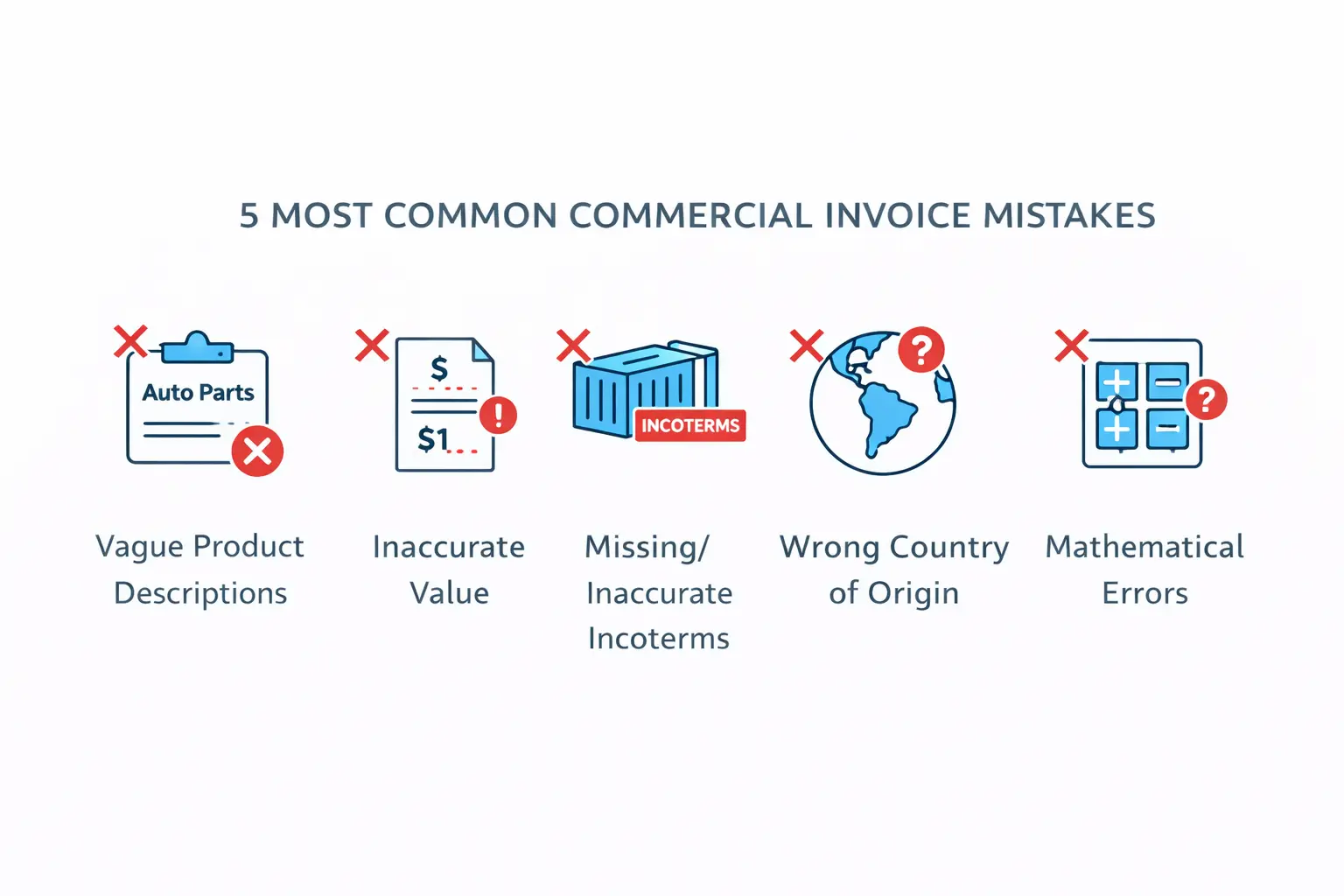
Even the best commercial invoice template can’t protect you if it’s filled in incorrectly. These are the most frequent and most costly errors exporters make:
1. Vague or Ambiguous Product Descriptions
‘Auto Parts’ tells a customs officer nothing. They need to know if it’s a rubber gasket, a steel brake rotor, or a circuit board, because each item carries a different tariff. Be specific: material, dimensions, model number, intended use.
2. Declaring an Inaccurate Value
It’s illegal, and customs authorities are trained to spot it. Whether a buyer asks you to write a lower value, or you mark something as a “sample” at “$1”, customs can and will challenge the declared value. If they suspect undervaluation, they’ll hold the shipment and apply their own estimate often higher than the actual value.
3. Missing or Incorrect Incoterms
Incoterms tell customs who is paying for freight and insurance information that affects how the dutiable value is calculated. A missing Incoterm causes delays. A wrong Incoterm can result in incorrect duty assessments or legal disputes.
For instance, in many countries, import duties are calculated on the CIF (Cost, Insurance, and Freight) value. If you sell goods FOB (Free On Board) but fail to state this, customs might assume the invoice value includes freight and insurance, or they might delay the shipment to ask for clarification. Always state the Incoterm and the named place (e.g., “DAP London”).
4. Wrong Country of Origin
Never assume that the country you’re shipping from is the country of origin. A Singapore distributor shipping Japanese-made electronics to Australia must declare Japan as the country of origin. Failing to declare the correct origin can lead to the denial of preferential tariff rates under free trade agreements, or the accidental violation of international trade embargoes.
5. Mathematical Errors and Inconsistencies
If the unit price multiplied by the quantity does not equal the line total, customs rejects the invoice. Furthermore, all figures must match across the Commercial Invoice, Bill of Lading, and Packing List. Even a single-unit discrepancy triggers a physical inspection. Use formulas or integrated software to eliminate manual calculation errors.
How to Choose the Right Commercial Invoice Format
The format and medium you choose for your commercial invoice template will largely depend on the size of your business, your export volume, and your technical infrastructure. There is no one-size-fits-all solution, but understanding the pros and cons of each method will help you make an informed decision.
Word Processors and Spreadsheets (Word/Excel)
Best for: Small businesses shipping internationally a few times a year. Easy to customize, costs nothing, and Excel allows basic formula automation. The downside is that static files are prone to human error and don’t connect with any other systems version control becomes a headache as your team grows.
Cloud-Based PDF Generators
Best for: Small to medium-sized exporters who want a more polished result. These web tools generate clean, professional PDFs from web forms and often allow you to save client and product details for faster future entries. However, they’re still standalone no connection to your inventory, accounting, or order management systems.
Integrated ERP and Automated Invoicing Software
Best for: Growing businesses and large enterprises. An ERP system generates your commercial invoice automatically by pulling data from the accepted Purchase Order, inventory module, and CRM eliminating duplicate data entry, ensuring accuracy, and standardizing your entire documentation workflow.
Managing Long-Term Projects: Commercial Invoices and Progress Billing
Not every export is a one-time shipment. Usually organization like large international contracts custom machinery, infrastructure components, complex software deployments are often executed across months or years. In these cases, waiting until final delivery to issue a single invoice is financially unsustainable.
Progress billing solves this. The seller invoices the buyer for a percentage of the total contract value at each predefined milestone. For example:
- 30% upon contract signing
- 40% when production is complete and tested at the factory
- 30% upon international delivery and installation
Each progress invoice must clearly reference the master contract, state which milestone has been reached, and show the total contract value, the amount previously billed, the current amount due, and the remaining balance.
Managing this manually across a multi-year project creates serious risk. Errors cause cash flow interruptions and contract disputes. Therefore, businesses involved in large-scale export projects benefit significantly from integrated invoicing software that tracks milestone progress automatically.
Advanced Practices for Global Trade Documentation
As your international operations grow, the basics are no longer enough. Here’s what leading exporters are doing to future-proof their documentation:
- Electronic Data Interchange (EDI): Transmitting commercial invoice data directly to customs authorities before cargo departs the origin port enabling pre-clearance and dramatically reducing transit times.
- AI-powered ERP automation: Systems that automatically update invoice templates when tariff rates change or new trade agreements are signed no manual oversight required.
- Quarterly compliance audits: Regularly comparing issued commercial invoices against actual customs clearance records to verify ongoing accuracy and flag any systemic errors before they become costly problems.
Conclusion
A commercial invoice is far more than just a payment request it’s the document your goods travel on. Get it wrong, and shipments stall, duties spike, and business relationships take a hit. Get it right consistently, and you build a reputation as a reliable international partner.
The fundamentals are straightforward: use a standardized template, fill in every required field with precision, align your figures with the purchase order, and always declare the true value of your goods. These aren’t optional best practices they’re the baseline of doing international business correctly.
As your export volume grows, so does the complexity of managing this documentation manually. Many businesses find that the right invoicing tool whether a smart template, a cloud platform, or a fully integrated ERP ends up paying for itself within the first few prevented delays.
FAQ About Commercial Invoice
-
Is a commercial invoice required for every international shipment?
In virtually all commercial cases, yes. Customs authorities in the destination country require it to assess duties and taxes. Some couriers generate simplified customs documents for low-value personal shipments, but any commercial transaction requires a proper commercial invoice
-
How many copies of a commercial invoice do I need?
Most countries require at least 3 copies, one for customs, one for the importer, and one for the exporter’s records. Some countries or freight arrangements require more. Always check the destination country’s specific import requirements before dispatch.
-
Can I use the same commercial invoice template for all countries?
A well-structured template covers universal requirements such as HS codes, Incoterms, value, and origin. However, some countries have additional requirements. Always verify the destination country’s import documentation rules before each shipment.
-
Is it legal to mark goods as gifts or samples to reduce duties?
No. Even genuine samples and gifts carry a fair market value. Declaring ‘zero value’ or an artificially low price constitutes customs fraud. Customs authorities can penalize exporters with fines, confiscation of goods, or in serious cases, legal prosecution.